Introduction
In today’s digital-first business environment, a great mobile app idea can become a powerful tool for customer engagement, business growth, and revenue generation. However, turning an idea into a successful mobile application requires much more than coding. It involves research, strategic planning, user-focused design, technical expertise, testing, and continuous improvement.
This is where experienced mobile app developers make a difference. They help businesses transform an initial concept into a reliable, secure, scalable, and market-ready product. With the right development partner, an idea can move from a simple concept to a mobile solution that delivers real value.
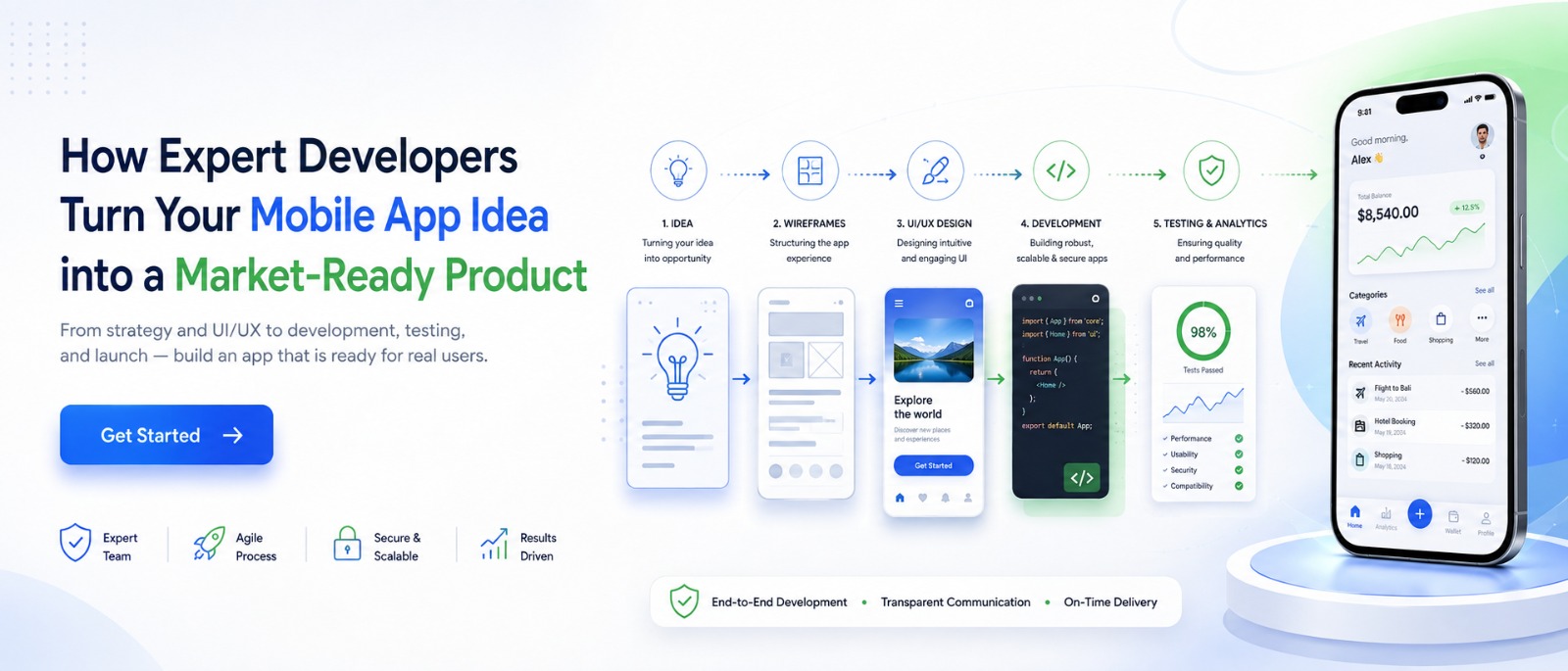
1. Understanding the App Idea and Business Goals
The first step is understanding what the app is supposed to achieve. Expert developers work closely with businesses to identify the purpose of the application, target audience, core features, business objectives, and expected outcomes.
Instead of immediately starting development, they ask important questions such as:
1.Who will use the application?
2.What problem does it solve?
3.What features are essential?
4.What makes the app different from competitors?
5.How can the application generate business value?
This discovery phase creates a clear foundation for the entire project.
2. Conducting Market and Competitor Research
A promising idea needs to fit the market. Professional developers and technology teams analyze existing applications, competitors, user expectations, and industry trends to identify opportunities and potential challenges. This research can reveal which features users value, where competitors are falling short, and how the proposed application can offer a better experience.
For businesses, this reduces the risk of investing heavily in an app without understanding its market potential.
3. Defining the Right Features and MVP
One common mistake in app development is trying to include every possible feature from the beginning. Expert developers help businesses prioritize functionality and create a Minimum Viable Product (MVP).
An MVP includes the essential features required to solve the target problem and launch the product. After receiving feedback from real users, additional features can be introduced based on actual demand.
This approach can shorten development time, control costs, and provide valuable insights before expanding the product.
4. Creating a User-Centric UI/UX Design
A technically powerful application can still fail if it is difficult to use. Professional developers work alongside UI/UX designers to create an intuitive and engaging experience.
From navigation and screen layouts to buttons, forms, icons, and onboarding, every element should make the application easy to understand.
A user-centric design helps reduce confusion, improve engagement, and encourage customers to continue using the app.
5. Choosing the Right Technology Technology
selection plays an important role in an application's long-term performance. Depending on business requirements, developers determine whether native Android or iOS development, cross-platform development, cloud services, APIs, or other technologies are appropriate.
The choice should consider factors such as performance, scalability, security, development time, maintenance, and future expansion.
The right technical architecture ensures that the application is built not only for today but also for tomorrow.
6. Developing a Secure and Scalable Application
Once the design and technology strategy are finalized, developers begin building the application. They develop the frontend, backend, APIs, databases, and integrations required for the product.
Security is also considered throughout the development process. Strong authentication, secure data handling, access controls, and appropriate security practices help protect both business and customer information.
At the same time, scalable architecture allows the application to handle increasing users, transactions, and data as the business grows.
7. Testing the Application Thoroughly
Before an app reaches customers, it needs extensive testing. Expert development teams test applications across different devices, operating systems, screen sizes, and network conditions. Testing can cover:
1.Functionality
2.Performance
3.Security
4.Usability
5.Compatibility
6.App navigation
7.API and integration performance
Identifying and resolving problems before launch helps create a smoother and more dependable user experience.
8. Preparing for App Store Launch
Building the application is only part of the journey. Developers also help prepare the product for release on relevant app stores.
This can involve creating production builds, configuring app settings, preparing required assets, resolving technical issues, and ensuring that the application meets platform requirements.
A structured launch process helps businesses enter the market with greater confidence.
9. Monitoring Performance After Launch
A successful app is not a one-time project. After launch, developers can monitor performance, user feedback, crashes, engagement, and other relevant metrics.
These insights help identify areas that require improvement. Regular updates can introduce new features, improve performance, strengthen security, and maintain compatibility with evolving mobile platforms.
Continuous optimization allows the application to remain relevant as customer expectations and technology change.
10. Turning Ideas into Business Growth with Softechedge
Transforming a mobile app concept into a market-ready product requires a combination of business understanding, creative thinking, technical expertise, and ongoing support. Softechedge focuses on helping businesses turn their digital ideas into practical mobile solutions through a structured development approach. From planning and UI/UX design to development, testing, deployment, and ongoing improvements, the right technology partner can simplify the journey from concept to launch.
Whether you are developing an app for customers, employees, e-commerce, services, or internal operations, professional development can help turn your vision into a solution designed for real-world use.
Conclusion
A mobile app idea is only the beginning. Its success depends on how effectively that idea is researched, designed, developed, tested, launched, and improved.
Expert developers bring structure and technical knowledge to every stage of the process. By focusing on user needs, choosing appropriate technologies, prioritizing security and scalability, and continuously improving the product, they can transform a promising concept into a market-ready mobile application.
For businesses looking to convert their app idea into a reliable digital product, partnering with an experienced development team can be the crucial step between simply having an idea and successfully bringing it to market.