Introduction
In today’s fast-changing digital environment, businesses need websites that can adapt quickly to new technologies, devices, customer expectations, and content strategies. Traditional content management systems (CMS) have helped businesses create and manage websites efficiently for years, but modern digital experiences often demand greater flexibility.
This is where headless CMS development comes into the picture. By separating content management from the website’s presentation layer, a headless CMS gives businesses greater freedom to build, modify, and deliver digital experiences across multiple platforms.
For businesses looking for scalable and future-ready web development solutions, understanding the advantages of headless CMS architecture can be an important step toward building a more flexible digital presence.
What Is a Headless CMS?
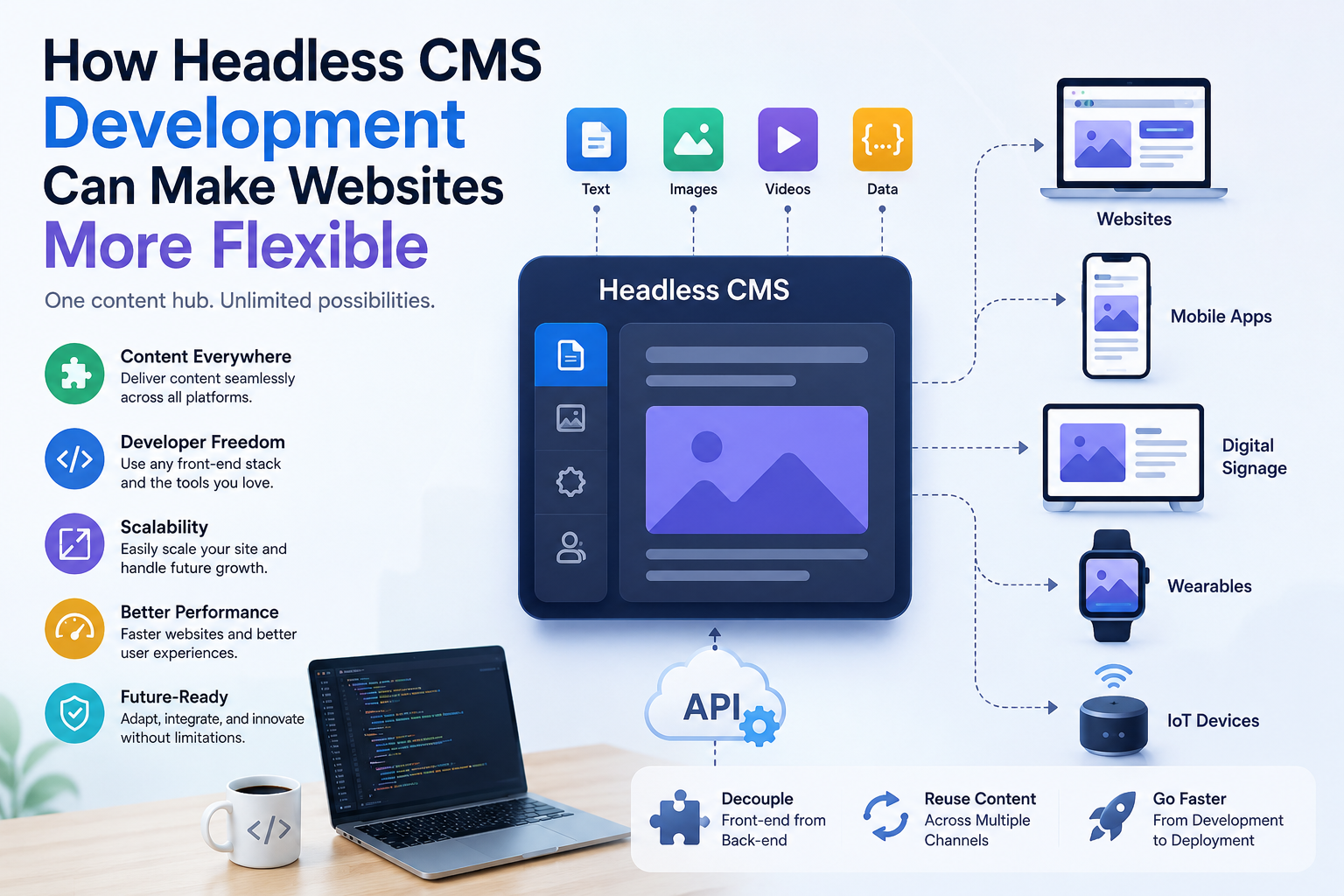
A headless CMS is a content management system in which the backend content repository is separated from the frontend presentation layer.
In a traditional CMS, the system generally manages both content and how that content appears on a website. With a headless CMS, content is stored and managed independently and delivered to different platforms through APIs.
For example, the same product information could be delivered to a website, mobile application, digital kiosk, smart device, or other digital channel without requiring completely separate content management systems.
This separation gives developers greater control over the frontend while allowing content teams to continue managing information through a centralized system.
Greater Freedom in Website Design
One of the biggest advantages of headless CMS development is frontend freedom.
Traditional CMS platforms can sometimes impose limitations because the content management system and website presentation are closely connected. Developers may have to work within themes, templates, or platform-specific structures.
A headless CMS removes much of this dependency. Developers can choose modern technologies and frameworks that best suit the project.
This makes it easier to create highly customized interfaces, interactive features, and unique user experiences without being restricted by the CMS’s frontend architecture.
Seamless Omnichannel Content Delivery
Customers interact with businesses through multiple digital touchpoints. They may visit a website, use a mobile app, interact with a digital display, or access content through another connected platform.
Managing content separately for every channel can become complicated and time-consuming.
A headless CMS allows businesses to maintain content in one central location and distribute it through APIs to multiple platforms. When content is updated, the latest information can potentially be delivered across connected digital experiences.
This approach is particularly useful for businesses that want to create consistent customer experiences across different channels.
Improved Scalability for Growing Businesses
A website that works well today may need significantly more functionality as the business grows. New products, services, markets, integrations, and digital channels can increase the complexity of a website.
Headless architecture can make expansion easier because the content layer and presentation layer operate independently.
Businesses can introduce a new frontend or digital channel without necessarily rebuilding the entire content infrastructure. Developers can also modify the frontend independently of the content management system.
This flexibility can help organizations adapt their websites as their digital requirements evolve.
Better Performance Opportunities
Website performance has a direct impact on user experience. Slow-loading pages can frustrate visitors and may contribute to higher bounce rates.
Headless CMS development gives developers more freedom to use modern frontend technologies and performance optimization techniques. Depending on the architecture, businesses can implement approaches such as static generation, caching, content delivery networks, optimized assets, and efficient API requests.
The result can be a faster and more responsive digital experience when the architecture is designed and implemented correctly.
However, headless CMS does not automatically make a website faster. Performance depends on the overall technical implementation, hosting environment, APIs, frontend architecture, and optimization strategy.
Stronger Developer Flexibility
Modern web development involves a wide range of frameworks, programming languages, APIs, and development tools.
With a headless CMS, developers are not necessarily tied to the frontend technology used by a traditional CMS. They can select technologies based on project requirements, performance goals, development expertise, and future scalability.
This flexibility can make it easier to integrate modern frontend frameworks and third-party services while maintaining a centralized content management environment.
Easier Integration With Business Systems
Modern websites rarely operate as standalone platforms. Businesses often need to connect websites with CRM systems, payment gateways, marketing automation tools, analytics platforms, inventory systems, customer portals, and other applications.
Because headless CMS platforms are generally API-driven, they can provide a flexible foundation for connecting content with external systems.
For example, an e-commerce business could combine product content from its CMS with inventory information from another system and customer data from a CRM to create a more connected digital experience.
Better Content Management for Marketing Teams
Headless architecture is not only beneficial for developers. Content and marketing teams can also benefit from centralized content management.
Instead of maintaining the same content separately across multiple platforms, teams can manage reusable content from one location and distribute it to connected channels.
This can improve workflow efficiency and reduce repetitive content-management tasks. It can also help maintain consistency in product descriptions, service information, brand messaging, and other important content.
Headless CMS and SEO: What Businesses Should Know
SEO remains an important consideration when developing a headless website.
A headless CMS itself does not guarantee better search rankings. SEO success depends on factors such as website structure, content quality, page speed, mobile usability, metadata, internal linking, structured data, crawlability, and technical implementation.
However, the flexibility of headless development allows developers to build SEO-friendly architectures and implement modern performance and rendering techniques according to project requirements.
Therefore, SEO should be considered during development rather than treated as an afterthought.
Is Headless CMS Right for Every Business?
Although headless CMS offers significant flexibility, it is not necessarily the best solution for every website.
A small business with a simple informational website may find a traditional CMS more cost-effective and easier to manage. Headless architecture becomes particularly attractive when a business needs customized frontend experiences, multiple digital channels, advanced integrations, or long-term scalability.
Businesses should evaluate development costs, technical expertise, content workflows, security requirements, maintenance, and future objectives before selecting an architecture.
Why Choose the Right Web Development Partner?
Implementing a headless CMS successfully requires more than selecting a platform. The architecture, frontend technology, APIs, integrations, hosting, security, performance, and content workflows all need to work together.
An experienced web development partner can help businesses evaluate their requirements, select an appropriate technology stack, design the architecture, develop the frontend, integrate APIs, and optimize the final experience. At Softechedge, businesses can leverage professional web development expertise to build scalable, modern, and business-focused digital solutions tailored to their specific requirements.
Conclusion
Headless CMS development provides businesses with a powerful way to separate content management from frontend presentation. This architecture can offer greater design freedom, easier omnichannel delivery, improved scalability, flexible integrations, and more control over modern digital experiences.
As businesses expand their digital presence across websites, applications, and emerging platforms, flexibility is becoming increasingly important. A well-planned headless CMS solution can provide the technical foundation needed to adapt to these changing requirements.
The key is not simply to adopt headless technology, but to implement it strategically around business objectives, user experience, performance, content needs, and long-term growth.