Introduction
Hiring one employee can be challenging. Hiring dozens or even hundreds of employees at the same time can be a completely different experience. Bulk hiring, also known as high-volume recruitment, requires careful planning, efficient processes, and the right recruitment strategy to ensure that companies attract qualified candidates without compromising hiring quality.
For businesses expanding rapidly, opening new locations, managing seasonal demand, or scaling operations, bulk recruitment can become essential. However, handling a large number of applications manually can consume significant time and resources. This is where structured recruitment processes and professional recruitment services can make a meaningful difference.
What Is Bulk Hiring?
Bulk hiring refers to the process of recruiting a large number of employees within a specific period. It is commonly used in industries such as BPO, retail, hospitality, logistics, manufacturing, sales, customer support, IT-enabled services, and e-commerce.
Unlike traditional recruitment, where recruiters may focus on a few vacancies at a time, bulk hiring involves managing multiple positions, applications, interviews, and onboarding activities simultaneously.
The objective is not simply to hire more people. It is to hire the right people efficiently and at scale.
Why Is High-Volume Recruitment Challenging?
Bulk recruitment comes with several challenges. A large candidate pool can make screening difficult, while repetitive interviews and coordination can place considerable pressure on HR teams.
Some common challenges include:
1.Managing a high volume of applications
2.Identifying qualified candidates quickly
3.Maintaining consistent screening standards
4.Scheduling multiple interviews
5.Communicating with candidates efficiently
6.Reducing time-to-hire
7.Preventing candidate drop-offs
8.Coordinating documentation and onboarding
Without a systematic approach, companies may experience delays, inconsistent candidate evaluation, and increased recruitment costs.
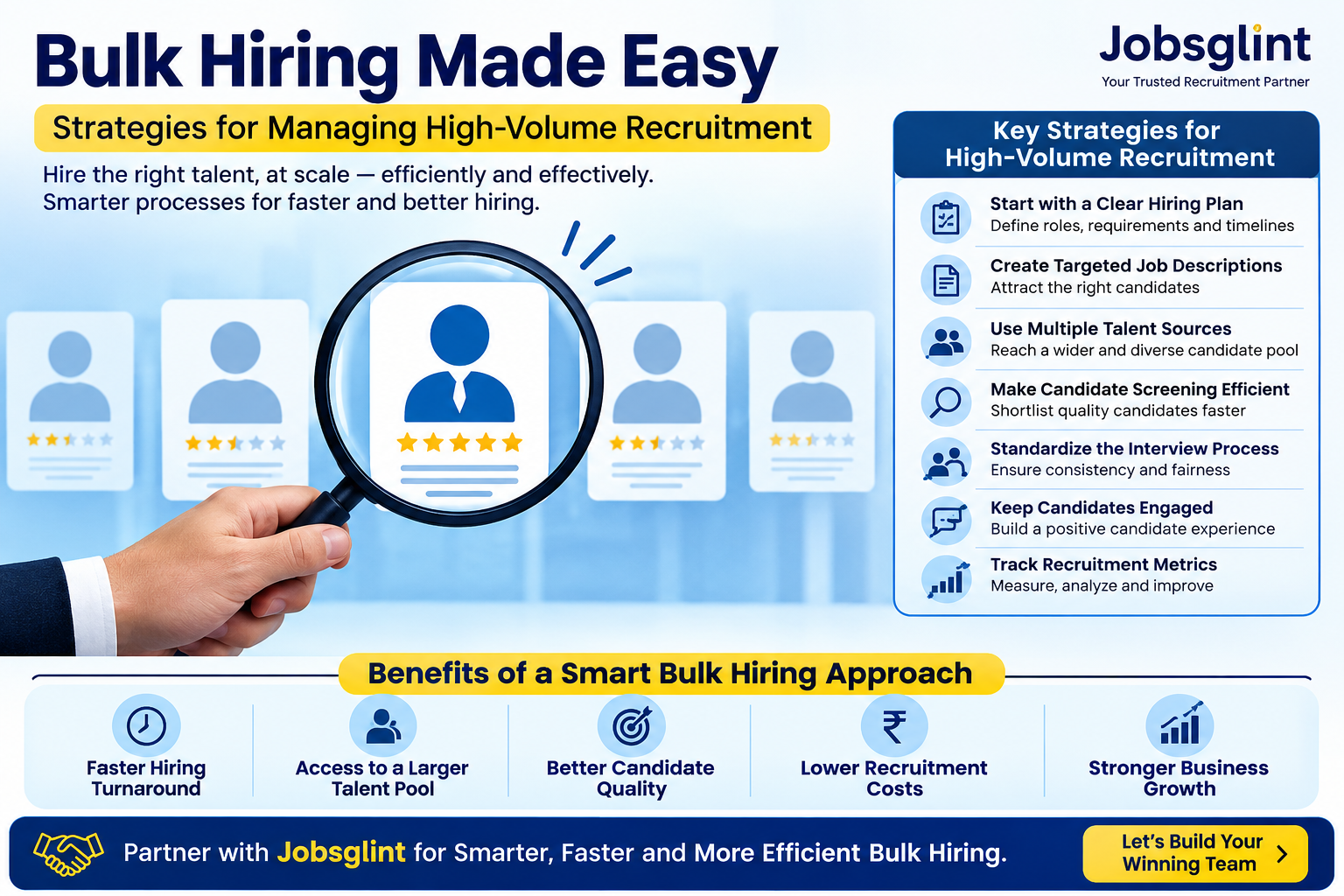
1. Start With a Clear Hiring Plan
Successful bulk hiring begins before the first job advertisement is published.
Companies should clearly define the number of employees required, job roles, qualifications, experience levels, locations, salary ranges, joining timelines, and selection criteria.
Creating a detailed hiring plan helps recruiters understand exactly what the organization needs. It also makes it easier to prioritize vacancies and allocate recruitment resources effectively.
A well-defined plan can prevent unnecessary applications and help recruiters focus on candidates who genuinely match the requirements.
2. Create Targeted Job Descriptions
When recruiting at scale, job descriptions play an important role in attracting suitable applicants.
A strong job description should clearly communicate:
1.Job responsibilities
2.Required qualifications
3.Essential skills
4.Experience requirements
5.Location and work arrangement
6.Compensation or relevant benefits
7.Selection process
8.Expected joining timeline
Avoid unnecessarily complicated descriptions. Simple, specific, and candidate-friendly job postings can encourage relevant applicants while reducing unsuitable applications.
3. Use Multiple Talent Sources
Relying on a single recruitment channel may limit the candidate pool. Bulk hiring requires a broader talent acquisition strategy.
Recruiters can explore job portals, professional networks, social media platforms, employee referrals, campus recruitment, recruitment databases, and industry-specific communities.
Using multiple channels helps organizations reach candidates with different backgrounds and skill sets. The key is to track which sources generate the highest-quality candidates rather than simply focusing on application numbers.
4. Make Candidate Screening More Efficient
Screening hundreds or thousands of applications manually can slow down recruitment considerably.
A structured screening system can help recruiters identify candidates who meet the basic requirements before moving them to the next stage. Applicant tracking systems, automated questionnaires, skill assessments, and standardized screening criteria can support this process. However, technology should complement human judgment rather than completely replace it. Recruiters still need to evaluate factors such as communication, motivation, cultural fit, and role suitability.
5. Standardize the Interview Process
Consistency is particularly important when several recruiters or interviewers are involved. Companies can create standardized interview questions, evaluation forms, scoring systems, and selection criteria. This allows candidates to be assessed using similar benchmarks.
Group interviews, virtual interviews, assessment centers, and scheduled hiring drives can also help organizations process candidates more efficiently while maintaining a structured evaluation process.
6. Keep Candidates Engaged
One of the biggest risks in bulk recruitment is candidate drop-off.
When candidates apply for jobs but receive little communication, they may lose interest or accept another opportunity. Regular updates can improve the overall candidate experience. Recruiters should communicate important information about interview schedules, selection status, documentation, offer letters, and joining dates.
Even simple automated notifications can help candidates feel informed throughout the recruitment journey.
7. Track Recruitment Metrics
What gets measured can be improved.
Organizations should monitor recruitment metrics such as:
1.Time-to-hire
2.Cost-per-hire
3.Application-to-interview ratio
4.Interview-to-selection ratio
5.Offer acceptance rate
6.Candidate drop-off rate
7.Source of hire
8.Joining ratio
9.Early employee retention
These insights help businesses identify bottlenecks and improve future hiring campaigns.
8. Strengthen Pre-Joining and Onboarding
Recruitment does not end when a candidate accepts an offer. In high-volume hiring, the period between offer acceptance and joining can be critical.
Companies should maintain regular communication with selected candidates, complete documentation efficiently, and provide clear joining instructions.
A structured onboarding process can help new employees settle into their roles faster and create a positive first impression of the organization.
How Recruitment Partners Can Simplify Bulk Hiring
Managing high-volume recruitment internally can put significant pressure on HR teams, especially when organizations need to fill positions within a short timeframe.
A professional recruitment partner can support businesses with candidate sourcing, screening, shortlisting, interview coordination, talent-pool management, and recruitment campaign execution.
With the right recruitment partner, businesses can expand their candidate reach while allowing their internal HR teams to focus on strategic workforce priorities.
Conclusion
Bulk hiring does not have to mean chaotic hiring. With the right planning, technology, communication, screening methods, and recruitment strategy, businesses can manage high-volume hiring more efficiently while maintaining candidate quality.
The goal should be to create a recruitment process that is scalable, structured, data-driven, and candidate-friendly.
For businesses looking to grow their workforce quickly, the right recruitment approach can turn a complex hiring campaign into a streamlined talent acquisition process. Jobsglint helps businesses move toward smarter recruitment by supporting organizations in connecting with suitable talent and managing their hiring needs more effectively.