Introduction
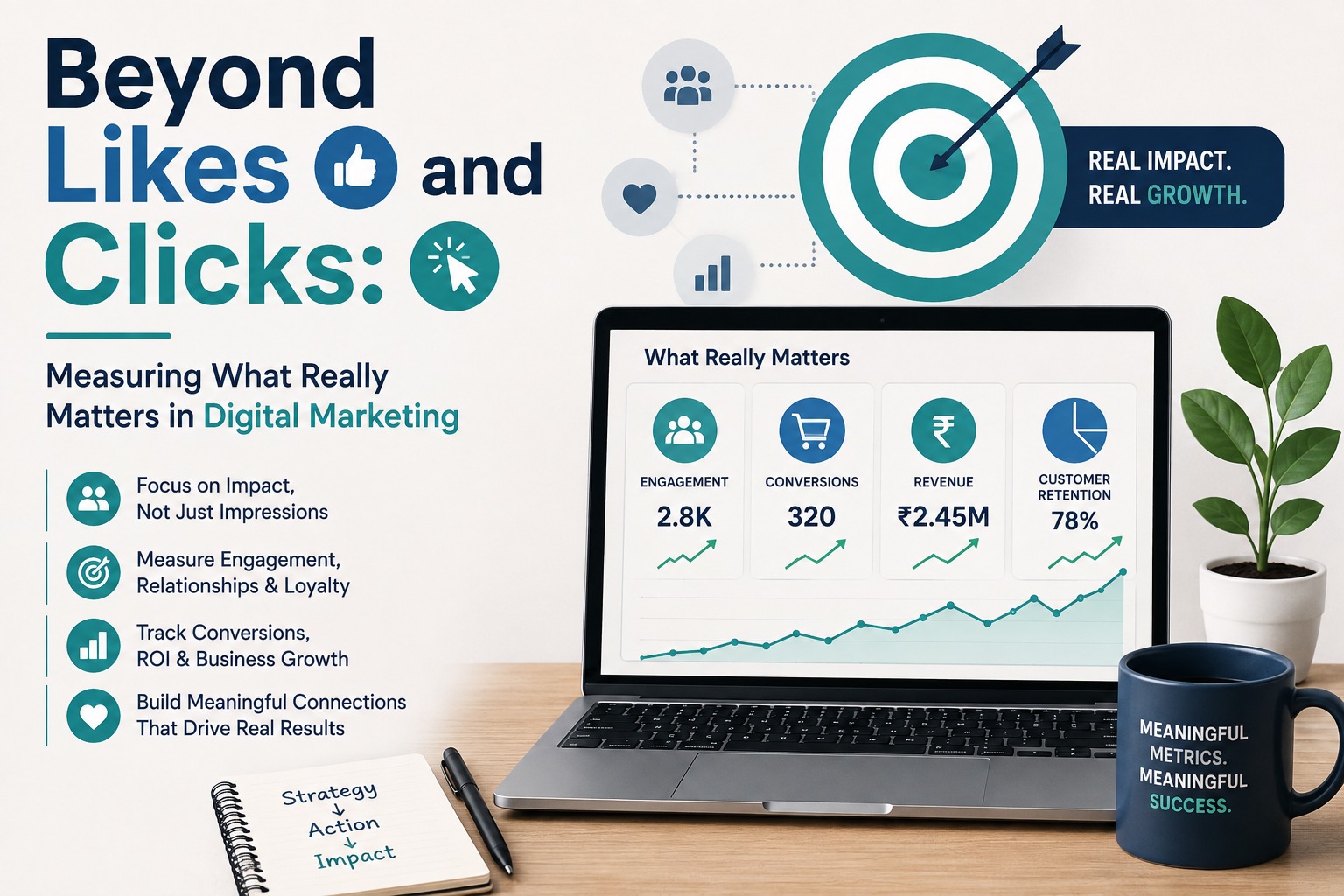
In digital marketing, likes, shares, comments, clicks, and follower counts often look like clear signs of success. While these metrics can indicate audience activity, they do not always tell you whether your marketing efforts are actually contributing to business growth.
A campaign can generate thousands of clicks and still produce very few customers. Similarly, a social media post may receive limited engagement but attract highly relevant leads. This is why businesses need to look beyond surface-level numbers and focus on metrics that connect marketing activity with real business outcomes.
At Softechedge, the focus is on creating digital marketing strategies that go beyond visibility and engagement to deliver measurable value, qualified leads, conversions, and sustainable growth.
Why Likes and Clicks Aren’t Enough
Likes and clicks are known as vanity metrics when they are viewed without business context. They can help marketers understand whether content is attracting attention, but they do not necessarily indicate revenue or customer acquisition.
For example, getting 10,000 website visits sounds impressive. But if only a handful of visitors submit an enquiry or make a purchase, the traffic may not be delivering meaningful results. Instead of asking,
“How many people interacted with our campaign?”
businesses should also ask:
1.How many qualified leads did we generate?
2.How many visitors converted?
3.What did it cost to acquire each customer?
4.How much revenue did the campaign generate?
5.Which channels delivered the best returns?
These questions provide a much clearer picture of marketing performance.
1. Conversion Rate: Turning Traffic into Action
One of the most important digital marketing metrics is conversion rate. It measures the percentage of users who complete a desired action after interacting with your website, landing page, advertisement, or content.
Conversions can include:
1.Filling out a contact form
2.Requesting a quotation
3.Booking a consultation
4.Signing up for a service
5.Downloading a resource
6.Completing an online purchase
A high volume of traffic with a low conversion rate may indicate problems with your landing page, messaging, offer, targeting, or user experience.
Tracking conversions helps businesses understand whether their digital presence is actually encouraging users to take meaningful action.
2. Cost Per Lead and Cost Per Acquisition
Generating leads is valuable, but businesses also need to understand how much they are spending to generate them.
Cost Per Lead (CPL) shows the average amount spent to acquire a lead, while Cost Per Acquisition (CPA) measures the cost of acquiring a customer or completing a specific conversion.
For instance, Campaign A may generate 500 leads while Campaign B generates only 200. At first glance, Campaign A appears better. However, if Campaign A costs significantly more or produces low-quality leads, Campaign B could be more efficient.
Tracking CPL and CPA allows marketers to identify campaigns that deliver better value and allocate budgets more intelligently.
3. Return on Ad Spend and Marketing ROI
Businesses ultimately need to connect marketing expenditure with financial outcomes.
Return on Ad Spend (ROAS) helps measure the revenue generated in relation to advertising expenditure. Meanwhile, broader marketing ROI can evaluate the financial return from an overall marketing investment.
These metrics help answer an essential question:
“Is our marketing investment generating enough business value?”
Rather than simply celebrating high impressions or engagement, companies can use ROI-focused measurement to identify profitable channels and improve future campaigns.
4. Quality of Leads Matters
Not every lead has the same value.
A campaign might produce hundreds of enquiries, but if most prospects are not genuinely interested, cannot afford the product, or do not match the target audience, the campaign may not be successful.
Businesses should therefore track lead quality alongside lead volume.
Useful indicators include:
1.Qualified leads
2.Sales-ready prospects
3.Lead-to-customer conversion rate
4.Average deal value
5.Sales pipeline contribution
This creates stronger alignment between marketing and sales teams and helps businesses focus on prospects who are more likely to become customers.
5. Customer Lifetime Value
A customer’s value does not necessarily end with their first purchase.
Customer Lifetime Value (CLV) estimates how much revenue a customer can generate throughout their relationship with a business. This metric is particularly important for subscription businesses, e-commerce companies, service providers, and brands focused on repeat purchases.
When businesses understand CLV, they can make better decisions about customer acquisition costs, retention strategies, loyalty campaigns, and marketing budgets.
A customer who initially generates a small purchase but continues buying for several years may ultimately be much more valuable than a one-time high-value customer.
6. Website Engagement and User Behaviour
Beyond traffic numbers, businesses should understand what visitors actually do on their websites.
Metrics such as engagement rate, session behaviour, landing-page performance, and funnel drop-offs can reveal where users lose interest.
For example, if visitors regularly leave after reaching a particular page, the business may need to improve its content, page speed, design, navigation, or call-to-action.
Understanding user behaviour allows marketers to make informed improvements instead of relying on assumptions.
7. Track the Entire Customer Journey
Modern customers rarely move directly from seeing an advertisement to making a purchase. They may discover a brand through search, visit the website, follow the company on social media, read a blog, return through an advertisement, and finally make an enquiry.
This makes customer journey and attribution analysis important.
Businesses should evaluate how different channels contribute to awareness, consideration, conversion, and retention. This provides a more complete understanding of which marketing activities are influencing customer decisions.
8. Set Metrics According to Business Goals
There is no single “best” digital marketing metric for every business.
A new brand may focus on awareness and qualified website traffic. A lead-generation company may prioritize CPL, qualified leads, and conversion rates. An e-commerce business may focus on revenue, ROAS, repeat purchases, and CLV.
The key is to establish clear business goals first and select relevant KPIs afterward.
When metrics are connected to specific objectives, reporting becomes more meaningful and marketing decisions become easier to justify.
Make Your Digital Marketing More Measurable with Softechedge
Digital marketing success is not simply about getting more likes, followers, impressions, or clicks. It is about understanding whether those activities are contributing to leads, customers, revenue, retention, and long-term business growth.
By tracking conversion rates, acquisition costs, lead quality, ROI, customer lifetime value, and customer journeys, businesses can move from simply measuring activity to measuring impact. At Softechedge, data-driven digital marketing strategies can help businesses understand what is working, identify opportunities for improvement, and focus their efforts on measurable outcomes.
Because successful digital marketing isn't about collecting more numbers—it’s about measuring the numbers that actually move your business forward.