Introduction
In today’s competitive job market, a strong resume needs to do more than list your education and work experience. Employers increasingly look for evidence of practical skills, continuous learning and the ability to apply knowledge in real-world situations. This is where certifications, professional courses and projects can make a meaningful difference.
When presented strategically, these elements can strengthen your profile, demonstrate relevant expertise and help recruiters quickly understand what you can bring to a role. However, simply creating a long list of certificates or projects is not enough. The key is to highlight the experiences that are relevant to your target position and explain the skills or outcomes behind them.
Why Certifications, Courses and Projects Matter on a Resume
Certifications can provide evidence of specialised knowledge, particularly when they are relevant to the position you are applying for. A certification from a recognised organisation can demonstrate that you have completed structured learning and developed specific competencies.
Courses can also demonstrate your commitment to professional development. For example, completing a course in data analytics, digital marketing, project management or a programming language can show that you have actively developed skills beyond your formal education.
Projects take this a step further by demonstrating application. They can show recruiters how you used your knowledge to solve a problem, create something useful or achieve a particular outcome. Relevant projects can therefore be particularly valuable for freshers, career changers and professionals moving into new fields.
How to Showcase Certifications Effectively
The first step is to select certifications that support your career objective. You do not need to include every certificate you have ever earned.
For example, if you are applying for a digital marketing position, certifications related to SEO, Google Ads, analytics, social media or content marketing may be more valuable than unrelated certificates.
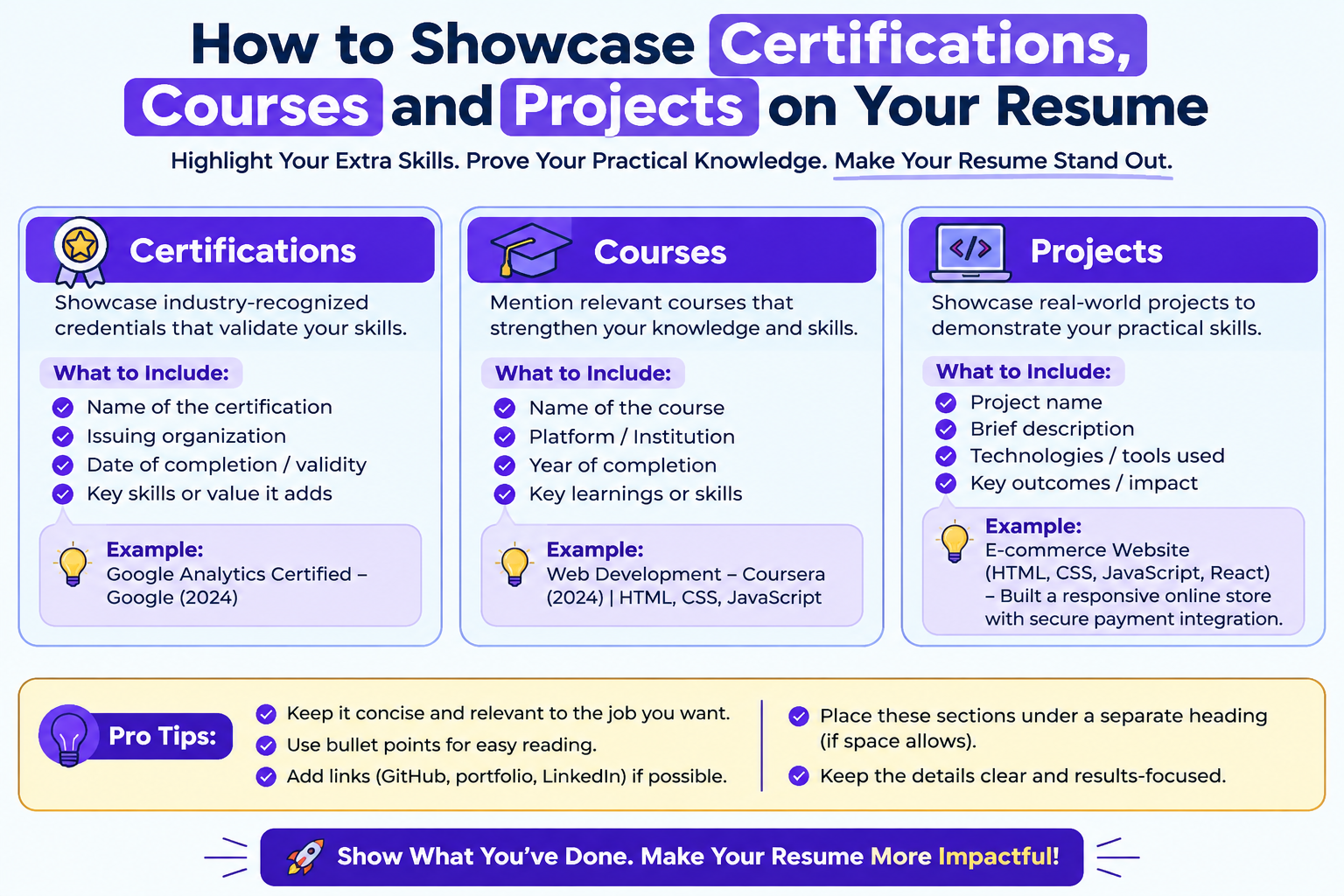
Create a dedicated “Certifications” section when you have several relevant credentials. For each certification, include:
1.Full certification name
2.Issuing organisation
3.Date earned
4.Expiry or renewal date, if applicable
5.Relevant skills, where useful
For example:
Google Analytics Certification
Google | Issued: June 2026
Relevant skills: Web Analytics, Reporting, Data Interpretation
Writing the full certification name is also useful because recruiters may not immediately recognise every abbreviation. Indeed recommends spelling out acronyms at least once, which can also make the credential clearer to resume-screening systems.
If you are currently pursuing an important certification, you can mention it as “In Progress” along with the expected completion date.
How to Include Professional Courses
Not every online course deserves a place on your resume. Focus on courses that add value to your target role.
For example, a software developer could highlight courses in React, Python, cloud computing or cybersecurity. An HR professional might include courses in HR analytics, talent acquisition or labour law.
You can place relevant courses under “Courses,” “Professional Development,” “Training & Certifications,” or incorporate particularly important learning into your skills or education section. A useful format is:
Advanced Excel for Business Analytics
Online Learning Platform | Completed: 2026
Key skills: Pivot Tables, Data Analysis, Dashboards
The goal is to show what you learned rather than simply stating that you watched or completed a course. Relevant online courses can demonstrate professional development and help differentiate candidates when they build skills aligned with the target position.
How to Showcase Projects on Your Resume
Projects are especially useful when you have limited professional experience. A well-presented project can demonstrate practical knowledge even if you have not yet held a full-time position.
When selecting projects, prioritise those that are:
1.Relevant to the job
2.Recent
3.Technically or professionally meaningful
4.Based on real-world problems
5.Supported by measurable results, where possible
Instead of writing:
E-commerce Website Project
Created an e-commerce website using HTML, CSS and JavaScript.
Make it stronger:
E-commerce Website Project
1.Developed a responsive e-commerce website using HTML, CSS and JavaScript.
2.Implemented product filtering, shopping-cart functionality and responsive layouts.Improved usability across desktop and mobile screen sizes.
This approach communicates both what you built and what skills you applied. Indeed recommends using concise descriptions and action verbs when presenting projects and choosing projects that align with the job description.
Connect Projects With the Job You Want
One of the biggest mistakes candidates make is listing projects without considering relevance.
Suppose you are applying for a data analyst position. A project involving Excel dashboards, SQL analysis or Power BI is likely to be more valuable than an unrelated college project.
Similarly, a candidate applying for a web development position should prioritise projects demonstrating relevant programming languages, frameworks, databases, APIs or deployment experience.
Before submitting your resume, compare your projects with the job description. Identify important skills and keywords and, where truthful, make sure your relevant projects clearly demonstrate them.
Quantify Your Project Achievements Whenever Possible
Numbers can make project descriptions more compelling.
Instead of:
“Created a social media campaign project.”
Consider:
“Developed a three-week social media campaign that generated 25% higher engagement during the project period.”
Similarly, you could mention the number of users, pages, products, datasets, processes, team members or other measurable outcomes associated with a project.
Even academic or personal projects can be presented in terms of scope, complexity and results.
Where Should These Sections Appear?
There is no single placement that works for every candidate.
For a fresher, certifications, courses and projects may deserve greater prominence because they can compensate for limited professional experience. For an experienced professional, relevant work history will generally remain the primary focus, while certifications and selected projects can support the expertise demonstrated through employment.
If a certification is specifically required for the role, make it easy to find rather than hiding it at the bottom of the resume. Current resume guidance recommends placing highly relevant credentials prominently and tailoring their placement to the job.
Common Mistakes to Avoid
Avoid turning your resume into a catalogue of every course and certificate you have completed.
Some common mistakes include:
1.Listing irrelevant certifications
2.Including expired credentials without clarification
3.Writing lengthy course descriptions
4.Listing projects without explaining your contribution
5.Using vague phrases such as “worked on a project”
6.Repeating the same skills in multiple sections
7.Adding certificates simply to fill space
8.Ignoring keywords from the target job description
Your resume should communicate relevance, credibility and impact, not simply quantity.
Final Thoughts
Certifications, courses and projects can transform a basic resume into a stronger representation of your skills and professional development. The most effective approach is to select relevant credentials, explain the skills gained through courses and describe projects in terms of actions, technologies and outcomes.
Remember: quality matters more than quantity. Ten unrelated certificates will not necessarily strengthen your application, but two highly relevant certifications and a well-described project can give recruiters a much clearer picture of your capabilities.
If you are unsure how to organise these elements or tailor your resume to your target role, professional resume writing support can help you present your qualifications in a clear, structured and recruiter-friendly way. Jobsglint’s Resume Writing Services can help job seekers build resumes that highlight relevant skills, experience, certifications and achievements while presenting their professional story more effectively.