Introduction
Artificial Intelligence is rapidly changing the way people work, learn, communicate, and do business. From automated customer support and AI-powered analytics to content creation, software development, recruitment, marketing, and healthcare, artificial intelligence is becoming part of everyday professional life.
As AI becomes more capable, an important question is being asked across industries:
Will artificial intelligence replace human workers, or will humans continue to remain essential?
The answer is more complex than simply choosing one or the other.
The future of work is unlikely to be based entirely on AI or entirely on human effort. Instead, the strongest organizations and professionals will increasingly combine artificial intelligence with human skills.
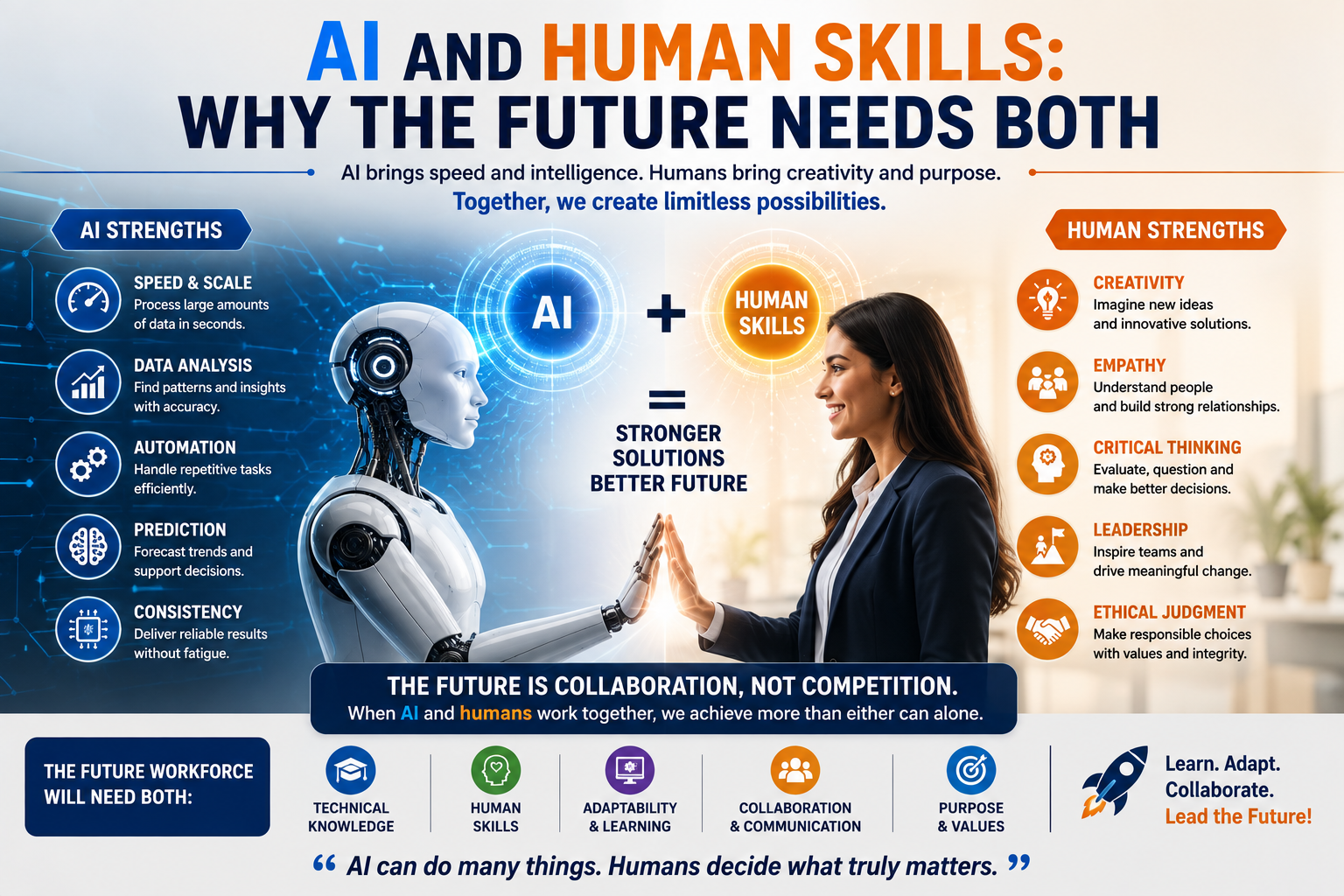
AI can process enormous amounts of information, recognize patterns, automate repetitive tasks, generate ideas, and support decision-making. Humans, meanwhile, bring creativity, empathy, judgment, communication, leadership, ethical reasoning, emotional intelligence, and the ability to understand complex social situations.
This combination creates a powerful model:
AI provides capability and efficiency. Humans provide judgment, creativity, context, and purpose.
Therefore, understanding AI and human skills is becoming essential for students, professionals, entrepreneurs, businesses, and organizations preparing for the future.
The question is no longer simply whether people should learn AI.
The more important question is:
How can people combine AI skills with uniquely human abilities to create greater value?
This article explores the growing relationship between AI and human skills, why both are necessary, the skills professionals will need in the future, how businesses can prepare their workforce, and how students can build future-ready careers.
What Are AI Skills?
AI skills refer to the knowledge and abilities required to understand, use, manage, or develop artificial intelligence technologies.
These skills can exist at different levels.
Basic AI Skills
These include:
Understanding what AI is
Using AI-powered applications
Writing effective prompts
Understanding AI limitations
Evaluating AI-generated information
Using AI responsibly
Intermediate AI Skills
Professionals may develop skills such as:
Data analysis
Machine learning concepts
AI-assisted automation
AI workflow design
Data visualization
AI-powered business applications
Advanced AI Skills
Technical professionals may work with:
Machine learning
Deep learning
Natural language processing
Computer vision
AI model development
Data engineering
AI infrastructure
Not every employee needs advanced technical AI expertise.
However, increasing numbers of professionals may benefit from basic AI literacy.
What Are Human Skills?
Human skills are abilities that depend heavily on human judgment, interaction, experience, and emotional understanding.
These include:
Communication
Creativity
Critical thinking
Leadership
Emotional intelligence
Empathy
Collaboration
Problem-solving
Adaptability
Decision-making
Negotiation
Ethical reasoning
These skills are important because business problems are rarely purely technical.
For example, AI may analyze customer data, but understanding why a customer feels frustrated requires context and empathy.
AI may generate a marketing campaign, but deciding whether the message is appropriate for a particular audience requires human judgment.
AI may provide several business strategies, but a leader must decide which strategy aligns with the organization's values and long-term goals.
Why AI Alone Is Not Enough
Artificial intelligence is powerful, but it has limitations.
AI systems work with patterns, data, algorithms, and instructions. They can generate impressive outputs, but they do not automatically possess human experiences, personal values, emotional understanding, or real-world responsibility in the same way humans do.
AI can provide an answer.
But humans need to determine:
Is the answer accurate?
Is it appropriate?
Is it ethical?
Does it make business sense?
What are the consequences?
How will people respond?
This is why human judgment remains critical.
The future is not simply about creating smarter AI. It is also about developing smarter ways for humans and AI to work together.
Why Human Skills Matter in the Age of AI
As technology becomes more capable, certain human abilities may become even more valuable.
1. Creativity
AI can generate text, images, designs, ideas, and variations quickly.
However, humans still play an important role in defining the purpose behind creative work.
Creativity is not simply producing something new. It involves understanding context, identifying meaningful problems, connecting unrelated ideas, and creating something relevant to people.
A designer may use AI to explore hundreds of visual concepts, but the designer's understanding of the brand and audience helps determine which concept actually works.
Therefore:
AI can accelerate creativity, but humans provide creative direction.
2. Critical Thinking
Critical thinking is one of the most important skills in an AI-powered workplace.
AI-generated information can sometimes be incomplete, inaccurate, outdated, or inappropriate.
Professionals therefore need to evaluate information rather than automatically accept it.
Critical thinkers ask:
What evidence supports this?
Is the information reliable?
What assumptions are being made?
What information is missing?
Are there alternative explanations?
What could go wrong?
As AI-generated content becomes more common, the ability to evaluate information becomes increasingly important.
3. Communication
Communication remains essential regardless of technological advancement.
Employees need to communicate with:
Customers
Managers
Colleagues
Partners
Investors
Stakeholders
AI can help draft emails, reports, presentations, and messages.
But effective communication requires understanding the person receiving the message.
The same information may need to be communicated differently to a customer, employee, senior executive, or business partner.
Humans provide this contextual understanding.
4. Emotional Intelligence
Emotional intelligence refers to the ability to understand and manage emotions and interact effectively with others.
It includes:
Self-awareness
Empathy
Self-management
Social awareness
Relationship management
These abilities are especially important in leadership, HR, customer service, negotiation, and team management.
AI may identify patterns in employee feedback, but a human manager needs to understand the emotional and organizational context behind that feedback.
5. Leadership
Leadership cannot be reduced to data analysis.
Leaders need to:
Create a vision
Motivate employees
Build trust
Make difficult decisions
Handle uncertainty
Resolve conflicts
Develop people
Take responsibility
AI can provide information that supports leadership decisions.
But leadership still requires human connection and accountability.
6. Adaptability
Technology changes rapidly.
Professionals who become comfortable with learning and adapting will have an advantage.
Adaptability means being willing to:
Learn new technologies
Change processes
Accept feedback
Experiment
Develop new skills
Work in unfamiliar situations
A professional does not need to know every technology today.
Instead, they need the ability to learn what becomes important tomorrow.
AI and Human Skills Complement Each Other
The greatest opportunity may come from combining AI capabilities with human strengths.
Consider the following:
| AI Strength | Human Strength |
|---|---|
| Data processing | Contextual understanding |
| Pattern recognition | Critical thinking |
| Automation | Judgment |
| Speed | Empathy |
| Information generation | Creativity and direction |
| Repetitive tasks | Strategic thinking |
| Data analysis | Ethical decision-making |
| Large-scale processing | Relationship building |
Neither side has to work alone.
When combined effectively, they can produce better outcomes.
AI + Human Collaboration in the Workplace
Imagine a marketing team launching a new campaign.
AI can help with:
Keyword research
Content ideas
Audience analysis
Data processing
Draft content
Performance analysis
The human marketing team can focus on:
Brand positioning
Creative direction
Audience psychology
Storytelling
Ethical considerations
Final decision-making
The result can be a faster and more effective marketing process.
This example demonstrates the principle of human-AI collaboration.
How AI Is Changing Different Job Roles
AI is not affecting every profession in exactly the same way.
Marketing
AI can support:
Content creation
Audience analysis
Campaign optimization
Data analysis
Personalization
Human marketers remain important for:
Strategy
Creativity
Brand understanding
Storytelling
Customer psychology
Human Resources
AI can assist with:
Resume screening
Employee data analysis
Interview scheduling
HR administration
Human HR professionals remain important for:
Employee relationships
Conflict resolution
Leadership
Organizational culture
Ethical decisions
Software Development
AI can assist developers with:
Code suggestions
Debugging
Documentation
Testing
Code generation
Developers still need:
System design
Problem-solving
Security awareness
Architecture
Business understanding
Customer Service
AI can handle routine queries.
Human employees can focus on:
Complex problems
Complaints
Emotional situations
Relationship management
High-value customers
This pattern may occur across many industries.
The Rise of AI Literacy
In the future, AI literacy may become as important as general digital literacy.
AI literacy does not mean everyone needs to become an AI engineer.
Instead, employees should understand:
What AI can do
What AI cannot do
How to use AI tools
How to evaluate AI output
How to protect sensitive information
How to use AI responsibly
For example, an HR professional may not need to build a machine learning model.
However, understanding how AI-assisted recruitment works can help them use technology more effectively and responsibly.
The Importance of Prompting Skills
As generative AI becomes increasingly common, the ability to give clear instructions to AI systems can be useful.
Effective prompting involves:
Providing context
Clearly defining the objective
Specifying the desired format
Providing relevant information
Setting appropriate constraints
Reviewing the output
However, prompting should not be considered the only future AI skill.
The ability to evaluate, refine, and apply AI-generated results is equally important.
AI Skills for Students
Students preparing for future careers should consider developing a combination of technical and human capabilities.
Technical Skills
Depending on their career goals, students can learn:
AI fundamentals
Data analytics
Programming
Cloud computing
Cybersecurity
Digital marketing
Automation
Digital tools
Human Skills
They should also develop:
Communication
Presentation
Critical thinking
Creativity
Teamwork
Leadership
Problem-solving
Adaptability
A student who combines both categories can become more versatile in the workplace.
Why Degrees Alone May Not Be Enough
A degree can provide foundational knowledge, but professional success increasingly requires continuous skill development.
Industries evolve after students graduate.
Therefore, students should develop a mindset of:
Degree + Skills + Experience + Continuous Learning
Practical projects, internships, certifications, workshops, and industry exposure can complement formal education.
This is particularly important in technology-driven industries where tools and processes can change rapidly.
AI and Human Skills for Entrepreneurs
Entrepreneurs can also benefit from combining AI with human capabilities.
AI can help entrepreneurs with:
Market research
Content creation
Data analysis
Customer communication
Business planning
Workflow automation
But entrepreneurs still need:
Vision
Leadership
Risk assessment
Negotiation
Relationship building
Creativity
Decision-making
AI can help entrepreneurs do more with limited resources, but human leadership determines how those resources are used.
AI and the Future of Employment
There is significant discussion about whether AI will eliminate jobs.
The reality is likely to be more complex.
Some tasks may become automated.
Some existing roles may change.
New roles may also emerge.
Employees may increasingly work alongside AI systems rather than simply compete against them.
This means professionals should focus on becoming AI-enabled rather than AI-resistant.
Learning how to use technology productively can help employees adapt as their roles evolve.
The Skills That May Become More Valuable
As AI handles more repetitive and data-heavy tasks, organizations may place greater emphasis on skills such as:
Critical Thinking
Evaluating information and making sound judgments.
Creativity
Generating meaningful ideas and innovative solutions.
Communication
Explaining ideas clearly and building understanding.
Leadership
Guiding people and making strategic decisions.
Emotional Intelligence
Understanding people and managing relationships.
Adaptability
Responding positively to change.
Problem-Solving
Addressing complex challenges that cannot be solved through simple automation.
Collaboration
Working effectively with people and technology.
Building a Future-Ready Workforce
Organizations need to prepare employees for technological change rather than simply introduce new technologies.
A future-ready workforce requires:
Technology + Skills + Training + Leadership + Adaptability
Companies can provide:
AI literacy programs
Digital skills training
Leadership development
Technical certifications
Practical learning
Mentorship
Cross-functional projects
Continuous learning opportunities
Organizations should also help employees understand why new technology is being introduced.
People are more likely to adopt technology when they understand how it improves their work.
How Businesses Can Encourage Human-AI Collaboration
Businesses can take several steps.
Step 1: Identify Repetitive Tasks
Determine which activities can benefit from automation.
Step 2: Identify Human-Centric Tasks
Determine where empathy, judgment, creativity, or relationship management is essential.
Step 3: Train Employees
Provide employees with relevant AI and digital skills.
Step 4: Establish Guidelines
Create clear policies around privacy, security, accuracy, and responsible AI usage.
Step 5: Encourage Experimentation
Allow employees to explore useful AI applications within appropriate boundaries.
Step 6: Measure Results
Evaluate whether AI is improving:
Productivity
Quality
Customer experience
Employee experience
Cost efficiency
Decision-making
The Importance of Ethical AI Use
Human involvement is particularly important when AI is used for decisions that affect people.
Businesses should consider:
Data privacy
Bias
Transparency
Security
Accuracy
Accountability
AI should not automatically be treated as neutral or infallible.
Human oversight helps organizations identify potential problems and ensure that technology is being used responsibly.
Continuous Learning Becomes Essential
The combination of AI and human skills creates another important requirement:
continuous learning.
Professionals cannot learn one set of skills and expect those skills to remain sufficient forever.
Instead, they need to continually update their capabilities.
A strong learning cycle looks like:
Learn → Practice → Apply → Evaluate → Improve → Learn Again
Businesses can support this process through training programs, while employees can take responsibility for their own professional development.
The Role of Practical Learning
Reading about AI is useful, but practical experience is equally important.
Professionals can learn by:
Using AI tools
Building projects
Solving real business problems
Experimenting with automation
Analyzing data
Creating digital solutions
Participating in workshops
Working on team projects
Practical learning helps employees understand not only what technology can do but also where it creates real value.
Why the Future Needs Both AI and Human Skills
The future workplace should not be viewed as a competition between humans and machines.
Instead, it can be viewed as a partnership.
AI is particularly strong at:
Speed + Scale + Data + Automation
Humans are particularly strong at:
Creativity + Empathy + Judgment + Purpose
Together, they can create:
Innovation + Productivity + Better Decisions + Better Experiences
This is the real opportunity.
Organizations that use AI while continuing to invest in human capabilities can build more adaptable and resilient workforces.
How Professionals Can Prepare for the Future
Professionals can take several practical steps.
1. Learn the Basics of AI
Understand common AI concepts and tools relevant to your profession.
2. Strengthen Digital Skills
Learn the technologies used in your industry.
3. Develop Human Skills
Improve communication, critical thinking, creativity, and leadership.
4. Build Practical Experience
Use new skills in real projects.
5. Keep Learning
Follow industry developments and continuously update your knowledge.
6. Build a Professional Portfolio
Showcase projects and achievements rather than relying only on qualifications.
7. Become Adaptable
Be prepared to learn new technologies as your industry changes.
How SAC Management India Pvt. Ltd. Fits Into the Future Skills Ecosystem
The relationship between skills, technology, employment, and business growth is becoming increasingly important.
As a parent organization connecting these areas, SAC Management India Pvt. Ltd. can be positioned around the broader idea that future success requires both technological capabilities and strong human potential.
Technology can create new opportunities, but skilled people are needed to use that technology effectively.
Similarly, businesses may adopt advanced digital solutions, but they need professionals who can operate, manage, evaluate, and improve those solutions.
This creates a connected ecosystem:
Skills → Technology → Employment → Business Growth
AI adds another important dimension to this ecosystem.
Future-ready professionals will need to understand technology while developing the human abilities that allow them to use technology effectively.
For organizations, this means investing not only in digital infrastructure but also in people.
For students and professionals, it means developing both technical and human capabilities.
Frequently Asked Questions
What is the importance of AI and human skills?
AI skills help professionals use emerging technologies effectively, while human skills such as creativity, communication, critical thinking, empathy, and leadership help them make better decisions and build meaningful relationships.
Will AI replace human skills?
AI may automate certain tasks, but human skills will remain important for areas requiring judgment, creativity, empathy, leadership, ethics, and complex decision-making.
What human skills are important in the AI era?
Important human skills include critical thinking, creativity, communication, emotional intelligence, leadership, adaptability, collaboration, and problem-solving.
What AI skills should students learn?
Students can start with AI literacy, responsible AI use, prompting, data analysis, digital tools, and AI fundamentals. Those interested in technical careers can explore programming, machine learning, data science, and related areas.
Why is continuous learning important in the AI era?
AI and other technologies are developing rapidly. Continuous learning helps professionals update their skills, remain relevant, adapt to new job requirements, and identify new career opportunities.
How can businesses prepare employees for AI?
Businesses can provide AI literacy training, technical upskilling, practical learning, responsible AI guidelines, and opportunities for employees to experiment with AI tools.
Conclusion
Artificial Intelligence is transforming the workplace, but technology alone cannot define the future of work.
The future needs both AI skills and human skills.
AI can process information, automate repetitive tasks, identify patterns, generate content, and support decision-making. Humans bring creativity, empathy, communication, critical thinking, leadership, ethical judgment, and the ability to understand context.
Neither should be viewed as a replacement for the other.
The most valuable professionals of the future may be those who know how to work with AI while strengthening the human capabilities that technology cannot easily replace.
For businesses, the lesson is equally important. Investing in AI should go hand in hand with investing in employees. Organizations need technology, but they also need people who can use that technology thoughtfully and effectively.
For students and professionals, the message is clear:
Do not choose between technology and human skills. Develop both.
Learn AI. Strengthen your communication. Understand data. Develop creativity. Improve critical thinking. Practice problem-solving. Build emotional intelligence. Stay adaptable.
The future will belong not simply to people who can use AI, but to people who can combine AI with uniquely human strengths to create meaningful value.
AI can increase what humans can do. Human skills determine what should be done.
And together, they can build a more innovative, productive, adaptable, and human-centered future of work.