Introduction
Mobile apps have become an important part of how businesses connect with customers, streamline operations, sell products, and deliver digital services. But before developing an app, businesses face an important decision: Should you choose native app development or cross-platform app development?
Both approaches have their own advantages. Native development is designed specifically for individual operating systems such as Android or iOS, while cross-platform development allows businesses to create apps for multiple platforms using a shared codebase. The right choice depends on your business goals, target audience, features, budget, performance requirements, and long-term growth plans.
What Is Native App Development?
Native app development involves building an application specifically for a particular operating system. For example, Android apps are commonly developed using Kotlin or Java, while iOS applications can be built using Swift or Objective-C.
Because native applications are designed specifically for their target platform, developers can make extensive use of platform-specific capabilities, APIs, hardware features, and design guidelines. Apple, for example, provides dedicated frameworks and tools that allow developers to take advantage of iOS capabilities, device hardware, security, and privacy features.
Advantages of Native Apps
Native development can be an excellent choice when your application requires:
1.High performance and responsiveness
2.Advanced animations or graphics
3.Extensive hardware integration
4.Complex device functionality
5.Platform-specific user experiences
6.Early access to operating-system features
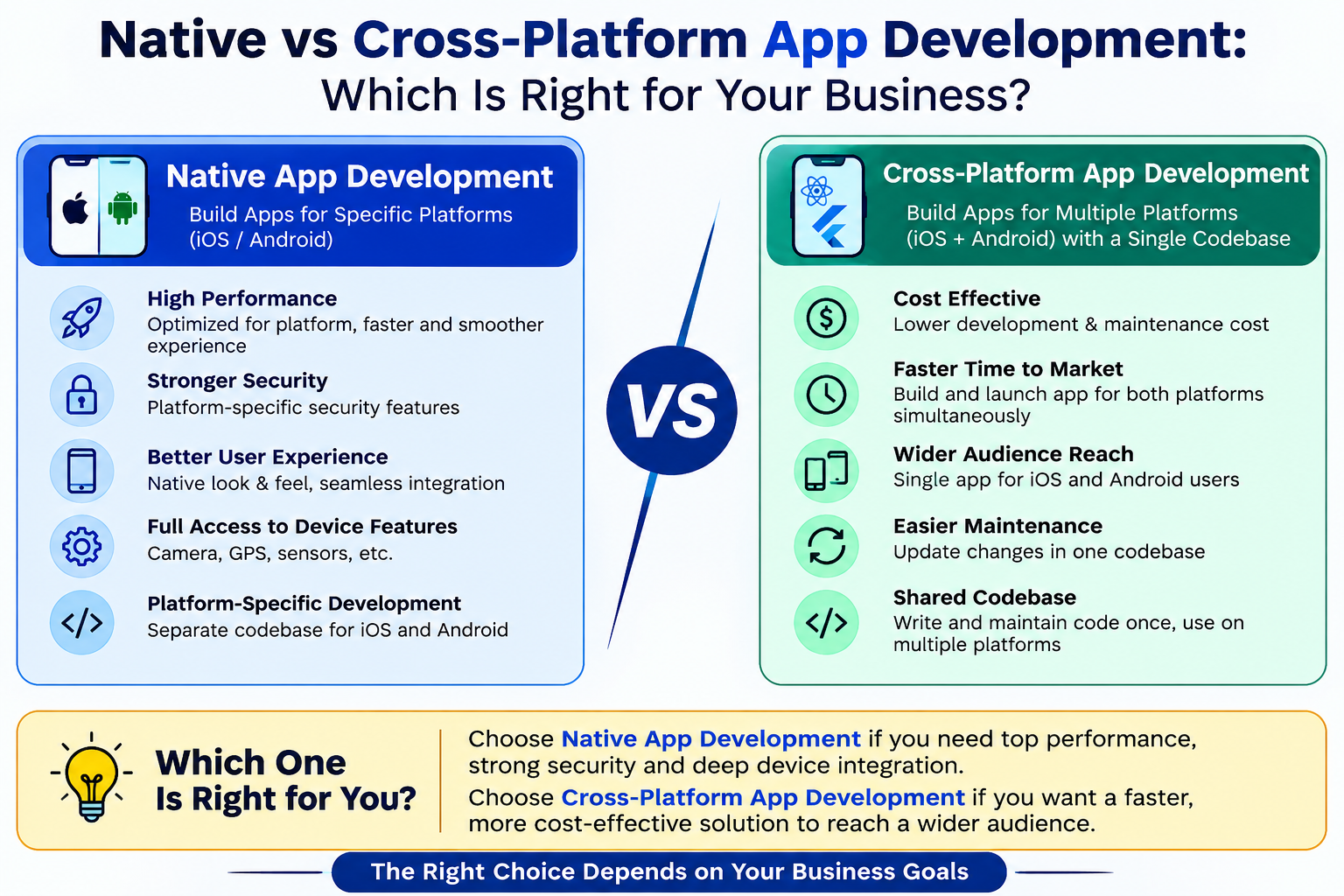
Native apps can provide a highly optimized experience because the application is built specifically for the target platform. This can be particularly valuable for applications involving intensive graphics, advanced camera functions, augmented reality, sophisticated background processing, or other demanding capabilities.
What Is Cross-Platform App Development?
Cross-platform development allows developers to build applications for multiple operating systems from a shared codebase. Technologies such as Flutter and React Native are commonly used for this approach.
Flutter, for example, is designed to support iOS and Android from a single codebase, allowing businesses to reach users across both ecosystems while maintaining a unified development process.
Cross-platform development can help businesses reduce duplicated development work and maintain greater consistency between applications. It is particularly useful for businesses that want to launch on Android and iOS without maintaining two completely separate development projects.
Benefits of Cross-Platform Development
One of the biggest advantages is development efficiency. A shared codebase can simplify development, testing, maintenance, and feature updates across multiple platforms.
Cross-platform development can also be suitable for:
1.Startups and new businesses
2.E-commerce applications
3.Customer-service apps
4.Booking and appointment platforms
5.Business productivity applications
6.Content-based applications
7.MVPs and new digital products
Flutter's architecture also allows developers to access platform services and APIs when required, meaning cross-platform development does not necessarily mean giving up access to device capabilities.
Native vs Cross-Platform: Key Differences
The primary difference is the development approach.
Native development focuses on one operating system at a time. This provides greater platform-specific control but may require separate development efforts for Android and iOS. Cross-platform development focuses on sharing a significant portion of the code between platforms. This can make development and maintenance more streamlined when businesses need both Android and iOS applications.
The decision should therefore not be based simply on which technology is more popular. Instead, businesses should evaluate what their app actually needs.
Which Option Is More Cost-Effective?
Cost is another major consideration. Developing separate native applications for Android and iOS can require additional development resources because each platform may need its own implementation, testing, and maintenance.
Cross-platform development can reduce duplicated effort by allowing teams to reuse a substantial portion of the application code.
However, the actual project cost depends on factors such as design complexity, integrations, backend requirements, security, testing, features, and post-launch support.
Therefore, businesses should avoid choosing a technology solely because it appears cheaper initially. The better approach is to consider the total cost of development, maintenance, scaling, and future upgrades.
When Should Your Business Choose Native Development?
Native development may be the better option if your application depends heavily on platform-specific functionality or requires maximum performance.
For example, businesses developing advanced gaming applications, AR experiences, sophisticated financial applications, or apps requiring deep integration with device hardware may benefit from native development.
Native development can also be valuable when delivering a highly customized experience for a particular operating system is a strategic priority.
When Is Cross-Platform Development the Better Choice?
Cross-platform development is often a strong option when you want to launch on both Android and iOS while maintaining development efficiency.
If your app primarily handles business data, customer accounts, transactions, bookings, content, communication, or standard device features, cross-platform development may provide an effective balance between performance, development speed, and budget.
It can also be a practical choice for startups that want to validate an idea before making larger technology investments.
Think Beyond Development Cost
Choosing an app technology is a long-term business decision. Consider how frequently you will release updates, how many platforms you need to support, what integrations are required, how your user base may grow, and what features you may add in the future.
You should also consider security, scalability, analytics, API integrations, cloud infrastructure, app-store requirements, and ongoing maintenance before selecting a development approach.
How Softechedge Can Help
At Softechedge, we understand that every business has different technology requirements. Instead of recommending a development approach simply because it is popular, the focus should be on understanding your business objectives, users, functionality, and growth plans. Whether your project requires native Android or iOS development or a cross-platform solution using modern technologies, the right development strategy can help create a mobile application that is reliable, scalable, user-friendly, and aligned with your business goals.
Conclusion
There is no universal winner in the native vs cross-platform app development debate. Native development can deliver exceptional platform-specific performance and access to advanced device capabilities, while cross-platform development can provide development efficiency and broader platform coverage through shared code.
The best choice depends on your application's complexity, target platforms, budget, performance expectations, and long-term strategy.
If you are planning a new mobile application, choosing the right technology at the beginning can make development, maintenance, and future growth much easier. With the right strategy and development partner, your mobile app can become more than just a digital product—it can become a valuable part of your business ecosystem.