Introduction
Choosing the right career is one of the most important decisions in life. However, many students and professionals choose a career based only on salary, social expectations, family pressure, or popular trends. While these factors can influence a career decision, they should not be the only considerations.
A successful career should ideally match your strengths, interests, skills, personality, values, and long-term goals. When you understand what you are naturally good at and learn how to develop those abilities, you can make more informed career decisions and increase your chances of professional satisfaction.
But how do you identify your strengths?
Some people know their strengths from an early age. Others discover them through education, internships, work experience, hobbies, challenges, or feedback from others. Your strengths are not necessarily limited to academic achievements. Communication, problem-solving, creativity, leadership, organization, adaptability, teamwork, empathy, analytical thinking, and learning ability can all become valuable professional strengths.
This guide explains how to identify your strengths and turn them into a career, with practical steps that students, fresh graduates, and working professionals can follow.
What Are Career Strengths?
Career strengths are the abilities, qualities, skills, and characteristics that help you perform tasks effectively and create value in a professional environment.
For example:
- Someone who enjoys explaining complicated concepts may have strong communication and teaching abilities.
- Someone who enjoys analyzing numbers may have analytical and numerical skills.
- Someone who naturally organizes people and activities may have planning and leadership abilities.
- Someone who constantly comes up with new ideas may have creative thinking skills.
- Someone who enjoys solving technical problems may have logical and problem-solving abilities.
- Someone who listens carefully and understands people's concerns may have strong interpersonal and emotional intelligence skills.
Your strengths can be divided into different categories.
1. Technical Strengths
These are specific skills related to a particular profession or industry.
Examples include:
- Programming
- Data analysis
- Accounting
- Graphic design
- Digital marketing
- Human resource management
- Web development
- Financial analysis
- Foreign languages
2. Soft Skills
Soft skills determine how effectively you interact with people and manage professional situations.
Examples include:
- Communication
- Teamwork
- Leadership
- Time management
- Adaptability
- Decision-making
- Problem-solving
- Emotional intelligence
3. Personal Strengths
Personal qualities can also influence career success.
Examples include:
- Discipline
- Curiosity
- Patience
- Creativity
- Confidence
- Persistence
- Responsibility
- Willingness to learn
Understanding all three categories can give you a clearer picture of your career potential.
Why Is It Important to Identify Your Strengths?
Identifying your strengths can make career planning more focused and practical. Instead of randomly selecting a course or profession, you can evaluate different career options based on what you can realistically develop and enjoy using.
Better Career Decisions
When you understand your abilities, it becomes easier to compare different career paths and determine which ones align with your profile.
Greater Confidence
Knowing your strengths can improve your confidence because you have a clearer understanding of what you can contribute.
Better Skill Development
Once you identify your existing strengths, you can determine which additional skills you need to develop for your desired career.
Improved Job Satisfaction
A career that allows you to regularly use your strengths can be more engaging and fulfilling.
Stronger Professional Growth
Organizations value employees who can solve problems, communicate effectively, adapt to change, and contribute meaningfully. Understanding your strengths can help you position yourself for career growth.
How to Identify Your Strengths
Identifying your strengths requires self-reflection, observation, experimentation, and feedback. The following steps can help.
1. Look at What Comes Naturally to You
Start by asking yourself:
What do I find easier than other people?
Think about situations where you perform well without requiring excessive effort.
Perhaps you are good at:
- Explaining things
- Organizing tasks
- Writing
- Working with numbers
- Speaking to people
- Learning new technology
- Solving problems
- Managing conflicts
- Generating ideas
Something that feels natural to you may indicate an underlying strength.
However, remember that a natural ability is only a starting point. Professional success requires practice and continuous development.
2. Think About Activities You Enjoy
Your interests can provide valuable clues about your strengths.
Think about activities that make you feel engaged rather than bored.
For example, if you enjoy:
- Creating social media content, you may have creative and communication strengths.
- Planning events, you may have organizational and coordination abilities.
- Teaching others, you may have communication and mentoring skills.
- Building websites, you may have technical and logical strengths.
- Researching topics, you may have analytical and investigative abilities.
- Working with people, you may have interpersonal and relationship-building skills.
Interest alone does not guarantee career success, but it can help you identify areas worth exploring.
3. Review Your Past Achievements
Your previous accomplishments can reveal patterns in your abilities.
Make a list of achievements from:
- School
- College
- Internships
- Jobs
- Projects
- Competitions
- Volunteering
- Hobbies
- Personal activities
Then ask:
What skills helped me achieve these results?
For example, if you successfully organized a college event, your strengths may include planning, teamwork, communication, coordination, and leadership.
If you completed a difficult technical project, your strengths may include persistence, research, logical thinking, and problem-solving.
Your achievements are evidence of your capabilities.
4. Ask Other People for Honest Feedback
Sometimes other people can identify our strengths more easily than we can.
Ask people who know your work or personality well:
- What do you think I am good at?
- What do people usually come to me for help with?
- Which qualities make me stand out?
- What professional role do you think would suit me?
- What do you think I should improve?
You can ask teachers, mentors, colleagues, managers, friends, or family members.
Do not simply collect compliments. Look for repeated patterns.
If several people independently say that you are good at explaining things, communication or teaching may be one of your strengths.
5. Analyze the Tasks People Ask You to Do
Pay attention to what people frequently ask you to help with.
For example:
If classmates ask you to explain difficult topics, you may have strong communication skills.
If colleagues ask you to organize work, you may have planning abilities.
If people ask you to solve technical problems, you may have technical or analytical strengths.
These repeated requests can provide useful clues about your abilities.
6. Use Career and Personality Assessments
Career assessments can help you understand your interests, personality characteristics, aptitude, and preferences.
These assessments should not be treated as a final decision-maker. Instead, they can be used as one source of information during career counselling.
A professional career counsellor can help you interpret assessment results and connect them with education and career options.
7. Identify Your Transferable Skills
Transferable skills are abilities that can be used across multiple jobs and industries.
For example, communication is useful in:
- HR
- Sales
- Marketing
- Teaching
- Management
- Customer service
- Public relations
Similarly, analytical thinking can be valuable in:
- Finance
- Data analysis
- Business management
- Consulting
- Operations
- Technology
Understanding transferable skills can help you discover career options you may not have considered.
8. Pay Attention to Problems You Enjoy Solving
One of the most useful questions in career planning is:
What kind of problems do I enjoy solving?
Different careers involve solving different problems.
Someone who enjoys helping people solve workplace issues may be interested in HR.
Someone who enjoys business challenges may be interested in management or consulting.
Someone who enjoys technical challenges may prefer software development or cybersecurity.
Someone who enjoys market-related challenges may consider marketing or sales.
The problems you enjoy solving can reveal the type of work that suits you.
9. Identify Your Values
Your strengths are important, but they should also align with your personal values.
Ask yourself what matters most to you.
Do you value:
- Financial stability?
- Creativity?
- Independence?
- Leadership?
- Helping others?
- Work-life balance?
- Learning?
- Recognition?
- Innovation?
- Social impact?
For example, a person who values independence may prefer a career with flexibility and autonomy, while someone who strongly values teamwork may prefer collaborative work environments.
A career should not only match what you are good at; it should also fit what matters to you.
10. Understand Your Weaknesses Without Becoming Discouraged
Identifying strengths does not mean ignoring weaknesses.
Instead, understand the difference between:
“I am not good at this.”
and
“I have not developed this skill yet.”
Some weaknesses can be improved through education, practice, mentoring, and experience.
For example, a student may initially struggle with public speaking but improve through presentations, communication training, and regular practice.
The goal is not to become perfect at everything. The goal is to understand which skills are essential for your chosen career and which ones you need to develop.
How to Connect Your Strengths With Career Options
Identifying strengths is only the first step. The next challenge is turning them into a realistic career direction.
Step 1: Create a Strengths Profile
Write down your top strengths.
For example:
| Strength | Evidence | Possible Career Areas |
|---|---|---|
| Communication | Presentations, teaching | HR, Marketing, Sales |
| Analytical Thinking | Research, data projects | Finance, Data, Business |
| Creativity | Content creation | Marketing, Design |
| Leadership | Managing college events | Management, HR |
| Technical Skills | Coding projects | Web Development, IT |
This simple exercise can help you see connections between your abilities and career options.
Step 2: Research Career Paths
Once you have identified potential career areas, research them carefully.
Look at:
- Job responsibilities
- Required qualifications
- Required technical skills
- Soft skills
- Salary expectations
- Growth opportunities
- Industry demand
- Work environment
- Career progression
Do not choose a career simply because someone says it is “high-paying.”
A high-paying career may not be suitable if it does not match your interests, strengths, or working style.
Step 3: Compare Your Current Skills With Industry Requirements
Suppose you discover that digital marketing matches your strengths.
You may already have:
- Communication
- Creativity
- Social media knowledge
- Writing ability
But you may need to develop:
- SEO
- Google Ads
- Analytics
- Content strategy
- Performance marketing
This creates a skill gap.
Once you understand the gap, you can create a learning plan.
Step 4: Build the Right Skills
Your strengths become professionally valuable when you combine them with relevant industry skills.
For example:
Communication + HR knowledge = HR professional
Creativity + Digital Marketing = Content/Marketing professional
Logical thinking + Programming = Software developer
Analytical thinking + Business knowledge = Business/Data analyst
Language skills + Professional expertise = International career opportunities
The combination of strengths and job-relevant skills can create a strong professional profile.
Step 5: Test Your Career Choice
Do not make a major career decision based only on theory.
Experiment first.
You can:
- Take an introductory course
- Complete a small project
- Attend a workshop
- Take an internship
- Talk to professionals
- Volunteer
- Freelance
- Participate in competitions
- Shadow someone working in the field
These experiences can help you determine whether the career actually suits you.
How Career Counselling Can Help
Career counselling can make the process more structured.
A career counsellor can help you understand your:
- Interests
- Strengths
- Aptitude
- Personality
- Skills
- Career goals
- Educational options
Career counselling is particularly useful for students who feel confused about what to choose after school or graduation.
Instead of selecting a course based solely on trends or peer pressure, students can evaluate their own abilities and interests.
For graduates and working professionals, career counselling can also help with:
- Career transitions
- Upskilling decisions
- Choosing professional courses
- Identifying suitable industries
- Planning long-term career growth
- Understanding transferable skills
Common Mistakes to Avoid When Choosing a Career
Following Friends
Your friend's career may be perfect for them but completely unsuitable for you.
Choosing Only Based on Salary
Salary matters, but long-term career satisfaction also depends on interests, abilities, growth, and work environment.
Following Family Pressure Without Self-Assessment
Family advice can be valuable, but your career should ultimately reflect your abilities and goals.
Ignoring Skill Development
A degree alone may not be enough for many modern careers. Employers increasingly value practical skills and relevant experience.
Choosing a Career Because It Is Trending
Career trends change. Build skills that remain useful while adapting to industry changes.
Comparing Your Journey With Others
Everyone develops at a different pace. Focus on building your own strengths instead of constantly comparing yourself with others.
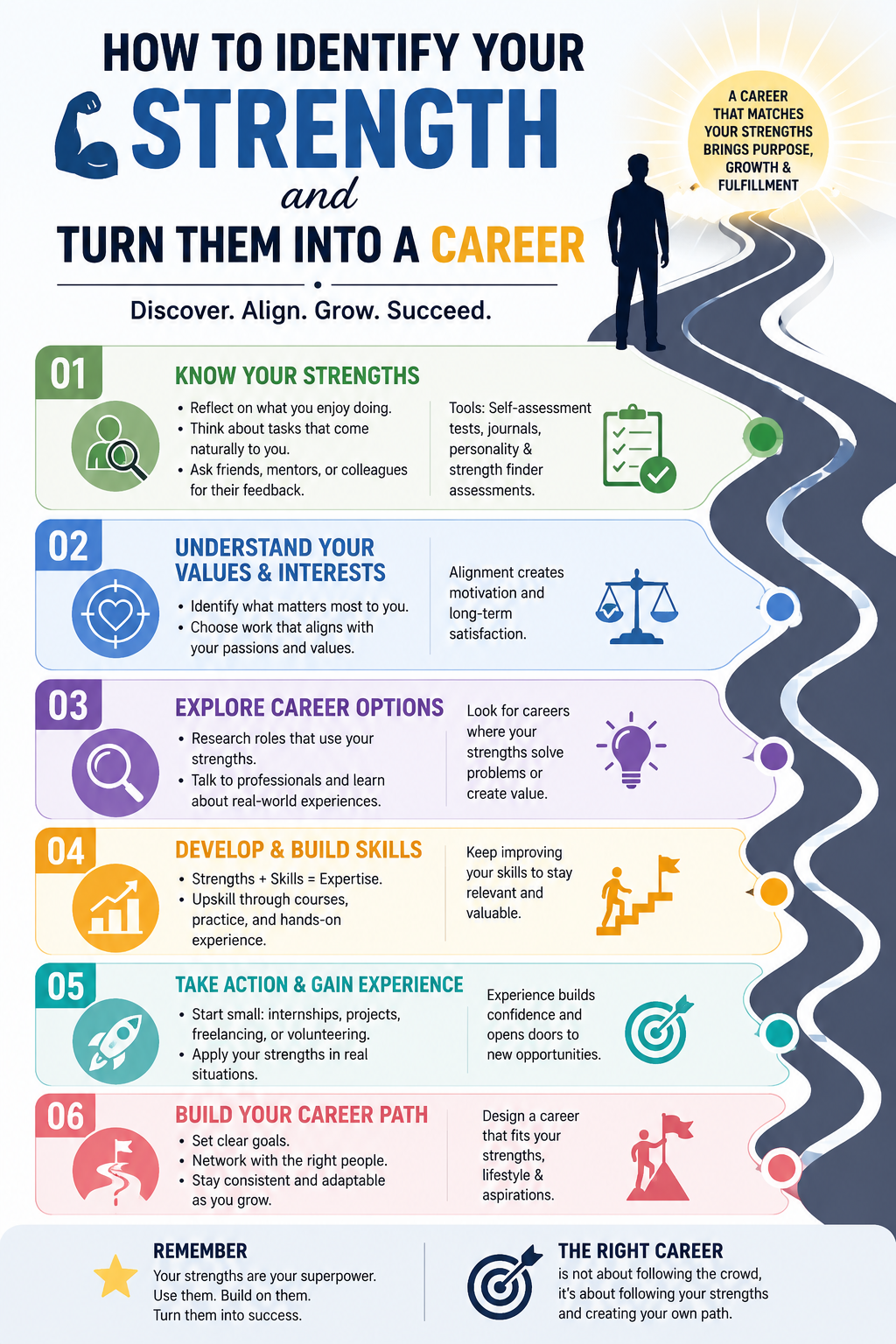
How to Turn Your Strengths Into a Career: A Practical Roadmap
Here is a simple roadmap you can follow.
Step 1: Discover
Identify your interests, abilities, personality traits, and values.
Step 2: Evaluate
Use feedback, self-reflection, aptitude assessments, and past experiences to understand your strengths.
Step 3: Explore
Research careers that match your strengths.
Step 4: Test
Try courses, internships, projects, workshops, or practical experiences.
Step 5: Identify the Skill Gap
Compare your current abilities with the skills required by your target career.
Step 6: Upskill
Take industry-oriented courses and develop practical knowledge.
Step 7: Build Experience
Work on projects, internships, freelance assignments, or real-world tasks.
Step 8: Create Your Professional Profile
Build a strong resume, portfolio, LinkedIn profile, and professional network.
Step 9: Seek Guidance
Talk to career counsellors, mentors, trainers, and professionals.
Step 10: Keep Learning
Career development is an ongoing process. Continue improving your skills as industries evolve.
The Role of Skill Development in Career Success
Your natural strengths provide a foundation, but professional success requires continuous learning.
For example, someone may naturally have strong communication skills. However, becoming a successful HR professional may require knowledge of:
- Recruitment
- Employee relations
- Performance management
- HR technology
- Labour laws
- Talent management
- Data-driven HR
Similarly, someone interested in web development needs more than an interest in technology. They may need practical knowledge of programming languages, frameworks, databases, version control, and development tools.
This is why skill development and career counselling should work together.
Career counselling helps answer:
“Which direction should I take?”
Skill development helps answer:
“How can I become capable of succeeding in that direction?”
How Skill Excellent Can Support Your Career Journey
For students and professionals who want structured career guidance and practical learning, Skill Excellent can be a useful part of the career development journey.
The objective of career-focused training should not simply be completing a course. It should be developing practical, industry-relevant skills that help learners become more confident and career-ready.
Before selecting any course, students should consider:
- Whether the curriculum is industry-oriented
- Whether practical learning is included
- Whether trainers have relevant expertise
- Whether projects are included
- Whether certification is provided
- Whether career guidance is available
- Whether the skills match current industry requirements
The right combination of self-awareness, career counselling, skill development, practical experience, and continuous learning can help students make stronger career decisions.
Frequently Asked Questions
How do I identify my strengths for a career?
Start by reviewing your interests, past achievements, skills, feedback from others, and activities you naturally enjoy. Career assessments and professional career counselling can also provide additional insights.
Can my hobbies become career strengths?
Yes. Hobbies can reveal creativity, communication, leadership, technical abilities, discipline, or other transferable skills. However, you should also evaluate the market demand and professional requirements of the related career.
What if I do not know what I am good at?
That is completely normal. Try different activities, courses, internships, projects, and assessments. Feedback from teachers, mentors, colleagues, and career counsellors can also help you identify patterns.
Should I choose a career based on my strengths or interests?
Ideally, consider both. A strong career match often occurs where your strengths, interests, values, and market opportunities overlap.
Can strengths change over time?
Yes. Some strengths develop through education, practice, experience, and exposure. A person who is not confident in a particular skill today may become highly capable after consistent learning and practice.
Is career counselling only for school students?
No. Career counselling can benefit school students, college students, graduates, freshers, working professionals, and people considering career changes.
How can I turn a strength into a professional skill?
First identify the strength, then understand which careers value it. Research the required skills, complete relevant training, practice through projects or internships, and gradually build professional experience.
Conclusion
Your strengths can provide important clues about the career path that may suit you, but identifying them is only the beginning. The real value comes from understanding how those strengths can be developed and applied in the professional world.
Instead of asking only “Which career is best?”, ask:
“What am I good at?”
“What do I enjoy doing?”
“What problems do I enjoy solving?”
“What skills do I need to develop?”
“Which careers can help me use my strengths?”
The answers to these questions can help you build a more personalized career roadmap.
Whether you are a student choosing your first course, a graduate searching for direction, or a professional planning a career transition, self-awareness can help you make better decisions.
A successful career is not necessarily about following the most popular path. It is about finding the right intersection between your strengths, interests, skills, values, and opportunities.
With proper career counselling, practical training, continuous upskilling, and real-world experience, your strengths can become more than personal qualities—they can become the foundation of a rewarding and sustainable career.
Ready to discover your strengths and build the right career path? Start by understanding yourself, exploring your options, developing relevant skills, and taking the first step toward your professional goals with Skill Excellent.