Introduction
The modern workplace is changing faster than ever before. Technology is evolving, industries are transforming, customer expectations are increasing, and new job roles are emerging every year. Skills that were highly valuable a few years ago may no longer be sufficient for today's workplace.
In this rapidly changing environment, education cannot stop after graduation or after an employee gets a job. Professionals need to continue learning, improving, and adapting throughout their careers.
This is where continuous learning in the modern workplace becomes important.
Continuous learning refers to the ongoing process of acquiring new knowledge, developing skills, improving existing capabilities, and adapting to changing professional requirements. It can take many forms, including formal training, online courses, workshops, mentoring, certifications, practical projects, peer learning, and self-directed learning.
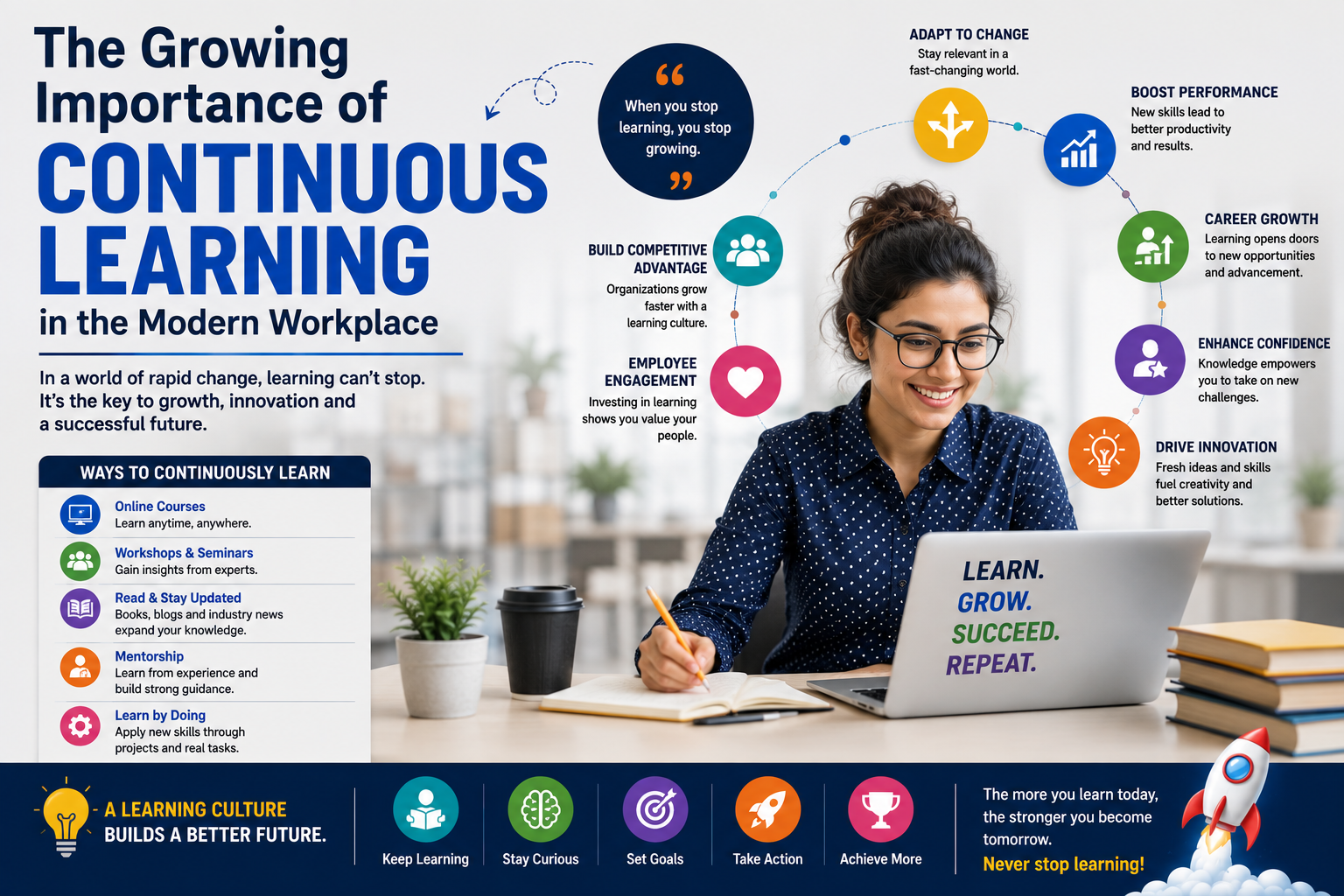
For employees, continuous learning can lead to better career opportunities, greater confidence, improved performance, and long-term professional growth. For organizations, it can support productivity, innovation, employee engagement, adaptability, and competitiveness.
The workplace of the future will not simply reward people who know the most today. It will increasingly reward people and organizations that are willing and able to keep learning tomorrow.
In this article, we will explore the growing importance of continuous learning in the modern workplace, its benefits for employees and businesses, the role of technology, the difference between upskilling and reskilling, challenges organizations may face, and practical strategies for building a continuous learning culture.
What Is Continuous Learning?
Continuous learning is the ongoing development of knowledge and skills throughout a person's professional career.
Traditional education often follows a structured pattern:
School → College → Graduation → Job
Continuous learning creates a different approach:
Learn → Apply → Improve → Adapt → Learn Again
Instead of considering education something that ends after completing a degree, continuous learning treats education as an ongoing professional journey.
Employees can learn through:
Professional training
Online courses
Workshops
Certifications
Conferences
Mentoring
Coaching
Practical projects
Team discussions
Industry research
Books and articles
Webinars
Peer-to-peer learning
Professional communities
Continuous learning does not always require returning to a classroom. In many cases, employees can learn directly through their daily work.
Why Is Continuous Learning Important in the Modern Workplace?
The modern workplace is influenced by several major changes.
These include:
Artificial intelligence
Automation
Cloud computing
Digital transformation
Remote work
Changing customer expectations
New business models
Global competition
New technologies
Changing workplace roles
As these changes accelerate, businesses need employees who can adapt.
For example, an employee who worked primarily with traditional office software may now need to understand cloud collaboration tools, data analytics, automation, or AI-assisted workflows.
Similarly, marketing professionals need to understand changing digital platforms, analytics, content formats, and customer behavior.
Continuous learning helps employees stay relevant in this environment.
1. Continuous Learning Helps Employees Stay Relevant
One of the biggest benefits of continuous learning is maintaining professional relevance.
Industries evolve continuously.
New technologies can change how tasks are performed, while new tools can make older processes less efficient.
Employees who continue learning can update their knowledge and remain prepared for changes in their industry.
For example, a finance professional may need to learn data analytics. A marketing professional may need to develop SEO and digital advertising skills. An HR professional may need to understand HR technology, people analytics, and digital recruitment platforms.
Continuous learning allows professionals to evolve along with their industries.
2. It Improves Employee Performance
Learning new skills can directly improve workplace performance.
An employee who understands modern tools and processes may complete tasks more efficiently and accurately.
For example:
A project manager can learn better project management software.
An HR professional can learn data-driven recruitment methods.
A salesperson can learn CRM technology.
A designer can learn new design tools.
A developer can learn emerging programming technologies.
When employees gain relevant skills, organizations can benefit from improved workflows and stronger performance.
3. Continuous Learning Supports Career Growth
Career growth is one of the strongest motivations for professional learning.
Employees who continuously develop their skills can prepare themselves for:
Promotions
Leadership roles
New responsibilities
Career transitions
Specialized positions
Higher-level projects
Learning demonstrates initiative and a willingness to improve.
For example, an employee working in digital marketing may learn analytics, performance marketing, SEO, and marketing automation. These additional skills can create opportunities to move into more advanced roles.
Continuous learning therefore connects directly with long-term career development.
4. Upskilling Helps Employees Become Better at Their Current Jobs
Upskilling means developing additional skills that improve performance in an existing role.
For example, an HR executive may learn:
HR analytics
Recruitment technology
Employee engagement tools
HR information systems
The employee remains in the same broad career area but becomes more capable.
Upskilling benefits both employees and organizations because businesses gain stronger capabilities while employees improve their professional value.
5. Reskilling Prepares Employees for New Roles
Reskilling involves learning new skills to transition into a different role or career area.
For example, someone working in a traditional administrative role may learn digital tools, data management, and technology skills to transition into a digital operations position.
Reskilling has become increasingly important as automation and technological change alter job responsibilities.
Instead of viewing technological change only as a threat, organizations can use reskilling to help employees transition into new opportunities.
6. Continuous Learning Encourages Innovation
Innovation requires people to think differently.
Employees who are exposed to new ideas, technologies, and approaches are more likely to identify opportunities for improvement.
A continuous learning culture can encourage employees to ask:
Can this process be improved?
Is there a better technology for this task?
How are other companies solving this problem?
Can automation reduce repetitive work?
How can we improve the customer experience?
Learning introduces new perspectives, and new perspectives can contribute to innovation.
7. It Helps Businesses Adapt to Technological Change
Technology is one of the biggest reasons continuous learning has become essential.
Artificial intelligence, cloud computing, automation, cybersecurity, data analytics, and other technologies are changing business operations.
Organizations that adopt new technologies without training their employees may fail to achieve the expected benefits.
For example, implementing a new CRM platform is not enough. Employees need to understand how to use it effectively.
Similarly, introducing AI tools requires employees to understand appropriate use, limitations, data considerations, and quality control.
Technology investment and employee learning should therefore go together.
8. Continuous Learning Improves Employee Confidence
Employees may feel uncertain when they encounter new technologies or responsibilities.
Training and learning opportunities can reduce this uncertainty.
When employees understand a new tool or process, they are more likely to feel confident using it.
Confidence can improve:
Decision-making
Communication
Problem-solving
Collaboration
Workplace participation
A learning-oriented workplace can therefore help employees feel more prepared for change.
9. It Can Improve Employee Engagement
Employees often want opportunities to grow professionally.
When organizations provide meaningful learning opportunities, employees may feel that their development is valued.
Learning programs can include:
Training sessions
Certification support
Mentoring
Leadership development
Skill workshops
Career development plans
Organizations that invest in employee development can create a stronger connection between individual career goals and organizational objectives.
10. Continuous Learning Supports Employee Retention
Employee turnover can be expensive and disruptive.
Employees may leave organizations when they feel that they have limited opportunities for growth.
A strong learning environment can provide employees with opportunities to:
Develop new skills
Take on challenging projects
Prepare for promotions
Explore career paths
Build leadership capabilities
When employees see a future within an organization, they may be more motivated to stay and grow.
Learning should therefore be considered not only a training expense but also part of a broader talent strategy.
11. It Helps Organizations Build a Future-Ready Workforce
A future-ready workforce is one that can adapt to changing business requirements.
Organizations cannot always predict exactly which technologies or roles will become important in the coming years.
However, they can build employees' ability to learn and adapt.
A future-ready employee may demonstrate:
Digital literacy
Communication skills
Critical thinking
Problem-solving
Adaptability
Collaboration
Creativity
Industry knowledge
Willingness to learn
These capabilities can help businesses respond to uncertainty.
12. Continuous Learning Bridges the Skills Gap
Many industries face a gap between the skills employers need and the skills available in the workforce.
This is commonly referred to as the skills gap.
For example, businesses may struggle to find professionals with expertise in:
Artificial intelligence
Cybersecurity
Cloud computing
Data analytics
Digital marketing
Software development
Automation
Continuous learning can help reduce this gap by enabling existing employees to develop relevant skills.
Instead of relying exclusively on external hiring, businesses can also develop internal talent.
13. Learning Helps Employees Adapt to Artificial Intelligence
Artificial intelligence is changing many workplaces.
AI can automate certain repetitive tasks and assist employees with activities such as research, analysis, content generation, customer support, and data processing.
This does not necessarily mean that human skills are becoming unimportant.
Instead, employees may need to develop new abilities such as:
AI literacy
Critical evaluation of AI-generated information
Data awareness
Prompting and AI tool usage
Problem-solving
Creativity
Strategic thinking
The future workplace is likely to require a combination of technology skills and distinctly human capabilities.
14. Digital Skills Are Becoming Essential
Digital skills are increasingly relevant across industries.
Employees may need to understand:
Cloud-based applications
Digital communication
Data analytics
Cybersecurity awareness
Collaboration platforms
AI tools
Digital project management
Online customer engagement
Digital literacy is no longer limited to IT departments.
Employees across HR, finance, sales, marketing, operations, and administration may need digital skills to perform their jobs effectively.
15. Continuous Learning Strengthens Leadership
Learning should not stop when an employee becomes a manager.
Leadership itself requires continuous development.
Managers may need to improve their skills in:
Communication
Delegation
Conflict resolution
Team management
Strategic thinking
Decision-making
Coaching
Employee development
Organizations that invest in leadership development can build stronger internal talent pipelines.
Continuous Learning and Organizational Culture
A training program alone does not create a learning organization.
Organizations need to build a culture where learning is encouraged.
A learning culture may include:
Managers encouraging development
Employees sharing knowledge
Regular training opportunities
Recognition for learning
Access to educational resources
Mentoring
Constructive feedback
Opportunities to apply new skills
Employees should not feel that learning is an additional burden unrelated to their work.
Instead, learning should become part of the way the organization operates.
The Role of Technology in Continuous Learning
Technology has transformed workplace learning.
Employees can now access educational resources from almost anywhere.
Digital learning can include:
Online courses
Learning management systems
Webinars
Video lessons
Virtual classrooms
Digital certifications
Interactive learning platforms
AI-powered learning tools
Online communities
This flexibility allows organizations to provide learning opportunities without requiring employees to attend traditional classroom sessions every time.
Microlearning: Learning in Small Steps
One emerging approach to workplace learning is microlearning.
Microlearning breaks larger subjects into small, focused learning units.
For example, instead of completing a five-hour training session in one sitting, employees might complete several short modules over multiple days.
Microlearning can cover topics such as:
One software feature
One communication skill
One cybersecurity practice
One sales technique
One leadership concept
Short learning experiences can be easier to integrate into busy work schedules.
Learning Through Practical Experience
Not all learning happens through formal courses.
Employees can develop skills through practical experience.
This may include:
New projects
Job rotations
Cross-functional assignments
Mentoring
Shadowing
Problem-solving activities
Team presentations
Practical learning is especially valuable because employees can immediately apply what they learn.
The combination of learning + practice + feedback can create stronger skill development.
Why Businesses Should Connect Learning With Business Goals
Training should not happen simply because training is available.
Organizations should identify the skills required to achieve their business objectives.
For example, if a company wants to expand its digital marketing operations, employees may need training in:
SEO
Content strategy
Performance marketing
Analytics
Social media
Marketing automation
If a business plans to modernize its IT infrastructure, employees may need skills in:
Cloud computing
DevOps
Cybersecurity
Automation
Learning becomes more valuable when it directly supports business strategy.
How to Build a Continuous Learning Culture
Organizations can take several practical steps.
Step 1: Identify Skill Gaps
Analyze current capabilities and compare them with future business requirements.
Step 2: Create Individual Development Plans
Employees can have personalized learning goals based on their current roles and career aspirations.
Step 3: Provide Multiple Learning Formats
Offer a combination of:
Courses
Workshops
Mentoring
Practical projects
Webinars
Certifications
Step 4: Encourage Managers to Support Learning
Managers should provide time and encouragement for development.
Step 5: Create Opportunities to Apply Skills
Employees should be able to use newly acquired knowledge in real workplace situations.
Step 6: Measure Results
Organizations can track:
Skill improvement
Employee performance
Training completion
Productivity
Internal promotions
Employee engagement
Step 7: Update Learning Programs Regularly
Training content should evolve as technologies and business requirements change.
Challenges of Continuous Learning
Although continuous learning has many advantages, organizations may face challenges.
Lack of Time
Employees already have busy schedules.
Solution: Use flexible learning formats and integrate learning into daily work.
Limited Budget
Small organizations may have limited training budgets.
Solution: Combine internal knowledge sharing, affordable online resources, mentoring, and targeted professional training.
Employee Resistance
Some employees may be uncomfortable learning new technologies.
Solution: Explain the benefits clearly and provide practical support.
Irrelevant Training
Training that does not relate to employees' roles may have limited value.
Solution: Connect learning programs with actual business requirements.
Lack of Management Support
If managers do not encourage learning, employees may prioritize immediate tasks.
Solution: Make learning part of organizational culture and leadership expectations.
Continuous Learning for Small and Medium Businesses
Continuous learning is not limited to large corporations.
Small and medium-sized businesses can also create effective learning environments.
They can use:
Online courses
Internal workshops
Mentoring
Peer learning
Industry webinars
Professional communities
External training providers
Small businesses can also encourage employees to share knowledge with one another.
For example, an employee who learns a new digital tool can conduct a short session for the rest of the team.
This creates a culture of knowledge sharing without requiring a large training department.
The Connection Between Continuous Learning and Business Growth
There is a strong relationship between employee capability and organizational performance.
When employees develop better skills, businesses may benefit through:
Better Skills → Better Performance → Better Processes → Better Customer Experience → Business Growth
Continuous learning can contribute to:
Improved productivity
Better quality
Faster adaptation
Innovation
Employee engagement
Customer satisfaction
Stronger leadership
It therefore has value beyond individual career development.
Continuous Learning and Career Development
Employees should take ownership of their learning as well.
Professionals can ask themselves:
What skills will my industry need in the future?
Which skills are becoming outdated?
What technology is changing my profession?
What new responsibilities do I want to take on?
What skills do I need for my next career step?
A personal learning plan can help answer these questions.
For example:
Short-Term Goal
Learn a new workplace tool.
Medium-Term Goal
Complete a professional certification.
Long-Term Goal
Develop leadership or specialist expertise.
This approach turns learning into a structured career strategy.
Human Skills Will Remain Important
Technology skills are important, but continuous learning should not focus exclusively on technology.
Human skills remain critical.
These include:
Communication
Creativity
Leadership
Emotional intelligence
Critical thinking
Collaboration
Negotiation
Adaptability
Problem-solving
As technology handles more repetitive tasks, human judgment and interpersonal skills may become even more valuable.
The future workforce will need both technical capabilities and human capabilities.
The Future of Continuous Learning
The future of workplace learning is likely to become more personalized, flexible, and technology-driven.
Organizations may increasingly use:
AI-assisted learning
Personalized learning paths
Skills assessments
Digital credentials
Virtual classrooms
Microlearning
Simulation-based training
Data-driven learning recommendations
Employees may also take greater responsibility for managing their own professional development.
The traditional idea of attending occasional training sessions may gradually evolve into a more continuous learning ecosystem.
Frequently Asked Questions
What is continuous learning in the workplace?
Continuous learning in the workplace is the ongoing process of developing employees' knowledge, skills, and capabilities throughout their careers.
Why is continuous learning important?
Continuous learning helps employees stay relevant, improve performance, prepare for career opportunities, and adapt to changing technologies and business requirements.
What is the difference between upskilling and reskilling?
Upskilling involves developing additional skills for an existing role, while reskilling involves learning new skills to transition into a different role.
How does continuous learning benefit businesses?
It can support productivity, innovation, employee engagement, internal talent development, adaptability, and competitiveness.
How can employees continue learning while working full-time?
Employees can use online courses, microlearning, workshops, books, webinars, mentoring, practical projects, and peer learning to develop skills alongside their regular work.
Does continuous learning only mean learning technology?
No. Continuous learning includes both technical and human skills, including communication, leadership, creativity, problem-solving, adaptability, and industry knowledge.
How can companies encourage employees to learn?
Companies can provide learning resources, training opportunities, mentoring, development plans, dedicated learning time, and recognition for professional development.
How SAC Management India Pvt. Ltd. Connects With Continuous Learning
In today's business environment, organizations need a combination of skilled people, relevant technology, employment opportunities, and business-focused solutions.
This makes continuous learning particularly relevant to an organization such as SAC Management India Pvt. Ltd., whose broader ecosystem connects skills, technology, employment, and business growth.
Continuous learning can support this ecosystem by helping individuals develop industry-relevant capabilities while helping businesses access and develop the talent and technological knowledge they need.
For businesses, this can mean encouraging employees to continuously improve their technical and professional skills.
For professionals and students, it can mean developing capabilities that align with changing industry requirements.
The broader message is simple: learning should not be viewed as something that happens before a career begins. It should remain part of the career itself.
Conclusion
The growing importance of continuous learning in the modern workplace reflects a fundamental change in the way careers and businesses develop.
Technology is changing rapidly. Job roles are evolving. New industries are emerging. Customer expectations are shifting. In such an environment, relying only on the knowledge acquired at the beginning of a career is no longer enough.
Employees need opportunities to upskill, reskill, experiment, practice, and adapt.
Businesses, meanwhile, need to create environments where learning is encouraged and connected to real organizational goals.
Continuous learning can help employees become more confident, capable, adaptable, and prepared for future opportunities. For organizations, it can support productivity, innovation, employee engagement, talent retention, and long-term competitiveness.
The most successful workplaces of the future will not necessarily be those with the most technology. They will be those that know how to combine technology with continuously developing human talent.
Ultimately, continuous learning is not just a training strategy. It is a mindset.
Learn today. Apply tomorrow. Improve continuously. Stay ready for the future.