Introduction
Small businesses are the backbone of the economy, but competing in today's business environment is not always easy. Large companies often have bigger budgets, larger teams, stronger brand recognition, and access to extensive resources. For a small business, competing with such organizations may seem difficult.
However, technology has changed the competitive landscape.
Today, a small business can use digital tools, cloud computing, artificial intelligence, social media, websites, e-commerce platforms, customer relationship management systems, analytics, automation, and digital marketing to compete more effectively with larger organizations.
Technology is no longer limited to large corporations with huge IT departments. Affordable and scalable digital solutions allow small businesses to improve productivity, reach customers beyond their local markets, reduce operational costs, and make data-driven decisions.
A local business can build an online presence and reach customers across cities. A small e-commerce company can sell products to customers across the country. A startup can use cloud infrastructure instead of investing heavily in physical servers. A small service provider can use digital marketing to reach highly targeted audiences.
This is why understanding how technology helps small businesses compete has become increasingly important.
Technology does not automatically guarantee success. Businesses still need good products, strong customer service, effective management, and a clear strategy. However, when technology is used correctly, it can provide small businesses with tools that were once available mainly to large organizations.
In this guide, we will explore how technology helps small businesses compete, the most useful technologies for small companies, the benefits of digital transformation, common challenges, and how businesses can build a practical technology strategy for long-term growth.
What Is Business Technology?
Business technology refers to digital systems, software, platforms, and tools that help organizations manage their operations and achieve business objectives.
These technologies can support areas such as:
Marketing
Sales
Customer service
Accounting
Human resources
Communication
Project management
Data analysis
Cybersecurity
E-commerce
Website management
Cloud computing
Business automation
For a small business, technology does not necessarily mean investing in complicated or expensive systems.
Even basic tools such as a professional website, cloud storage, online accounting software, video conferencing, social media platforms, and digital payment systems can make a significant difference.
Why Technology Is Important for Small Businesses
Small businesses often operate with limited resources.
They may have:
Smaller teams
Limited budgets
Fewer employees
Smaller marketing departments
Less infrastructure
Limited geographic reach
Technology can help compensate for some of these limitations.
For example, automation can reduce repetitive work. Digital marketing can provide targeted visibility. Cloud software can eliminate the need for extensive physical infrastructure. Analytics can help owners understand customer behavior.
The result is a more efficient and competitive business.
1. Technology Helps Small Businesses Reach More Customers
One of the biggest advantages of technology is the ability to expand market reach.
In the past, a small business might have depended primarily on customers in its local area.
Today, a business can reach customers through:
Websites
Search engines
Social media
E-commerce platforms
Email marketing
Online advertising
Video platforms
Online marketplaces
A small company can therefore market its products or services to customers outside its immediate geographical area.
For example, a small handmade-product business can create an e-commerce website and promote its products through social media. Customers from different cities can discover and purchase the products online.
This creates opportunities that traditional local marketing alone may not provide.
2. A Professional Website Builds Credibility
A website is one of the most important digital assets for a modern business.
Potential customers frequently search online before deciding whether to contact or purchase from a company.
A professional website can provide information about:
Products
Services
Pricing
Company background
Contact information
Customer reviews
Case studies
Frequently asked questions
Blogs
A well-designed website can also communicate professionalism and credibility.
For small businesses competing with larger companies, having a modern and informative website can help create a stronger first impression.
3. Digital Marketing Creates Affordable Growth Opportunities
Traditional advertising can be expensive.
Television, newspapers, billboards, and large-scale offline campaigns may require significant investment.
Digital marketing provides small businesses with more flexible options.
Businesses can use:
Search engine optimization
Social media marketing
Content marketing
Email marketing
Online advertising
Video marketing
Local SEO
One major advantage is targeting.
A business can focus its marketing on specific audiences based on factors such as location, interests, demographics, search behavior, and other relevant characteristics.
This can make marketing expenditure more efficient.
4. SEO Helps Small Businesses Compete in Search Results
Search Engine Optimization, or SEO, helps businesses improve their visibility in search engines.
For example, suppose someone searches for:
"best web development company near me."
A small technology company with a properly optimized website may have an opportunity to appear in relevant search results.
SEO strategies can include:
Keyword research
Helpful content
Technical optimization
Local SEO
Internal linking
Website speed optimization
Mobile optimization
Quality backlinks
SEO is particularly valuable because it can attract people who are already searching for products or services related to a business.
5. Social Media Gives Small Businesses a Voice
Social media has significantly changed the way businesses communicate with customers.
A small business can create content and communicate directly with its audience without requiring a large advertising department.
Social media can be used to:
Promote products
Share educational content
Introduce employees
Show behind-the-scenes activities
Answer customer questions
Collect feedback
Announce offers
Build communities
The key is consistency and relevance.
Small businesses should focus on creating content that provides value rather than turning every post into a sales advertisement.
6. Technology Improves Customer Service
Customer expectations have changed.
People increasingly expect businesses to respond quickly and provide convenient communication channels.
Technology can help businesses provide customer service through:
Email
Live chat
Messaging platforms
Chatbots
Customer portals
Social media
Helpdesk systems
A small business can use these tools to respond faster and organize customer requests more effectively.
Good customer service can become a competitive advantage.
A customer may choose a smaller company over a larger competitor because the smaller company provides faster, more personalized service.
7. CRM Software Helps Manage Customer Relationships
Customer Relationship Management, or CRM, software helps businesses organize information about customers and leads.
A CRM can help track:
Customer details
Sales leads
Follow-ups
Communication history
Sales opportunities
Customer interactions
Without a CRM, information may be scattered across spreadsheets, emails, notebooks, and messaging platforms.
A centralized CRM system can help a small business organize its sales process and ensure that potential customers are not forgotten.
8. Cloud Computing Reduces Infrastructure Barriers
Cloud computing is another technology that has created opportunities for small businesses.
Instead of purchasing and maintaining extensive physical infrastructure, businesses can access computing resources and software through cloud-based services.
Cloud technology can support:
File storage
Website hosting
Databases
Business applications
Collaboration
Data backup
Software development
Analytics
This can allow small businesses to access sophisticated technology without building everything themselves.
Cloud systems can also scale as a company grows.
9. Automation Saves Time
Small businesses often have employees performing multiple responsibilities.
Automation can reduce the amount of time spent on repetitive activities.
Businesses can automate processes such as:
Email responses
Appointment reminders
Invoice notifications
Social media scheduling
Lead follow-ups
Data entry
Reports
Customer notifications
For example, instead of manually sending every appointment reminder, a business can configure an automated system.
Employees can then spend more time on tasks requiring human judgment, creativity, and customer interaction.
10. Artificial Intelligence Is Creating New Opportunities
Artificial Intelligence is increasingly becoming accessible to smaller businesses.
AI tools can assist with:
Content ideation
Customer support
Data analysis
Document processing
Marketing personalization
Research
Workflow automation
Forecasting
For example, a small marketing team can use AI-assisted tools to generate content ideas, analyze campaign data, and identify customer trends.
However, AI should be used responsibly.
Human review remains important for accuracy, quality, privacy, and strategic decision-making.
11. Data Analytics Helps Businesses Make Better Decisions
Data is one of the most valuable resources available to modern businesses.
Analytics tools can help small businesses understand:
Which products sell best
Where customers come from
Which marketing campaigns perform well
Which website pages receive traffic
When customers make purchases
Which services generate the most revenue
This allows businesses to replace guesswork with evidence-based decisions.
For example, if analytics show that most website leads come from search engines, the business may decide to increase its investment in SEO.
12. Technology Improves Business Productivity
Productivity is particularly important for small businesses because they often have limited human resources.
Digital productivity tools can help teams:
Organize tasks
Track deadlines
Share documents
Manage projects
Schedule meetings
Communicate
Collaborate remotely
Project management platforms can provide visibility into who is responsible for each task and whether work is progressing according to schedule.
This can reduce confusion and improve accountability.
13. Digital Payments Make Transactions Easier
Digital payment technology has changed how customers pay for products and services.
Small businesses can offer convenient payment options through:
Online payment gateways
Digital wallets
UPI
QR codes
Debit and credit cards
Internet banking
Convenient payment options can improve the customer experience and make it easier for businesses to accept transactions.
For businesses selling online, reliable digital payment systems are particularly important.
14. E-Commerce Helps Small Businesses Expand Their Market
E-commerce has removed many geographical barriers.
A small business can create an online store and sell products to customers beyond its local area.
E-commerce technology can support:
Product catalogs
Online payments
Order management
Inventory tracking
Customer accounts
Shipping integration
Marketing
A small business with a unique product can therefore build a customer base beyond its physical location.
15. Technology Makes Remote Work Possible
Remote and hybrid work have become increasingly common.
Cloud-based tools allow employees to collaborate from different locations.
Businesses can use:
Video conferencing
Cloud storage
Team messaging
Project management
Online document collaboration
Digital HR systems
For small businesses, remote work can provide access to talent beyond their immediate geographic area.
It can also reduce certain office-related expenses when implemented effectively.
16. Technology Improves Financial Management
Financial management is essential for small businesses.
Digital accounting tools can simplify:
Invoicing
Expense tracking
Payroll
Financial reporting
Cash-flow monitoring
Record keeping
Automated financial systems can reduce manual errors and provide business owners with better visibility into their financial position.
This can support better budgeting and planning.
17. Cybersecurity Protects Small Businesses
Small businesses sometimes assume that cybercriminals only target large corporations.
However, every business that stores digital information can face cybersecurity risks.
A small business may hold:
Customer information
Employee records
Financial information
Passwords
Business documents
Intellectual property
Cybersecurity tools and practices can help protect these assets.
Important measures include:
Strong passwords
Multi-factor authentication
Secure backups
Antivirus and endpoint protection
Regular software updates
Access controls
Employee cybersecurity training
Security monitoring
Cybersecurity should be treated as an ongoing business requirement.
18. Technology Helps Small Businesses Understand Their Competitors
Digital platforms also make competitive research easier.
Businesses can study publicly available information about competitors, including:
Website content
Search visibility
Social media activity
Product offerings
Customer reviews
Marketing approaches
This information can help small businesses identify opportunities for differentiation.
The goal should not be to copy competitors.
Instead, businesses should understand the market and identify ways to offer greater value.
19. Technology Enables Personalized Marketing
Customers increasingly expect relevant communication.
Technology allows businesses to segment customers and provide more personalized experiences.
For example, an online store can recommend products based on browsing or purchasing behavior, where appropriate and compliant with privacy requirements.
Email campaigns can also be segmented based on customer interests.
Personalization can improve engagement because customers are more likely to respond to content that is relevant to their needs.
20. Technology Helps Small Businesses Build Stronger Brands
Brand building is not limited to large companies.
Small businesses can create strong brands through consistent:
Visual identity
Messaging
Website design
Social media communication
Customer experience
Content
Technology provides the platforms through which customers experience the brand.
A professional digital presence can make a small business appear more established while allowing it to communicate its unique identity.
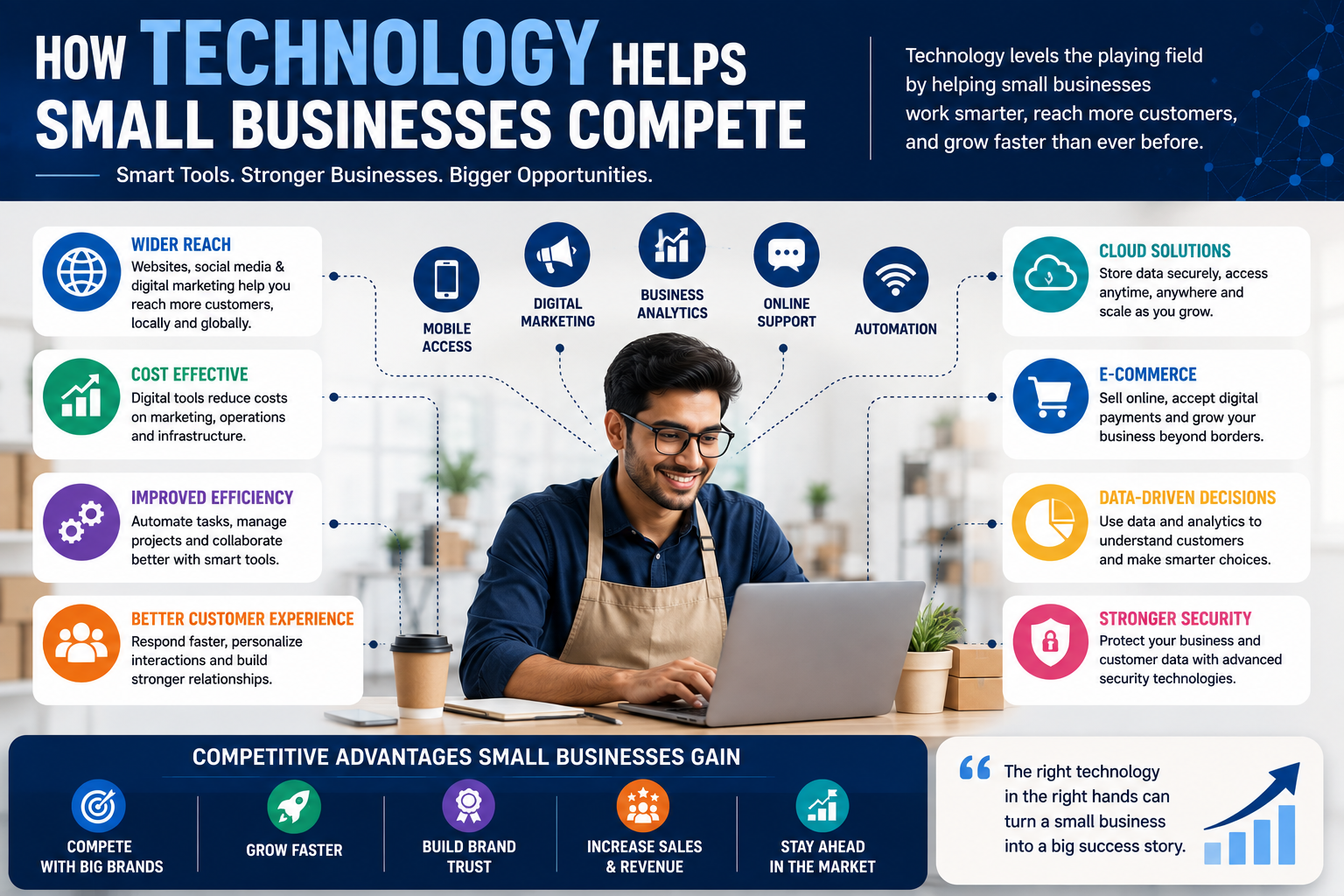
Technology Levels the Competitive Playing Field
One of the most significant impacts of technology is that it can reduce certain barriers between small and large businesses.
A small company can use:
Website + SEO + Social Media + CRM + Cloud Computing + Analytics + Automation
to build a sophisticated digital ecosystem without necessarily having a large internal IT department.
This does not mean technology eliminates the advantages of large organizations.
Large companies may still have greater budgets, larger teams, and stronger resources.
However, technology gives small businesses tools to compete more effectively.
How Small Businesses Can Start Using Technology
Businesses do not need to transform everything at once.
A practical approach is to begin with the most important business challenges.
Step 1: Identify Problems
Ask:
What tasks consume too much time?
Where are customers experiencing difficulties?
Which processes are repetitive?
Where are employees losing productivity?
What information is difficult to track?
Step 2: Set Clear Goals
Examples include:
Increase online leads
Reduce administrative work
Improve customer service
Increase sales
Improve productivity
Expand into new markets
Step 3: Choose Appropriate Tools
Select technology that directly supports those objectives.
Step 4: Train Employees
Technology is only useful when employees understand how to use it.
Step 5: Measure Results
Track whether the technology is producing meaningful improvements.
Step 6: Scale Gradually
Once a system works, businesses can expand their technology ecosystem.
Common Technology Mistakes Small Businesses Should Avoid
Adopting Too Many Tools
Using too many platforms can create complexity.
Businesses should focus on tools that provide clear value.
Choosing Technology Without a Strategy
Technology should support business goals rather than exist simply because it is popular.
Ignoring Cybersecurity
Every digital system requires appropriate security measures.
Failing to Train Employees
Employees may struggle with new systems without proper training.
Not Measuring ROI
Businesses should evaluate whether technology is improving revenue, productivity, efficiency, customer satisfaction, or other relevant outcomes.
The Role of Skilled Professionals in Technology Adoption
Technology alone does not create business success.
People are equally important.
A business may purchase advanced software, but without employees who understand how to use it, much of its potential may remain unused.
This is why skill development and technology adoption must work together.
Employees may need training in:
Digital marketing
Data analytics
Cloud computing
Cybersecurity
Software tools
Communication platforms
AI tools
Project management
Businesses that invest in both technology and people are better positioned to achieve sustainable digital growth.
How SAC Management India Pvt. Ltd. Can Support Small Businesses
For small businesses, adopting technology can sometimes be challenging because they may not have dedicated technology teams.
This is where professional technology, digital, and skill-development support can become valuable.
SAC Management India Pvt. Ltd., as a parent organization working across skills, technology, employment, and business growth, can support organizations looking to strengthen their digital capabilities.
Businesses can explore areas such as:
Website development
Software solutions
IT consulting
Digital marketing
Cloud and DevOps
Cybersecurity
Professional training
Skill development
Recruitment and talent solutions
The combination of technology, skilled professionals, and business-focused strategy can help organizations make better use of digital opportunities.
For small businesses in particular, the objective should not simply be to "go digital." The objective should be to use technology to solve real problems and create measurable business value.
Future of Technology for Small Businesses
Technology will continue to evolve rapidly.
Several developments are expected to influence small businesses significantly.
Artificial Intelligence
AI will become increasingly integrated into marketing, customer service, analytics, content creation, and business operations.
Cloud Computing
Cloud-based infrastructure and software will continue to support scalable business operations.
Automation
More repetitive business processes will become automated.
Data Analytics
Even small businesses will increasingly rely on data to understand customers and improve decision-making.
Cybersecurity
As digital dependence increases, businesses will need stronger security practices.
E-Commerce
Online selling will continue to create opportunities for businesses to reach customers beyond local markets.
Digital Customer Experience
Customers will increasingly expect fast, convenient, and personalized digital interactions.
Businesses that adapt to these developments while maintaining a strong focus on customer needs will be better positioned for long-term success.
Frequently Asked Questions
How does technology help small businesses compete?
Technology helps small businesses improve productivity, reach more customers, reduce certain operational costs, improve customer service, automate repetitive tasks, analyze data, and compete in digital markets.
What are the most important technologies for small businesses?
Important technologies include websites, cloud computing, CRM systems, digital marketing platforms, accounting software, analytics tools, communication platforms, cybersecurity solutions, automation tools, and e-commerce systems.
Can technology reduce the cost of running a small business?
Technology can reduce certain costs by automating repetitive tasks, enabling remote collaboration, reducing paperwork, improving efficiency, and providing scalable digital services. However, businesses should carefully evaluate technology expenses and usage.
Is digital marketing important for small businesses?
Yes. Digital marketing can help small businesses increase online visibility, reach targeted audiences, generate leads, build brand awareness, and communicate directly with customers.
How can small businesses use AI?
Small businesses can use AI for tasks such as content ideation, customer support, data analysis, workflow automation, research, and marketing assistance. Human oversight remains important.
Why is cloud computing useful for small businesses?
Cloud computing can provide flexible access to storage, software, computing resources, and infrastructure without requiring businesses to build and maintain extensive physical systems themselves.
Does every small business need a website?
For most modern businesses, a professional website is highly valuable because it provides customers with information about the business and can support marketing, lead generation, sales, and credibility.
Conclusion
Technology has fundamentally changed the way small businesses compete.
A business no longer needs a huge office, large marketing department, or extensive IT infrastructure to establish a strong presence in the market. With the right digital tools and strategy, even a small organization can reach customers beyond its local market, build a recognizable brand, improve productivity, provide excellent customer service, and make data-driven decisions.
From websites and SEO to cloud computing, CRM software, automation, artificial intelligence, cybersecurity, e-commerce, and digital marketing, technology provides small businesses with a wide range of opportunities.
However, successful technology adoption is not about using as many tools as possible. It is about choosing the right technologies for specific business needs.
A small business should first understand its challenges, define measurable goals, select appropriate solutions, train employees, and continuously evaluate results.
Most importantly, technology should work together with people.
Skilled employees, effective leadership, customer understanding, and strong business strategy remain essential. Technology simply provides the tools that can help those strengths operate more efficiently and at greater scale.
For small businesses looking toward the future, embracing technology is no longer simply an option. It is an opportunity to become more efficient, more visible, more responsive, and more competitive.
The businesses that learn to combine technology with human skills and customer-focused strategies will be better prepared to compete and grow in the digital economy.