Introduction
In today’s digital-first marketplace, your website is more than an online presence. It is a powerful business asset that can generate leads, build credibility, support customers, showcase products and services, and contribute directly to revenue growth.
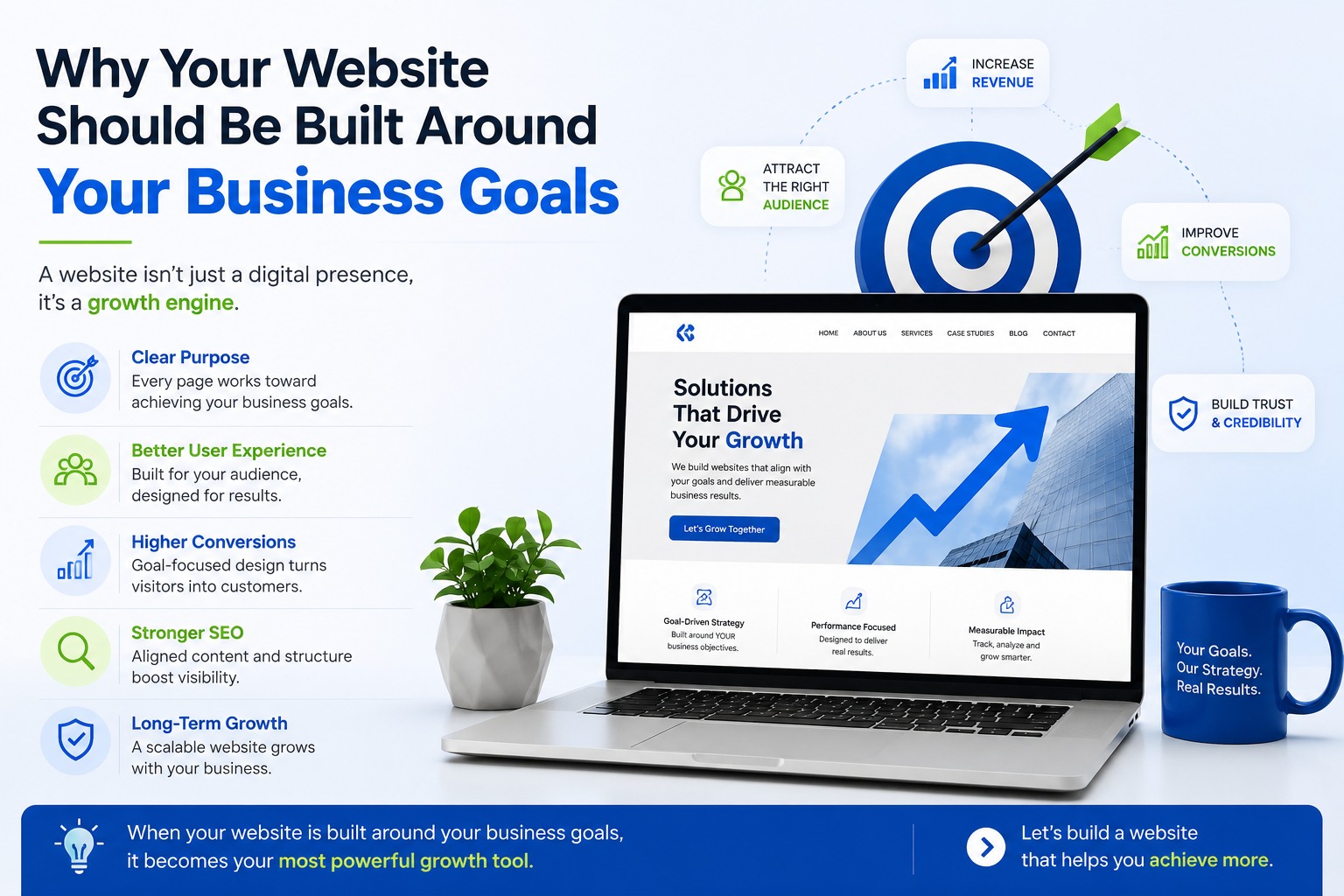
However, simply having a visually attractive website does not guarantee business success. A website can look modern and still fail to generate enquiries, convert visitors, or communicate the right message. The real difference comes from building your website around clearly defined business goals.
Whether your objective is to generate leads, increase online sales, improve brand visibility, provide customer support, or expand into new markets, your website should be designed and developed to support that objective.
1. Your Website Becomes a Business Tool, Not Just a Digital Brochure
Many businesses approach website development by focusing primarily on colours, layouts, animations and images. While these elements matter, they should support the bigger purpose of the website.
A goal-oriented website functions as an extension of your business strategy. Every page, feature and user journey should have a specific purpose.
For example, a service-based company may want more enquiries. Its website should therefore make services easy to understand, highlight expertise, display trust signals and provide strategically placed enquiry forms or calls to action.
An e-commerce business, on the other hand, may focus on increasing sales. Its website should prioritise product discovery, easy navigation, secure payments, fast checkout and a smooth shopping experience.
2. Start Development With Clear Business Objectives
Before development begins, businesses should identify what they want their website to achieve.
Some common goals include:
1.Generating qualified leads
2.Increasing online sales
3.Building brand awareness
4.Improving customer engagement
5.Promoting specific products or services
6.Supporting digital marketing campaigns
7.Providing self-service customer support
8.Expanding into new markets
Once these objectives are clear, developers and designers can create a website structure that aligns with them.
For example, if lead generation is the primary goal, the development strategy may include dedicated landing pages, enquiry forms, strong calls to action and CRM integrations.
3. Design the User Journey Around Your Target Audience
Your website should not only reflect what your business offers; it should also address what your customers need.
Understanding your target audience helps determine how information should be organised and how visitors should move through the website.
A potential customer should be able to quickly answer questions such as:
What does this business offer? Is it relevant to me? Why should I trust it? What should I do next?
Goal-driven web development creates a logical user journey from the first interaction to the desired action.
Whether that action is submitting a form, booking a consultation, purchasing a product or contacting the business, the journey should be simple and intuitive.
4. Choose Features Based on Business Requirements
Not every business needs the same website features. Adding unnecessary functionality can increase development costs and make a website more complicated to manage.
A business-focused approach helps identify which features actually contribute to growth. Depending on your objectives, your website may require:
1.Customer portals
2.Online booking systems
3.E-commerce functionality
4.Payment gateway integration
5.CRM integration
6.API integrations
7.Content management systems
8.Advanced search
9.Chat functionality
10.Analytics and reporting
11.Custom web applications
The goal should not be to add as many features as possible. Instead, businesses should invest in features that solve genuine problems and improve customer or operational outcomes.
5. Performance Should Support Business Growth
Website performance directly influences user experience. A slow or poorly optimised website can frustrate visitors and potentially result in lost opportunities.
Business-oriented development considers performance from the beginning. Developers can focus on efficient code, optimised images, responsive design, appropriate hosting infrastructure and other technical factors that contribute to faster loading and smoother experiences.
A high-performing website also provides a stronger foundation for digital marketing and search engine optimisation.
6. Build With SEO and Digital Marketing in Mind
A website should not operate separately from your marketing strategy.
If your goal is to increase organic traffic, SEO considerations should be incorporated during development rather than added as an afterthought.
This can include creating a logical site structure, implementing clean URLs, ensuring mobile responsiveness, improving page speed, using appropriate metadata and making content accessible to search engines.
Similarly, websites designed to support Google Ads, social media campaigns or content marketing should have dedicated landing pages and conversion-focused experiences.
7. Make Your Website Scalable
Business goals can change as a company grows. A website that works for a small business today may not be sufficient after expansion.
That is why scalability should be considered during development.
A scalable website architecture makes it easier to add new products, services, integrations, pages and functionalities in the future.
Instead of rebuilding the entire website whenever the business evolves, a well-planned development approach allows the platform to grow alongside the organisation.
8. Security and Reliability Are Business Priorities
Security isn't simply a technical concern. It is also a business requirement.
Customers expect businesses to protect their information and provide reliable digital experiences. Security vulnerabilities, downtime or data loss can damage both reputation and revenue.
Businesses should therefore consider secure development practices, regular updates, backups, access controls, SSL implementation and appropriate security measures based on their website's requirements.
9. Use Data to Measure Website Performance
A goal-oriented website should have measurable outcomes.
Analytics can help businesses understand how visitors interact with the website, which pages perform well, where users leave and which actions generate results.
For example, a lead-generation website can monitor enquiries, conversion rates and landing-page performance. An e-commerce website can track product views, cart activity, checkout behaviour and purchases.
These insights allow businesses to continuously improve their website instead of relying on assumptions.
10. Partner With the Right Web Development Team
Turning business goals into a successful digital platform requires more than coding skills. It requires an understanding of business objectives, customer behaviour, technology and digital performance.
This is where a professional web development partner can add value. At Softechedge, web development can be approached with a focus on creating solutions aligned with the specific needs and objectives of a business.
From custom websites and web applications to e-commerce solutions and integrations, the focus should be on developing digital experiences that support measurable business outcomes.
Conclusion
Your website should work for your business, not simply exist for your business.
When development starts with clear objectives, every component—from design and functionality to performance, SEO, security and analytics—can contribute towards a common purpose.
Whether you want more leads, higher sales, stronger customer engagement or a scalable digital platform, your website should be built around those goals from day one.
A successful website isn't defined only by how it looks. It is defined by how effectively it helps your business move forward.