Introduction
Searching for a job can often feel like a full-time task. Candidates may apply to dozens of openings every week, hoping that one of them will lead to an interview. But there is one common mistake that can reduce the effectiveness of this approach: sending the same resume, cover letter, and application message to every employer.
Applying for multiple jobs is completely fine. In fact, using a job portal can make the process faster and more efficient. The key is to avoid making every application look identical. A well-planned approach allows you to apply to several relevant positions while still showing employers why you are a suitable candidate.
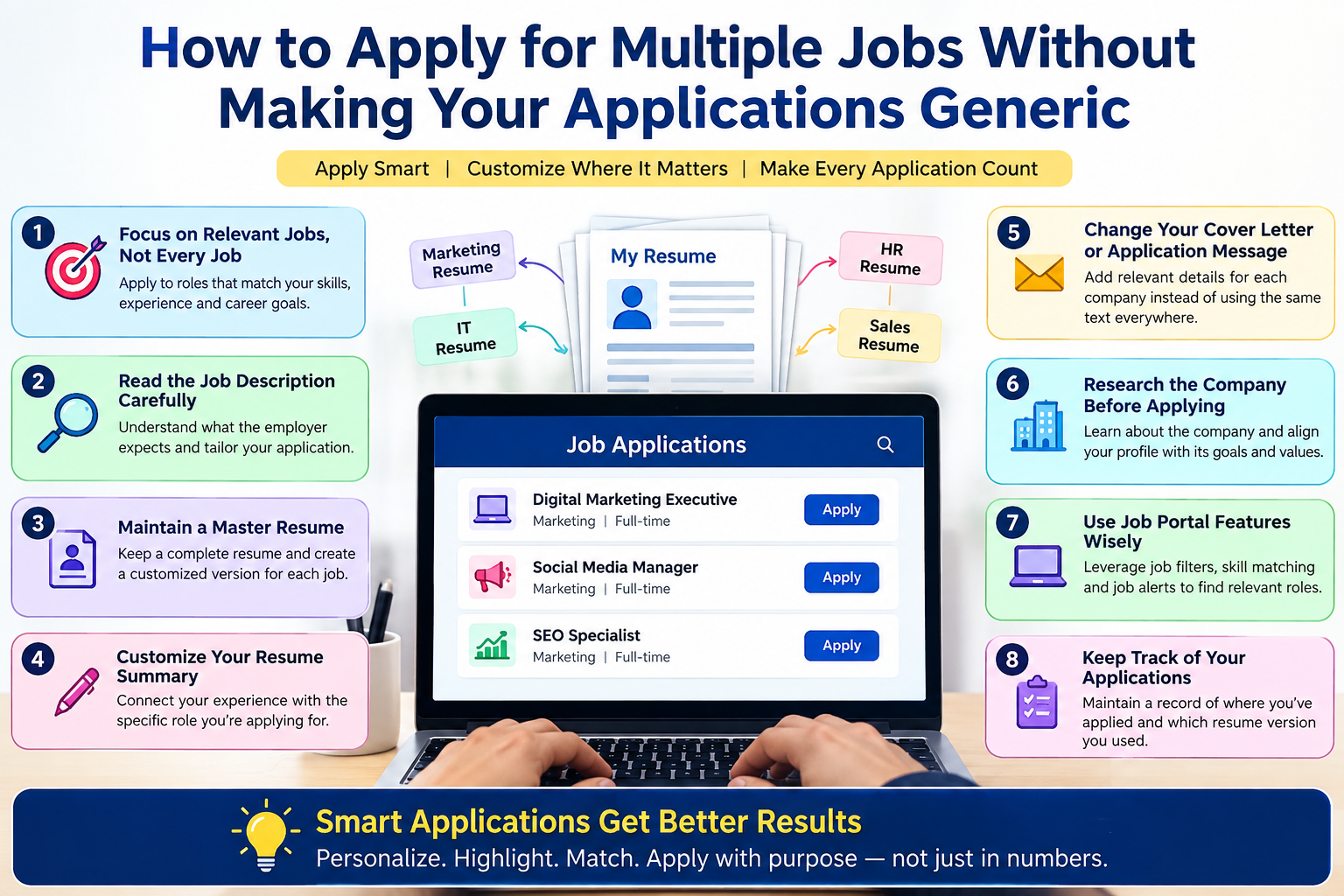
Focus on Relevant Jobs, Not Every Job
The first step is to avoid applying randomly. Sending applications to every vacancy you see can waste time and make your job search less effective.
Instead, identify positions that match your:
1.Skills
2.Educational background
3.Work experience
Career interests
Salary expectations
Preferred location
For example, if you are a digital marketing professional, applying for SEO, social media, content marketing, and performance marketing roles makes sense. However, applying for completely unrelated positions simply because they are available may not produce good results.
Quality applications are generally more valuable than a large number of irrelevant applications.
Read the Job Description Carefully
Before clicking the “Apply” button, spend a few minutes reading the job description.
Look for the skills, responsibilities, qualifications, and experience mentioned by the employer. These details tell you what the company actually wants from a candidate.
For example, a job description may specifically mention:
1.SEO and keyword research
2.Google Analytics
3.Social media management
4.Content creation
5.Campaign reporting
If you have these skills, your application should highlight them rather than simply saying, “I am a hardworking and motivated professional.”
Understanding the job description helps you make each application more relevant without rewriting everything from scratch.
Maintain a Master Resume
You don't need to create a completely new resume for every job application.
Instead, maintain a master resume containing your complete professional information, including your education, experience, skills, certifications, projects, achievements, and relevant responsibilities.
When you find a suitable vacancy, create a customized version using the master resume.
For instance, if a company is hiring for an SEO Executive, place your SEO-related experience and skills more prominently. If another company is hiring for a Social Media Executive, emphasize your social media campaigns, content creation, and analytics experience.
This approach saves time while keeping your resume targeted.
Customize Your Resume Summary
Your professional summary is one of the easiest sections to personalize.
Instead of using the same generic introduction everywhere, connect your experience with the specific role.
For example:
Generic:
“Motivated marketing professional with excellent communication and teamwork skills.”
More targeted:
“Digital marketing professional with experience in SEO, content strategy, and performance tracking, seeking to contribute to data-driven marketing campaigns.”
The second version immediately tells the recruiter why your profile is relevant to the position.
Match Your Skills With the Job
Recruiters often scan resumes quickly. Make it easy for them to identify your relevant skills.
If a job requires Python, Django, REST APIs, and SQL, and you have experience with those technologies, make sure they are clearly visible in your skills or experience sections.
However, never add skills you don't actually possess just to match a job description.
The goal is not to manipulate your application. The goal is to present your genuine qualifications in a way that matches the employer's requirements.
Change Your Cover Letter or Application Message
If the employer asks for a cover letter or introductory message, avoid sending the same text to every company.
You don't need to write a completely new letter every time. A simple structure can be customized quickly:
1.Mention the position you're applying for.
2.Highlight your most relevant experience.
3.Connect your skills to the company's requirements.
4.Explain why you are interested in the opportunity.
5.End with a professional call to action.
Even changing a few relevant details can make the application feel more intentional and professional.
Research the Company Before Applying
A few minutes of company research can make your application much stronger.
Visit the company's website, understand its products or services, and learn about the role you're applying for. If the company emphasizes innovation, customer experience, sustainability, technology, or another specific area, consider how your experience relates to that focus.
This information can also help you answer application questions and prepare for interviews.
Use Job Portal Features Wisely
Modern job portals can make the application process considerably easier. Instead of manually searching through countless websites, candidates can use features such as job filters, skill-based searches, location preferences, profile matching, and job alerts.
Platforms such as Jobsglint can help candidates discover opportunities that are more aligned with their profiles and career goals.
The important thing is to use these features as a smart job-search system, rather than simply applying to every recommendation without checking the details.
Keep Track of Your Applications
When you apply for several jobs, it is easy to forget which company received which version of your resume. This helps you stay organized and ensures that you don't accidentally send the wrong application to a recruiter.
Don't Over-Customize Everything
Customization doesn't mean spending an hour on every application.
The objective is to create a repeatable process.
You can divide your job search into categories and maintain different resume versions, such as:
Marketing Resume
HR Resume
IT Resume
Sales Resume
Fresher Resume
Then make small adjustments according to each vacancy.
This approach gives you the best of both worlds: speed and personalization.
Focus on Your Value, Not Just Your Need for a Job
One of the biggest differences between a generic and a strong application is the way the candidate communicates their value.
Instead of repeatedly saying:
“I am looking for an opportunity to grow my career.”
Show the employer what you can contribute.
For example, mention how you improved website traffic, managed recruitment processes, increased sales leads, developed applications, handled customer relationships, or completed relevant projects.
Specific achievements make an application more memorable than generic statements.
Apply Smart, Not Just More
Applying for multiple jobs doesn't mean sending the same application to 100 companies.
A smarter strategy is to identify relevant opportunities, understand what each employer needs, and make small but meaningful adjustments to your application.
Your objective should be simple: make the recruiter feel that you applied for this particular role—not that you sent the same resume to everyone.
Conclusion
A successful job search requires more than simply increasing the number of applications. When candidates personalize their resumes, highlight relevant skills, understand job descriptions, research companies, and keep track of applications, they can apply to multiple opportunities without making their profiles look generic.
Job portals can simplify this process by helping candidates discover relevant openings and manage their job search more efficiently. With the right strategy, you don't have to choose between applying quickly and applying thoughtfully.
Apply more strategically. Customize where it matters. Let your skills speak for you—and make every application count with Jobsglint.