Introduction
Technology has become an essential part of modern business. Whether a company is a startup, small business, growing enterprise, or established organization, digital tools can improve the way it communicates, manages operations, serves customers, markets its products, and makes decisions.
In the past, businesses could manage many activities through paperwork, spreadsheets, physical meetings, and traditional communication methods. Today, customers expect faster responses, seamless online experiences, secure transactions, personalized communication, and convenient digital services. Businesses that fail to adapt to these expectations can quickly fall behind competitors.
This is where digital tools for business become important.
Digital tools include software, platforms, applications, cloud-based systems, communication solutions, analytics platforms, cybersecurity tools, project management software, customer relationship management systems, and many other technologies that help organizations work more efficiently.
However, businesses do not need to adopt every new technology available. The goal should be to identify the tools that solve real business problems and contribute to productivity, customer satisfaction, security, and growth.
For example, a small business may need a professional website, accounting software, cloud storage, social media management tools, and customer relationship management software. A larger organization may require enterprise resource planning, advanced analytics, cybersecurity systems, collaboration platforms, automation, and cloud infrastructure.
The right combination depends on the organization's size, industry, goals, budget, and operational requirements.
In this comprehensive guide, we will explore the essential digital tools every business needs, how these tools can improve business performance, and how organizations can create an effective digital technology ecosystem.
What Are Digital Tools for Business?
Digital business tools are technology-based solutions that help organizations perform tasks more efficiently.
They can support almost every area of business, including:
- Communication
- Project management
- Marketing
- Sales
- Customer service
- Accounting
- Human resources
- Recruitment
- Data analysis
- Cybersecurity
- Document management
- Website management
- Cloud computing
- Business automation
Digital tools can be installed on computers and mobile devices or accessed through cloud-based platforms.
The major advantage of modern cloud-based business tools is accessibility. Employees can often access information and collaborate from different locations, making remote and hybrid work more practical.
Why Every Business Needs Digital Tools
Digital tools are no longer simply an advantage. For many businesses, they have become an essential part of day-to-day operations.
1. Improve Business Productivity
One of the biggest benefits of digital tools is increased productivity.
Employees can use technology to automate repetitive tasks, organize information, communicate quickly, and manage multiple responsibilities more effectively.
For example, instead of manually sending individual reminders, businesses can use automation tools to schedule emails or notifications.
Instead of maintaining physical documents, teams can use cloud storage and digital document management systems.
These improvements save time and allow employees to focus on higher-value activities.
2. Improve Communication
Effective communication is critical for business success.
Modern businesses often have employees, customers, vendors, and partners in different locations. Digital communication tools make it easier to stay connected.
Businesses can use:
- Email platforms
- Video conferencing
- Instant messaging
- Team collaboration platforms
- Project communication tools
- Digital calendars
These tools allow teams to communicate quickly and maintain better coordination.
3. Reduce Operational Costs
Digital technology can reduce expenses by automating processes and reducing the need for manual work.
For example:
- Digital documents reduce printing costs.
- Cloud storage reduces physical storage requirements.
- Online meetings can reduce travel expenses.
- Automated marketing reduces repetitive manual tasks.
- Digital accounting can simplify financial processes.
Over time, these efficiencies can contribute significantly to business profitability.
4. Improve Customer Experience
Customers expect businesses to be accessible and responsive.
Digital tools can help businesses provide better customer experiences through:
- Online support
- Chatbots
- Customer relationship management
- Automated email communication
- Personalized marketing
- Online booking systems
- Self-service portals
A business that responds quickly and provides convenient digital experiences is more likely to build customer trust and loyalty.
5. Enable Data-Driven Decisions
Businesses generate enormous amounts of data every day.
This data can provide valuable insights into:
- Customer behavior
- Sales performance
- Marketing campaigns
- Website traffic
- Employee productivity
- Business expenses
- Product performance
Analytics tools help businesses turn raw information into actionable insights.
Instead of making decisions based entirely on assumptions, management can use data to identify trends and opportunities.
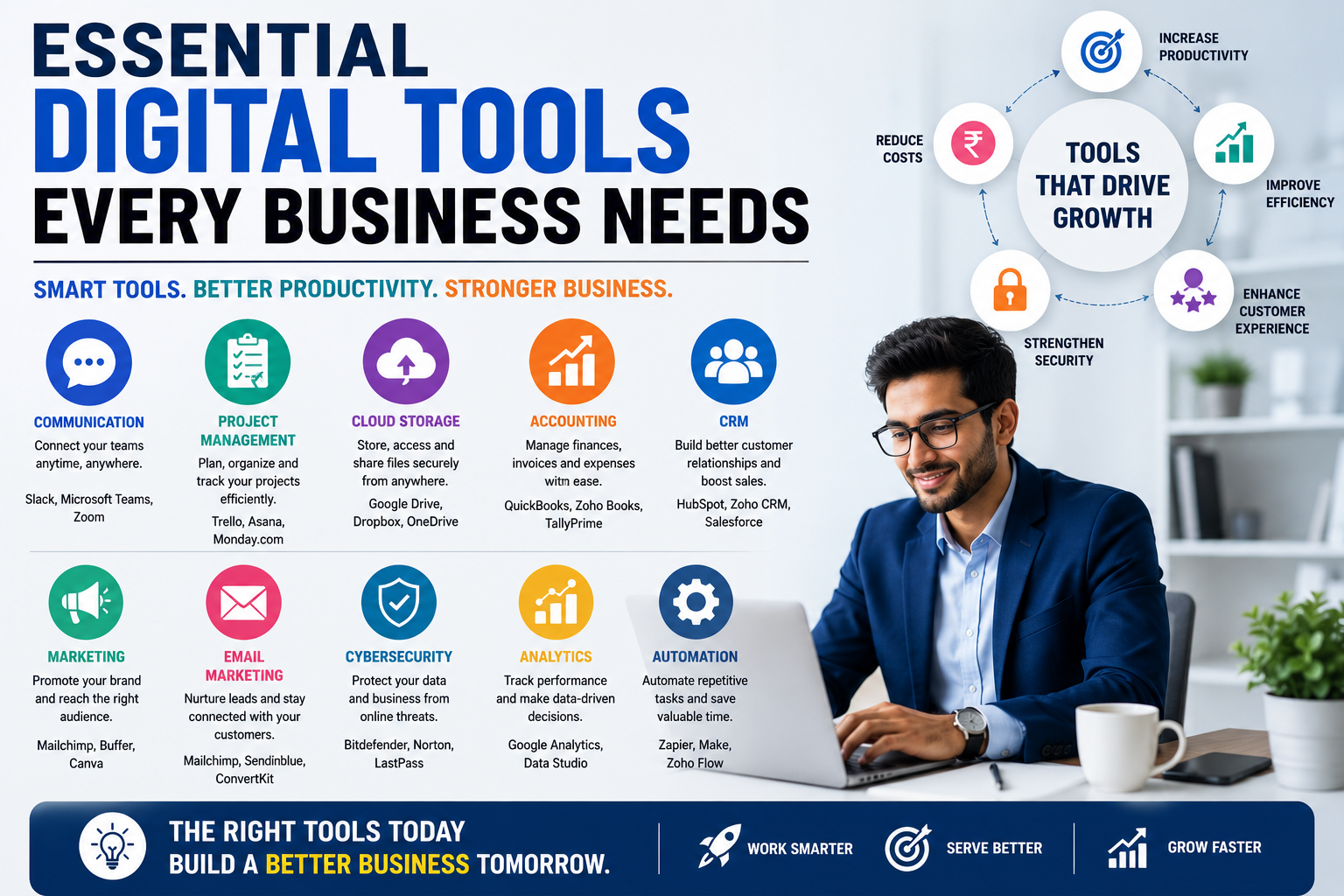
Essential Digital Tools Every Business Needs
Different organizations require different technology solutions, but several categories of digital tools are useful for almost every modern business.
1. Professional Website and Website Management Tools
A professional website is one of the most important digital assets for a business.
Customers often search online before contacting or purchasing from a company. A website provides a central location where customers can learn about:
- Products and services
- Company information
- Contact details
- Pricing
- Testimonials
- Case studies
- Blogs
- FAQs
A business website should be:
- Mobile-friendly
- Fast-loading
- Secure
- Easy to navigate
- Search-engine optimized
- Professionally designed
Website management tools and content management systems also allow businesses to update their online presence without making every change manually through a developer.
2. Customer Relationship Management (CRM) Software
CRM software helps businesses manage interactions with current and potential customers.
A CRM system can organize:
- Customer information
- Leads
- Sales opportunities
- Communication history
- Follow-ups
- Customer support requests
For businesses with sales teams, a CRM can make lead management much more organized.
Instead of keeping customer information across different spreadsheets or email conversations, teams can maintain information in one centralized system.
3. Project Management Tools
Managing projects becomes increasingly difficult as teams grow.
Project management software helps businesses organize tasks, deadlines, responsibilities, and project progress.
Common features include:
- Task management
- Project timelines
- Team assignments
- Deadlines
- Progress tracking
- File sharing
- Notifications
These tools can reduce confusion and improve accountability.
4. Communication and Collaboration Tools
Businesses need reliable tools for internal and external communication.
Digital collaboration platforms can support:
- Instant messaging
- Video meetings
- File sharing
- Team discussions
- Virtual presentations
- Group collaboration
These tools are particularly useful for remote and hybrid teams.
Effective digital communication can reduce delays and keep employees aligned with organizational goals.
5. Cloud Storage and Cloud Computing
Cloud technology has transformed business operations.
Cloud storage allows organizations to store files securely online and access them from different devices.
Benefits include:
- Remote access
- Easy collaboration
- Data backup
- Scalability
- Reduced infrastructure requirements
Cloud computing can also provide businesses with access to computing resources, applications, databases, and infrastructure without requiring all systems to be physically maintained within the organization's office.
6. Accounting and Financial Management Software
Financial management is essential for every business.
Accounting tools can help organizations manage:
- Invoices
- Expenses
- Payments
- Financial reports
- Tax-related records
- Payroll
- Cash flow
Digital accounting reduces manual calculations and helps businesses maintain better financial records.
For growing businesses, financial management software can also provide management with a clearer view of profitability and cash flow.
7. Digital Marketing Tools
A strong online presence requires more than a website.
Businesses can use digital marketing tools to manage:
- SEO
- Social media
- Email marketing
- Content marketing
- Online advertising
- Analytics
- Lead generation
Digital marketing tools allow companies to reach specific audiences and measure campaign performance.
For example, businesses can determine which campaigns generate the most traffic, leads, or conversions and adjust their strategies accordingly.
8. Search Engine Optimization Tools
SEO tools help businesses understand how their websites perform in search engines.
They can assist with:
- Keyword research
- Competitor analysis
- Website audits
- Backlink analysis
- Search performance
- Content optimization
SEO is particularly valuable for businesses that want to generate long-term organic traffic.
A strong SEO strategy can help potential customers discover a business when searching for relevant products or services.
9. Social Media Management Tools
Managing multiple social media platforms manually can be time-consuming.
Social media management tools can help businesses:
- Schedule posts
- Manage content calendars
- Monitor engagement
- Track performance
- Respond to messages
- Analyze audience behavior
These tools help businesses maintain consistency while saving time.
However, automation should not replace genuine interaction. Businesses should continue responding to customers and participating in conversations.
10. Email Marketing Tools
Email remains an important communication and marketing channel.
Businesses can use email marketing platforms to send:
- Newsletters
- Product announcements
- Offers
- Educational content
- Event invitations
- Customer updates
Email automation can also help businesses nurture leads and maintain relationships with existing customers.
11. Business Analytics Tools
Analytics tools provide valuable information about business performance.
Website analytics can reveal:
- Number of visitors
- Traffic sources
- Popular pages
- User behavior
- Conversion rates
Marketing analytics can show which campaigns generate the best results.
Business analytics can help management identify patterns and make more informed decisions.
12. Cybersecurity Tools
As businesses become more digital, cybersecurity becomes increasingly important.
Businesses store sensitive information such as:
- Customer details
- Financial records
- Employee information
- Business documents
- Login credentials
- Intellectual property
Cybersecurity tools can help protect systems against unauthorized access, malware, phishing, data theft, and other threats.
Important cybersecurity practices include:
- Strong passwords
- Multi-factor authentication
- Regular software updates
- Secure backups
- Employee security training
- Endpoint protection
- Access management
Cybersecurity should be considered an ongoing business responsibility rather than a one-time investment.
13. Human Resource and Recruitment Tools
Human resources departments can also benefit significantly from digital technology.
HR tools can help manage:
- Employee records
- Attendance
- Leave
- Payroll
- Recruitment
- Performance management
- Training
- Employee communication
Recruitment technology can also help businesses manage job applications and identify suitable candidates more efficiently.
For growing organizations, digital HR solutions can reduce administrative work and improve employee management.
14. Productivity and Automation Tools
Automation is one of the most valuable applications of modern technology.
Businesses can automate repetitive processes such as:
- Email notifications
- Appointment reminders
- Data entry
- Lead follow-ups
- Reports
- Customer responses
- Social media scheduling
Automation does not necessarily mean replacing employees. Instead, it can reduce repetitive work and allow employees to spend more time on strategic and creative activities.
15. Document Management Tools
Businesses handle large amounts of documentation every day.
Digital document management tools can help organizations:
- Store files
- Organize documents
- Search information
- Control access
- Track versions
- Share documents
This reduces dependence on physical paperwork and makes information easier to retrieve.
How to Choose the Right Digital Tools for Your Business
With thousands of digital products available, choosing the right tools can be challenging.
Businesses should not select software simply because it is popular.
Instead, consider the following factors.
Identify Your Business Needs
Start by identifying the problems you want technology to solve.
Ask:
- What tasks consume the most time?
- Where do communication problems occur?
- Which processes are repetitive?
- Where are customers experiencing difficulties?
- What information is difficult to track?
Once these challenges are identified, businesses can search for appropriate solutions.
Consider Your Budget
Digital tools are available at different price points.
Startups and small businesses should prioritize tools that provide the highest value for their investment.
It is often better to use a small number of effective tools than to pay for dozens of platforms that employees rarely use.
Check Scalability
The tool should be able to grow with the business.
A solution that works for five employees may not be suitable when the organization has fifty or five hundred employees.
Scalability is particularly important for startups and rapidly growing businesses.
Consider Integration
Business tools should ideally work together.
For example, CRM software should integrate with marketing platforms, email systems, and analytics tools where appropriate.
Integration reduces duplicate data entry and improves workflow efficiency.
Prioritize Security
Security should never be ignored when selecting business software.
Businesses should evaluate:
- Data protection
- Access controls
- Authentication
- Backup systems
- Privacy practices
- Security certifications where relevant
Digital Tools for Small Businesses
Small businesses often operate with limited budgets and teams.
Therefore, technology should focus on simplicity and efficiency.
A small business may benefit from a digital ecosystem consisting of:
Professional Website → CRM → Accounting → Cloud Storage → Communication → Marketing → Analytics
This combination can cover many essential business requirements without creating unnecessary complexity.
Small businesses should gradually add new tools as their operations expand.
Digital Tools for Startups
Startups need technology that supports rapid experimentation and growth.
Useful categories include:
- Cloud computing
- Project management
- CRM
- Digital marketing
- Analytics
- Collaboration
- Accounting
- Cybersecurity
- Automation
Startups should avoid investing heavily in complicated systems before understanding their actual requirements.
A scalable and flexible technology foundation allows startups to adapt as their customer base and operations grow.
The Role of Artificial Intelligence in Business Tools
Artificial Intelligence is becoming increasingly integrated into business software.
AI-powered tools can assist with:
- Content creation
- Data analysis
- Customer support
- Document processing
- Personalization
- Forecasting
- Marketing optimization
- Workflow automation
However, businesses should use AI responsibly.
Human oversight remains important, particularly when dealing with sensitive information, important business decisions, customers, and employees.
The best approach is often to use AI as a productivity and decision-support tool rather than relying on it blindly.
Benefits of Digital Transformation for Businesses
Digital tools are individual solutions, while digital transformation is a broader process of integrating technology into business operations and strategy.
A successful digital transformation can help businesses achieve:
Greater Productivity
Employees spend less time on repetitive processes.
Better Customer Experience
Customers receive faster and more convenient services.
Improved Decision-Making
Managers can use real-time information and analytics.
Greater Flexibility
Cloud technology supports remote and hybrid work.
Increased Scalability
Digital systems can often expand as business requirements grow.
Stronger Competitive Advantage
Businesses that use technology effectively can respond faster to market changes.
Common Mistakes Businesses Make When Adopting Digital Tools
Using Too Many Tools
More technology does not always mean better performance.
Too many platforms can create confusion.
Ignoring Employee Training
Employees need proper training to use new systems effectively.
Choosing Tools Without a Strategy
Technology should solve business problems rather than exist simply because competitors use it.
Ignoring Cybersecurity
Every new digital system can introduce potential security considerations.
Failing to Measure Results
Businesses should evaluate whether a tool actually improves productivity, customer experience, or profitability.
How SAC Management India Pvt. Ltd. Can Support Digital Business Growth
Digital transformation requires more than purchasing software. Businesses need the right technology strategy, implementation approach, skilled professionals, and ongoing support.
SAC Management India Pvt. Ltd. operates as a parent organization bringing together solutions across skills, technology, employment, and business growth.
Through its specialized verticals, SAC can support organizations in areas connected to modern business requirements, including technology solutions, digital growth, skill development, and recruitment.
Businesses can benefit from solutions related to:
- Website and software development
- IT consulting
- Digital transformation
- Digital marketing
- Skill development
- Professional training
- Recruitment and talent solutions
The combination of technology and skilled human resources is increasingly important for businesses seeking sustainable growth.
Digital tools provide the infrastructure, while skilled professionals provide the creativity, strategy, and expertise needed to use that infrastructure effectively.
Future of Digital Tools for Business
The future of business technology will be shaped by several major developments.
Artificial Intelligence
AI will increasingly become part of everyday business applications.
Automation
More repetitive processes will become automated.
Cloud Technology
Cloud-based systems will continue supporting flexible and scalable operations.
Data Analytics
Businesses will increasingly rely on data to understand customers and make strategic decisions.
Cybersecurity
As digital dependence increases, businesses will need stronger security practices.
Digital Customer Experience
Customers will expect increasingly personalized and convenient digital interactions.
Organizations that continuously adapt to these changes will be better positioned to compete.
Frequently Asked Questions
1. What are the most essential digital tools for a business?
The most important categories include professional website tools, CRM software, project management, cloud storage, accounting software, communication platforms, digital marketing tools, analytics, and cybersecurity solutions.
2. Do small businesses need digital tools?
Yes. Digital tools can help small businesses save time, improve customer service, reduce manual work, and compete more effectively.
3. How do digital tools improve business productivity?
They automate repetitive tasks, organize information, improve communication, simplify collaboration, and provide better access to business data.
4. Are digital tools expensive?
Not necessarily. Many tools offer affordable plans or free versions. Businesses should select solutions based on their actual needs and expected return on investment.
5. How can businesses choose the right digital tools?
Businesses should evaluate their needs, budget, scalability, security, integrations, ease of use, and expected business value before selecting a tool.
6. Why is cybersecurity important for digital businesses?
Digital businesses store valuable information online. Cybersecurity helps protect business systems, customer information, financial data, and intellectual property from potential threats.
7. What is digital transformation?
Digital transformation is the broader process of using digital technologies to improve business operations, customer experiences, decision-making, and overall business strategy.
Conclusion
Digital technology has changed the way modern businesses operate. From communication and marketing to accounting, recruitment, customer service, analytics, and cybersecurity, digital tools now influence almost every aspect of business management.
The essential digital tools every business needs will vary depending on its size, industry, objectives, and customers. However, a professional website, CRM system, cloud storage, communication platform, accounting solution, marketing tools, analytics, project management software, and cybersecurity measures provide a strong foundation for most organizations.
The key is not to adopt technology simply because it is new or popular. Businesses should identify their challenges first and then select tools that solve those challenges efficiently.
Technology is most valuable when it improves productivity, strengthens customer relationships, supports employees, reduces unnecessary costs, and contributes to measurable business outcomes.
For startups and small businesses, digital tools can create opportunities to compete with larger organizations without requiring enormous infrastructure. For established companies, technology can improve efficiency, support digital transformation, and create new avenues for growth.
The future of business will increasingly depend on the ability to combine technology, data, skilled people, and strategic thinking. Artificial intelligence, automation, cloud computing, analytics, and cybersecurity will continue to evolve, but businesses that focus on customer needs and practical outcomes will remain best positioned for success.
Ultimately, digital tools are not a replacement for good business strategy. They are the infrastructure that helps a good strategy become more efficient, scalable, measurable, and effective.
For organizations looking to strengthen their digital capabilities, investing in the right tools today can create a stronger foundation for tomorrow's growth.