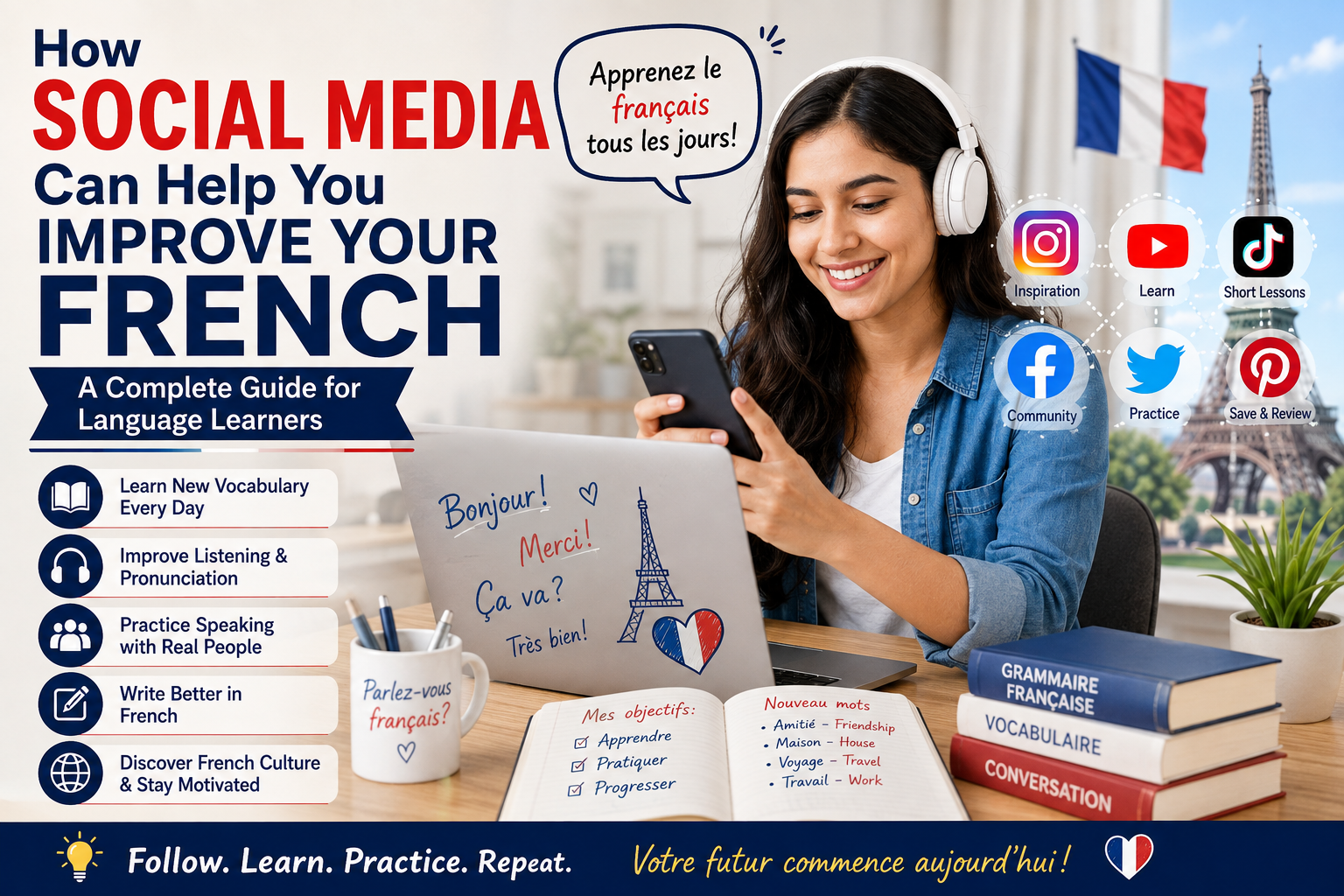
Learning a new language requires more than memorizing vocabulary and studying grammar rules. To become confident in French, learners need regular exposure to the language, opportunities to listen to native speakers, and consistent practice. Fortunately, technology has made language learning more accessible than ever before. One of the easiest and most engaging ways to practice French every day is through social media.
Platforms such as Instagram, YouTube, Facebook, TikTok, LinkedIn, Reddit, and podcasts integrated with social platforms provide learners with access to French-speaking creators, teachers, communities, videos, conversations, and educational content. Instead of treating social media only as entertainment, students can use it as a practical tool to develop their French vocabulary, pronunciation, listening, speaking, reading, and writing skills.
For students and professionals learning French in India, social media can be particularly useful because it provides regular exposure to authentic French without requiring travel to a French-speaking country.
This guide explains how social media can help you improve your French, which platforms you can use, what type of content you should follow, and how to create an effective French-learning routine using social media.
Why Use Social Media to Learn French?
Traditional language learning often involves textbooks, classroom lessons, grammar exercises, and vocabulary lists. These methods are useful, but learners sometimes struggle to connect classroom French with real-world communication.
Social media fills this gap by exposing learners to French as it is actually used in everyday life.
Through social media, you can hear:
- Native French pronunciation
- Everyday expressions
- Informal conversations
- Different accents
- Current vocabulary
- French slang
- Business French
- Travel-related language
- Cultural references
- Different speaking speeds
This regular exposure can make French feel less like a subject and more like a language you actually use.
The key is to use social media actively rather than passively.
Simply watching French videos may improve listening familiarity, but actively repeating phrases, writing down vocabulary, speaking along with videos, and participating in conversations can make the experience much more effective.
1. Instagram Can Help You Learn French Every Day
Instagram is one of the easiest platforms to incorporate into your daily French-learning routine.
You can follow French teachers, language-learning accounts, French news pages, travel creators, food bloggers, musicians, businesses, and native French speakers.
Short-form content is particularly useful for beginners because it allows you to learn small amounts of French without feeling overwhelmed.
For example, you can follow accounts that teach:
- French vocabulary
- Common French phrases
- French pronunciation
- Grammar tips
- Everyday expressions
- French culture
- Business French
- French pronunciation challenges
How to Use Instagram Effectively
Instead of scrolling randomly, create a dedicated French-learning environment.
Follow relevant French-language accounts and interact with their content.
When you come across a new word:
- Read the word.
- Listen to its pronunciation.
- Write down its meaning.
- Create a sentence using it.
- Say the sentence aloud.
For example:
Voyage = Travel
You could create:
J'aime voyager.
"I like travelling."
This simple process turns social media scrolling into active learning.
2. YouTube Is Excellent for French Listening Practice
YouTube can be one of the most powerful resources for improving French.
Unlike short social media posts, YouTube provides longer videos that allow learners to hear French conversations in context.
You can find videos about:
- French grammar
- Pronunciation
- French interviews
- Travel
- Cooking
- News
- French culture
- Movies and entertainment
- Daily life in France
- Business
- History
- Language lessons
Beginners can start with videos designed specifically for French learners.
As their skills improve, they can gradually move toward content created primarily for native French speakers.
Use French Subtitles
One effective technique is to watch French videos with French subtitles.
Avoid relying on English subtitles all the time.
When you hear:
"Je vais au marché demain."
and see the same sentence written on screen, your brain connects:
Sound + spelling + meaning.
This can improve listening and vocabulary recognition.
3. TikTok Can Make French Learning Fun
TikTok and other short-video platforms can be useful for quick language practice.
Short videos are ideal for learning:
- Slang
- Pronunciation
- Everyday phrases
- Common mistakes
- Vocabulary
- Cultural expressions
- Informal French
For example, a creator might explain the difference between formal and informal expressions.
You might learn:
Bonjour – Hello / Good morning
Salut – Hi / Bye
Understanding these differences helps you communicate more naturally.
However, learners should remember that slang and informal expressions are not always appropriate in professional situations.
Learn them for comprehension, but understand when and where they should be used.
4. Social Media Helps Improve French Vocabulary
Vocabulary is one of the most important parts of language learning.
Many learners memorize lists of words but forget them because they rarely encounter those words in real situations.
Social media provides repeated exposure.
Suppose you learn the word:
Travail – Work
Then you see it several times in different posts:
Je vais au travail.
Le travail est important.
Je cherche un nouveau travail.
Seeing the same word in multiple contexts makes it easier to remember.
You can maintain a digital French vocabulary notebook and add useful words whenever you encounter them.
Try organizing vocabulary into categories such as:
Daily Life
- Maison – House
- Nourriture – Food
- École – School
- Travail – Work
Travel
- Hôtel – Hotel
- Gare – Station
- Billet – Ticket
- Voyage – Trip
Business
- Réunion – Meeting
- Client – Client
- Entreprise – Company
- Contrat – Contract
Context-based vocabulary is generally more useful than memorizing random words.
5. Social Media Can Improve Your French Pronunciation
French pronunciation can be challenging for beginners.
Some French sounds do not exist in the same way in English or Indian languages.
Social media gives learners access to native pronunciation demonstrations.
When watching a French-speaking creator, don't just listen.
Repeat what they say.
This technique is often called shadowing.
What Is Shadowing?
Shadowing involves listening to a speaker and repeating the words immediately or shortly after hearing them.
For example:
Speaker:
"Bonjour, comment allez-vous?"
You repeat:
"Bonjour, comment allez-vous?"
Try to copy:
- Pronunciation
- Rhythm
- Intonation
- Speed
- Word connections
Regular practice can gradually make your French sound more natural.
6. Follow French-Speaking Creators
One of the best ways to improve your French naturally is to follow people who actually speak French.
You can follow creators based on your interests.
For example:
Interested in travel? Follow French travel creators.
Interested in food? Follow French chefs and food bloggers.
Interested in fashion? Follow French fashion creators.
Interested in business? Follow French-speaking entrepreneurs and professionals.
Interested in entertainment? Follow French actors, musicians, and creators.
When you learn through subjects you already enjoy, language practice becomes less boring.
7. Learn French Through French News
Social media can also help intermediate and advanced learners improve their French by following French-language news.
News content introduces learners to:
- Formal vocabulary
- Current events
- Professional language
- Complex sentence structures
- Different accents
- More advanced grammar
Beginners may find news difficult initially, so start with short clips or simplified French news.
As your comprehension improves, gradually increase the difficulty.
This approach can be particularly useful for students preparing for higher French proficiency levels.
8. Join French-Learning Communities
Language learning does not have to happen alone.
Social media platforms have communities where learners can communicate with others who are studying French.
These communities can help you:
- Ask questions
- Share learning resources
- Practice writing
- Find conversation partners
- Discuss grammar
- Exchange learning tips
- Stay motivated
Interacting with other learners also reminds you that making mistakes is a normal part of language learning.
9. Use Facebook Groups for French Practice
Facebook groups can be useful for structured community interaction.
You can find communities dedicated to:
- French learners
- French grammar
- French conversation
- French culture
- DELF preparation
- French vocabulary
- French-speaking communities
Participate actively instead of simply reading posts.
For example, if someone asks:
"What did you do today?"
Try answering in French.
Even a simple response such as:
"Aujourd'hui, j'ai étudié le français."
can give you writing practice.
10. Use LinkedIn to Learn Professional French
For professionals, LinkedIn can be an interesting source of French-language content.
Follow French-speaking:
- Companies
- Recruiters
- Business professionals
- Entrepreneurs
- Industry experts
- Universities
- Organizations
Reading professional posts can help you learn business vocabulary.
For example:
Entreprise – Company
Carrière – Career
Emploi – Employment/Job
Compétences – Skills
Expérience professionnelle – Professional experience
This can be particularly valuable for people learning French for international careers.
11. Listen to French Podcasts and Short Audio Content
Listening is critical for language development.
Social platforms and podcast services offer French audio content covering almost every subject.
You can listen while:
- Travelling
- Exercising
- Cooking
- Walking
- Commuting
- Taking a break
Start with slow and learner-friendly French.
Later, move to natural-speed conversations.
The goal is not to understand every single word.
Instead, focus on understanding the main idea.
With regular practice, your ability to recognize words and phrases will improve.
12. Use Social Media to Practice French Writing
Social media isn't only useful for listening.
It can also improve your writing.
Try writing:
- Comments
- Short posts
- Captions
- Replies
- Daily journal entries
- Questions
For example:
Aujourd'hui, je vais apprendre dix nouveaux mots français.
Writing short sentences regularly helps you become more comfortable constructing French sentences.
Don't worry about making mistakes.
Correct mistakes, learn from them, and try again.
13. Turn Your Social Media Feed Into a French Learning Tool
One of the easiest strategies is to change the content you consume.
If your social media feed contains almost entirely English or Hindi content, you will naturally have limited French exposure.
Start following French-language accounts.
Like and interact with French content.
Watch French videos.
Search French hashtags.
Over time, recommendation algorithms may show you more French-language content.
Your regular social media feed can gradually become an informal French-learning environment.
14. Learn French Through Hashtags
Hashtags can help learners discover relevant French content.
You can search for terms related to:
- French learning
- French vocabulary
- French grammar
- French pronunciation
- French culture
- French conversations
You can also search French-language hashtags connected to your interests.
For example, someone interested in food can search French food-related content rather than only searching for language lessons.
This allows you to learn French through subjects you enjoy.
15. Learn French Slang and Everyday Expressions
Textbooks often teach formal French.
Real conversations can include informal expressions that learners may not encounter in beginner courses.
Social media provides exposure to everyday expressions, abbreviations, and informal language.
For example, you may encounter:
Ça va? – How are you?
C'est cool! – That's cool!
À bientôt! – See you soon!
Learning these expressions can help you understand casual conversations.
However, remember to distinguish between:
Formal French and Informal French.
Use appropriate language depending on the situation.
16. Follow French Content Based on Your Level
Not every piece of French content is suitable for every learner.
Beginners
Focus on:
- Vocabulary videos
- Basic grammar
- Slow conversations
- Pronunciation lessons
- Simple captions
Intermediate Learners
Move toward:
- Interviews
- Travel videos
- Short news clips
- French podcasts
- Everyday conversations
Advanced Learners
Challenge yourself with:
- Native-level podcasts
- French news
- Debates
- Business discussions
- Films and documentaries
- Long-form interviews
This gradual progression prevents learners from becoming overwhelmed.
17. Use the 15-Minute French Social Media Method
You don't need to spend hours on social media to improve your French.
Try a simple 15-minute daily routine.
Minutes 1–5: Vocabulary
Watch a French vocabulary video and learn three to five new words.
Minutes 6–10: Listening
Watch a short French video without translating every sentence.
Minutes 11–13: Speaking
Repeat useful phrases aloud.
Minutes 14–15: Writing
Write two or three French sentences using what you learned.
Doing this consistently can be more useful than spending two hours scrolling through random content.
18. Don't Translate Everything
One common mistake among language learners is trying to translate every French sentence into English or Hindi.
Instead, try to understand meaning through:
- Context
- Images
- Facial expressions
- Situations
- Familiar vocabulary
For example, if a French creator is showing food and says:
"C'est délicieux!"
You may understand the meaning from the context even before memorizing the translation.
This encourages your brain to process French more naturally.
19. Social Media Can Help You Build Confidence
Many learners understand French but hesitate to speak because they are afraid of making mistakes.
Social media can provide low-pressure opportunities to practice.
Start with:
- Reading French posts.
- Liking French content.
- Writing short comments.
- Recording yourself speaking.
- Participating in language communities.
- Having conversations with language partners.
Confidence develops through practice.
You do not need perfect French before you start speaking French.
20. Avoid Common Social Media Language-Learning Mistakes
Although social media can be extremely useful, it should be used carefully.
Mistake 1: Following Too Many Accounts
You don't need hundreds of French-learning accounts.
Choose a small number of high-quality sources.
Mistake 2: Passive Scrolling
Watching videos without practicing does not maximize learning.
Repeat, write, speak, and review.
Mistake 3: Learning Only Slang
Slang can be fun, but learners also need proper grammar and formal vocabulary.
Mistake 4: Depending Completely on Subtitles
Use subtitles as support rather than depending on them permanently.
Mistake 5: Not Reviewing Vocabulary
Learning a word once is not enough.
Review it regularly.
Mistake 6: Comparing Your Progress With Others
Everyone learns at a different pace.
Focus on consistent improvement.
21. Combine Social Media With Structured French Training
Social media is an excellent supplementary learning tool, but it should not necessarily replace structured language education.
A structured French course can provide a systematic learning path covering:
- Grammar
- Vocabulary
- Pronunciation
- Speaking
- Listening
- Reading
- Writing
- Assessments
- Feedback
Social media can then provide additional real-world exposure.
Think of it this way:
French Course = Structured Foundation
Social Media = Daily Practice & Real-World Exposure
Combining both can create a more balanced learning experience.
22. How Skill Excellent Learners Can Use Social Media
For students learning French through Skill Excellent, social media can become an extension of classroom learning.
After a French class, students can spend a few minutes searching for French content related to the day's lesson.
For example, if today's lesson covers food vocabulary, watch French cooking videos.
If the lesson covers travel vocabulary, watch French travel content.
If the lesson covers business communication, follow French business creators.
This approach connects classroom knowledge with real-world language use.
23. A 7-Day Social Media French Learning Plan
Here's a simple weekly routine.
Monday – Vocabulary
Learn 10 new French words from short videos.
Tuesday – Pronunciation
Watch pronunciation content and repeat the words aloud.
Wednesday – Listening
Watch a French interview or short conversation.
Thursday – Grammar
Follow a French grammar lesson and create your own examples.
Friday – Speaking
Record yourself speaking French for two to five minutes.
Saturday – Culture
Watch French content about food, travel, music, history, or lifestyle.
Sunday – Review
Review the week's vocabulary and phrases.
This routine keeps French learning interesting and varied.
24. How Social Media Can Improve All Four French Skills
A successful French learner needs to develop four major skills:
Reading
Reading French captions, posts, comments, and articles improves vocabulary recognition.
Listening
French videos, interviews, podcasts, and audio clips improve listening comprehension.
Speaking
Repeating videos and participating in conversations improves pronunciation and confidence.
Writing
Writing comments, captions, and short posts improves sentence construction.
Therefore, social media can support almost every aspect of language learning.
The Importance of Consistency
The biggest advantage of social media is accessibility.
You don't need to wait for your next French class to practice.
You can practice French:
5 minutes in the morning.
10 minutes during lunch.
15 minutes in the evening.
The important thing is consistency.
Ten minutes of focused French practice every day can become a meaningful habit over time.
Instead of asking:
"How can I learn French quickly?"
ask:
"How can I practice French every day?"
That change in mindset can make language learning much more sustainable.
Conclusion: Make Social Media Your Daily French Practice Partner
Social media has transformed the way people communicate, discover information, and learn new skills. For French learners, it offers an opportunity to experience the language beyond textbooks and classrooms.
From Instagram vocabulary lessons and YouTube conversations to French podcasts, Facebook communities, TikTok pronunciation videos, and professional content on LinkedIn, there are countless ways to incorporate French into your daily routine.
The key is to use social media intentionally.
Follow useful French-language accounts. Watch French videos. Listen to native speakers. Learn new vocabulary. Repeat phrases aloud. Write comments. Join communities. And most importantly, practice consistently.
For students and professionals in India, combining structured French language training with daily social media exposure can be an effective way to build confidence and develop practical communication skills.
If you're learning French for career growth, higher education, travel, international business, or personal development, don't limit your learning to the classroom.
Make French a part of your everyday digital life.
Follow French. Listen to French. Speak French. Practice French. And gradually make French a natural part of your world.
Frequently Asked Questions (FAQs)
1. Can social media really help me learn French?
Yes. Social media provides regular exposure to French vocabulary, pronunciation, conversations, culture, and real-world expressions. It works best when combined with active practice and structured learning.
2. Which social media platform is best for learning French?
There is no single best platform. YouTube is useful for longer lessons and listening practice, Instagram and TikTok are useful for short vocabulary and pronunciation content, while Facebook and LinkedIn can provide communities and professional French content.
3. Can beginners learn French through social media?
Yes. Beginners can start with basic vocabulary, pronunciation videos, simple conversations, and beginner-friendly French content.
4. How much time should I spend learning French on social media?
Even 10–15 minutes of focused practice every day can be useful. Consistency is more important than spending several hours occasionally.
5. Can social media improve French pronunciation?
Yes. Listening to native speakers and repeating their sentences can help learners practice pronunciation, rhythm, and intonation.
6. Should I use English subtitles while learning French?
English subtitles can help beginners, but gradually switching to French subtitles can encourage stronger listening and vocabulary skills.
7. Can social media help with French speaking skills?
Yes. Learners can use shadowing, record themselves speaking, participate in French communities, and communicate with language partners to develop speaking confidence.
8. Is social media enough to become fluent in French?
Social media can be a valuable learning resource, but structured courses, regular speaking practice, grammar study, and feedback can provide a more complete learning experience.