Introduction
In digital marketing, getting clicks, impressions, and website visitors is only part of the equation. The real question is: What happens after someone interacts with your campaign? Do they fill out a form, make a purchase, book a consultation, download an app, or simply leave the website?
This is where conversion tracking becomes essential. It helps businesses understand which marketing activities are actually generating meaningful results. For performance marketing, where campaigns are measured by outcomes and return on investment, accurate conversion tracking is not just useful—it is the foundation of an effective strategy.
What Is Conversion Tracking?
Conversion tracking is the process of monitoring and recording specific actions that users take after interacting with a marketing campaign.
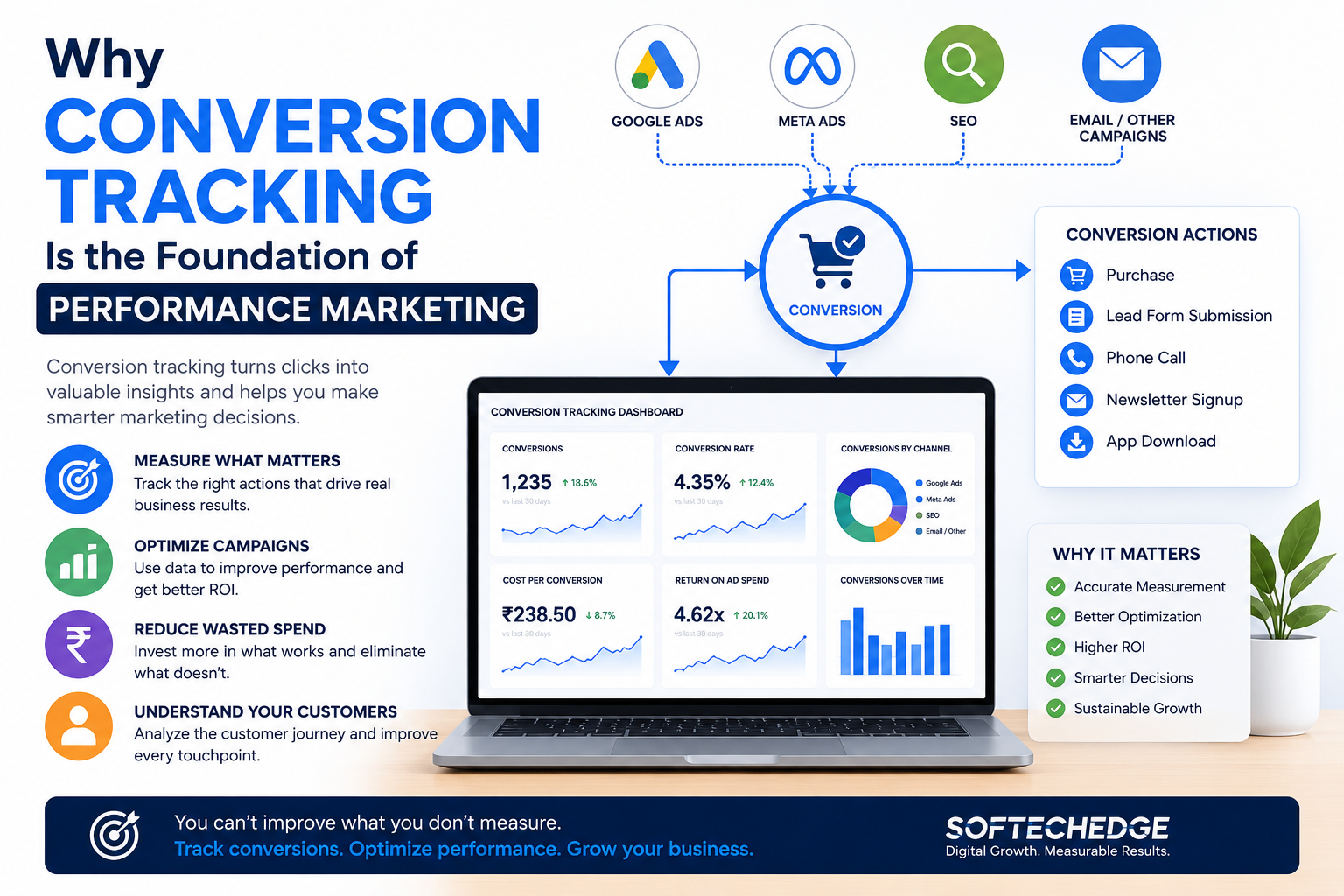
A conversion can mean different things depending on the business. For an e-commerce company, it may be a completed purchase. For a service-based business, it could be a lead form submission, phone call, consultation booking, or WhatsApp inquiry. Other conversions may include newsletter sign-ups, app downloads, product demos, or account registrations.
By tracking these actions, businesses can connect marketing efforts with actual customer outcomes instead of relying only on surface-level metrics such as clicks and impressions.
Why Conversion Tracking Matters in Performance Marketing
Performance marketing focuses on measurable results. Businesses invest in platforms such as Google Ads, Meta Ads and other digital channels with the expectation that their spending will generate leads, sales or other valuable actions.
Without conversion tracking, marketers may know that an advertisement received thousands of clicks but have no clear idea whether those clicks generated revenue.
Conversion tracking answers critical questions such as:
1.Which campaigns are generating the most leads?
2.Which advertisements are producing actual customers?
3.Which keywords are driving valuable traffic?
4.How much does it cost to acquire a customer?
5.Which channels are delivering the best return on investment?
This information enables marketers to move from assumptions to data-driven decision-making.
It Helps Measure Real Marketing ROI
One of the biggest advantages of conversion tracking is that it makes marketing performance measurable.
Suppose a business spends ₹50,000 on two advertising campaigns. Campaign A generates 2,000 clicks, while Campaign B generates only 1,200 clicks. At first glance, Campaign A appears to be the better performer.
However, conversion data might reveal that Campaign A generated only 20 qualified leads, while Campaign B generated 75. In this situation, Campaign B is clearly more valuable despite receiving fewer clicks.
This demonstrates why clicks and traffic alone cannot determine marketing success. Conversion tracking connects advertising expenditure to meaningful business outcomes.
Better Optimization Through Better Data
Digital advertising platforms continuously optimize campaigns based on available data. When conversion tracking is configured correctly, marketers can provide platforms with information about the actions that matter most.
For example, instead of optimizing a campaign simply for website traffic, a business can focus on generating completed purchases or qualified leads.
Over time, conversion data can help identify high-performing audiences, keywords, advertisements, landing pages and campaigns. Marketers can then allocate more budget toward what works and reduce spending on activities that produce weak results.
Understanding the Customer Journey
Customers rarely move directly from seeing an advertisement to making a purchase. Their journey may involve multiple touchpoints.
A potential customer might see a Meta ad, visit the website, leave without taking action, search for the brand on Google several days later, and eventually submit an inquiry.
Conversion tracking helps businesses understand these interactions and identify important stages in the customer journey.
This insight is particularly valuable for businesses with longer sales cycles, where several marketing touchpoints may influence the final conversion.
Improving Landing Pages and User Experience
Conversion tracking is not limited to advertising campaigns. It can also reveal how effectively a website converts visitors.
If a landing page receives substantial traffic but generates very few leads, there may be issues with the page's messaging, design, loading speed, trust signals or call-to-action.
By comparing traffic and conversion data across different pages, businesses can identify opportunities for Conversion Rate Optimization (CRO).
Even small improvements to forms, headlines, CTAs and page layouts can have a significant impact when applied to high-traffic pages.
Making Smarter Budget Decisions
Every marketing budget has limits. Businesses therefore need to know where their money is producing the strongest results. Conversion tracking allows marketers to compare campaigns based on meaningful metrics such as Cost Per Lead (CPL), Cost Per Acquisition (CPA), Conversion Rate and Return on Ad Spend (ROAS).
Instead of distributing budgets equally across multiple channels, businesses can prioritize campaigns that consistently deliver better outcomes.
This makes performance marketing more efficient and scalable.
Common Conversion Tracking Mistakes
Despite its importance, conversion tracking is often implemented incorrectly. Common mistakes include tracking the wrong events, counting duplicate conversions, failing to track phone calls or forms, and ignoring important post-conversion actions.
Another issue is tracking too many low-value actions without distinguishing them from genuine business outcomes. For example, a page view may indicate interest, but it should not necessarily be treated with the same importance as a completed purchase.
Businesses should clearly define their primary and secondary conversions before setting up tracking.
The Role of Accurate Data in 2026
As digital advertising becomes increasingly automated and AI-driven, high-quality data is becoming even more important. Advertising platforms depend on reliable conversion signals to make optimization and bidding decisions.
Businesses should therefore focus not only on collecting more data but on collecting accurate, relevant and actionable data.
Proper implementation may involve analytics platforms, advertising pixels, conversion APIs, tag management systems and CRM integrations, depending on the business model and marketing setup.
How Softechedge Can Help
At Softechedge, conversion tracking can be integrated into a broader performance marketing strategy designed around measurable business goals. From campaign tracking and analytics to Google Ads, Meta Ads, SEO and conversion optimization, the focus should remain on connecting digital activity with real business results.
A campaign should not simply generate traffic—it should help generate measurable growth.
Conclusion
Conversion tracking is the foundation of performance marketing because it transforms digital activity into measurable business intelligence. It tells marketers what is working, what needs improvement and where budgets should be invested.
Without accurate conversion data, businesses are essentially navigating their digital marketing strategy without a clear view of the destination.
With the right tracking setup, businesses can measure performance, optimize campaigns, improve customer journeys, reduce wasted ad spend and make smarter growth decisions. In a competitive digital environment, that ability to turn data into action can make the difference between simply running campaigns and building a performance-driven marketing engine.