Introduction
Starting a business is exciting, but building a successful startup is challenging. A great product or innovative idea alone does not guarantee success. Startups also need visibility, customer trust, consistent communication, and a reliable way to reach their target audience.
This is where digital marketing for startups becomes essential.
In today's technology-driven world, customers search online before making purchasing decisions. They compare brands, read reviews, visit websites, watch videos, check social media profiles, and search for solutions on Google. If a startup does not have a strong digital presence, potential customers may never discover it.
Digital marketing allows startups to promote their products and services through channels such as search engines, social media, websites, email, online advertising, content marketing, and video platforms. More importantly, it allows businesses to reach specific audiences and measure the results of their campaigns.
Unlike traditional marketing methods that can require significant budgets, digital marketing provides startups with flexible and scalable options. A small business can begin with a focused SEO strategy, social media presence, content marketing, or targeted advertising and gradually increase its investment as it grows.
Whether you are launching a technology company, e-commerce business, professional service, educational platform, or local startup, digital marketing can help you establish your brand and compete in an increasingly crowded market.
In this guide, we will explore why every startup needs digital marketing, the benefits it provides, the most effective strategies startups can use, common mistakes to avoid, and how businesses can build a sustainable digital marketing strategy.
What Is Digital Marketing?
Digital marketing refers to the promotion of products, services, or brands through digital channels and technologies.
These channels can include:
- Search engines
- Websites
- Social media platforms
- Online advertising
- Video platforms
- Mobile applications
- Content platforms
- Online communities
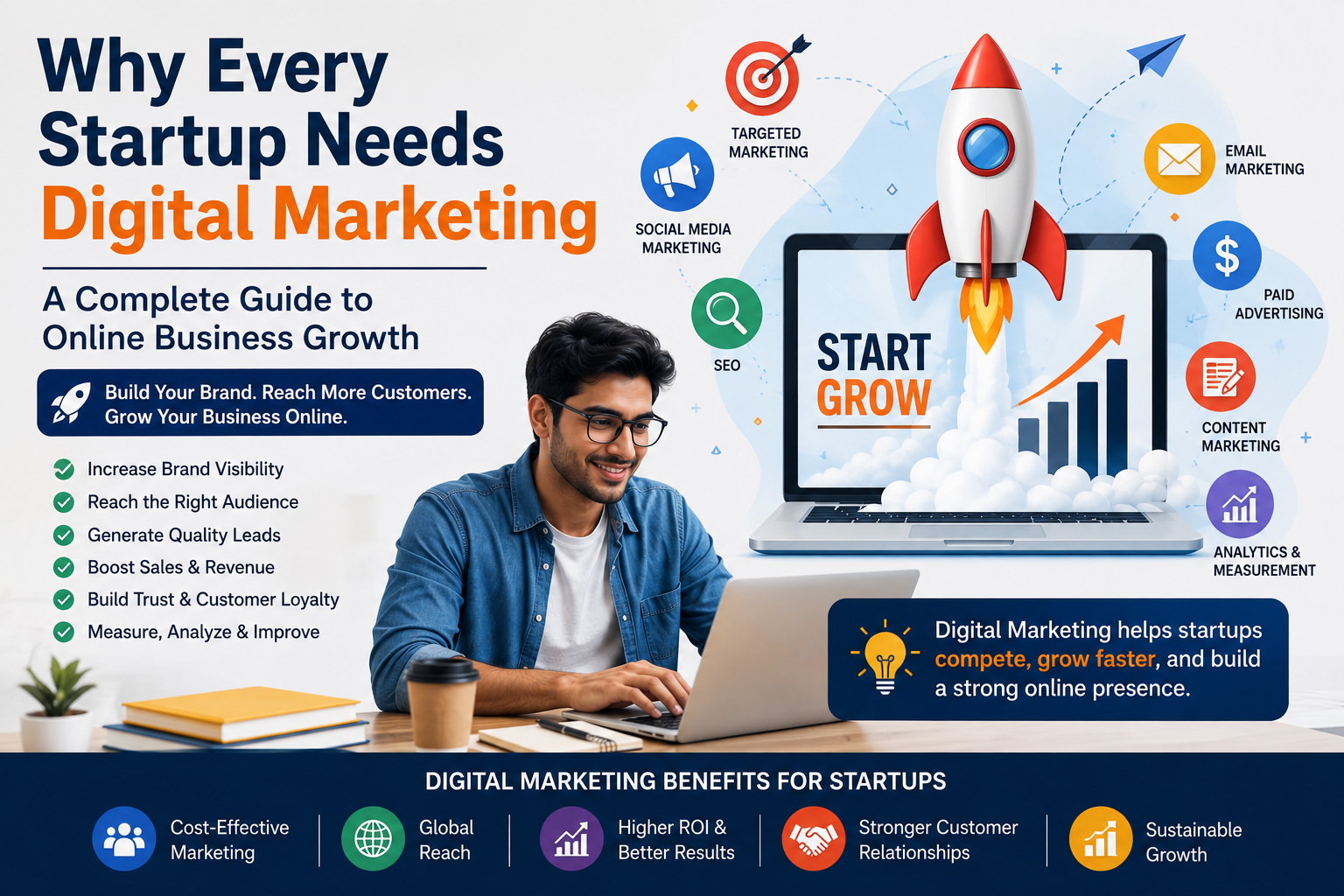
Some of the most important areas of digital marketing include:
Search Engine Optimization (SEO)
SEO helps websites improve their visibility in organic search results.
Social Media Marketing
Social media marketing helps businesses build communities, increase awareness, and communicate directly with customers.
Content Marketing
Content marketing involves creating useful and relevant content that attracts and educates potential customers.
Paid Advertising
Paid advertising allows startups to reach specific audiences through platforms such as search engines and social media.
Email Marketing
Email marketing helps businesses nurture leads, communicate with existing customers, and encourage repeat purchases.
Performance Marketing
Performance marketing focuses on measurable results such as clicks, leads, conversions, and sales.
Together, these strategies create a comprehensive digital marketing strategy for startups.
Why Every Startup Needs Digital Marketing
1. Digital Marketing Increases Brand Visibility
One of the biggest challenges for a new startup is getting noticed.
Established companies already have brand recognition, customer relationships, and large marketing budgets. Startups have to work harder to introduce themselves to the market.
Digital marketing helps solve this problem.
Through SEO, social media, content, video marketing, and online advertising, startups can introduce their brands to potential customers.
For example, a startup offering professional services can create informative blogs around common customer problems. Someone searching for a solution online may discover the startup through its content.
Over time, consistent online visibility can turn an unknown startup into a recognizable brand.
2. Digital Marketing Helps Startups Reach the Right Audience
Traditional advertising often involves reaching a broad audience. Digital marketing provides much greater targeting capabilities.
Startups can target audiences based on factors such as:
- Age
- Location
- Interests
- Profession
- Search behavior
- Online activity
- Purchasing behavior
- Demographics
This means a startup can focus its marketing efforts on people who are most likely to become customers.
For example, an online training company targeting college students can create campaigns specifically designed for students interested in professional courses.
This targeted approach helps reduce wasted marketing expenditure and improves the chances of generating qualified leads.
3. Digital Marketing Is More Cost-Effective for Startups
Budget constraints are a major concern for many startups.
Traditional advertising methods such as television, newspapers, radio, and large outdoor campaigns can require substantial investment.
Digital marketing offers more flexible options.
A startup can begin with:
- Organic social media content
- SEO
- Blog marketing
- Email marketing
- Short-form videos
- Local SEO
- Small paid advertising campaigns
As the business grows, the marketing budget can increase.
This scalability makes digital marketing particularly valuable for startups that need to carefully manage their resources.
4. Digital Marketing Helps Build Brand Awareness
Building awareness is one of the first stages of the customer journey.
Before customers buy from a startup, they need to know that the business exists.
Consistent digital marketing helps create repeated exposure through:
- Social media posts
- Search results
- Blog articles
- Videos
- Advertisements
- Email campaigns
- Online communities
Over time, this exposure improves brand recall.
When customers eventually need the product or service offered by the startup, they are more likely to remember the brand they have encountered repeatedly.
5. Digital Marketing Builds Customer Trust
Customers may hesitate to purchase from a new business because they are unfamiliar with the brand.
A professional digital presence can help overcome this barrier.
Startups can build trust by publishing:
- Customer testimonials
- Case studies
- Reviews
- Educational content
- Product demonstrations
- Behind-the-scenes content
- Founder stories
- Industry insights
A well-designed website with clear information and transparent communication also improves credibility.
Trust is especially important for startups because positive customer experiences can lead to referrals and repeat business.
6. Digital Marketing Helps Generate Leads
Lead generation is one of the most important objectives of startup marketing.
A lead is a potential customer who has shown interest in a product or service.
Startups can generate leads through:
- Website forms
- Landing pages
- Social media campaigns
- Search advertisements
- Downloadable resources
- Webinars
- Email subscriptions
- Free consultations
- Contact forms
For example, a business consultancy can offer a free consultation through its website. Interested visitors can submit their contact details, allowing the business to follow up with potential customers.
A well-designed digital marketing funnel can gradually convert these leads into paying customers.
7. Digital Marketing Supports Customer Acquisition
Getting new customers is essential for startup growth.
Digital marketing allows startups to create structured customer acquisition strategies.
A typical customer journey may look like this:
Awareness → Interest → Consideration → Conversion → Retention → Advocacy
For example:
A potential customer sees a social media video.
↓
They visit the startup's website.
↓
They read a blog or watch a product demonstration.
↓
They sign up for a newsletter or request more information.
↓
The business follows up.
↓
The customer purchases the product or service.
↓
The business provides a positive experience.
↓
The customer returns or recommends the brand.
Digital marketing supports every stage of this journey.
8. SEO Helps Startups Build Long-Term Visibility
Search Engine Optimization is particularly valuable for startups because it can create sustainable organic traffic.
When a startup publishes useful content around relevant search terms, its website can gradually gain visibility in search engines.
For example, a startup offering web development services could create content around topics such as:
- How much does website development cost?
- Why does every business need a website?
- How to choose a web development company
- Website trends for small businesses
- Benefits of mobile-friendly websites
High-quality content can attract people who are already searching for related information.
Unlike paid advertisements, organic search traffic can continue generating visitors after the initial content has been published.
SEO is therefore an important component of a long-term digital marketing strategy for startups.
9. Social Media Helps Startups Build Communities
Social media is more than a promotional platform.
It allows startups to create communities around their brands.
Platforms such as Instagram, LinkedIn, Facebook, and YouTube can help startups:
- Share educational content
- Introduce team members
- Showcase products
- Answer customer questions
- Share company updates
- Collect feedback
- Build relationships
Startups should avoid making every social media post a sales pitch.
Instead, they should focus on providing value.
Educational, entertaining, inspirational, and relatable content can generate stronger engagement than constant promotional messages.
10. Digital Marketing Provides Measurable Results
One of the biggest advantages of digital marketing is measurability.
Traditional marketing can sometimes make it difficult to determine exactly how many people interacted with an advertisement.
Digital marketing provides access to metrics such as:
- Website traffic
- Click-through rate
- Conversion rate
- Cost per click
- Cost per lead
- Engagement rate
- Bounce rate
- Return on advertising spend
- Customer acquisition cost
These insights allow startups to understand what is working and what needs improvement.
Instead of relying entirely on assumptions, businesses can make decisions based on data.
11. Digital Marketing Helps Startups Compete With Larger Businesses
Startups often compete against companies with significantly larger budgets.
However, digital marketing can reduce some of the disadvantages associated with being a smaller business.
A startup with excellent content, strong SEO, creative social media campaigns, and a compelling customer experience can attract attention even when competing with established brands.
Digital platforms have created opportunities for smaller businesses to build audiences based on creativity, expertise, and customer value rather than marketing budget alone.
12. Content Marketing Establishes Industry Authority
Startups need to demonstrate expertise.
Content marketing provides an effective way to do this.
Businesses can publish:
- Blog articles
- Research reports
- Case studies
- Guides
- Videos
- Podcasts
- Infographics
- Webinars
For example, a cybersecurity startup can publish educational content explaining common security threats and prevention methods.
When potential customers repeatedly find useful information from the startup, they may begin viewing the company as an authority in its industry.
This can positively influence purchasing decisions.
13. Digital Marketing Helps Startups Understand Customers
Successful businesses understand their customers.
Digital marketing provides valuable insights into customer behavior.
Analytics can reveal:
- What people search for
- Which pages they visit
- Which content they engage with
- How long they stay on a website
- Which advertisements generate leads
- Which products receive the most interest
These insights can help startups improve their products, services, messaging, and overall customer experience.
In this way, digital marketing becomes more than a promotional tool—it becomes a source of business intelligence.
14. Email Marketing Helps Build Long-Term Relationships
Not every website visitor will purchase immediately.
Email marketing allows startups to stay connected with potential customers.
Businesses can send:
- Newsletters
- Educational content
- Product updates
- Special offers
- Event invitations
- Industry insights
Lead nurturing is particularly important for startups selling products or services that require customers to conduct research before making a purchase.
Consistent communication keeps the business visible while gradually building trust.
15. Digital Marketing Supports Business Growth and Scalability
A successful startup needs a marketing system that can grow with the business.
Digital marketing provides scalability.
A startup can begin with one platform and gradually expand into multiple channels.
For example:
Stage 1: Website + Social Media
Stage 2: SEO + Content Marketing
Stage 3: Email Marketing + Lead Generation
Stage 4: Paid Advertising + Retargeting
Stage 5: Marketing Automation + Analytics
This gradual approach allows startups to develop their marketing capabilities without immediately spending large amounts of money.
Essential Digital Marketing Strategies for Startups
A startup does not need to use every marketing channel simultaneously.
Instead, it should focus on strategies that match its audience and business goals.
Build a Professional Website
Your website is often the digital home of your startup.
It should be:
- Mobile-friendly
- Fast-loading
- Easy to navigate
- Secure
- Search-engine optimized
- Professionally designed
- Clear about products and services
A website should also include strong calls-to-action such as:
Contact Us | Book a Consultation | Get Started | Request a Quote
Develop an SEO Strategy
Identify keywords that your target audience searches for and create useful content around them.
Focus on:
- Keyword research
- On-page SEO
- Technical SEO
- Local SEO
- Content creation
- Internal linking
- Quality backlinks
SEO should be treated as a long-term investment.
Maintain a Consistent Social Media Presence
Choose platforms based on where your target customers spend time.
Rather than trying to be everywhere, startups should focus on two or three relevant platforms and maintain consistency.
Use Video Marketing
Video content is increasingly important for digital communication.
Startups can create:
- Product demonstrations
- Educational videos
- Customer testimonials
- Behind-the-scenes content
- Explainer videos
- Short-form videos
- Founder messages
Video can make complex ideas easier to understand and help humanize a startup.
Common Digital Marketing Mistakes Startups Should Avoid
Trying Every Platform at Once
Being active on every platform can stretch limited resources.
Choose platforms strategically.
Ignoring the Target Audience
Marketing becomes ineffective when businesses do not understand who they are trying to reach.
Focusing Only on Followers
A large follower count does not automatically mean business success.
Focus on meaningful metrics such as leads, conversions, customer acquisition, and revenue.
Expecting Immediate Results
SEO, content marketing, and brand building take time.
Startups should balance short-term campaigns with long-term strategies.
Creating Content Without a Strategy
Publishing random content without clear objectives can waste time.
Every piece of content should have a purpose.
How to Create a Digital Marketing Strategy for Your Startup
A practical startup digital marketing strategy can follow these steps:
Step 1: Define Your Goals
Set measurable objectives such as:
- Increase website traffic
- Generate leads
- Improve brand awareness
- Increase sales
- Build an email list
Step 2: Identify Your Audience
Understand your ideal customer's needs, challenges, interests, and purchasing behavior.
Step 3: Study Your Competitors
Analyze what competitors are doing well and identify opportunities to differentiate your startup.
Step 4: Choose the Right Channels
Select digital marketing channels based on your audience and objectives.
Step 5: Create Valuable Content
Develop content that answers customer questions and demonstrates your expertise.
Step 6: Measure Performance
Track important metrics and identify areas for improvement.
Step 7: Optimize Continuously
Digital marketing is not a one-time activity. Test different strategies and improve campaigns based on results.
The Future of Digital Marketing for Startups
The digital marketing landscape will continue to evolve.
Emerging technologies such as artificial intelligence, automation, predictive analytics, conversational tools, and personalization are changing how businesses communicate with customers.
AI can help marketers with tasks such as:
- Content ideation
- Data analysis
- Customer segmentation
- Campaign optimization
- Personalization
- Chatbots
- Marketing automation
However, technology alone will not create successful marketing.
Customers will continue to value authenticity, trust, creativity, and meaningful experiences.
Startups that combine technology with genuine customer understanding will be better positioned for long-term growth.
Frequently Asked Questions
Is digital marketing important for startups?
Yes. Digital marketing helps startups build visibility, reach targeted audiences, generate leads, establish credibility, and compete in digital marketplaces.
How much should a startup spend on digital marketing?
There is no universal budget. Startups should determine their marketing investment based on business objectives, industry, target audience, revenue, and growth stage. Starting with focused, measurable campaigns can help businesses manage costs.
Which digital marketing strategy is best for startups?
There is no single strategy that works for every startup. SEO, content marketing, social media, email marketing, paid advertising, and performance marketing can all be effective when aligned with the target audience and business objectives.
Can startups do digital marketing themselves?
Yes. Startups can manage certain activities internally, particularly social media and content creation. However, specialized areas such as technical SEO, paid advertising, analytics, and advanced performance marketing may benefit from professional expertise.
How long does digital marketing take to show results?
Results vary depending on the strategy. Paid campaigns can generate traffic and leads quickly, while SEO and content marketing generally require consistent effort over a longer period.
Why is SEO important for startups?
SEO helps startups improve organic search visibility and attract people who are actively searching for relevant products, services, and information.
Conclusion
Digital marketing is no longer optional for startups. It has become an essential component of modern business growth.
For a startup, having a great product is only the beginning. Customers need to discover the business, understand its value, trust the brand, and have an easy way to take action. Digital marketing connects these stages by creating visibility, generating leads, nurturing relationships, and supporting conversions.
From SEO and content marketing to social media, email campaigns, paid advertising, and video marketing, startups have numerous opportunities to connect with their target audiences.
The biggest advantage is that digital marketing can be flexible and measurable. Startups can begin with focused strategies, analyze their results, learn from customer behavior, and gradually scale their efforts.
However, successful digital marketing requires consistency. Posting occasionally, running random advertisements, or creating content without a strategy is unlikely to deliver sustainable results. Startups need a clear understanding of their audience, measurable goals, consistent branding, valuable content, and a willingness to continuously optimize their approach.
The future belongs to businesses that can combine innovation with strong digital communication. Whether a startup is selling technology, education, professional services, products, or creative solutions, establishing a strong online presence can create opportunities that extend far beyond geographical boundaries.
Digital marketing does not simply help startups get noticed—it helps them build relationships, create credibility, generate opportunities, and grow.
For startups looking to establish themselves in a competitive market, investing in a well-planned digital marketing strategy today can become one of the strongest foundations for sustainable business growth tomorrow.