Introduction
Your website is often the first interaction customers have with your business. In a digital-first market, a website is no longer just an online brochure—it is a powerful business tool that influences credibility, customer experience, lead generation, and sales.
However, websites can become outdated over time. Changes in technology, customer expectations, design trends, security standards, and business goals can make an older website less effective. Even if your website is still functioning, it may not be delivering the results your business needs.
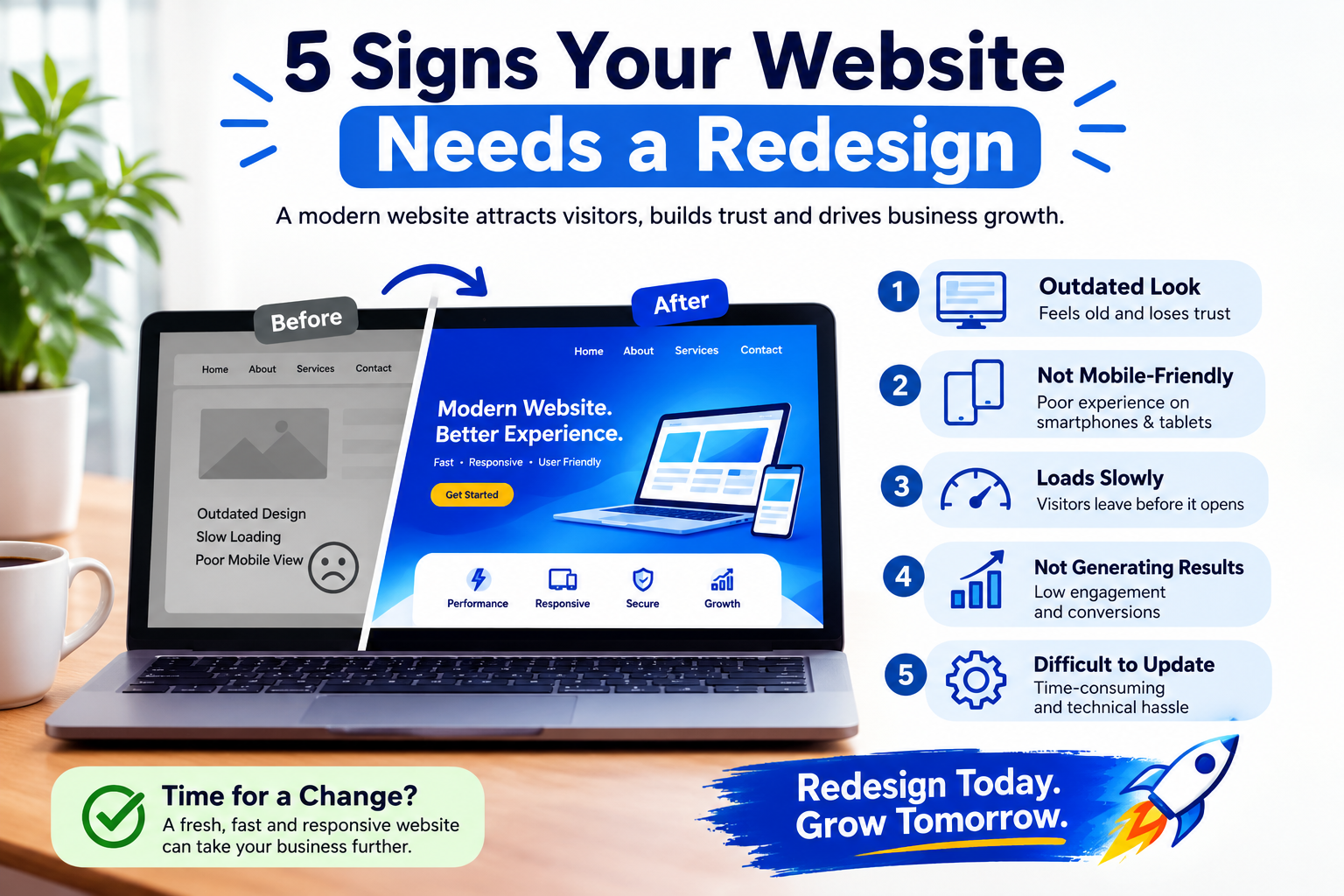
So, how do you know when it is time for a redesign? Here are five important signs that your website needs a redesign.
1. Your Website Looks Outdated
First impressions matter. If your website looks like it belongs to another era of the internet, visitors may assume that your business is outdated too.
Older websites often have cluttered layouts, excessive text, outdated graphics, inconsistent fonts, or poor visual hierarchy. Modern users expect clean designs, intuitive navigation, engaging visuals, and content that is easy to scan.
A professional redesign can give your website a fresh and modern appearance while maintaining consistency with your brand identity. Elements such as typography, colours, images, buttons, spacing, and page structure can be optimized to create a more polished experience.
A modern website should not simply look attractive—it should communicate your brand message quickly and guide visitors toward meaningful actions.
2. Your Website Is Not Mobile-Friendly
A large percentage of website visitors access websites through smartphones and tablets. If your website does not adapt properly to different screen sizes, you could be losing potential customers.
Common signs of poor mobile responsiveness include:
1.Text that is difficult to read
2.Buttons that are too small to tap
3.Images that do not fit the screen
4.Horizontal scrolling
5.Menus that are difficult to navigate
6.Forms that are frustrating to complete
A website redesign can introduce a mobile-first and responsive design approach, ensuring that your website works smoothly across smartphones, tablets, laptops, and desktops.
Mobile usability is particularly important for businesses that rely on online enquiries, e-commerce purchases, bookings, or lead generation. A frustrating mobile experience can cause visitors to leave before taking any action.
3. Your Website Loads Slowly
Website speed has a direct impact on user experience. Nobody wants to wait several seconds for a webpage to load, especially when competitors are just one search away.
Slow performance can be caused by large image files, outdated code, excessive plugins, inefficient databases, poor hosting configurations, or unnecessary website elements.
If visitors frequently abandon your pages before they load, your website may need more than a few minor updates—it may require a technical redesign.
During a redesign, developers can optimize images, improve code structure, reduce unnecessary scripts, enhance caching, and improve the overall performance of the website.
A faster website creates a smoother user experience and makes it easier for visitors to explore your products, services, and content.
4. Your Website Is Not Generating Results
A beautiful website is not necessarily an effective website.
If your traffic is reasonable but visitors are not filling out enquiry forms, making purchases, calling your business, or taking other desired actions, there may be a problem with your website's structure or user experience.
Look for warning signs such as:
1.High bounce rates
2.Low conversion rates
3.Few enquiries
4.Abandoned forms or carts
5.Poor engagement with important pages
6.Visitors struggling to find key information
A redesign provides an opportunity to rethink the customer journey. Clear calls-to-action, simplified navigation, stronger landing pages, trust signals, better content placement, and optimized forms can help visitors move naturally from discovering your business to taking action.
The goal should be to design the website around business objectives, not simply aesthetics.
5. Your Website Is Difficult to Update or Maintain
Technology evolves quickly. If making a simple change to your website requires extensive technical work, your existing platform may be holding your business back.
An outdated website may rely on old frameworks, unsupported plugins, complicated code, or a content management system that is difficult for your team to use.
This can make regular updates expensive and time-consuming.
A redesign can provide a more flexible technical foundation. Modern development practices can make it easier to update content, integrate third-party tools, improve security, and add new features as your business grows.
This is especially important for businesses that frequently update products, services, blogs, pricing, promotions, or customer resources.
A Website Redesign Is More Than a New Look
A website redesign should not simply mean changing colours, images, and fonts. It should be an opportunity to evaluate the complete digital experience.
Before redesigning, businesses should consider:
1.Who are our target users?
2.What do visitors expect from our website?
3.
What pages generate the most value?
4.Where are users dropping off?
5.Is the website technically scalable?
6.Is it optimized for search engines?
7.Does it support our current business goals?
Combining UI/UX design, responsive development, performance optimization, SEO, security, and business strategy can create a website that is both visually appealing and commercially effective.
Build a Website That Grows With Your Business
Your website should evolve as your business evolves. An outdated design, poor mobile experience, slow performance, weak conversions, or difficult maintenance can all indicate that it is time for a change.
A strategic redesign can transform your website from a basic digital presence into a stronger platform for customer engagement, lead generation, brand building, and business growth.
At Softechedge, web development should go beyond simply creating attractive pages. The focus is on building websites that align technology with business objectives, user expectations, performance requirements, and long-term growth.
Your website represents your business online. If it no longer represents where your business is going, it may be time for a redesign.