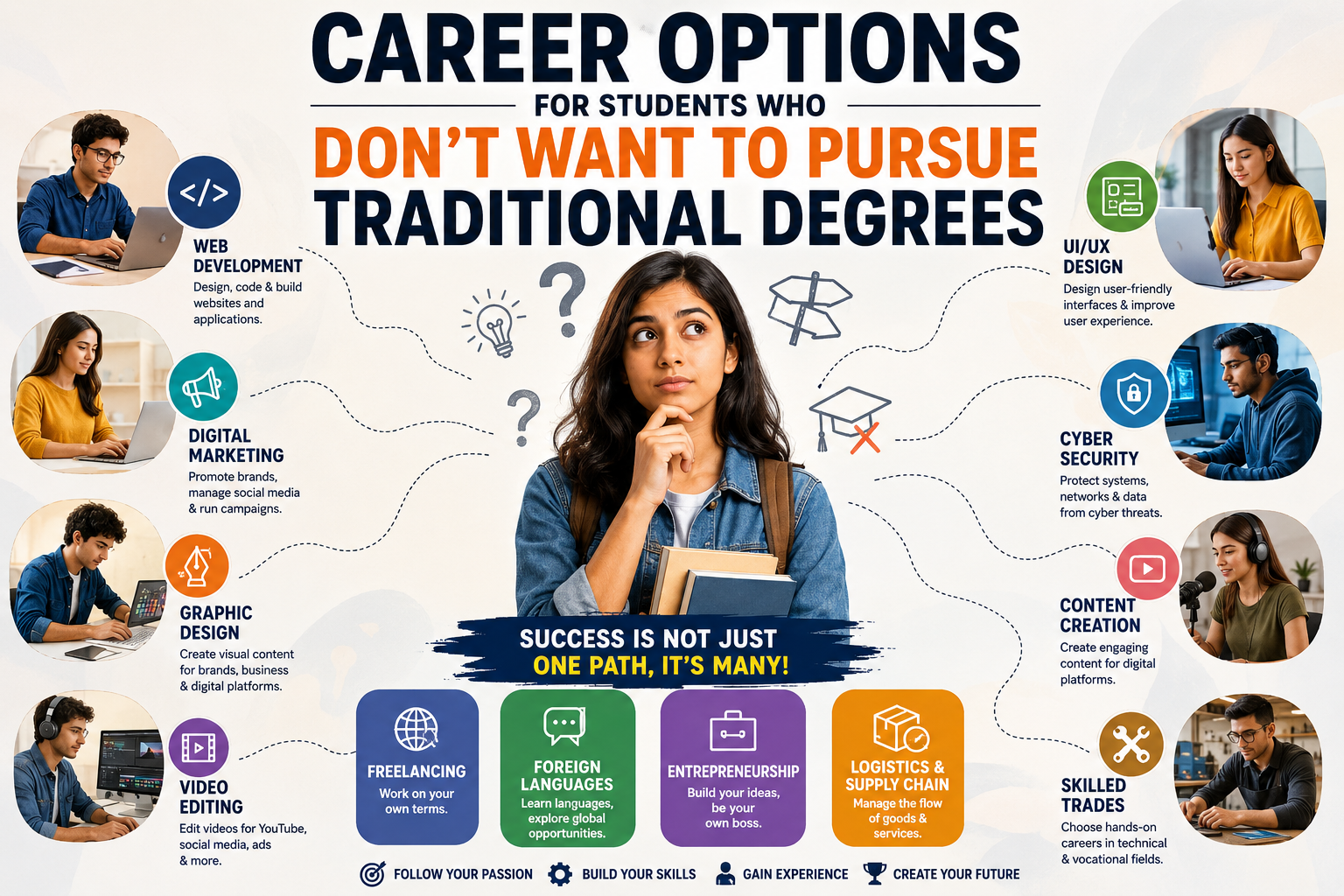
Choosing a career after school or college can feel overwhelming, especially when everyone around you seems to be following the same path: complete Class 12, earn a bachelor's degree, pursue a master's degree, and then look for a job. But the world of work is changing rapidly. Today, students have more career options than ever before, and a traditional three- or four-year degree is no longer the only way to build valuable skills and create a successful career.
For students who don't want to pursue traditional degrees, there are several alternative career paths based on practical skills, certifications, vocational training, professional courses, freelancing, entrepreneurship, and industry-focused learning. The key is to identify your interests, understand market demand, develop relevant skills, and gain practical experience.
This guide explores some of the best career options without a traditional degree, the skills students should develop, and how career counselling can help them choose the right path.
Why Are Students Moving Beyond Traditional Degrees?
Traditional degrees continue to be valuable for many professions. Careers such as medicine, law, teaching in certain settings, engineering in regulated roles, and several government positions may require specific academic qualifications.
However, many modern careers focus strongly on skills, practical experience, portfolios, certifications, and demonstrated abilities.
Technology has also changed how companies hire. Employers increasingly look for candidates who can actually perform the tasks required for a particular position. A student who has completed practical training in web development, digital marketing, graphic design, cybersecurity, foreign languages, or other fields can begin developing professional experience without necessarily following a conventional academic route.
Another important factor is flexibility. Not every student enjoys traditional classroom education. Some learn better through practical projects, online courses, workshops, internships, apprenticeships, or hands-on training.
This does not mean that degrees have become useless. Instead, it means students now have more than one route to career success.
What Does a Non-Traditional Career Path Mean?
A non-traditional career path refers to a route where a student develops professional skills without relying entirely on conventional degree-based education.
Such a career path may include:
- Skill-based certification courses
- Vocational education
- Professional training programs
- Online learning
- Apprenticeships
- Internships
- Industry certifications
- Freelancing
- Entrepreneurship
- Portfolio-based careers
- Language training
- Short-term career-oriented programs
The best option depends on the student's interests, abilities, financial situation, career goals, and the requirements of the chosen profession.
Best Career Options for Students Who Don't Want Traditional Degrees
1. Web Development
Web development is one of the most popular career options for students interested in technology.
Web developers create and maintain websites and web applications. Depending on their specialization, they may work as front-end developers, back-end developers, or full-stack developers.
Students can begin by learning technologies such as:
- HTML
- CSS
- JavaScript
- React
- Node.js
- Databases
- APIs
- Git and GitHub
A strong portfolio can be extremely useful for demonstrating practical abilities. Students can build personal websites, e-commerce projects, dashboards, blogs, or other applications to showcase their skills.
Career opportunities include:
- Front-End Developer
- Back-End Developer
- Full-Stack Developer
- WordPress Developer
- Web Designer
- Junior Software Developer
For students who enjoy technology and problem-solving, web development without a traditional degree can be a promising option.
2. Digital Marketing
Digital marketing is another career field where practical skills can be more important than following a specific academic degree.
Businesses need professionals who understand how to promote products and services online. Digital marketers work across search engines, social media, websites, email, advertising platforms, and content channels.
Students can learn:
- Search Engine Optimization (SEO)
- Social media marketing
- Content marketing
- Google Ads
- Email marketing
- Analytics
- Performance marketing
- Marketing automation
A student can demonstrate their abilities by creating sample campaigns, managing a website, developing content strategies, or building a portfolio.
Potential career roles:
- Digital Marketing Executive
- SEO Executive
- Social Media Manager
- Content Marketer
- PPC Executive
- Performance Marketing Executive
- Email Marketing Specialist
Digital marketing can also provide opportunities for freelancing and entrepreneurship.
3. Graphic Design
Creative students may find graphic design to be an excellent alternative career path.
Graphic designers create visual content for brands, websites, advertisements, social media, packaging, publications, and digital platforms.
Students can develop skills in tools such as:
- Adobe Photoshop
- Adobe Illustrator
- Canva
- Figma
- Adobe InDesign
A strong portfolio is one of the most important assets for an aspiring designer. Students can create logos, posters, social media designs, brand identities, advertisements, and other sample projects.
Career options include:
- Graphic Designer
- Brand Designer
- UI Designer
- Social Media Designer
- Visual Designer
- Freelance Designer
For creative students, practical design training combined with portfolio development can open multiple career opportunities.
4. UI/UX Design
UI/UX design is another growing field for students interested in technology and creativity.
UI stands for User Interface, while UX stands for User Experience. Professionals in this field focus on creating digital products that are visually appealing, easy to use, and useful for customers.
Students can learn:
- User research
- Wireframing
- Prototyping
- Interface design
- Design thinking
- Usability testing
- Figma
A portfolio containing real or practice projects can help demonstrate design thinking and problem-solving abilities.
Possible career roles include:
- UI Designer
- UX Designer
- Product Designer
- UX Research Assistant
- Interaction Designer
5. Cybersecurity
Cybersecurity is an important field for students who are interested in computers, networks, and digital security.
Cybersecurity professionals help organizations protect systems, applications, networks, and data from cyber threats.
Students interested in this field can start with fundamentals such as:
- Computer networks
- Operating systems
- Cybersecurity fundamentals
- Ethical hacking concepts
- Network security
- Security tools
- Risk management
Industry-recognized certifications and practical labs can help students build credibility.
Potential roles include:
- Cybersecurity Analyst
- Security Operations Center (SOC) Analyst
- Security Support Associate
- Network Security Assistant
- Ethical Hacking Trainee
Students should understand that advanced cybersecurity roles often require substantial technical knowledge and experience, so continuous learning is essential.
6. Cloud Computing and DevOps
Cloud computing has become an important part of modern technology infrastructure.
Students can explore cloud platforms and concepts involving servers, storage, databases, networking, deployment, and application management.
Popular learning areas include:
- Cloud fundamentals
- Linux
- Networking
- Virtualization
- Containers
- DevOps practices
- CI/CD
- Cloud security
Students can also work toward industry certifications and practical projects.
Career opportunities include:
- Cloud Support Associate
- Cloud Administrator
- DevOps Trainee
- Cloud Engineer
- Site Reliability Engineering roles
This field is particularly suitable for students who enjoy technology, systems, and problem-solving.
7. Foreign Language Careers
Learning a foreign language can create opportunities in multiple industries.
Languages such as German, French, Spanish, Japanese, and others can be valuable depending on the industry, location, and role.
Students can pursue opportunities related to:
- Translation
- Interpretation
- Customer support
- Tourism
- Hospitality
- International business
- Export-import
- Teaching
- Content localization
For example, students learning German may explore opportunities connected with German-speaking markets, while French can be useful in international business and organizations where French is used.
Foreign language learning can also complement another professional skill. For example, digital marketing + French, or customer support + German, can create a more specialized profile.
8. Digital Content Creation
Content creation has developed into a legitimate career path for individuals who understand storytelling, communication, editing, and digital platforms.
Students can create:
- YouTube videos
- Instagram content
- Educational content
- Podcasts
- Blogs
- Short-form videos
- Brand content
Useful skills include:
- Video editing
- Scriptwriting
- Copywriting
- Photography
- Social media management
- SEO
- Graphic design
However, content creation can be unpredictable initially. Students should focus on developing transferable skills rather than relying only on social media popularity.
9. Video Editing
Video content is widely used by businesses, creators, educational platforms, media organizations, and brands.
Students can learn video editing software and develop skills in:
- Video editing
- Motion graphics
- Audio editing
- Color correction
- Storytelling
- Short-form video production
Career opportunities include:
- Video Editor
- Social Media Video Editor
- Motion Graphics Assistant
- YouTube Video Editor
- Freelance Video Editor
A portfolio is particularly important in this field.
10. Photography
Photography can become a professional career for students who are passionate about visual storytelling.
Possible areas include:
- Product photography
- Fashion photography
- Wedding photography
- Event photography
- Food photography
- Travel photography
- Commercial photography
Students can start by learning camera fundamentals, lighting, composition, editing, and business skills.
Building a portfolio and networking with clients are important steps toward becoming a professional photographer.
11. Skilled Trades and Vocational Careers
Not every successful career is based around an office or computer.
Vocational careers can provide valuable opportunities in areas such as:
- Electrical work
- Plumbing
- Automotive services
- Welding
- HVAC
- Construction
- Machine operation
- Technician roles
Vocational training and apprenticeships can provide hands-on experience and industry-specific knowledge.
For students who enjoy practical work and problem-solving, skilled trades can be a strong career choice.
12. Logistics and Supply Chain
The growth of e-commerce, manufacturing, retail, and international trade has increased the importance of logistics and supply chain operations.
Students can develop skills in:
- Inventory management
- Warehousing
- Procurement
- Transportation
- Supply chain planning
- Documentation
- Operations
Entry-level roles may include logistics coordinator, warehouse executive, operations executive, and supply chain assistant.
Specialized training can help students understand how businesses manage the movement of goods from suppliers to customers.
13. Entrepreneurship
Entrepreneurship is another option for students who want to build something of their own.
A student does not necessarily need a traditional degree to start a business, but entrepreneurship requires knowledge, discipline, planning, financial awareness, communication, and problem-solving.
Students can explore businesses related to:
- E-commerce
- Digital services
- Food
- Handicrafts
- Education
- Technology
- Local products
- Creative services
Before starting a business, students should research the market, identify a genuine customer problem, calculate costs, understand regulations, and develop a sustainable business model.
14. Freelancing
Freelancing allows individuals to offer professional services to clients on a project or contract basis.
Popular freelance skills include:
- Writing
- Graphic design
- Web development
- Video editing
- Digital marketing
- Translation
- Data-related services
- Virtual assistance
Freelancing can provide flexibility, but students should understand that it requires self-discipline and continuous client acquisition.
Building a strong portfolio, professional communication skills, and a reliable reputation can gradually improve freelance opportunities.
Skills Students Should Develop Instead of Focusing Only on Degrees
Choosing an alternative career path does not mean choosing the easy path. Students still need to develop valuable and marketable skills.
1. Communication Skills
Good communication is useful in almost every profession. Students should learn how to write professional emails, communicate with clients, present ideas, and participate confidently in interviews.
2. Digital Skills
Basic digital literacy is essential in the modern workplace. Depending on the chosen career, students can develop skills in office software, digital platforms, AI tools, analytics, design software, or programming.
3. Problem-Solving
Employers value people who can identify problems and develop practical solutions. Students should focus on projects and real-world challenges rather than only theoretical learning.
4. Critical Thinking
Students should learn to analyze information, compare alternatives, identify risks, and make informed decisions.
5. Adaptability
Technology and job roles change quickly. Students who are willing to learn new tools and update their skills can remain competitive.
6. Teamwork
Many careers require collaboration. Learning how to work with different people is an important professional skill.
7. Time Management
Whether working for a company or freelancing, managing deadlines and priorities is essential.
How to Choose the Right Non-Traditional Career
With so many options available, students may still feel confused about what to choose.
A structured approach can help.
Step 1: Understand Your Interests
Ask yourself:
- What subjects do I enjoy?
- What activities can I do for hours without getting bored?
- Do I prefer creative, technical, practical, or people-oriented work?
Step 2: Identify Your Strengths
Consider whether you are good at:
- Communication
- Mathematics
- Technology
- Creativity
- Leadership
- Organization
- Problem-solving
- Working with people
Step 3: Research Career Demand
Do not choose a career only because it is trending. Research the skills employers require, career progression, working conditions, and potential opportunities.
Step 4: Try Before You Commit
Take introductory courses, attend workshops, complete small projects, or participate in internships. Practical exposure can help you understand whether a career genuinely suits you.
Step 5: Build a Portfolio
For many skill-based careers, a portfolio can demonstrate what you can actually do.
A developer can show websites. A designer can show designs. A writer can show articles. A video editor can show edited videos.
Step 6: Seek Career Counselling
Professional career counselling can help students understand their interests, strengths, career options, and skill requirements.
A career counsellor can help create a structured roadmap rather than leaving students to make decisions based entirely on peer pressure or social media trends.
Can You Get a Job Without a Traditional Degree?
The answer depends heavily on the profession, employer, location, and role.
Some professions require formal degrees or licenses. Others are more flexible and may place greater emphasis on skills, certifications, portfolios, experience, and practical ability.
For example, a student pursuing web development can demonstrate skills through projects. A graphic designer can build a portfolio. A digital marketer can demonstrate campaign experience. A video editor can show previous work.
However, students should always check the qualification requirements of their target career before deciding to skip a degree.
The goal should not be to avoid education. The goal should be to choose the right form of education for the career you want.
Degree vs Skill-Based Learning: Which Is Better?
There is no universal answer.
A degree can provide structured education, theoretical knowledge, networking, and eligibility for careers that require formal qualifications.
Skill-based learning can provide focused, practical training and may help students enter certain industries faster.
In many cases, the strongest approach can be a combination of both.
For example, a student may pursue a degree while simultaneously developing skills in digital marketing, coding, design, foreign languages, data analytics, or other areas.
Students should therefore focus less on the question “Degree or no degree?” and more on:
“What combination of education, skills, experience, and credentials will help me achieve my career goal?”
The Importance of Career Counselling for Alternative Career Paths
Students choosing non-traditional careers can sometimes face uncertainty because their career path may not look like that of their classmates.
Family expectations, social pressure, lack of information, and confusion about job opportunities can make decision-making difficult.
Career counselling can help students:
- Understand their strengths
- Explore career alternatives
- Identify suitable skill courses
- Understand industry requirements
- Set realistic career goals
- Create an action plan
- Avoid decisions based only on peer pressure
- Understand their education and training options
At Skill Excellent, career-oriented learning can be approached with a focus on practical skills, industry relevance, and career development.
How Skill-Based Learning Can Build a Career
A successful career is rarely created by completing one course and stopping.
Students should think of career development as a continuous process:
Learn → Practice → Build Projects → Gain Experience → Improve Skills → Network → Apply → Grow
This approach helps students become more confident and career-ready.
For example, someone interested in web development can start with HTML and CSS, learn JavaScript, build projects, create a portfolio, complete internships, and eventually apply for development roles.
Similarly, an aspiring digital marketer can learn SEO, social media marketing, analytics, and advertising, then work on practice campaigns and gain real-world experience.
Common Mistakes Students Should Avoid
Following Trends Blindly
Just because a career is popular does not mean it is right for everyone.
Choosing a Career Based Only on Salary
Salary matters, but students should also consider interests, skills, growth opportunities, work environment, and long-term sustainability.
Ignoring Practical Experience
Watching courses without practicing can limit skill development.
Not Building a Portfolio
For many skill-based careers, students need evidence of what they can do.
Stopping Learning After One Course
Industries evolve continuously. Professionals need to keep learning.
Comparing Your Journey With Others
Every student has different strengths, circumstances, and goals. Career success does not follow one fixed timeline.
Final Thoughts
Students who don't want to pursue traditional degrees have more career possibilities today than ever before. From web development, digital marketing, graphic design, UI/UX design, cybersecurity, cloud computing, foreign languages, video editing, logistics, skilled trades, freelancing, and entrepreneurship, there are numerous ways to build a professional future.
However, choosing an alternative career path does not mean avoiding education or hard work. It means choosing an education model that aligns with your goals.
The most important factors are relevant skills, practical experience, continuous learning, professional networking, and a clear career plan.
If you are confused about what to choose after school or graduation, don't make your decision simply because everyone else is doing it. Explore your interests, understand your strengths, research career opportunities, and consider professional career counselling.
Your career does not have to follow a traditional path to become successful. What matters is whether the path you choose helps you develop valuable skills, solve real problems, create opportunities, and grow professionally.
The future belongs to learners who are willing to adapt, build skills, and keep moving forward.
Choose Skills. Build Experience. Create Your Career.
If you're looking for career counselling, skill-based training, and industry-oriented courses, explore the learning opportunities available through Skill Excellent and take the next step toward building a career that matches your interests and goals.