Introduction
In today's competitive business landscape, the terms branding and marketing are often used interchangeably. While both play a crucial role in the success of a business, they are not the same. Many startups, small businesses, and even established organizations mistakenly believe that running advertisements or posting on social media is enough to build a successful brand. In reality, marketing and branding serve different purposes, yet they work together to create long-term business growth.
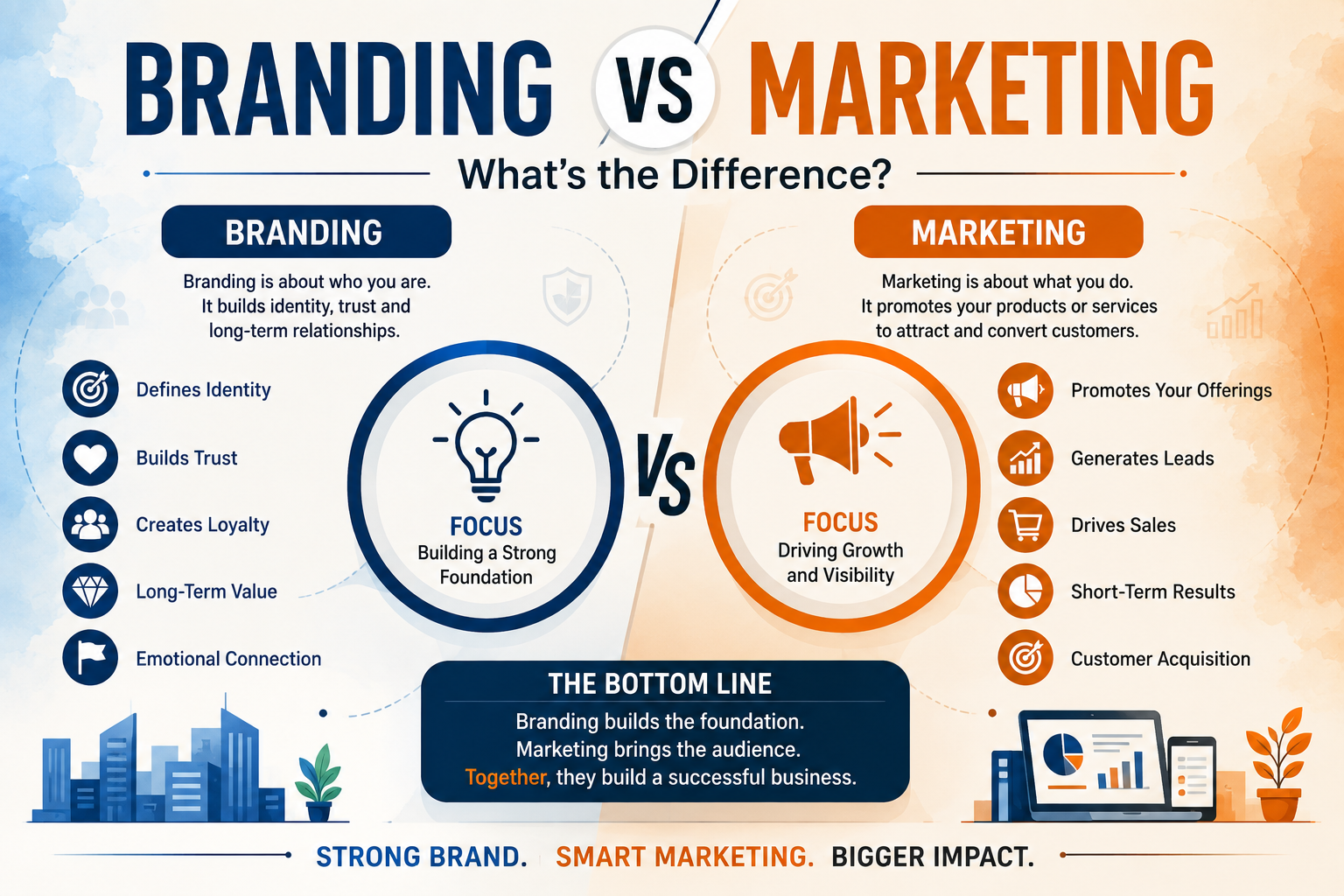
Think of branding as who you are and marketing as how you communicate who you are to the world. Branding shapes your identity, defines your values, and influences how people perceive your business. Marketing, on the other hand, involves the strategies and activities used to attract customers, generate leads, and promote products or services.
A company can spend millions on marketing campaigns, but if its brand lacks consistency, trust, or a clear identity, customers are unlikely to remain loyal. Similarly, having a strong brand without effective marketing may limit visibility and business growth. The most successful organizations combine strong branding with strategic marketing to create lasting customer relationships and sustainable success.
As businesses continue to evolve in the digital age, understanding the difference between branding and marketing has become more important than ever. Whether you're an entrepreneur, a startup founder, a marketing professional, or a business owner, knowing how these two concepts complement each other can help you make smarter business decisions.
In this comprehensive guide, we will explore what branding and marketing really mean, how they differ, why both are essential, and how businesses can use them together to build trust, attract customers, and achieve long-term growth.
What Is Branding?
Branding is the process of creating a unique identity for your business in the minds of your customers. It is much more than a logo, a color palette, or a catchy tagline. Branding defines how people perceive your company, what they feel when they interact with your business, and why they choose you over your competitors.
A strong brand communicates your company's mission, vision, values, personality, and promise. It creates consistency across every customer touchpoint, from your website and social media presence to customer service and product quality.
Simply put:
Branding is the emotional connection people have with your business.
When customers recognize your company, trust your services, and recommend you to others, your branding is doing its job.
Elements of a Strong Brand
Building a successful brand requires several key elements working together.
Brand Identity
Brand identity includes all the visual and verbal components that represent your business.
These include:
Company name
Logo
Color palette
Typography
Brand voice
Website design
Packaging
Visual style
Brand messaging
A consistent identity helps customers recognize your business across different platforms.
Brand Personality
Just as people have personalities, brands do too.
Your brand personality influences how your audience connects with your business.
For example, a brand may be:
Professional
Innovative
Friendly
Luxurious
Creative
Trustworthy
Bold
Fun
A clear personality makes your business more relatable and memorable.
Brand Values
Brand values represent the principles your company stands for.
Examples include:
Innovation
Integrity
Sustainability
Customer-first approach
Quality
Transparency
Social responsibility
Excellence
Today's customers increasingly prefer businesses whose values align with their own.
Brand Positioning
Brand positioning explains how your business differs from competitors.
It answers questions such as:
Why should customers choose you?
What unique value do you offer?
What problem do you solve better than others?
Effective positioning helps businesses occupy a distinct place in the market.
Brand Promise
A brand promise is the commitment you make to your customers.
For example:
Exceptional customer service
Premium quality
Fast delivery
Affordable pricing
Innovative solutions
Reliable support
Consistently delivering on this promise builds trust and loyalty over time.
Why Branding Matters
Strong branding provides long-term business advantages that extend far beyond sales.
Builds Trust
Customers are more likely to buy from businesses they recognize and trust.
Professional branding signals credibility, reliability, and consistency, reducing uncertainty during purchasing decisions.
Trust is especially important in today's digital marketplace, where customers have countless options.
Creates Recognition
Think about some of the world's most successful companies. Many are instantly recognizable through their logos, colors, messaging, or overall identity.
Consistent branding helps customers remember your business even when they are not actively looking for your products or services.
Greater recognition often leads to increased customer recall and repeat business.
Creates an Emotional Connection
People often make purchasing decisions based on emotions before justifying them with logic.
Strong branding tells stories, communicates values, and creates meaningful experiences that resonate with customers on a personal level.
When customers feel emotionally connected to a brand, they are more likely to remain loyal and recommend it to others.
Encourages Customer Loyalty
Loyal customers are one of the most valuable assets for any business.
They:
Purchase repeatedly
Recommend your business
Leave positive reviews
Defend your reputation
Spend more over time
Brand loyalty reduces customer acquisition costs and contributes to sustainable business growth.
Supports Premium Pricing
Customers are often willing to pay higher prices for brands they trust.
A strong brand shifts the conversation from price to value.
Instead of competing solely on cost, businesses with strong branding compete on reputation, quality, customer experience, and perceived value.
Creates a Competitive Advantage
Many businesses offer similar products or services.
Branding helps differentiate your company by creating a unique identity and customer experience.
Even in highly competitive markets, strong branding enables businesses to stand out and build lasting relationships.
Examples of Strong Branding
Successful businesses understand that branding is much more than visual design.
They focus on delivering consistent experiences that reinforce their identity and values.
Common characteristics of strong brands include:
Clear mission and vision
Consistent messaging
High-quality customer experiences
Memorable visual identity
Strong emotional connection
Authentic communication
Customer trust
Long-term consistency
Regardless of industry, businesses that consistently deliver on their promises build stronger reputations over time.
Branding Is an Ongoing Process
Many businesses assume branding is complete once they have designed a logo and launched a website.
In reality, branding evolves continuously.
Every interaction with customers contributes to your brand image, including:
Customer service
Website experience
Social media engagement
Product quality
Employee behavior
Online reviews
Marketing campaigns
Community involvement
Strong brands maintain consistency across all these touchpoints.
Signs Your Business Needs Better Branding
If your business experiences any of the following challenges, it may be time to strengthen your branding strategy:
Customers don't remember your business.
Your messaging is inconsistent across platforms.
Your business competes mainly on price.
You struggle to build customer loyalty.
Your competitors appear more recognizable.
Your visual identity feels outdated.
Customers are unclear about what makes your business different.
Improving your branding can enhance credibility, attract the right audience, and support long-term business growth.
Branding Is the Foundation of Marketing
A common misconception is that marketing creates a brand.
In reality, branding comes first.
Without a clear brand identity, marketing campaigns often lack consistency and fail to leave a lasting impression.
Branding provides the foundation by defining:
Who you are
What you stand for
Who your audience is
What makes you different
Why customers should trust you
Marketing then communicates these qualities to potential customers through various channels and campaigns.
A strong brand makes every marketing effort more effective.
What Is Marketing?
While branding defines who your business is, marketing focuses on how you attract, engage, and convert customers.
Marketing is the process of promoting your products or services to the right audience through strategic communication, advertising, and customer engagement. Its primary objective is to generate awareness, leads, sales, and long-term customer relationships.
Unlike branding, which builds perception over time, marketing often focuses on measurable actions and short- to medium-term business goals. A successful marketing strategy helps businesses reach potential customers at the right time, through the right channels, with the right message.
In today's digital world, marketing is no longer limited to television commercials or newspaper advertisements. Businesses now use websites, search engines, social media, email, video content, influencer collaborations, and AI-powered tools to reach customers more effectively.
Why Marketing Matters
No matter how great your product or service is, people won't buy it if they don't know it exists.
Marketing helps businesses:
Increase brand awareness
Generate qualified leads
Drive website traffic
Build customer relationships
Increase sales and revenue
Educate customers
Launch new products
Stay competitive in the market
An effective marketing strategy ensures your brand reaches the right audience and remains visible in a crowded marketplace.
Types of Marketing
Modern businesses use multiple marketing channels depending on their goals, target audience, and budget.
Digital Marketing
Digital marketing uses online platforms and technologies to promote products and services.
It includes:
Websites
Search engines
Mobile apps
Online advertising
Social media
Email campaigns
Digital marketing allows businesses to reach global audiences while measuring campaign performance in real time.
Search Engine Optimization (SEO)
SEO focuses on improving a website's visibility in search engine results.
Benefits include:
Higher organic traffic
Better search rankings
Increased credibility
More qualified visitors
Long-term online visibility
SEO is one of the most cost-effective long-term marketing strategies.
Content Marketing
Content marketing involves creating valuable and informative content that educates, entertains, or solves customer problems.
Examples include:
Blogs
Videos
Infographics
Guides
E-books
Case studies
Whitepapers
Podcasts
High-quality content builds trust while supporting SEO and lead generation.
Social Media Marketing
Social media platforms allow businesses to connect directly with customers.
Common platforms include:
LinkedIn
Instagram
Facebook
X (formerly Twitter)
YouTube
Pinterest
Social media helps increase engagement, brand awareness, and customer loyalty.
Email Marketing
Email remains one of the highest-return marketing channels.
Businesses use email to:
Share newsletters
Promote offers
Educate customers
Nurture leads
Announce new products
Maintain customer relationships
Personalized email campaigns often achieve strong engagement.
Paid Advertising
Paid campaigns provide immediate visibility.
Examples include:
Google Ads
Social media advertising
Display advertising
Video advertising
Retargeting campaigns
Paid marketing helps businesses reach highly targeted audiences quickly.
Influencer Marketing
Businesses collaborate with creators and industry experts who have established audiences.
Influencer partnerships help:
Increase credibility
Expand reach
Build trust
Generate engagement
Introduce products to new audiences
Choosing influencers whose values align with the brand is essential for authentic campaigns.
Branding vs Marketing: Key Differences
Although branding and marketing are closely connected, they serve different purposes.
| Branding | Marketing |
|---|---|
| Defines who your business is | Promotes your business to customers |
| Builds long-term trust | Generates leads and sales |
| Focuses on perception | Focuses on promotion |
| Creates emotional connections | Encourages customer action |
| Long-term strategy | Short- and medium-term strategy |
| Shapes customer loyalty | Attracts new customers |
| Builds reputation | Increases visibility |
| Guides business identity | Supports business growth |
A simple way to understand the difference is:
Branding builds relationships. Marketing starts conversations.
Branding vs Marketing: A Practical Example
Imagine a business that sells premium coffee.
Branding answers:
Why does the company exist?
What values does it represent?
What experience should customers expect?
How should customers feel when they think about the brand?
Why is it different from competitors?
Marketing answers:
How will customers discover the coffee?
Which social media platforms should be used?
What promotions should run this month?
Which keywords should be targeted?
What advertising budget is required?
Both are necessary, but they solve different business challenges.
Common Branding Mistakes
Even businesses with excellent products sometimes struggle because of weak branding.
Inconsistent Visual Identity
Using different logos, fonts, colors, or messaging across platforms creates confusion and weakens recognition.
Consistency builds trust.
Trying to Appeal to Everyone
Businesses that attempt to target every customer often fail to connect deeply with any audience.
Successful brands understand their ideal customers and communicate specifically to them.
Ignoring Customer Experience
A strong logo cannot compensate for poor customer service.
Every interaction influences brand perception.
Focusing Only on Design
Branding involves much more than visual elements.
Values, communication, customer experience, and reputation are equally important.
Lack of Brand Story
Customers connect with stories more than products.
Businesses should communicate:
Why they started
Their mission
Their vision
Their purpose
Their impact
Authentic storytelling strengthens emotional connections.
Common Marketing Mistakes
Marketing campaigns often underperform because of avoidable mistakes.
No Clear Target Audience
Marketing to everyone usually results in ineffective campaigns.
Successful marketing begins with understanding customer needs.
Ignoring Data
Modern marketing provides valuable analytics.
Businesses should monitor:
Website traffic
Conversion rates
Engagement
Click-through rates
Customer behavior
Return on investment
Data-driven decisions improve campaign performance.
Focusing Only on Selling
Constant promotional messages can overwhelm audiences.
Educational and valuable content builds stronger long-term relationships.
Neglecting SEO
Businesses that ignore search engine optimization lose valuable opportunities for long-term organic traffic.
SEO should be integrated into every content strategy.
Lack of Consistency
Posting irregularly or changing messaging frequently reduces audience engagement.
Consistent communication builds familiarity and trust.
How Branding and Marketing Work Together
Branding and marketing are not competitors—they complement each other.
Think of branding as the foundation of a house and marketing as the roads that lead people to it.
Branding establishes:
Identity
Purpose
Values
Personality
Customer expectations
Marketing communicates those qualities through:
Advertising
SEO
Social media
Content
Email
Events
Public relations
Campaigns
Without branding, marketing lacks direction.
Without marketing, branding lacks visibility.
Businesses achieve the best results when both work together.
Why Businesses Need Both Branding and Marketing
Companies that invest in branding alone may struggle to reach new audiences.
Companies that focus only on marketing often generate short-term sales but fail to build lasting customer loyalty.
Together, branding and marketing help businesses:
Increase recognition
Build trust
Attract quality customers
Improve customer retention
Support premium pricing
Strengthen competitive positioning
Generate sustainable business growth
The most successful organizations balance long-term brand building with strategic marketing initiatives.
How Businesses Can Build a Strong Brand
Building a successful brand doesn't happen overnight. It requires consistency, strategic planning, and a deep understanding of your audience. While marketing campaigns may bring immediate attention, a strong brand creates lasting impressions and encourages customer loyalty.
Here are the essential steps businesses should follow to build a memorable and trusted brand.
1. Define Your Mission and Vision
Every successful brand starts with a clear purpose.
Ask yourself:
Why does your business exist?
What problem are you solving?
What impact do you want to create?
What do you want customers to remember about your company?
A strong mission and vision provide direction for every branding and marketing decision.
2. Understand Your Target Audience
Your brand should be built around the needs, preferences, and expectations of your ideal customers.
Research factors such as:
Age
Location
Profession
Interests
Pain points
Buying behavior
Online habits
The better you understand your audience, the more effectively you can communicate with them.
3. Create a Consistent Brand Identity
Consistency builds recognition and trust.
Ensure your brand maintains uniformity across:
Logo
Colors
Typography
Website
Social media
Marketing materials
Business presentations
Email communication
Customers should experience the same brand personality wherever they interact with your business.
4. Develop a Unique Brand Voice
Your communication style should reflect your brand personality.
For example:
Professional and authoritative
Friendly and conversational
Innovative and modern
Inspirational and motivational
A consistent tone strengthens brand recognition and builds familiarity.
5. Deliver Outstanding Customer Experiences
Brand perception extends far beyond advertising.
Customers evaluate your business based on every interaction, including:
Customer support
Website usability
Product quality
Delivery experience
After-sales service
Responsiveness
Positive experiences turn satisfied customers into loyal advocates.
6. Invest in Valuable Content
Educational and informative content positions your business as an industry expert.
Examples include:
Blogs
Videos
Case studies
Guides
Webinars
Infographics
Whitepapers
Consistent content marketing strengthens both branding and SEO.
7. Build Trust Through Transparency
Modern customers value honesty.
Businesses should communicate openly about:
Pricing
Policies
Services
Business practices
Customer support
Transparency builds credibility and long-term relationships.
The Future of Branding and Marketing in the AI Era
Artificial Intelligence is reshaping how businesses build brands and market their products. AI-powered tools now assist with content creation, customer service, advertising optimization, market research, and data analysis.
However, while AI improves efficiency, it cannot replace authenticity, creativity, empathy, and human connection—the qualities that make a brand memorable.
Businesses that combine AI-driven insights with genuine customer experiences will have a significant competitive advantage.
Future branding and marketing trends include:
AI-powered personalization
Voice search optimization
Predictive analytics
Hyper-targeted advertising
Conversational AI and chatbots
Interactive and immersive content
Video-first marketing
Community-driven brand building
Technology will continue to evolve, but trust and meaningful customer relationships will remain at the heart of successful brands.
How SAC Management India Pvt. Ltd. Helps Businesses Grow
Building a successful business requires more than a great idea—it requires the right strategy, technology, skilled professionals, and continuous innovation.
SAC Management India Pvt. Ltd. brings together multiple business solutions under one parent organization to support growth across different industries. Through its specialized verticals, the company helps individuals and businesses strengthen their capabilities, embrace digital transformation, and achieve long-term success.
Its key areas of expertise include:
Skill Development
Industry-oriented training programs help students and professionals build practical, job-ready skills for today's competitive workforce.
IT Solutions
Businesses receive support for:
Website Development
Mobile Application Development
Software Development
Cloud Solutions
Digital Transformation
IT Consulting
Digital Marketing
Organizations can improve their online presence through:
Search Engine Optimization (SEO)
Social Media Marketing
Content Marketing
Performance Marketing
Branding Support
Lead Generation
Recruitment Solutions
Connecting employers with skilled professionals through recruitment and placement services helps organizations build strong teams while supporting career growth.
By integrating education, technology, employment, and business solutions, SAC Management India Pvt. Ltd. enables organizations to build stronger brands and achieve sustainable growth.
Frequently Asked Questions (FAQs)
1. What is the difference between branding and marketing?
Branding defines your business identity, values, and customer perception, while marketing promotes your products or services to attract and retain customers.
2. Which comes first, branding or marketing?
Branding should come first because it establishes your identity and messaging. Marketing then communicates that identity through various promotional channels.
3. Can a business succeed with marketing but without branding?
Marketing may generate short-term sales, but without strong branding, businesses often struggle to build customer loyalty, trust, and long-term recognition.
4. Is branding only about logos?
No. Branding includes your company's mission, values, personality, customer experience, communication style, reputation, and visual identity.
5. Why is branding important for small businesses?
Strong branding helps small businesses stand out, build trust, attract loyal customers, and compete effectively against larger competitors.
6. How does digital marketing support branding?
Digital marketing increases brand visibility by promoting consistent messaging through search engines, websites, social media, email campaigns, and online advertising.
Conclusion
Although branding and marketing are closely connected, they serve different purposes in building a successful business. Branding defines who you are, what your business stands for, and how customers perceive your company. Marketing, on the other hand, communicates that identity to the right audience through strategic campaigns, content, advertising, and customer engagement.
A strong brand creates trust, recognition, and emotional connections that encourage customer loyalty. Effective marketing increases visibility, generates leads, drives sales, and helps businesses reach new audiences. When these two functions work together, businesses are better positioned to achieve sustainable growth, strengthen customer relationships, and stand out in competitive markets.
In today's digital landscape, customers expect more than quality products or services—they seek meaningful experiences, authentic communication, and brands they can trust. Businesses that consistently deliver value while maintaining a clear and recognizable identity are more likely to build long-term success.
At SAC Management India Pvt. Ltd., we understand that growth requires the right combination of branding, technology, skill development, recruitment, and digital transformation. By offering integrated business solutions through our specialized verticals, we help organizations strengthen their market presence, enhance customer engagement, and prepare for the future.
Whether you're launching a startup, expanding an existing business, or refining your brand strategy, remember that branding and marketing are not competing ideas—they are complementary forces. Branding builds the foundation, marketing amplifies the message, and together they create lasting business impact.