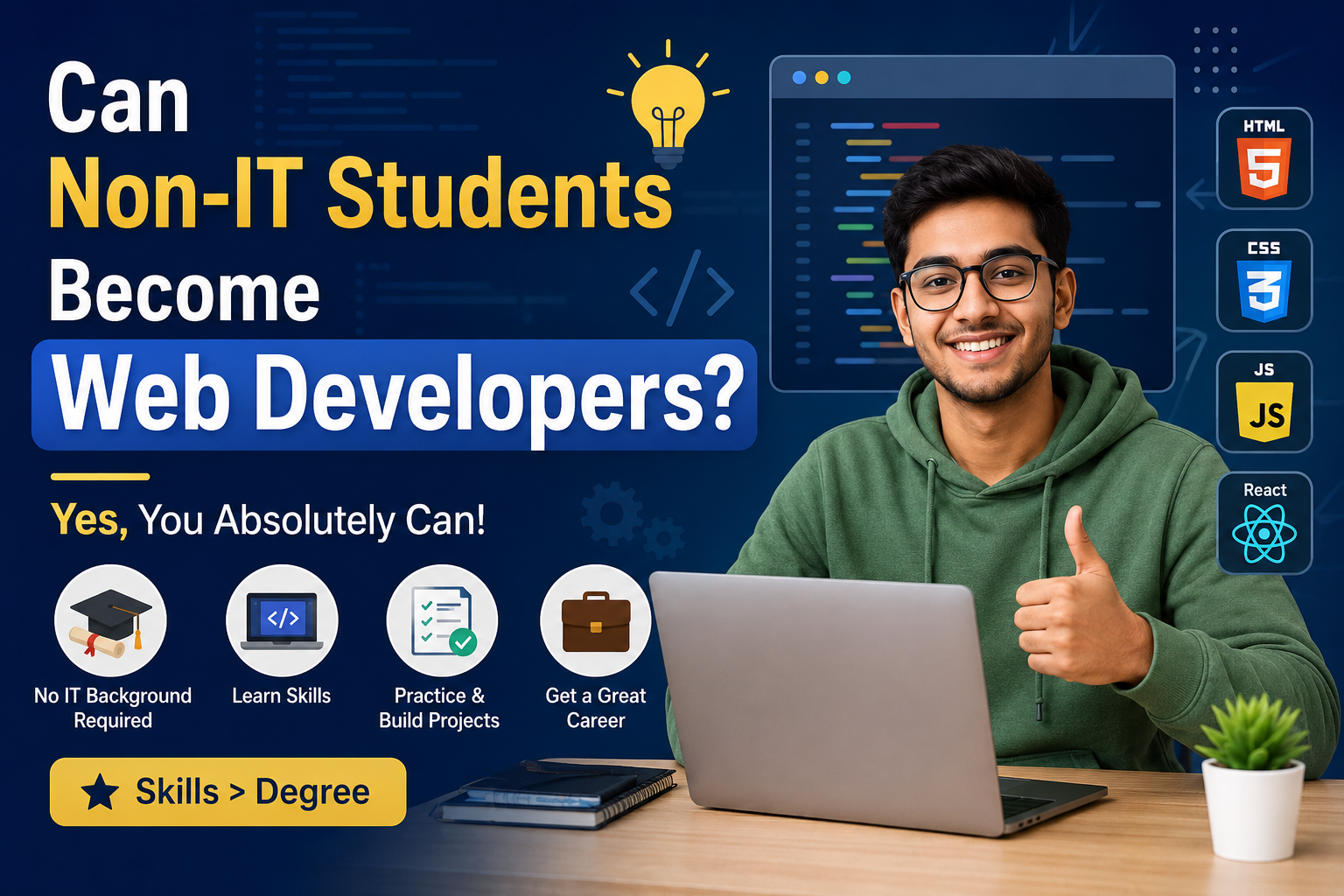
In today's digital era, websites and web applications have become an essential part of every business. From shopping online and booking tickets to attending virtual classes and managing businesses, almost everything happens through websites. As a result, the demand for skilled web developers is increasing rapidly across the world.
One question that many students ask is:
"Can a non-IT student become a web developer?"
The answer is absolutely yes!
Thousands of successful web developers today come from non-technical backgrounds such as Commerce, Arts, Science, Management, Hotel Management, Mechanical Engineering, Civil Engineering, and even Medicine. What matters most is your willingness to learn, practice consistently, and solve problems—not your educational background.
If you are wondering whether you need a Computer Science degree to build a successful career in web development, this comprehensive guide will answer all your questions.
What Is Web Development?
Before discussing whether non-IT students can become web developers, let's first understand what web development actually means.
Web development is the process of creating, designing, developing, and maintaining websites and web applications. A web developer writes code that makes websites functional, interactive, responsive, and user-friendly.
Web development generally consists of three major areas:
1. Frontend Development
Frontend development focuses on everything users see and interact with on a website.
Frontend developers work with technologies like:
HTML
CSS
JavaScript
React
Bootstrap
Tailwind CSS
They create visually attractive and responsive websites that work smoothly across devices.
2. Backend Development
Backend development handles the server-side logic behind a website.
Backend developers manage:
Databases
Authentication
APIs
Server communication
Business logic
Popular backend technologies include:
Node.js
Express.js
PHP
Python
Java
MySQL
MongoDB
3. Full Stack Development
A Full Stack Developer works on both frontend and backend development.
Since full stack developers can handle complete website development, they are among the most in-demand professionals in the IT industry.
Do You Need an IT Degree to Become a Web Developer?
The biggest misconception among students is that only Computer Science graduates can become software developers.
This is completely false.
Unlike many traditional professions, the IT industry values skills more than degrees.
Companies today focus on:
Practical coding knowledge
Portfolio projects
Problem-solving ability
Communication skills
Teamwork
Continuous learning
If you possess these skills, your educational background becomes far less important.
Many multinational companies, startups, and software agencies hire talented developers regardless of whether they studied Computer Science.
Why Non-IT Students Are Choosing Web Development
Over the past few years, thousands of students from non-technical backgrounds have shifted toward web development.
Here are some major reasons behind this trend.
1. High Demand Across Industries
Every business today needs an online presence.
Industries such as:
Healthcare
Education
Banking
Retail
Hospitality
Travel
Manufacturing
Real Estate
Government
all require professional websites and web applications.
This creates a huge demand for web developers every year.
2. Attractive Salary Packages
Web development offers competitive salaries even for freshers.
As developers gain experience and expertise, their earning potential increases significantly.
Skilled developers can also work as:
Freelancers
Remote employees
Consultants
Startup founders
3. No Specific Degree Required
Unlike many careers, web development doesn't require a specific educational qualification.
Many successful developers have backgrounds in:
B.Com
BBA
BA
B.Sc.
MBA
Hotel Management
Mechanical Engineering
Civil Engineering
What matters most is your practical coding ability.
4. Flexible Career Options
Web developers can work in multiple ways:
Full-time jobs
Freelancing
Remote jobs
International clients
Startup companies
Government projects
Personal business
This flexibility attracts students from various educational backgrounds.
Can Commerce Students Become Web Developers?
Yes.
Commerce students often possess strong analytical thinking and business knowledge.
These skills help them understand:
Business requirements
Customer behavior
E-commerce websites
Financial platforms
CRM systems
Many successful developers today started their journey after completing B.Com or BBA.
Can Arts Students Become Web Developers?
Absolutely.
Arts students usually have excellent creativity and communication skills.
These qualities help in:
UI Design
UX Design
Website content planning
User experience
Responsive design
Creative problem-solving
Many frontend developers come from Arts backgrounds because they naturally understand design principles.
Can Science Students Become Web Developers?
Definitely.
Science students already have experience with logical thinking and analytical reasoning.
This makes learning programming concepts much easier.
Students from Physics, Mathematics, Chemistry, Biotechnology, and other science streams frequently transition into software development.
Why Educational Background Matters Less Than Skills
The software industry is project-driven.
Employers want developers who can:
Build websites
Solve coding problems
Debug errors
Meet project deadlines
Collaborate with teams
Learn new technologies quickly
During interviews, recruiters often ask candidates to demonstrate their coding skills or complete technical tasks. Your ability to solve real-world problems carries much more weight than the name of your degree.
Common Myths About Non-IT Students Becoming Developers
Many students hesitate to pursue web development because of common misconceptions. Let's separate fact from fiction.
Myth 1: Only Computer Science Students Can Learn Programming
Reality: Programming is a skill that anyone can learn with consistent practice. Students from Arts, Commerce, Science, and other fields successfully transition into web development every year.
Myth 2: Coding Is Too Difficult
Reality: Coding may seem challenging at first, but it becomes easier with regular practice. Like learning a new language, the more you practice, the more confident you become.
Myth 3: Mathematics Must Be Very Strong
Reality: Basic mathematical understanding is sufficient for most web development roles. Advanced mathematics is generally not required for building websites and web applications.
Myth 4: Age Is a Barrier
Reality: Whether you're a college student, a graduate, or someone looking to switch careers, web development remains an accessible and rewarding field. Many professionals begin learning coding in their late twenties or thirties and build successful careers.
Myth 5: You Need Expensive Equipment
Reality: A standard laptop with a stable internet connection is enough to begin learning web development. Many of the tools used by developers are free and open source.
Essential Skills Every Non-IT Student Should Develop
To become a successful web developer, focus on building these core skills:
Technical Skills
HTML for creating web page structure
CSS for designing layouts and styling
JavaScript for adding interactivity
Responsive web design
Version control with Git and GitHub
Basic understanding of databases
API integration
Problem-solving through coding
Soft Skills
Technical knowledge alone isn't enough. Employers also value:
Communication skills
Time management
Team collaboration
Adaptability
Critical thinking
Continuous learning mindset
Developing both technical and interpersonal skills will make you a well-rounded web developer and improve your employability.
Step-by-Step Roadmap for Non-IT Students
One of the biggest mistakes beginners make is trying to learn everything at once. Web development includes many technologies, but you don't need to master them all on day one.
Follow this structured roadmap to learn efficiently.
Step 1: Understand How Websites Work
Before writing your first line of code, it's important to understand the basics of how websites function.
Learn concepts such as:
What is a website?
What is a web browser?
How does the internet work?
What is a domain name?
What is web hosting?
How do client and server communicate?
What is HTTP and HTTPS?
Having a strong foundation will make learning programming much easier.
Step 2: Learn HTML
HTML (HyperText Markup Language) is the building block of every website.
It defines the structure of web pages using elements such as:
Headings
Paragraphs
Images
Buttons
Links
Tables
Forms
Lists
Practice Projects
Personal Profile Page
Resume Website
College Assignment Page
Product Landing Page
Spend enough time understanding semantic HTML because it improves website accessibility and SEO.
Step 3: Learn CSS
Once you've learned HTML, the next step is CSS (Cascading Style Sheets).
CSS makes websites attractive and responsive.
You'll learn:
Colors
Fonts
Layouts
Flexbox
CSS Grid
Animations
Responsive Design
Media Queries
Beginner Projects
Restaurant Website
Portfolio Website
Travel Website
Event Landing Page
Responsive design is especially important because most users access websites through mobile devices.
Step 4: Learn JavaScript
JavaScript brings websites to life by adding interactivity.
You'll learn concepts such as:
Variables
Functions
Loops
Arrays
Objects
Events
DOM Manipulation
ES6 Features
Practice Projects
Calculator
Digital Clock
To-Do List
Quiz App
Weather App
Image Slider
JavaScript is considered one of the most important programming languages for web development, making it a must-learn skill.
Step 5: Learn Git and GitHub
Every professional developer uses Git for version control.
Git helps you:
Track code changes
Work in teams
Restore previous versions
Collaborate on projects
GitHub allows you to:
Store your projects online
Build your portfolio
Showcase your coding skills to recruiters
Contribute to open-source projects
Employers often review GitHub profiles before scheduling interviews.
Step 6: Learn a Frontend Framework
Once you're comfortable with JavaScript, move on to a frontend framework.
The most popular choice is React.js, which is widely used for building fast, interactive user interfaces.
Learning React helps you:
Build reusable components
Manage application state
Create Single Page Applications (SPAs)
Improve development speed
Other frameworks include Angular and Vue.js, but React remains one of the most in-demand skills in the industry.
Step 7: Learn Backend Development
Frontend development focuses on what users see, while backend development handles the logic behind the scenes.
Popular backend technologies include:
Node.js
Express.js
PHP
Python (Django/Flask)
You'll learn to:
Build APIs
Handle user authentication
Process forms
Connect applications to databases
Manage server-side operations
Backend skills allow you to create complete web applications.
Step 8: Learn Databases
Every dynamic website stores data.
Some commonly used databases are:
SQL Databases
MySQL
PostgreSQL
NoSQL Databases
MongoDB
Topics to learn include:
CRUD Operations
Tables and Collections
Relationships
Queries
Data Validation
Understanding databases is essential for developing scalable applications.
Step 9: Build Real-World Projects
Projects are the strongest proof of your skills. Recruiters are more interested in what you've built than in how many tutorials you've watched.
Start with simple projects and gradually increase complexity.
Beginner Projects
Portfolio Website
Calculator
Quiz Application
Weather App
Blog Website
Intermediate Projects
E-commerce Website
Movie Search App
Expense Tracker
Food Ordering Website
Student Management System
Advanced Projects
Online Learning Platform
Hospital Management System
Job Portal
CRM Dashboard
Social Media Application
Aim to create 8–10 high-quality projects to showcase your abilities.
Create a Professional Portfolio
A portfolio website acts as your online resume.
Include:
About Me
Skills
Projects
Certifications
Resume Download
Contact Form
GitHub Profile
LinkedIn Profile
A well-designed portfolio demonstrates both your technical expertise and your attention to detail.
How Long Does It Take to Become a Web Developer?
The timeline depends on your learning pace and consistency.
If You Study 1–2 Hours Daily
HTML & CSS: 1 Month
JavaScript: 2 Months
React: 1–2 Months
Backend Development: 2 Months
Projects & Portfolio: 1–2 Months
Overall, many learners can become job-ready within 6–9 months of focused study and practice.
Common Challenges Faced by Non-IT Students
Transitioning into web development comes with challenges, but they can be overcome with the right mindset.
Fear of Coding
Many beginners believe coding is too difficult. In reality, regular practice helps build confidence over time.
Information Overload
The internet offers countless tutorials and resources, which can be overwhelming. Stick to a structured learning path instead of jumping between topics.
Comparing Yourself to Others
Everyone learns at a different pace. Focus on improving your own skills rather than comparing your progress with others.
Lack of Practical Experience
Watching videos isn't enough. Build projects, solve coding problems, and apply what you learn to gain real-world experience.
Tips to Learn Faster
To accelerate your learning:
Practice coding every day.
Build projects after each topic.
Read official documentation.
Participate in coding challenges.
Join developer communities.
Review and improve your old projects.
Learn from your mistakes instead of fearing them.
Consistency is more valuable than studying for long hours occasionally.
Do Certifications Matter?
Certifications can strengthen your profile, especially if you're from a non-IT background. They demonstrate your commitment to learning and can help your resume stand out.
However, certifications should complement—not replace—practical skills. Employers are more likely to evaluate your portfolio, coding ability, and problem-solving skills during the hiring process.
Career Opportunities After Learning Web Development
Web development is one of the fastest-growing career fields in the IT industry. As businesses continue to expand their digital presence, the demand for skilled web developers continues to rise.
Whether you're a graduate, a career changer, or a student from a non-IT background, mastering web development can open the door to numerous career paths.
Some popular job roles include:
• Frontend Developer
Frontend developers create the user interface (UI) of websites and web applications using technologies such as HTML, CSS, JavaScript, and React.
Responsibilities:
Designing responsive web pages
Improving user experience
Optimizing website performance
Ensuring cross-browser compatibility
• Backend Developer
Backend developers build the server-side logic that powers websites and applications.
Responsibilities:
Managing databases
Building APIs
Handling authentication and security
Developing business logic
• Full Stack Developer
A Full Stack Developer works on both the frontend and backend, making them highly valuable in startups, software companies, and product-based organizations.
This role offers excellent career growth because it combines multiple technical skills.
• WordPress Developer
Many businesses use WordPress for their websites. Developers who specialize in WordPress can create custom themes, plugins, and business websites without building everything from scratch.
• UI Developer
UI Developers focus on creating visually appealing interfaces while ensuring an excellent user experience.
This role is ideal for individuals who enjoy creativity and design.
• Freelance Web Developer
Freelancing allows developers to work independently with clients from around the world.
Popular freelance services include:
Business websites
Portfolio websites
E-commerce websites
Landing pages
Website maintenance
Bug fixing
Website redesign
Freelancers enjoy flexible working hours and the opportunity to work on diverse projects.
Salary of Web Developers in India
One of the biggest advantages of choosing web development is its strong earning potential.
While salaries vary depending on location, skills, company, and experience, the career offers excellent growth opportunities.
Average Salary Progression
| Experience | Expected Salary Range (Approx.) |
|---|---|
| Fresher | ₹3–6 LPA |
| 2–4 Years | ₹6–10 LPA |
| 5+ Years | ₹10–20+ LPA |
Developers with expertise in modern technologies such as React, Node.js, TypeScript, cloud platforms, and DevOps often command even higher salaries.
Freelancers and remote developers working with international clients may earn significantly more based on project scope and expertise.
Can Non-IT Students Get IT Jobs?
Yes.
Companies primarily evaluate candidates based on:
Technical knowledge
Practical coding skills
Portfolio projects
Problem-solving ability
Communication skills
Willingness to learn
If you can demonstrate these qualities during interviews, your academic background becomes much less important.
Many organizations now conduct coding assessments or technical interviews to assess real-world capabilities rather than focusing solely on degrees.
Importance of Building a Strong Portfolio
Your portfolio is often your first impression on recruiters.
A well-crafted portfolio should include:
Personal introduction
Technical skills
Real-world projects
GitHub profile
Resume
Certifications
Contact information
Showcasing live projects with clean code and proper documentation can significantly improve your chances of getting shortlisted.
Why Internships Matter
Internships provide practical exposure to real-world development environments.
Benefits include:
Hands-on project experience
Team collaboration
Industry exposure
Mentorship from experienced developers
Improved confidence
Better placement opportunities
Even short internships can strengthen your resume and prepare you for full-time roles.
Tips to Crack Your First Web Development Interview
Preparing for interviews is just as important as learning to code.
Here are some practical tips:
Revise HTML, CSS, JavaScript, and your chosen framework.
Be ready to explain your projects in detail.
Practice coding problems regularly.
Understand Git and version control basics.
Learn how APIs and databases work.
Improve your communication and presentation skills.
Stay updated with current web development trends.
Interviewers appreciate candidates who can clearly explain their thought process and demonstrate practical problem-solving.
Why Choose Skill Excellent for Web Development Training?
Choosing the right training institute plays a crucial role in your learning journey.
At Skill Excellent, our Web Development Course is designed to help beginners and non-IT students build practical skills that align with current industry requirements.
What Makes Skill Excellent Different?
✔ Industry-Oriented Curriculum
Our curriculum is regularly updated to include modern technologies and development practices used by leading IT companies.
✔ Expert Trainers
Learn from experienced professionals who bring real-world insights into the classroom.
✔ Hands-on Practical Training
Students work on real projects, gaining practical experience beyond theoretical concepts.
✔ Live Projects
Build a portfolio through live and industry-relevant projects that demonstrate your capabilities to employers.
✔ Placement Assistance
Receive guidance on resume building, interview preparation, and career opportunities to help you transition into the IT industry.
✔ Beginner-Friendly Learning
Whether you're from Commerce, Arts, Science, or another non-IT background, our structured learning approach helps you progress confidently from the basics to advanced concepts.
Frequently Asked Questions (FAQs)
1. Can I become a web developer without a Computer Science degree?
Yes. Many successful web developers come from non-IT backgrounds. Employers value practical skills, projects, and problem-solving abilities more than a specific degree.
2. Is web development difficult for beginners?
Web development has a learning curve, but with consistent practice and the right guidance, beginners can master it effectively.
3. How long does it take to become job-ready?
With focused learning and regular practice, many students become job-ready within 6–9 months, though timelines vary based on individual dedication and prior experience.
4. Which programming language should I learn first?
Start with HTML, CSS, and JavaScript. These technologies form the foundation of web development before moving on to frameworks like React and backend technologies.
5. Do I need advanced mathematics?
No. Basic mathematical understanding is generally sufficient for most web development roles.
6. Can I work as a freelancer after learning web development?
Yes. Many web developers begin freelancing by building business websites, portfolios, blogs, and e-commerce sites for clients.
7. Is web development a good career in 2026?
Absolutely. As businesses continue to invest in digital transformation, the demand for skilled web developers remains strong, making it a promising career choice.
Final Thoughts
The idea that only Computer Science graduates can become web developers is a misconception. Today's IT industry rewards skills, practical experience, and a willingness to learn. If you're from a Commerce, Arts, Science, Management, or any other non-IT background, you can absolutely build a successful career in web development.
Success comes from following a structured learning path, practicing consistently, creating real-world projects, and staying curious about new technologies. With dedication and the right training, you can confidently transition into the world of web development and unlock exciting opportunities in full-time jobs, freelancing, or even entrepreneurship.
If you're ready to start your journey, Skill Excellent's Web Development Course offers industry-focused training, hands-on projects, expert mentorship, and placement support to help you become a job-ready web developer.