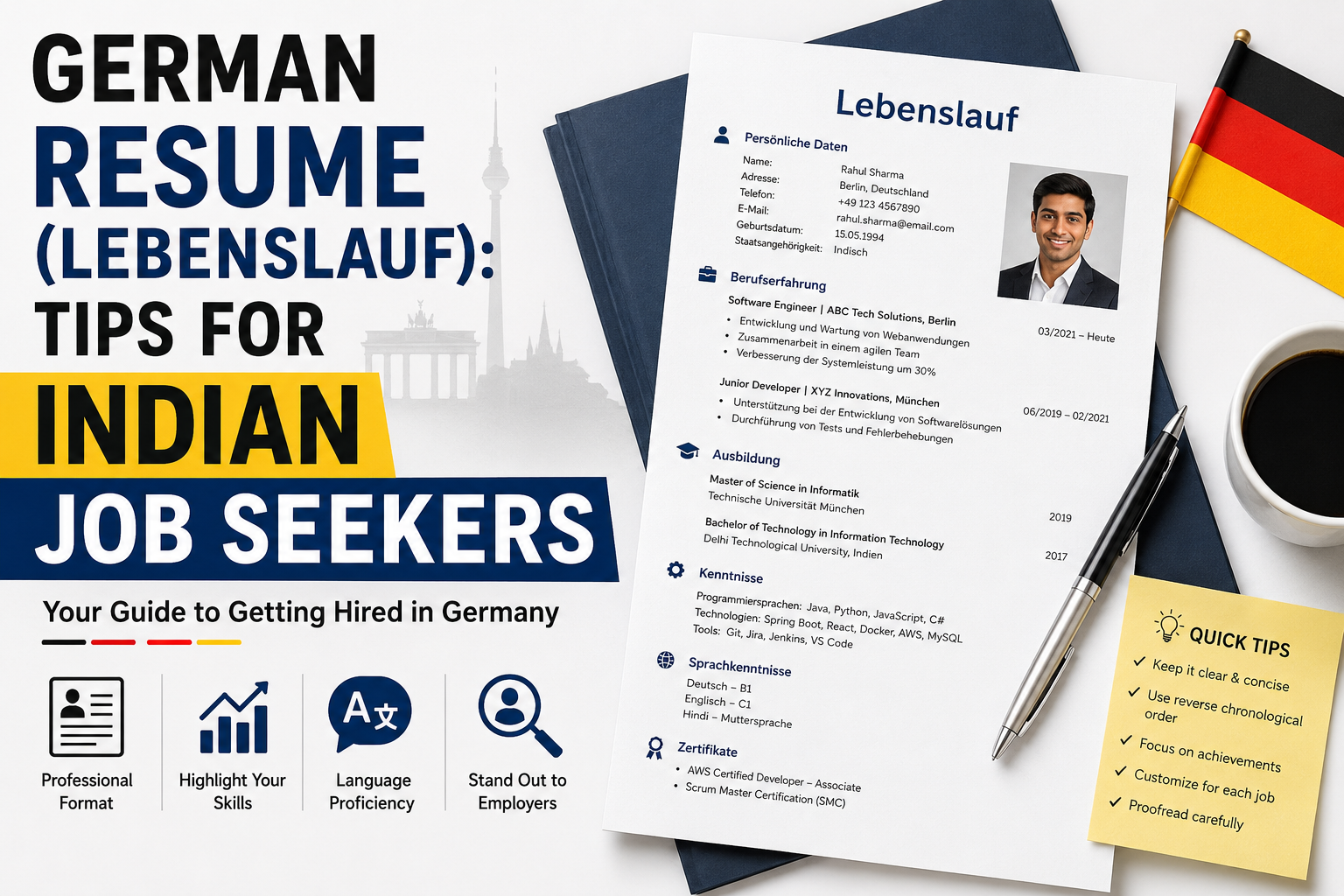
Germany has become one of the most preferred destinations for Indian professionals looking for international career opportunities. With its strong economy, excellent work-life balance, competitive salaries, and growing demand for skilled professionals, Germany offers exciting prospects across industries such as IT, engineering, healthcare, finance, manufacturing, logistics, and research.
However, getting shortlisted for a job in Germany is not only about having the right skills—it is equally important to present them in the right way. One of the first things recruiters evaluate is your Lebenslauf, the German version of a resume or CV.
Many Indian applicants make the mistake of sending an Indian-style resume when applying for German jobs. Unfortunately, this often reduces their chances of receiving interview calls because German employers expect resumes to follow specific standards and formats.
In this comprehensive guide, you'll learn everything you need to know about creating a professional German resume (Lebenslauf), especially if you're an Indian job seeker planning to work in Germany.
What is a German Resume (Lebenslauf)?
A Lebenslauf is the standard resume used in Germany for job applications. The word "Lebenslauf" literally translates to "course of life."
Unlike many resumes used in India, a German Lebenslauf is:
Professional
Structured
Easy to read
Fact-based
Chronological
Highly organized
German recruiters usually spend only 20–40 seconds reviewing a resume initially. Therefore, your resume should communicate your qualifications quickly and clearly.
The primary objective of a Lebenslauf is to demonstrate:
Your educational background
Professional experience
Technical skills
Language proficiency
Certifications
Career progression
It should present information in a logical order without unnecessary graphics, lengthy paragraphs, or exaggerated claims.
Why Indian Job Seekers Need a German-Style Resume
Germany follows different recruitment practices compared to India. Recruiters appreciate precision, honesty, and structure.
A German recruiter expects applicants to submit documents that match local hiring standards.
Submitting an Indian-format resume may create issues such as:
Excessive personal details
Long career summaries
Multiple-page resumes with unnecessary information
Decorative templates
Informal language
Lack of chronological consistency
Using the proper German resume format immediately shows employers that you understand their professional culture.
It also demonstrates:
Attention to detail
Professionalism
Cultural awareness
Serious interest in working in Germany
Germany's Growing Demand for Skilled Professionals
Germany continues to experience shortages across multiple industries due to demographic changes and increasing demand for skilled workers.
Some of the most in-demand professions include:
Information Technology
Software Developers
Full Stack Developers
Cloud Engineers
Cyber Security Specialists
AI Engineers
Data Analysts
DevOps Engineers
Engineering
Mechanical Engineers
Civil Engineers
Electrical Engineers
Automotive Engineers
Industrial Engineers
Healthcare
Registered Nurses
Doctors
Physiotherapists
Medical Technicians
Business & Finance
Accountants
Financial Analysts
HR Professionals
Supply Chain Managers
Skilled Trades
Electricians
Welders
Technicians
Machine Operators
Because thousands of international professionals compete for these positions, having a properly formatted German resume significantly improves your chances of being shortlisted.
German Resume vs Indian Resume
Many applicants assume that all resumes are the same.
This is one of the biggest mistakes.
Let's compare both formats.
| German Resume | Indian Resume |
|---|---|
| Clean and professional | Often colorful |
| Reverse chronological order | Mixed formatting |
| 1–2 pages | Sometimes 3–5 pages |
| Fact-based | Detailed descriptions |
| Minimal design | Graphic-heavy templates |
| ATS-friendly | Often not ATS optimized |
| Focus on achievements | Focus on responsibilities |
| Easy scanning | Long paragraphs |
German employers value clarity more than creativity.
Simple formatting almost always performs better.
Ideal Length of a German Resume
One common question Indian candidates ask is:
How long should my German resume be?
The answer depends on your experience.
Freshers
One page is ideal.
Professionals (2–10 years)
Two pages are acceptable.
Senior Professionals
Maximum two pages unless specifically requested.
Recruiters appreciate concise resumes.
Avoid filling pages with irrelevant information.
Standard Format of a German Resume
A professional German resume generally follows this structure.
1. Personal Information
Include only relevant details.
Typically include:
Full Name
Phone Number
Professional Email Address
LinkedIn Profile (optional)
Location
Nationality (optional)
Some employers may also expect:
Date of Birth
Place of Birth
However, international companies increasingly focus on skills rather than personal details, so requirements may vary.
2. Professional Summary
Write a concise summary in 3–5 lines highlighting:
Years of experience
Industry
Core expertise
Career objective
Example:
"Software Engineer with four years of experience in Java, Spring Boot, and cloud technologies. Skilled in designing scalable enterprise applications with expertise in Agile development. Seeking opportunities to contribute to Germany's growing technology sector."
3. Work Experience
This is the most important section.
Always list your experience in reverse chronological order, meaning your most recent job comes first.
For every position mention:
Job title
Company name
Location
Employment duration
Major achievements
Instead of writing duties, focus on measurable accomplishments.
For example:
Weak Example
Responsible for software development.
Strong Example
Developed enterprise applications serving over 50,000 users while reducing processing time by 35%.
Numbers make achievements more credible.
4. Educational Qualifications
Include:
Degree
University
Location
Graduation year
Percentage or CGPA (if relevant)
Example:
MBA (Human Resource Management)
XYZ University, India
2024
Bachelor of Commerce
ABC University
2022
5. Skills
Recruiters often scan this section before reading the rest of the resume.
Separate your skills into categories.
Technical Skills
Examples:
Java
Python
SQL
SAP
AutoCAD
AWS
Excel
Power BI
Soft Skills
Examples:
Leadership
Teamwork
Communication
Problem Solving
Time Management
Adaptability
Avoid mentioning every skill you've ever learned.
Only include skills relevant to the job.
6. Language Skills
Language proficiency is extremely important in Germany.
Mention your level honestly.
Example:
English – C1
German – B1
Hindi – Native
If you have certifications such as Goethe, TestDaF, or TELC, mention them.
Even if a role is advertised in English, German language skills can significantly strengthen your application.
7. Certifications
Highlight professional certifications relevant to your field.
Examples:
AWS Certified Cloud Practitioner
PMP
Scrum Master
Google Data Analytics
Microsoft Azure Fundamentals
Cisco CCNA
Industry-recognized certifications demonstrate your commitment to continuous learning and help differentiate your profile from other applicants.
Why Learning German Gives You a Competitive Advantage
Although many multinational companies in Germany hire English-speaking professionals, learning German greatly improves your career prospects.
Benefits include:
Better job opportunities
Higher salary potential
Easier workplace communication
Improved networking
Faster career growth
Better integration into German society
Many employers prefer candidates who possess at least A2 or B1 level German, especially for customer-facing, healthcare, logistics, manufacturing, and administrative roles.
Learning German before applying for jobs also reflects commitment and adaptability—qualities that German employers highly value.
How to Write an ATS-Friendly German Resume
Many companies in Germany use Applicant Tracking Systems (ATS) to screen resumes before they reach a recruiter. An ATS scans your resume for relevant keywords, skills, and formatting. If your resume isn't optimized, it may never be seen by a hiring manager—even if you're highly qualified.
Tips to Make Your Resume ATS-Friendly
1. Use a Simple Format
Avoid:
Tables with complex layouts
Text boxes
Graphics
Icons
Charts
SmartArt
Multiple columns
Instead, use clear headings and standard fonts like:
Calibri
Arial
Helvetica
Times New Roman
Maintain a font size of 10–12 pt for body text and 14–16 pt for headings.
2. Include Relevant Keywords
Recruiters and ATS software look for job-specific keywords.
For example, if the job description mentions:
Java
Spring Boot
REST APIs
Docker
AWS
Your resume should naturally include these terms—provided you genuinely possess those skills.
Avoid keyword stuffing. Use them where they accurately reflect your experience.
3. Save Your Resume in the Right Format
Unless the employer specifies otherwise, save your resume as a PDF to preserve formatting. If the application explicitly requests a Microsoft Word document, submit a .docx file instead.
Use a professional file name, such as:
Rahul_Sharma_Lebenslauf.pdf
Avoid names like:
Resume Final
CV Latest
New Resume 2026
Updated Resume Final Final
Tailor Your Resume for Every Job Application
One of the biggest mistakes candidates make is sending the same resume to every employer.
German recruiters appreciate resumes that clearly match the job description.
Before applying:
Read the job posting carefully.
Highlight the required skills and qualifications.
Adjust your professional summary.
Prioritize relevant work experience.
Add keywords that match the role.
Remove unrelated information.
A tailored resume significantly increases your chances of passing ATS filters and attracting recruiter attention.
Writing Strong Achievement Statements
German employers value measurable results more than generic job responsibilities.
Instead of writing:
Managed a sales team.
Write:
Led a team of 12 sales executives and increased annual revenue by 28% through strategic client acquisition.
Instead of:
Worked on software development.
Write:
Developed cloud-based applications that reduced system downtime by 40% and improved application performance.
Formula for Writing Achievements
Action Verb + Task + Measurable Result
Examples:
Implemented a new inventory management system that reduced stock errors by 35%.
Automated HR reporting, saving over 15 hours of manual work each week.
Improved customer satisfaction scores from 82% to 95% within one year.
Numbers make your accomplishments more credible and impactful.
Common Resume Mistakes Indian Job Seekers Should Avoid
Many qualified candidates lose interview opportunities because of avoidable errors.
1. Using an Unprofessional Email Address
Avoid:
Use a professional format:
2. Including Irrelevant Personal Information
Avoid mentioning:
Religion
Caste
Marital status (unless specifically requested)
Aadhaar number
PAN card number
Passport number
Father's or mother's name
German employers are primarily interested in your qualifications and experience.
3. Writing Long Paragraphs
Recruiters prefer resumes that are easy to scan.
Use:
Bullet points
Short sentences
Clear headings
Consistent formatting
4. Spelling and Grammar Errors
Even minor language mistakes can create a negative impression.
Before submitting:
Run a spell check.
Proofread carefully.
Ask someone else to review your resume if possible.
A polished resume reflects professionalism and attention to detail.
5. Exaggerating Skills or Experience
Never claim skills you don't possess.
For example:
If your German proficiency is A2, don't write C1.
If you haven't worked with SAP professionally, don't list yourself as an expert.
German employers value honesty, and inconsistencies may become evident during interviews.
Should You Include a Photo?
This is a common question among Indian applicants.
Traditionally, German resumes often included a professional passport-style photo. However, many international companies and modern organizations no longer require one.
If you choose to include a photo:
Use a recent, high-quality headshot.
Wear professional attire.
Ensure a clean, neutral background.
Avoid selfies, casual photos, or vacation pictures.
Always follow the employer's instructions if the job posting specifies whether a photo is required.
Should You Write Your Resume in German or English?
The answer depends on the job posting.
Write in German if:
The vacancy is advertised in German.
German proficiency is required.
The company primarily operates in German.
Write in English if:
The job advertisement is in English.
The company is international.
English is listed as the primary working language.
Never translate your resume using machine translation without proofreading. If writing in German, ensure the language is accurate and natural.
Industry-Specific Resume Tips
Different industries emphasize different skills. Tailor your resume accordingly.
Information Technology (IT)
Highlight:
Programming languages
Frameworks
Databases
Cloud platforms
DevOps tools
Certifications
GitHub or portfolio links (if relevant)
Focus on projects, technical expertise, and measurable results.
Engineering
Include:
CAD software
Technical standards
Manufacturing processes
Project management
Quality assurance
Industry certifications
Mention specific projects and their outcomes.
Healthcare
Emphasize:
Clinical experience
Medical certifications
Patient care
Language proficiency (especially German)
Licenses and registrations
Accuracy and compliance are essential in this sector.
Business and Management
Highlight:
Leadership experience
Team management
Budget handling
Process improvement
Client relationship management
Strategic planning
Use metrics to demonstrate business impact.
Sample German Resume Structure
Below is a simplified structure of a German Lebenslauf:
Name
Phone Number
Professional Email
Location
LinkedIn (Optional)
Professional Summary
A concise overview of your experience, expertise, and career objective.
Professional Experience
Software Engineer
ABC Technologies | Bengaluru, India
2023 – Present
Developed scalable web applications using Java and Spring Boot.
Reduced API response time by 35%.
Collaborated with cross-functional teams using Agile methodologies.
Education
Bachelor of Technology – Computer Science
XYZ University
2022
Skills
Technical Skills
Java
Python
SQL
AWS
Docker
Soft Skills
Teamwork
Problem Solving
Communication
Leadership
Languages
English – C1
German – B1
Hindi – Native
Certifications
AWS Certified Cloud Practitioner
Scrum Master Certification
This structure is clean, professional, and easy for both ATS software and recruiters to read.
Why a Well-Written Cover Letter Matters
In Germany, many employers expect applicants to submit a cover letter (Anschreiben) along with their resume.
A strong cover letter should:
Explain why you're interested in the role.
Highlight your most relevant qualifications.
Demonstrate your understanding of the company.
Show enthusiasm for working in Germany.
Avoid repeating your resume. Instead, use the cover letter to connect your experience with the employer's needs.
Preparing Supporting Documents
In addition to your Lebenslauf, German employers may ask for:
Educational certificates
Work experience letters
Professional certifications
Language certificates (Goethe, TELC, TestDaF, etc.)
Reference letters
Portfolio (for creative or technical roles)
Keep scanned copies in high quality and organize them in clearly named PDF files for easy submission.
Advanced Tips to Make Your German Resume Stand Out
A professional resume should do more than list your qualifications—it should demonstrate your value to potential employers. Here are some strategies that can help you leave a lasting impression.
1. Quantify Your Achievements
Recruiters appreciate measurable results because they clearly show your impact.
Instead of writing:
Improved customer service.
Write:
Increased customer satisfaction from 85% to 96% by implementing a new feedback system.
Instead of:
Managed projects.
Write:
Successfully delivered 12 client projects within budget and before deadlines.
Using numbers makes your accomplishments more credible and memorable.
2. Highlight International Experience
If you have worked with:
International clients
Global teams
Overseas projects
Remote international companies
Be sure to mention it.
German employers value candidates who can collaborate across cultures and communicate effectively in international environments.
3. Showcase Relevant Projects
Freshers and early-career professionals often have limited work experience. In such cases, academic and personal projects can strengthen your profile.
Examples include:
Software applications
Research projects
Data analysis projects
Engineering prototypes
Marketing campaigns
HR case studies
Supply chain simulations
For each project, include:
Project title
Technologies or tools used
Your role
Key outcomes or achievements
4. Include Volunteer Experience
Volunteer work can demonstrate:
Leadership
Teamwork
Communication
Initiative
Social responsibility
If you've volunteered for NGOs, college events, community programs, or professional organizations, include relevant experiences that align with the role you're applying for.
5. Keep Your LinkedIn Profile Updated
Many German recruiters review candidates' LinkedIn profiles before scheduling interviews.
Ensure your profile includes:
Professional headline
Updated work experience
Skills
Certifications
Professional photo
Recommendations (if available)
Your LinkedIn information should match the details in your resume.
Resume Checklist Before Applying
Before submitting your application, review the following checklist:
✅ Resume limited to one or two pages
✅ Professional formatting with clear headings
✅ ATS-friendly layout
✅ Correct grammar and spelling
✅ Professional email address
✅ Updated phone number
✅ Relevant work experience
✅ Measurable achievements
✅ Job-specific keywords
✅ Education details
✅ Technical and soft skills
✅ Language proficiency
✅ Certifications
✅ Correct PDF file name
A final review can prevent simple mistakes that may affect your chances of getting shortlisted.
Common Questions About German Resumes (FAQs)
1. Is a German resume different from an Indian resume?
Yes. A German Lebenslauf is generally more concise, structured, and achievement-focused. It emphasizes clarity, reverse chronological order, and professional formatting.
2. How long should a German resume be?
Freshers: One page
Experienced professionals: One to two pages
Senior professionals: Maximum two pages unless otherwise requested
3. Should I include my photograph?
It depends on the employer. While many traditional German companies still accept resumes with a professional photo, many international organizations do not require one. Always follow the job posting's instructions.
4. Should I write my resume in German?
Write your resume in:
German if the job posting is in German.
English if the employer specifies English as the working language.
5. Is German language proficiency necessary?
Not always, but it offers a significant advantage. Many English-speaking roles exist, particularly in IT and multinational companies. However, proficiency at A2, B1, or higher can improve your employment prospects and workplace integration.
6. What file format should I use?
PDF is generally the preferred format unless the employer specifically requests a Word document.
7. Should I include hobbies?
Only if they add value or demonstrate relevant qualities.
Examples:
Learning foreign languages
Public speaking
Volunteering
Chess
Marathon running
Avoid listing generic hobbies that do not contribute to your professional profile.
Best Practices for Indian Job Seekers
If you're planning to work in Germany, your preparation should extend beyond creating a resume.
Consider the following:
Learn basic German before applying.
Research German workplace culture.
Prepare a customized cover letter for each application.
Optimize your LinkedIn profile.
Obtain internationally recognized certifications relevant to your field.
Build a portfolio if you're in IT, design, marketing, or engineering.
Stay updated with Germany's in-demand occupations and hiring trends.
Practice interview questions commonly asked by German employers.
A well-rounded application significantly increases your chances of receiving interview invitations.
How Learning German Can Boost Your Career
For Indian professionals, learning German is an investment that offers long-term benefits.
Advantages include:
Access to more job opportunities
Better communication with colleagues
Increased employability
Higher earning potential
Faster career growth
Easier integration into German society
Improved chances of long-term settlement
Even achieving A2 or B1 proficiency can make your profile more attractive to employers.
Final Thoughts
Creating a professional German Lebenslauf is one of the most important steps toward building a successful career in Germany. Unlike traditional resumes used in many countries, a German resume emphasizes simplicity, structure, honesty, and measurable achievements.
For Indian job seekers, understanding these expectations can make a significant difference. A concise, ATS-friendly, and role-specific resume demonstrates professionalism and increases the likelihood of progressing to the interview stage.
Remember that your resume is often your first impression. Invest time in tailoring it for every application, highlighting your strengths with evidence, and presenting your qualifications in a way that aligns with German hiring standards. Combined with a strong cover letter, relevant certifications, and German language skills, a well-crafted Lebenslauf can open doors to exciting career opportunities in one of Europe's strongest economies.
Conclusion
Germany continues to attract skilled professionals from around the world, and Indian candidates are well-positioned to benefit from its growing demand for talent. However, success begins with a resume that reflects German recruitment expectations.
By following the guidance in this three-part series—using a clean format, emphasizing achievements, optimizing for ATS, and continuously improving your professional profile—you can significantly enhance your chances of securing interviews and advancing your international career.
Whether you're a fresher, an experienced professional, or planning to relocate in the future, creating a strong German Lebenslauf is a crucial first step toward achieving your career goals in Germany.