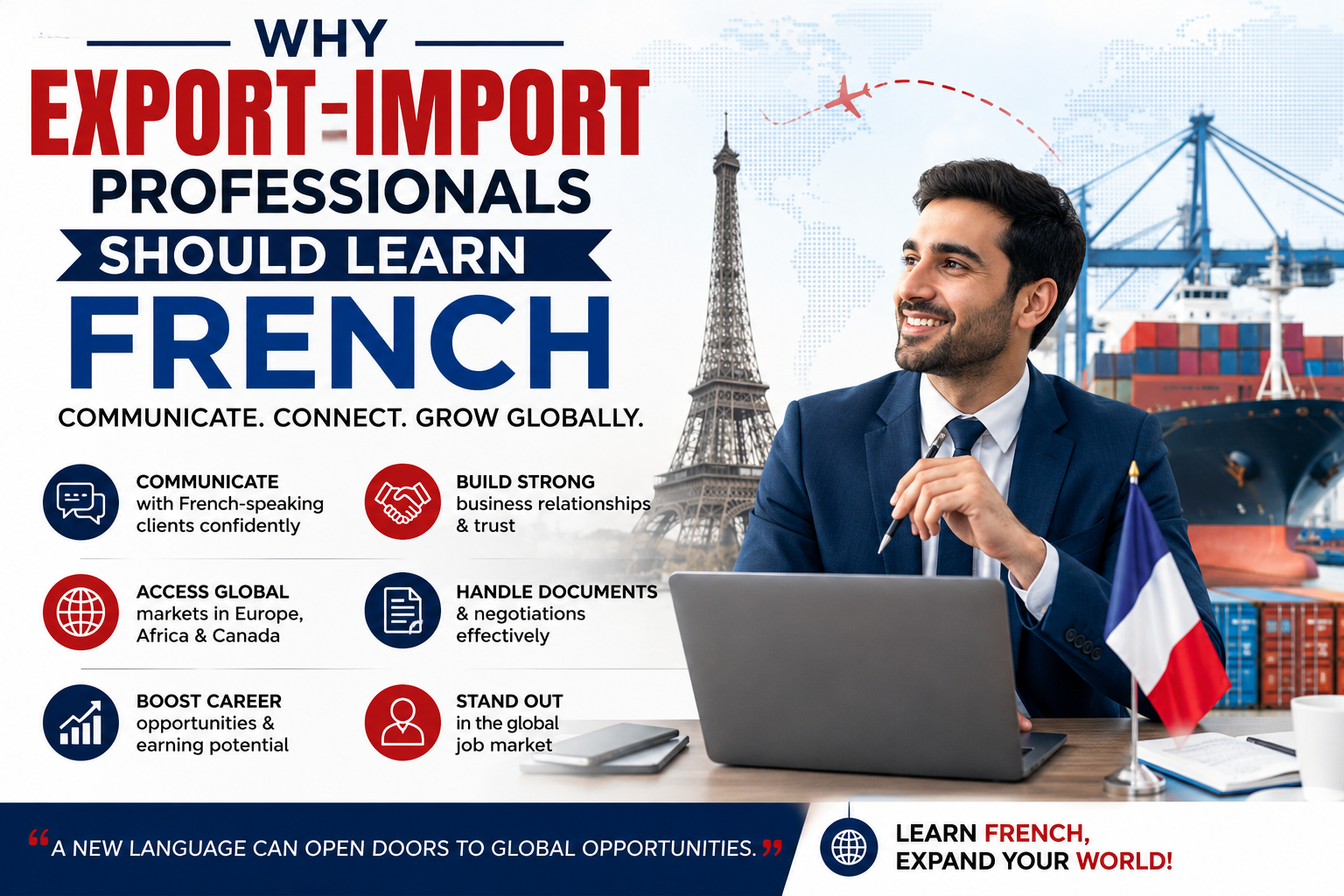
Introduction
The export-import industry has evolved into one of the fastest-growing sectors in the global economy. Businesses today no longer operate within national boundaries; they actively trade with partners, suppliers, distributors, and customers across multiple countries. As international trade continues to expand, professionals working in export-import must develop skills that give them a competitive advantage.
While knowledge of international trade regulations, logistics, customs procedures, and documentation remains essential, language skills have become equally valuable. Effective communication is the foundation of successful international business, and professionals who can communicate in more than one language often enjoy better career opportunities, stronger client relationships, and faster business growth.
Among the world's leading business languages, French holds a unique position. It is spoken by more than 320 million people across five continents and serves as an official language in nearly 30 countries. Many of these countries are emerging markets with rapidly growing economies and increasing trade relationships with India.
For export-import professionals, learning French is not merely about acquiring another language—it is about unlocking access to international markets, improving negotiations, building trust with overseas clients, and creating new business opportunities.
Whether you work as an export manager, import executive, logistics coordinator, international sales representative, customs consultant, freight forwarder, supply chain professional, entrepreneur, or business owner, learning French can significantly enhance your professional value in today's competitive global marketplace.
The Growing Importance of French in Global Trade
International trade is becoming increasingly multilingual. Although English is widely used for business communication, it is not always the preferred language in many parts of the world.
French remains one of the most influential languages in international commerce because it is spoken across Europe, Africa, North America, and several island nations involved in global trade. Countries where French is widely used are major producers and consumers of products ranging from agricultural goods and pharmaceuticals to luxury products, machinery, automobiles, aerospace equipment, minerals, energy resources, textiles, and consumer goods.
Many multinational companies based in French-speaking countries prefer conducting meetings, negotiations, presentations, and official communications in French. Professionals who understand the language often find it easier to build long-term partnerships and establish credibility with international clients.
As India's exports continue to diversify into sectors such as engineering goods, pharmaceuticals, information technology, textiles, processed foods, chemicals, handicrafts, renewable energy equipment, and electronic products, communication with French-speaking buyers has become increasingly important.
Learning French enables professionals to communicate confidently with buyers, suppliers, distributors, customs authorities, logistics partners, and trade organizations across multiple regions.
Why French Is a Strategic Business Language
French is often referred to as the language of diplomacy, international cooperation, and global commerce. It is one of the official languages of numerous international organizations, making it highly relevant for professionals involved in cross-border business.
For export-import professionals, French offers strategic advantages that extend beyond everyday communication. It allows professionals to understand cultural expectations, negotiate effectively, interpret business documents accurately, and participate confidently in international trade exhibitions and business meetings.
Unlike many languages that are primarily limited to one country, French provides access to a vast network of economies across different continents. This makes it one of the most valuable languages for professionals involved in international trade.
Some of the world's most influential industries—including luxury goods, aerospace, automotive manufacturing, pharmaceuticals, agriculture, fashion, cosmetics, food processing, logistics, shipping, and renewable energy—have strong French-speaking markets. Professionals who understand the language can engage more effectively with companies operating in these sectors.
In today's competitive business environment, language skills are often viewed as an investment rather than an additional qualification. Employers increasingly seek candidates who can manage international communications without relying entirely on translators or intermediaries.
Top Reasons Export-Import Professionals Should Learn French
1. Access to Major French-Speaking Markets
One of the biggest advantages of learning French is gaining access to a wide network of international markets.
French is spoken in countries such as France, Belgium, Switzerland, Luxembourg, Canada (particularly Quebec), Senegal, Côte d'Ivoire, Cameroon, Morocco, Tunisia, Algeria, Madagascar, Benin, Burkina Faso, Niger, Mali, the Democratic Republic of the Congo, and several others.
These countries collectively represent significant opportunities for exporters and importers across various industries.
Indian businesses increasingly export products such as:
- Pharmaceuticals
- Textiles and garments
- Engineering goods
- Agricultural products
- Processed foods
- Tea and coffee
- Leather products
- Chemicals
- Gems and jewellery
- Information technology services
- Automobile components
- Handicrafts
Similarly, India imports machinery, industrial equipment, aircraft components, luxury goods, cosmetics, chemicals, advanced technology products, and specialized manufacturing equipment from several French-speaking economies.
Professionals who understand French can communicate directly with buyers, suppliers, distributors, and logistics companies without always depending on translators. This improves efficiency, reduces communication gaps, and accelerates business processes.
2. Better Communication with International Clients
Communication is one of the most critical aspects of successful international trade.
Even when business agreements are written in English, clients appreciate professionals who make an effort to communicate in their native language.
Simple interactions—such as greeting clients, discussing product specifications, explaining shipping schedules, responding to inquiries, or participating in meetings in French—can leave a lasting positive impression.
When clients feel understood, they are more likely to trust your company and continue long-term business relationships.
Language barriers often create misunderstandings regarding product quality, packaging requirements, shipping timelines, payment terms, customs documentation, and technical specifications.
Learning French minimizes these risks by enabling professionals to communicate more clearly and confidently.
Moreover, professionals who speak French often become the preferred point of contact for French-speaking customers, increasing their value within their organizations.
3. Build Stronger Business Relationships Through Cultural Understanding
Successful international trade is built not only on competitive pricing and high-quality products but also on trust, respect, and long-term relationships.
Learning French helps professionals understand the cultural values, communication styles, and business etiquette of French-speaking countries. This cultural awareness can make a significant difference during negotiations, business meetings, and partnership discussions.
For example, many French-speaking business communities appreciate professionalism, punctuality, clear communication, and respectful interactions. Knowing how to greet clients appropriately, conduct formal conversations, and understand local business customs demonstrates commitment and professionalism.
This deeper cultural understanding helps avoid misunderstandings, strengthens partnerships, and creates a positive impression that can lead to repeat business and long-term collaboration.
In international trade, where relationships often determine future opportunities, the ability to connect with clients in both language and culture becomes a powerful competitive advantage.
4. Gain a Competitive Edge in International Negotiations
Negotiation is at the heart of every successful export-import transaction. Whether discussing product pricing, payment terms, shipping schedules, minimum order quantities, or long-term supply agreements, effective communication can influence the outcome of a deal.
Professionals who can negotiate in French often have an advantage because they can communicate directly with clients without relying solely on translators. Direct communication helps build trust, reduces the chances of misunderstandings, and allows both parties to express their expectations more clearly.
When negotiations take place in the client's preferred language, discussions tend to become more comfortable and productive. Clients appreciate the effort made to understand their language and culture, which can lead to stronger partnerships and improved business relationships.
In many cases, language proficiency also enables professionals to understand subtle expressions, business etiquette, and cultural nuances that may not be fully conveyed through translation. These insights can make negotiations smoother and contribute to more successful agreements.
5. Simplify International Documentation and Business Communication
Export-import operations involve extensive documentation. Purchase orders, invoices, shipping instructions, certificates of origin, customs declarations, quality certifications, contracts, and product specifications require careful attention to detail.
While English is commonly used in international trade, many suppliers and buyers from French-speaking countries prepare supporting documents, product manuals, compliance guidelines, or business correspondence in French.
Professionals with French language skills can:
- Read business emails more efficiently.
- Understand product specifications accurately.
- Review contracts with greater confidence.
- Interpret technical documents correctly.
- Communicate effectively with overseas suppliers.
- Respond to customer queries without unnecessary delays.
This reduces dependency on external translators and minimizes the risk of costly communication errors that could affect shipments or business agreements.
6. Expand Business Opportunities Across Multiple Continents
One of the greatest strengths of the French language is its global reach. Unlike languages limited to a specific region, French is spoken across Europe, Africa, North America, and parts of the Caribbean and the Pacific.
For export-import professionals, this means access to diverse markets with varying demands and growth opportunities.
Europe
France, Belgium, Luxembourg, and parts of Switzerland are well-developed economies with high demand for quality products, technology, engineering goods, pharmaceuticals, food products, and sustainable solutions.
Africa
French-speaking African countries are among the fastest-growing economies in the world. These markets offer increasing opportunities in sectors such as agriculture, healthcare, renewable energy, infrastructure, education, consumer goods, and manufacturing.
India's trade with Africa has expanded steadily over the years, creating significant opportunities for exporters who can communicate effectively with local businesses.
North America
The Canadian province of Quebec has a large French-speaking population and is an important market for international trade. Companies operating in Quebec often prefer professionals who understand French, particularly in customer communication and business development.
By learning French, professionals gain the ability to engage confidently with businesses across multiple continents, making them valuable assets to organizations involved in global trade.
7. Improve Career Growth and Employment Opportunities
The export-import sector values professionals who possess a combination of technical knowledge and communication skills.
A candidate who understands international logistics, customs procedures, supply chain management, and foreign languages stands out during recruitment.
French language proficiency can open career opportunities in roles such as:
- Export Executive
- Import Manager
- International Sales Executive
- International Business Development Manager
- Logistics Coordinator
- Supply Chain Analyst
- Freight Forwarding Specialist
- Customs Documentation Executive
- Trade Compliance Officer
- International Procurement Specialist
- Business Development Executive
- Foreign Trade Consultant
Many multinational corporations, shipping companies, logistics firms, manufacturing organizations, consulting companies, and international trading houses actively seek multilingual professionals.
For fresh graduates entering the export-import industry, French can serve as a distinguishing skill that increases employability and career prospects.
8. Increase Salary Potential
Employers recognize that multilingual professionals bring additional value to international business operations.
Professionals who can communicate with overseas clients, coordinate international shipments, and participate in multilingual negotiations often receive greater responsibilities within their organizations.
These additional responsibilities can contribute to:
- Better salary packages
- Faster promotions
- International assignments
- Overseas training opportunities
- Leadership roles in global business teams
- Increased job security
Companies also save time and operational costs when employees can manage international communication without depending on external interpreters or translation services.
As global trade continues to grow, the demand for professionals with foreign language skills is expected to increase across industries.
9. Strengthen International Networking
Business growth often depends on building strong professional networks.
Export-import professionals regularly participate in:
- International trade fairs
- Business exhibitions
- Buyer-seller meets
- Trade missions
- Industry conferences
- International webinars
- Chamber of commerce events
French language skills allow professionals to engage more confidently with delegates, buyers, suppliers, government representatives, and business leaders from French-speaking countries.
Instead of limiting conversations to formal business discussions, professionals can establish meaningful personal connections that often lead to long-term partnerships and future business opportunities.
Networking becomes more effective when communication feels natural and respectful.
10. Better Customer Service for International Clients
Customer satisfaction plays a crucial role in retaining international buyers.
French-speaking clients often appreciate receiving support in their preferred language.
Professionals who speak French can assist customers by:
- Answering product inquiries.
- Resolving shipment-related issues.
- Explaining payment procedures.
- Handling complaints professionally.
- Providing after-sales support.
- Coordinating order tracking.
Providing multilingual customer service improves customer satisfaction and strengthens brand reputation in global markets.
Satisfied customers are more likely to place repeat orders and recommend reliable suppliers to other businesses.
11. French Is Valuable Across Multiple Export Industries
Learning French benefits professionals working in various export-oriented sectors.
Pharmaceuticals
India exports medicines to numerous French-speaking countries. French language skills help professionals communicate with distributors, healthcare organizations, and regulatory authorities.
Textile and Garments
France is internationally recognized for fashion and luxury products. Indian textile exporters frequently engage with buyers from French-speaking regions.
Agriculture and Food Products
Indian exporters of tea, coffee, spices, rice, seafood, processed foods, and organic products can benefit from direct communication with importers in French-speaking markets.
Engineering and Manufacturing
Machinery, industrial equipment, automobile components, and engineering goods are major export categories where effective communication is essential.
Information Technology
Many IT companies provide services to clients in France, Belgium, Switzerland, and Canada. French-speaking professionals can support business development, client servicing, and project coordination.
Tourism and Hospitality
International travel companies, airlines, hotels, and tourism businesses often interact with French-speaking travelers. Language skills enhance customer experiences and improve service quality.
12. Build Confidence in International Business Meetings
Business meetings require more than technical knowledge—they demand confidence, professionalism, and effective communication.
Professionals who speak French can:
- Introduce their company confidently.
- Present products and services.
- Explain technical features.
- Participate in discussions.
- Respond to client questions.
- Understand feedback accurately.
This confidence contributes to stronger business relationships and enhances an organization's international image.
As businesses continue to expand globally, professionals who can communicate across cultures become increasingly valuable members of international teams.
13. The Future Scope of French in International Trade
As global markets become more interconnected, the importance of multilingual professionals continues to grow. Businesses are expanding beyond traditional markets and actively exploring opportunities in Europe, Africa, and North America—regions where French plays a significant role in business communication.
India has been strengthening its trade relationships with several French-speaking countries through exports of pharmaceuticals, engineering goods, textiles, food products, information technology services, renewable energy solutions, and automobile components. At the same time, imports of advanced machinery, aerospace technology, luxury products, chemicals, and industrial equipment from these countries are also increasing.
With the rise of globalization, companies are looking for professionals who can not only understand international trade processes but also communicate effectively with overseas clients and partners. French language skills can therefore become a valuable asset for professionals aiming to build long-term careers in international business.
In the coming years, industries such as logistics, e-commerce, manufacturing, healthcare, renewable energy, education, tourism, and technology are expected to create more opportunities for individuals with foreign language proficiency. Learning French today is an investment that can continue to provide career benefits for years to come.
14. The Role of French in Digital Commerce and Global Supply Chains
The digital transformation of international trade has changed the way businesses operate. Exporters and importers now use digital platforms for sourcing products, communicating with buyers, managing logistics, processing payments, and tracking shipments.
French language skills are becoming increasingly useful in these digital business environments. Professionals who can communicate in French are better equipped to:
- Coordinate with overseas suppliers through email and virtual meetings.
- Manage international customer inquiries.
- Understand product catalogs and technical documentation.
- Participate in online trade exhibitions and webinars.
- Collaborate with global procurement and supply chain teams.
- Build relationships with international distributors and business partners.
As cross-border e-commerce continues to grow, businesses value employees who can connect with customers from diverse linguistic backgrounds. French-speaking professionals can contribute to smoother communication, faster problem-solving, and stronger international partnerships.
15. How to Start Learning French for an Export-Import Career
Learning French does not require prior language experience. With consistent practice and structured training, professionals can develop the communication skills needed for international business.
Here are some practical tips to begin your learning journey:
Start with the Basics
Learn everyday vocabulary, common greetings, numbers, dates, business expressions, and simple sentence structures. Building a strong foundation makes advanced learning much easier.
Practice Listening and Speaking
Listening to French conversations, podcasts, and business presentations helps improve pronunciation and comprehension. Speaking regularly builds confidence and fluency.
Learn Business Vocabulary
Focus on industry-specific terms related to:
- International trade
- Shipping and logistics
- Customs procedures
- Import-export documentation
- Finance and payments
- Supply chain management
- Sales and negotiations
This specialized vocabulary enables professionals to communicate effectively in real business situations.
Read French Business Content
Reading newspapers, trade articles, company websites, and business magazines improves vocabulary while helping learners understand current trends in international markets.
Join a Professional Training Program
A structured French language course provides expert guidance, interactive learning, practical speaking sessions, and continuous feedback. Professional training also helps learners prepare for internationally recognized language certifications and develop confidence in business communication.
Why Choose Skill Excellent for French Language Training?
At Skill Excellent, we believe that language learning should prepare students for real-world success. Our French Language Course is designed for students, professionals, entrepreneurs, and job seekers who want to develop practical communication skills and enhance their career opportunities.
Our Course Highlights
- Industry-experienced trainers
- Beginner-friendly curriculum
- Interactive speaking sessions
- Practical grammar and vocabulary training
- Business communication modules
- Flexible learning options
- Regular assessments and practice activities
- Career-oriented guidance
- Certification upon successful completion
Whether your goal is to work in export-import, study abroad, join a multinational company, or build an international business, Skill Excellent provides the knowledge and confidence needed to succeed.
Conclusion
The export-import industry thrives on effective communication, strong relationships, and international collaboration. While technical expertise in logistics, customs regulations, supply chain management, and documentation remains essential, language proficiency has become a powerful competitive advantage.
French is one of the world's most influential business languages, connecting professionals to markets across Europe, Africa, North America, and many other regions. It enables export-import professionals to communicate confidently with overseas clients, negotiate more effectively, understand business documentation, participate in international trade events, and build lasting business relationships.
Learning French is not just about speaking another language—it is about opening doors to global career opportunities, expanding professional networks, increasing earning potential, and contributing more effectively to international business success.
If you aspire to build a rewarding career in export-import or international trade, investing in French language skills can be one of the smartest decisions you make.
Frequently Asked Questions (FAQs)
1. Why is French important for export-import professionals?
French is spoken in many countries involved in global trade. Learning the language helps professionals communicate with international clients, suppliers, distributors, and business partners more effectively, strengthening relationships and improving business opportunities.
2. Is French useful for international business?
Yes. French is widely used in international commerce, diplomacy, logistics, manufacturing, tourism, and multinational organizations. It is an excellent language for professionals working in global business environments.
3. Which industries benefit most from French language skills?
Industries such as export-import, logistics, supply chain management, pharmaceuticals, engineering, manufacturing, textiles, fashion, hospitality, tourism, aviation, information technology, and international sales can benefit significantly from French language proficiency.
4. Can learning French improve career opportunities?
Absolutely. Professionals with French language skills often enjoy access to multinational companies, international assignments, better networking opportunities, and increased responsibilities, which can contribute to career growth.
5. Do I need prior knowledge to learn French?
No. Most professional French language courses begin with the basics, making them suitable for complete beginners as well as working professionals.
6. How long does it take to learn French?
The learning timeline depends on your goals, consistency, and practice. With regular study and professional guidance, beginners can develop conversational skills within a few months and continue progressing toward advanced proficiency.
Ready to Build a Global Career?
If you're looking to enhance your career in export-import, logistics, international business, or multinational organizations, now is the perfect time to start learning French.
Join the French Language Course at Skill Excellent and gain practical communication skills, expert guidance, and the confidence to connect with opportunities across the world. Invest in a language that not only broadens your horizons but also strengthens your professional future.