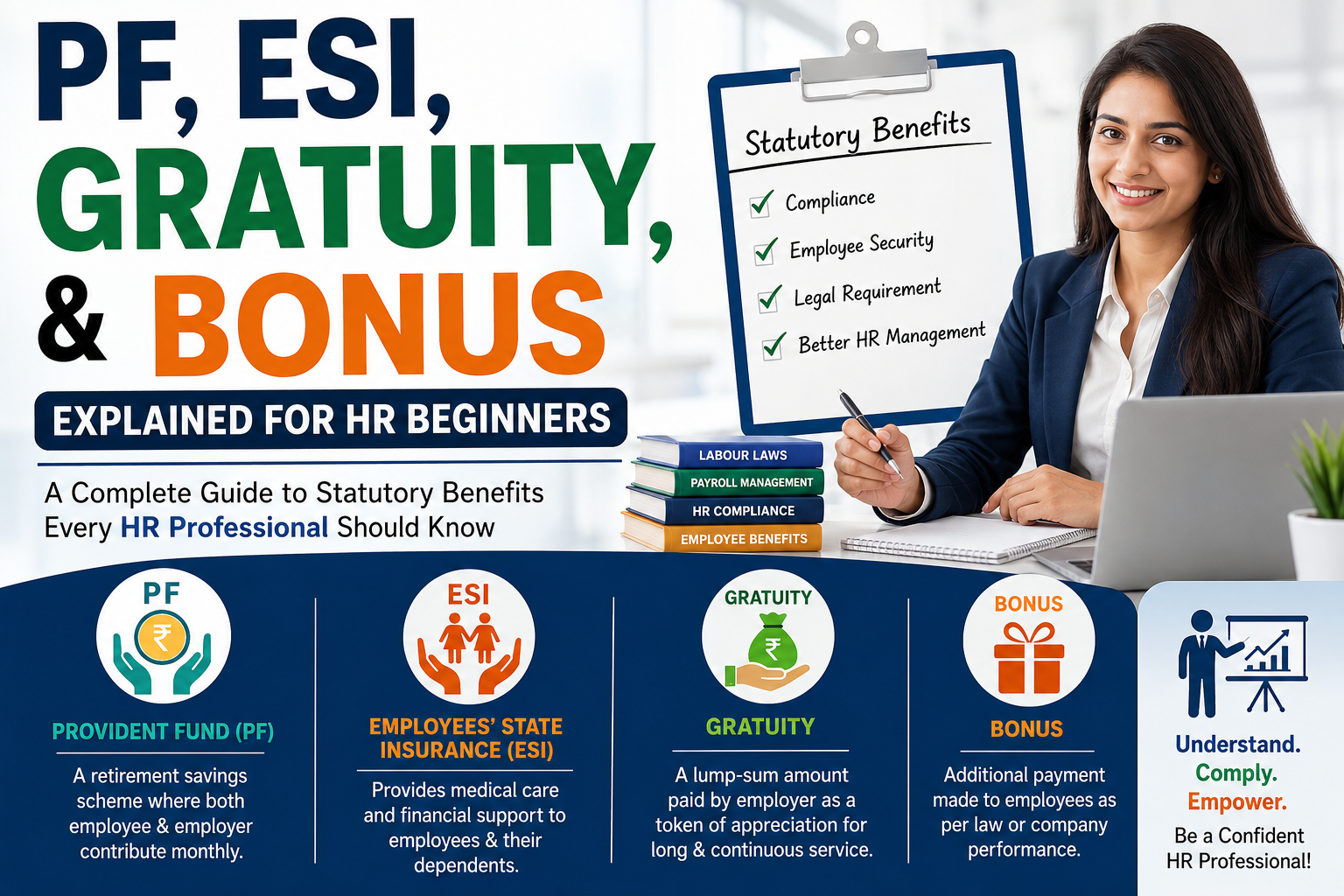
Managing employees is much more than hiring and onboarding. One of the most important responsibilities of every Human Resource (HR) professional is ensuring that employees receive their statutory benefits correctly and on time. Among these benefits, Provident Fund (PF), Employees' State Insurance (ESI), Gratuity, and Bonus are the most essential.
For HR beginners, these concepts often appear technical and confusing because they involve labour laws, salary structures, government compliance, payroll processing, and documentation. However, understanding these benefits is one of the first steps towards becoming a successful HR professional.
Whether you are a fresher, an MBA graduate, or someone pursuing an HR Training Course at Skill Excellent, mastering these topics will help you confidently manage payroll and statutory compliance while ensuring employee satisfaction.
This comprehensive guide explains each concept in simple language with practical HR insights.
Why Every HR Professional Must Understand Statutory Benefits
Every organisation is legally responsible for providing eligible employees with statutory benefits prescribed by Indian labour laws. Failure to comply can result in financial penalties, legal action, and reputational damage.
Understanding statutory benefits enables HR professionals to:
Ensure legal compliance
Process payroll accurately
Reduce employee grievances
Improve employee trust
Avoid government penalties
Build efficient HR operations
Support smooth audits
In today's competitive business environment, companies prefer HR professionals who possess practical knowledge of payroll and statutory compliance rather than just theoretical understanding.
What Are Statutory Benefits?
Statutory benefits are employee benefits mandated by law. Employers must provide these benefits to eligible employees according to applicable regulations.
The major statutory benefits in India include:
Provident Fund (PF)
Employees' State Insurance (ESI)
Gratuity
Statutory Bonus
Maternity Benefits
Leave Benefits
Employee Compensation
Among these, PF, ESI, Gratuity, and Bonus form the foundation of payroll compliance.
Understanding Provident Fund (PF)
What is Provident Fund?
The Employees' Provident Fund (EPF) is a government-backed retirement savings scheme designed to help employees build financial security for the future.
Both the employer and employee contribute a fixed percentage of the employee's salary every month into the PF account.
The accumulated amount, along with interest declared by the government, is paid to the employee at retirement or under permitted withdrawal conditions.
Objectives of PF
The primary objectives include:
Retirement savings
Financial security
Long-term wealth creation
Emergency financial support
Social security
Who Is Eligible?
Generally, employees working in establishments covered under the EPF law are eligible. HR professionals should verify current statutory applicability and wage thresholds as prescribed by the government, since these can change over time.
PF Contribution
Traditionally, both employer and employee contribute a prescribed percentage of eligible wages every month. HR should always follow the latest government notifications and organisational payroll policies when calculating contributions.
HR Responsibilities for PF
An HR executive should:
Register eligible employees
Collect KYC documents
Generate Universal Account Numbers (UAN), where applicable
Deduct employee contributions correctly
Deposit employer and employee contributions within statutory timelines
Maintain PF records
Assist employees with transfers and withdrawals
Resolve PF-related queries
Benefits of PF
Employees enjoy several advantages:
Retirement savings
Tax benefits (subject to applicable tax laws)
Pension-related benefits where applicable
Financial support during emergencies under eligible withdrawal rules
Long-term interest accumulation
Common PF Mistakes HR Should Avoid
Incorrect salary calculations
Late PF deposits
Wrong employee information
Missing documentation
Non-compliance with filing requirements
Delayed UAN activation assistance
Even a small mistake can lead to compliance issues and employee dissatisfaction.
Understanding Employees' State Insurance (ESI)
What is ESI?
Employees' State Insurance (ESI) is a social security and health insurance scheme that provides medical and financial assistance to eligible employees and their dependents.
It protects employees during illness, maternity, disability, workplace injuries, and certain other situations covered under the scheme.
Purpose of ESI
The scheme aims to provide:
Medical treatment
Cash benefits during sickness
Maternity support
Disability benefits
Dependants' benefits
Funeral expenses (subject to scheme provisions)
Who Is Eligible?
Eligibility depends on factors such as establishment coverage and the wage ceiling notified by the government. HR professionals should always use the latest official limits while processing payroll.
HR Responsibilities for ESI
HR professionals must:
Register eligible employees
Obtain insurance numbers where required
Deduct employee contributions accurately
Deposit contributions on time
Maintain ESI records
Help employees access benefits
Coordinate during medical claims
Benefits Under ESI
Employees may receive:
Medical Benefits
Treatment for employees and eligible family members.
Sickness Benefit
Income support during eligible periods of certified illness.
Maternity Benefit
Financial assistance for eligible women employees during maternity leave.
Disablement Benefit
Compensation in cases of employment-related injury leading to disability.
Dependants' Benefit
Support for eligible dependants in certain unfortunate situations involving employment-related death.
Importance of ESI for Employees
ESI significantly reduces employees' financial burden during medical emergencies and promotes workplace well-being.
For employers, it also supports a healthier and more secure workforce.
Understanding Gratuity
What is Gratuity?
Gratuity is a lump-sum amount paid by an employer as a token of appreciation for long and continuous service.
Unlike PF, gratuity is generally funded by the employer and becomes payable when the employee satisfies the eligibility conditions laid down under the law.
Why Is Gratuity Important?
Gratuity recognises employee loyalty and long-term contribution.
It serves as:
Retirement support
Financial reward
Employee retention benefit
Social security measure
Eligibility for Gratuity
In many cases, an employee becomes eligible after completing the minimum continuous service period prescribed under applicable law, subject to exceptions where the law provides otherwise.
HR professionals should always verify eligibility based on the latest legal provisions.
Factors Affecting Gratuity
The gratuity amount depends on:
Last drawn eligible salary
Years of continuous service
Applicable legal formula
Maximum limits prescribed by law
HR Responsibilities
The HR department should:
Maintain accurate joining and exit records
Calculate gratuity correctly
Verify service period
Process payments within prescribed timelines
Maintain documentation
Explain gratuity benefits during employee exit
Common Gratuity Mistakes
Avoid:
Wrong service calculations
Incorrect salary calculations
Delayed payment
Poor documentation
Ignoring employee eligibility
Understanding Bonus
What is Bonus?
Bonus is an additional payment made to eligible employees based on the provisions of applicable law and, in some organisations, company policies or performance.
It serves as a reward for employees' contribution towards organisational growth.
Why Is Bonus Paid?
Bonus helps:
Motivate employees
Improve productivity
Increase job satisfaction
Reward performance
Build employee loyalty
Types of Bonus
Statutory Bonus
Paid according to the applicable legal framework.
Performance Bonus
Based on individual performance.
Festival Bonus
Given during festive occasions by some employers.
Annual Bonus
Paid yearly based on company policy or performance.
Incentive Bonus
Awarded for achieving specific targets.
HR Responsibilities
HR professionals should:
Identify eligible employees
Calculate bonus accurately
Coordinate with payroll
Ensure timely disbursement
Maintain records
Communicate bonus policies clearly
Difference Between PF, ESI, Gratuity, and Bonus
| Benefit | Purpose | Contribution/Funding | When Employee Benefits |
|---|---|---|---|
| Provident Fund (PF) | Retirement savings | Employer and employee contributions | Retirement, eligible withdrawals, or separation as per rules |
| ESI | Medical and social security | Employer and employee contributions (subject to eligibility) | During eligible medical and social security events |
| Gratuity | Reward for long service | Employer-funded | On becoming eligible under the law, often at exit |
| Bonus | Employee reward | Employer | As per statutory provisions or company policy |
Documents HR Should Maintain
For smooth statutory compliance, maintain:
Aadhaar (where applicable)
PAN
Bank details
Appointment letter
Salary records
Attendance records
Employee ID
PF records
ESI records
Gratuity records
Bonus payment records
Exit documents
Proper documentation ensures smooth audits and minimises compliance risks.
Payroll Compliance Tips for HR Beginners
To ensure accuracy:
Stay updated with labour law changes.
Verify employee eligibility before processing benefits.
Reconcile payroll data every month.
Maintain digital records securely.
Coordinate closely with finance and payroll teams.
Conduct regular compliance reviews.
Educate employees about statutory benefits.
Use reliable HRMS or payroll software.
Maintain confidentiality of employee information.
Meet all statutory filing and payment deadlines.
Essential Skills Every HR Professional Should Learn
Beyond statutory compliance, HR professionals should develop:
Recruitment and talent acquisition
Payroll management
Labour law awareness
HR documentation
Communication skills
Employee relations
HR analytics
HRMS software
Microsoft Excel
Conflict resolution
Interviewing skills
Compliance management
Practical exposure to these areas makes HR professionals more job-ready.
Why Practical HR Training Matters
Reading about PF, ESI, Gratuity, and Bonus builds foundational knowledge, but practical application is what employers value.
A quality HR training programme should include:
Live payroll processing
Compliance documentation
HRMS software practice
Salary structure preparation
Recruitment simulations
Attendance management
Leave administration
Interview coordination
Labour law orientation
Real-world case studies
Hands-on experience helps bridge the gap between classroom learning and workplace expectations.
How Skill Excellent Helps You Become Industry-Ready
At Skill Excellent, HR training focuses on practical, industry-oriented learning designed to prepare students for real workplace responsibilities.
Key highlights include:
Practical HR training
Live payroll exercises
Recruitment process training
HR documentation practice
HRMS software exposure
Interview preparation
Resume-building support
Expert trainers
Industry-relevant curriculum
Career guidance
Placement assistance
This approach helps learners develop confidence in handling HR operations from day one.
Frequently Asked Questions (FAQs)
Is PF mandatory for every employee?
PF applicability depends on the establishment, employee eligibility, and prevailing statutory rules. HR professionals should always follow the latest legal requirements.
Is ESI only for medical treatment?
No. ESI provides a range of benefits, including medical care, sickness, maternity, and certain disability-related benefits, subject to eligibility.
Does every employee receive gratuity?
No. Employees generally need to satisfy the eligibility conditions prescribed under the applicable law.
Is bonus compulsory?
Statutory bonus is governed by applicable legislation for eligible employees, while some organisations also provide additional bonuses based on company policy or performance.
Why should HR professionals learn statutory compliance?
Because payroll accuracy, legal compliance, employee satisfaction, and organisational credibility all depend on proper handling of statutory benefits.
Conclusion
PF, ESI, Gratuity, and Bonus are the pillars of employee welfare and statutory compliance in India. For HR beginners, understanding these concepts is essential to building a successful career in human resources.
By learning how these benefits work, maintaining accurate records, and following the latest legal requirements, HR professionals can ensure smooth payroll operations, protect employee interests, and help organisations remain compliant.
If you aspire to become a skilled HR professional, focus on gaining practical knowledge alongside theory. Mastering statutory benefits, payroll processes, and compliance will make you a valuable asset to any organisation and significantly improve your career prospects.