Introduction
The education landscape has changed significantly over the past decade. While academic knowledge remains an essential foundation, employers today are looking for candidates who can do more than just explain concepts—they want professionals who can apply their knowledge to solve real-world problems. This shift has made practical learning one of the most important aspects of modern education.
In the past, success in education was often measured by examination scores and theoretical understanding. Today, however, industries value candidates who possess practical skills, critical thinking abilities, adaptability, and hands-on experience. As technology evolves and businesses become more dynamic, the gap between classroom learning and workplace expectations has become increasingly evident.
Imagine two graduates applying for the same job. One has excellent academic grades but limited exposure to real-world projects. The other has good academic knowledge along with internships, live projects, industry certifications, and practical experience using professional tools. In many cases, employers are more likely to select the second candidate because they can contribute more quickly in a professional environment.
This does not mean theory is unimportant. Theoretical knowledge provides the concepts, principles, and understanding needed to build expertise. However, theory alone is no longer sufficient. Practical learning transforms knowledge into skills, enabling individuals to confidently perform tasks, solve challenges, and adapt to changing workplace demands.
Whether you are a student, a working professional, an educator, or an employer, understanding the importance of practical learning can help you prepare for the future of work.
In this blog, we'll explore why practical learning matters more than theory in today's competitive world, how it improves employability, and how students can build industry-ready skills.
What Is Practical Learning?
Practical learning is an educational approach that focuses on applying theoretical knowledge through real-world experiences and hands-on activities. Instead of simply memorizing concepts, learners actively practice, experiment, and solve real problems.
Practical learning can take many forms, including:
Laboratory sessions
Live projects
Case studies
Simulations
Workshops
Industry internships
Apprenticeships
Coding exercises
Design projects
Business presentations
Group assignments
Field visits
By participating in these activities, learners gain confidence, improve problem-solving abilities, and develop skills that employers value.
Understanding Theoretical Learning
Theoretical learning focuses on building conceptual knowledge and understanding fundamental principles.
It includes:
Classroom lectures
Textbooks
Research
Academic discussions
Written examinations
Assignments
Theoretical education helps students understand why things work. It builds analytical thinking and provides the foundation for further learning.
For example:
A software engineering student may study programming concepts, algorithms, and database theory through textbooks. However, without writing code, building applications, or debugging programs, it becomes difficult to understand how those concepts work in real-world situations.
Similarly, a marketing student may learn consumer behavior and branding theories but truly develops expertise by creating campaigns, analyzing customer data, and working on real marketing projects.
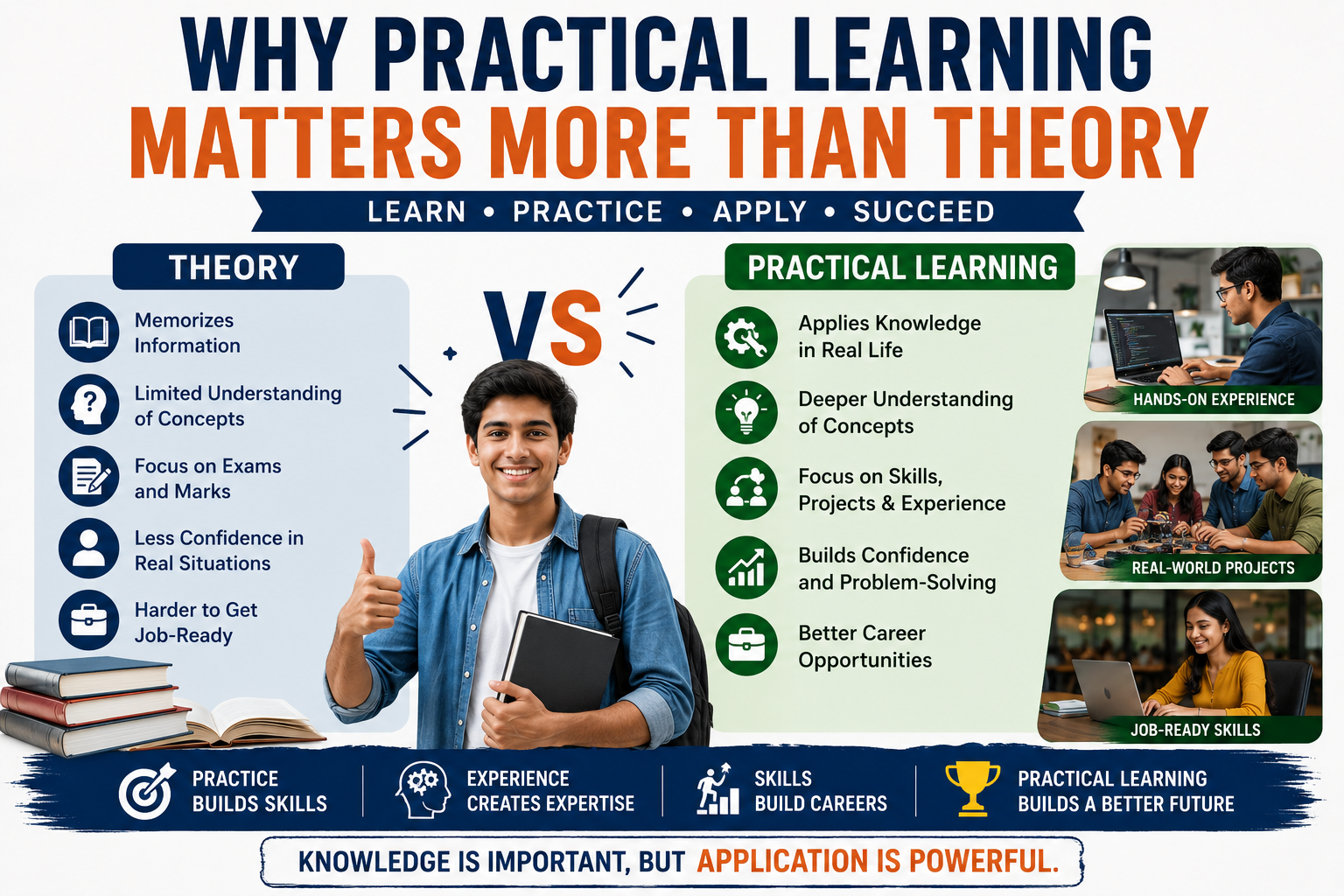
Practical Learning vs. Theoretical Learning
Both practical and theoretical learning have important roles in education. The key difference lies in how knowledge is acquired and applied.
| Theoretical Learning | Practical Learning |
|---|---|
| Focuses on concepts and principles | Focuses on application and execution |
| Primarily classroom-based | Real-world and hands-on experiences |
| Builds foundational knowledge | Develops professional skills |
| Often assessed through written exams | Evaluated through projects, tasks, and performance |
| Explains why things work | Demonstrates how things work |
| Encourages analytical thinking | Encourages critical thinking and problem-solving |
The most effective education combines both approaches, creating graduates who understand concepts and can apply them confidently.
Why Practical Learning Is Becoming More Important
The modern workplace is evolving rapidly due to technological advancements, automation, and changing business needs.
Employers increasingly expect candidates to be productive from the beginning of their careers.
Practical learning helps meet these expectations by enabling students to:
Apply classroom knowledge.
Work with industry-standard tools.
Solve real business challenges.
Build confidence.
Develop communication skills.
Collaborate in teams.
Adapt to workplace environments.
This is why many educational institutions now include internships, project work, industrial training, and skill-based courses in their programs.
The Changing Expectations of Employers
Employers today are not only evaluating academic qualifications—they also assess practical abilities.
Recruiters commonly look for candidates who can:
Solve problems independently.
Think critically.
Communicate effectively.
Learn new technologies quickly.
Work collaboratively.
Handle workplace responsibilities.
Demonstrate initiative.
Adapt to changing environments.
Practical experience often provides evidence of these capabilities.
Benefits of Practical Learning
Practical learning offers numerous advantages that extend beyond academic success.
1. Better Understanding of Concepts
Applying theoretical knowledge through real-world activities reinforces learning.
Students gain a deeper understanding because they experience concepts rather than simply memorizing them.
For example, building a website helps a web development student understand coding principles much more effectively than reading about them alone.
2. Improved Problem-Solving Skills
Real-world projects rarely have perfect solutions.
Students learn to:
Analyze situations.
Identify challenges.
Evaluate alternatives.
Make informed decisions.
Implement practical solutions.
These problem-solving abilities are highly valued across industries.
3. Increased Confidence
Practical experience helps learners become more confident in their abilities.
Completing projects, presenting ideas, and working with professional tools reduces fear and prepares students for workplace responsibilities.
Confidence also improves interview performance and professional communication.
4. Stronger Technical Skills
Hands-on practice allows students to master industry-relevant technologies and tools.
Examples include:
Programming software
Design applications
Cloud platforms
HR management systems
Data analysis tools
Digital marketing platforms
Customer relationship management (CRM) software
Technical proficiency increases employability.
5. Enhanced Creativity
Practical learning encourages experimentation and innovation.
Instead of following fixed answers, students explore different approaches to solving challenges.
This develops creativity, which is increasingly important in technology, marketing, design, business, and entrepreneurship.
6. Better Teamwork and Collaboration
Many practical learning experiences involve group projects.
Students learn how to:
Share responsibilities.
Communicate effectively.
Resolve conflicts.
Respect different perspectives.
Achieve common goals.
These collaboration skills are essential in modern workplaces.
Practical Learning Builds Career Readiness
Career readiness involves more than earning a degree.
Employers seek candidates who understand workplace expectations and can contribute effectively from day one.
Practical learning prepares students by exposing them to:
Workplace communication
Time management
Professional ethics
Client interactions
Project management
Industry workflows
Team collaboration
Problem-solving under deadlines
Students who experience these situations before graduation often transition more smoothly into professional careers.
The Role of Skill-Based Education
Skill-based education complements traditional academic learning by emphasizing practical competence.
Instead of focusing solely on examinations, skill-based programs encourage learners to:
Build portfolios.
Complete projects.
Participate in internships.
Earn professional certifications.
Solve industry problems.
Practice using professional software.
Develop communication and leadership skills.
This approach helps students become industry-ready rather than simply degree-ready.
Practical Learning Across Different Fields
Practical learning benefits learners in almost every discipline.
Information Technology
Students develop applications, create websites, manage databases, and work with cloud platforms.
Digital Marketing
Learners create real campaigns, optimize websites, analyze performance metrics, and manage social media strategies.
Human Resources
Students practice recruitment, payroll processes, employee engagement, and HR software.
Business Management
Learners analyze case studies, develop business plans, conduct market research, and simulate organizational decision-making.
Healthcare
Medical and nursing students gain experience through clinical training, laboratory work, and patient care under supervision.
Engineering
Engineering students design prototypes, conduct experiments, and solve technical challenges using industry-standard equipment.
Why Theory Alone Is No Longer Enough
In today's competitive job market, employers often expect candidates to demonstrate what they can do—not just what they know.
A graduate with excellent theoretical knowledge but limited practical exposure may require significant additional training before becoming fully productive.
In contrast, candidates with hands-on experience through internships, projects, workshops, or industry-oriented training are often better prepared to contribute from the start.
This is why combining theoretical understanding with practical application has become the preferred approach in modern education.
How Practical Learning Improves Employability
In today's competitive job market, employers are not only looking for candidates with strong academic qualifications but also for individuals who can apply their knowledge in real workplace situations. Practical learning bridges the gap between education and employment by helping students develop job-ready skills.
Candidates who have completed internships, worked on live projects, built portfolios, or participated in industry training often stand out during the hiring process because they have already demonstrated their ability to perform real tasks.
Practical learning improves employability by helping students:
Gain hands-on experience
Build confidence in professional environments
Understand workplace expectations
Solve real-world problems
Communicate effectively with teams and clients
Adapt quickly to new technologies and processes
As industries continue to evolve, organizations increasingly value candidates who can contribute from day one with minimal training.
Why Employers Prefer Practical Skills
Recruiters receive hundreds of applications for a single position. While academic performance is important, employers often evaluate whether a candidate can perform the responsibilities of the role effectively.
They look for individuals who can:
Apply knowledge to practical situations
Think critically under pressure
Work independently and as part of a team
Communicate professionally
Manage deadlines
Learn new technologies quickly
Solve business challenges creatively
Practical experience provides evidence that a candidate possesses these capabilities.
The Importance of Internships
Internships are among the most valuable forms of practical learning.
They allow students to experience real workplace environments before completing their education.
During internships, students learn:
Professional communication
Workplace etiquette
Time management
Team collaboration
Client interaction
Industry workflows
Problem-solving under deadlines
Internships also help students discover their strengths and identify areas for improvement before starting full-time careers.
Learning Through Live Projects
Working on live projects enables students to apply classroom knowledge to actual business challenges.
Examples include:
Web Development
Building responsive websites for businesses or organizations.
Digital Marketing
Creating SEO strategies, social media campaigns, or online advertisements for real clients.
Human Resources
Participating in recruitment drives, onboarding processes, employee engagement activities, or HR analytics projects.
Business Management
Conducting market research, preparing business plans, and analyzing organizational performance.
Live projects help students understand industry standards while building portfolios that demonstrate practical expertise.
Industry-Oriented Training
Industry-oriented training programs focus on teaching skills that align with current market demands.
Unlike traditional academic programs, these courses emphasize:
Practical assignments
Hands-on workshops
Industry software
Case studies
Capstone projects
Professional certifications
Career guidance
Students who complete such training are often better prepared to meet employer expectations.
The Role of Technology in Practical Learning
Technology has transformed the way practical education is delivered.
Modern learners can now gain hands-on experience using digital platforms and advanced tools from anywhere in the world.
Examples include:
Virtual labs
Coding platforms
Cloud-based development environments
Simulation software
Learning Management Systems (LMS)
AI-powered learning assistants
Virtual reality training
Online collaboration platforms
These technologies make practical learning more accessible, flexible, and interactive.
Building a Professional Portfolio
One of the biggest advantages of practical learning is the ability to create a portfolio that showcases real work.
A portfolio may include:
Websites
Mobile applications
Marketing campaigns
Research projects
Graphic designs
Business presentations
HR process documentation
Data analysis reports
Video editing projects
Portfolios help employers evaluate practical abilities beyond resumes and academic transcripts.
Practical Learning Enhances Soft Skills
Success in the workplace depends not only on technical expertise but also on professional behavior and interpersonal abilities.
Practical learning helps students develop essential soft skills, including:
Communication
Students learn to present ideas clearly, write professional emails, and participate in meetings.
Teamwork
Collaborative projects teach learners how to work with diverse teams, resolve conflicts, and achieve shared goals.
Leadership
Project-based learning often gives students opportunities to coordinate tasks, motivate team members, and manage responsibilities.
Time Management
Meeting deadlines during internships and projects helps students develop discipline and organizational skills.
Adaptability
Working with changing project requirements prepares students to respond effectively to workplace challenges.
Real-Life Examples of Practical Learning
Example 1: Full Stack Web Development
A student learns HTML, CSS, JavaScript, and databases in class.
Instead of stopping there, they build:
Personal portfolio websites
E-commerce platforms
Blog websites
Business management systems
These projects strengthen technical skills while creating evidence of practical competence.
Example 2: Digital Marketing
A learner studies SEO, social media marketing, and content creation.
They then:
Optimize a website for search engines.
Manage social media pages.
Run advertising campaigns.
Analyze website traffic.
Prepare performance reports.
This practical experience prepares them for real marketing roles.
Example 3: Human Resources
An HR student studies recruitment and employee management.
Through internships, they gain experience in:
Resume screening
Interview coordination
Employee onboarding
HR documentation
Attendance management
Performance evaluation
This exposure helps them understand organizational processes beyond textbooks.
Challenges in Traditional Education
Although traditional education provides valuable theoretical knowledge, it often faces several limitations.
Limited Industry Exposure
Many students graduate without interacting with businesses or participating in real projects.
Examination-Oriented Learning
Students frequently focus on memorizing information for exams rather than developing practical problem-solving abilities.
Outdated Curriculum
Rapid technological changes can make academic content outdated if curricula are not regularly updated.
Lack of Professional Skills
Communication, teamwork, leadership, and workplace etiquette are sometimes overlooked despite being highly valued by employers.
Minimal Hands-on Experience
Without practical assignments or internships, graduates may struggle to transition into professional roles.
How Students Can Gain Practical Experience
Students do not have to wait until graduation to build practical skills.
Here are several effective strategies:
Complete Internships
Even short-term internships provide valuable workplace exposure.
Build Personal Projects
Develop websites, mobile apps, business plans, or marketing campaigns to demonstrate practical abilities.
Earn Industry Certifications
Professional certifications validate technical knowledge and demonstrate a commitment to continuous learning.
Participate in Workshops
Hands-on workshops expose students to current tools, technologies, and industry practices.
Join Competitions
Hackathons, business competitions, and innovation challenges encourage creative problem-solving and teamwork.
Volunteer for Real Projects
Working with startups, NGOs, or local businesses helps students apply classroom knowledge while contributing to meaningful initiatives.
Learn Modern Tools
Become familiar with industry-standard software relevant to your career path.
Examples include:
Adobe Creative Cloud
Microsoft Power BI
Google Analytics
Visual Studio Code
Git and GitHub
Figma
HRMS platforms
CRM software
Cloud platforms
Practical familiarity with these tools improves employability.
The Importance of Continuous Learning
Practical learning does not end after securing a job.
Industries continue to evolve, requiring professionals to update their skills regularly.
Continuous learning may include:
Online courses
Professional certifications
Industry webinars
Workshops
Conferences
Self-learning
Mentorship programs
Professionals who embrace lifelong learning remain competitive and adaptable throughout their careers.
Practical Learning Builds Entrepreneurial Skills
Practical education also supports entrepreneurship.
Students who work on real projects develop:
Business planning abilities
Financial awareness
Customer understanding
Product development skills
Marketing knowledge
Decision-making confidence
These experiences prepare individuals not only for employment but also for creating their own businesses.
The Future of Skill-Based Education
The future of education is rapidly shifting from a knowledge-based model to a skill-based model. While academic qualifications will always remain important, employers increasingly expect candidates to demonstrate practical expertise, adaptability, and the ability to solve real-world problems.
Technological advancements such as Artificial Intelligence (AI), automation, cloud computing, and data analytics are transforming industries at an unprecedented pace. As a result, educational institutions must continuously update their teaching methods and curricula to prepare students for emerging career opportunities.
The future of education will focus on:
Project-based learning
Industry certifications
Internship-integrated programs
Hybrid and online learning
AI-assisted personalized education
Collaborative learning environments
Continuous skill development
Lifelong learning
Students who embrace these approaches will be better equipped to thrive in a rapidly changing job market.
How Educational Institutions Can Bridge the Skills Gap
One of the biggest challenges in today's education system is the gap between what students learn in classrooms and what employers expect in the workplace.
Educational institutions can bridge this gap by:
1. Updating the Curriculum Regularly
Course content should reflect current industry trends, technologies, and workplace practices.
2. Introducing Project-Based Learning
Students should complete real-world assignments that encourage problem-solving, teamwork, and innovation.
3. Strengthening Industry Partnerships
Collaborating with companies for guest lectures, workshops, internships, and live projects helps students gain valuable exposure.
4. Encouraging Professional Certifications
Industry-recognized certifications complement academic degrees and demonstrate practical competence.
5. Providing Career Guidance
Career counseling, resume-building workshops, mock interviews, and placement assistance help students prepare for employment.
The Role of Businesses in Practical Learning
Businesses also play a vital role in developing future talent.
Organizations can support practical learning by:
Offering internships and apprenticeships
Conducting training workshops
Sponsoring innovation challenges
Mentoring students
Collaborating with educational institutions
Providing real business case studies
Supporting employee upskilling initiatives
These partnerships create a stronger talent pipeline while reducing the gap between education and employment.
Technology Is Redefining Practical Learning
Modern technologies have made practical learning more accessible than ever before.
Students can now practice and build experience through:
Virtual Labs
Providing safe environments to perform technical experiments and simulations.
Coding Platforms
Allowing learners to solve programming challenges and build software applications.
Cloud-Based Learning
Giving access to enterprise-level technologies without requiring expensive infrastructure.
Artificial Intelligence
AI-powered learning platforms provide personalized recommendations, adaptive assessments, and instant feedback.
Virtual Reality (VR) and Augmented Reality (AR)
These immersive technologies are increasingly used in fields such as healthcare, engineering, aviation, and manufacturing to simulate real-world environments.
Technology ensures that learners gain relevant practical experience regardless of their location.
The Importance of Lifelong Learning
Graduation is no longer the end of education—it is the beginning of continuous professional development.
As industries evolve, professionals must regularly update their skills to remain competitive.
Lifelong learning can include:
Online certification courses
Industry webinars
Professional workshops
Conferences
Reading industry publications
Learning new software and tools
Mentorship programs
Individuals who continuously learn are more adaptable, resilient, and prepared for future career opportunities.
Practical Learning Across Different Career Stages
Practical learning benefits individuals throughout their professional journey.
Students
Gain foundational skills through projects, internships, and workshops.
Fresh Graduates
Build confidence and transition more smoothly into full-time employment.
Working Professionals
Upgrade skills to adapt to new technologies and advance in their careers.
Entrepreneurs
Develop practical business knowledge in areas such as marketing, finance, operations, and customer management.
Regardless of career stage, hands-on learning remains essential for long-term success.
The Role of Skill Excellent in Career Development
In today's competitive job market, students and professionals need more than theoretical knowledge—they need practical skills that align with industry expectations. Skill Excellent focuses on delivering career-oriented training designed to bridge this gap.
Key strengths include:
Industry-oriented curriculum
Hands-on practical sessions
Live projects and case studies
Experienced trainers
Professional certification programs
Career counseling and guidance
Interview preparation
Resume-building support
Job assistance
By combining theoretical concepts with practical application, Skill Excellent helps learners become confident, job-ready professionals capable of succeeding in today's dynamic workplace.
Practical Learning: A Competitive Advantage
Candidates with practical experience often have several advantages during the recruitment process:
Stronger resumes
Impressive project portfolios
Better interview performance
Higher confidence
Faster workplace adaptation
Improved problem-solving skills
Greater employability
In a competitive job market, practical learning can be a key differentiator.
Frequently Asked Questions (FAQs)
1. What is practical learning?
Practical learning is an educational approach where students apply theoretical knowledge through hands-on activities, real-world projects, internships, workshops, and simulations.
2. Is theory still important?
Yes. Theory provides the foundational knowledge needed to understand concepts and principles. Practical learning complements theory by teaching learners how to apply that knowledge effectively.
3. Why do employers value practical experience?
Practical experience demonstrates that candidates can solve problems, use industry tools, collaborate with teams, and adapt to workplace environments with greater confidence.
4. How can students gain practical experience?
Students can:
Complete internships
Build personal projects
Participate in workshops
Join hackathons
Earn professional certifications
Volunteer for real-world assignments
Create online portfolios
5. Can practical learning improve employability?
Absolutely. Practical learning develops technical expertise, professional skills, confidence, and real-world experience, making candidates more attractive to employers.
Conclusion
Practical learning has become an essential component of modern education. While theoretical knowledge forms the foundation of understanding, practical experience transforms that knowledge into meaningful skills that can be applied in professional environments.
Today's employers seek candidates who can contribute from the very beginning of their careers. They value problem-solving abilities, adaptability, teamwork, communication, and hands-on experience just as much as academic achievements. This shift makes practical learning a critical factor in career readiness and long-term professional success.
Educational institutions, businesses, and learners all share the responsibility of promoting practical education. Schools and training providers should integrate live projects, internships, and industry-relevant assignments into their programs. Organizations should offer meaningful learning opportunities that expose students to real workplace challenges. Learners, in turn, should actively seek opportunities to build portfolios, earn certifications, and continuously upgrade their skills.
At Skill Excellent, we believe that education should prepare individuals not only to pass examinations but also to excel in their careers. Through industry-oriented training, hands-on learning, experienced mentors, and career support, we help students and professionals develop the practical expertise needed to succeed in today's evolving job market.
The future belongs to individuals who combine strong theoretical foundations with practical skills, continuous learning, and the confidence to solve real-world challenges. By embracing practical learning, students can unlock better career opportunities, contribute more effectively in the workplace, and build successful, future-ready careers.