Introduction
Bulk hiring is an essential recruitment strategy for organizations looking to expand rapidly, launch new projects, open new branches, or meet seasonal workforce demands. Whether you're hiring dozens or hundreds of employees, managing the recruitment process efficiently can be challenging without the right planning and tools. A poorly managed bulk hiring campaign can result in increased hiring costs, delayed onboarding, and mismatched candidates.
To overcome these challenges, employers need a structured recruitment process supported by modern technology and reliable hiring partners. Platforms like Jobsglint simplify large-scale recruitment by helping organizations connect with qualified candidates faster, streamline hiring workflows, and reduce overall recruitment time.
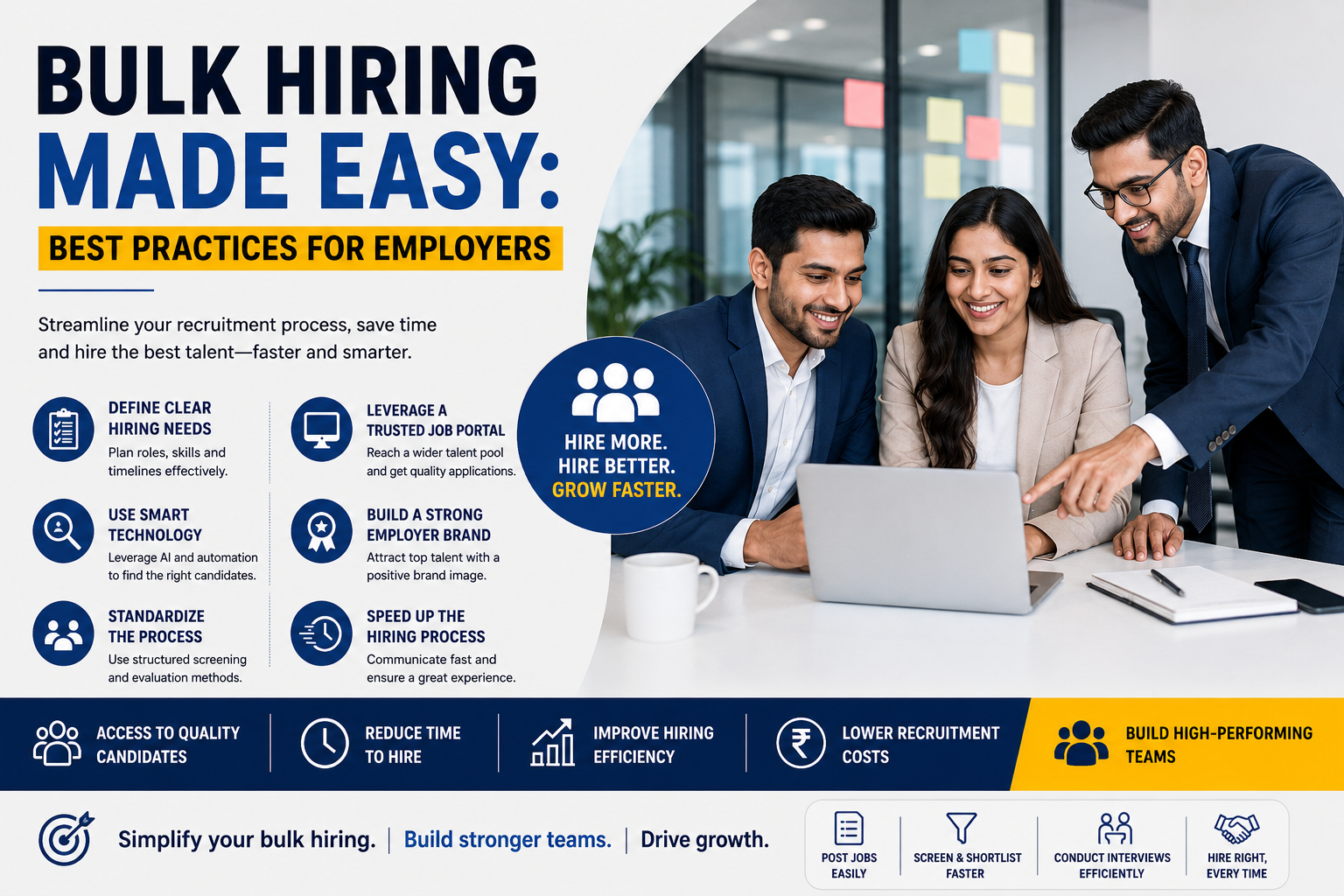
Understand Your Hiring Requirements
Successful bulk hiring begins with proper workforce planning. Before posting vacancies, employers should clearly define the number of positions, required skills, educational qualifications, experience levels, work locations, salary ranges, and joining timelines.
Having a detailed hiring plan helps recruiters create accurate job descriptions and target the right talent pool. It also enables hiring managers to estimate recruitment budgets, allocate interview panels, and prepare onboarding resources well in advance.
Write Clear and Attractive Job Descriptions
An effective job description is one of the most important factors in attracting suitable candidates. It should clearly explain the job role, responsibilities, eligibility criteria, required skills, salary range (if applicable), work location, employment type, and career growth opportunities.
Avoid using complicated language or unnecessary jargon. Candidates are more likely to apply when they clearly understand what the organization expects and what benefits they will receive in return.
Use a Reliable Job Portal
One of the fastest ways to reach a large pool of job seekers is through a trusted online job portal. A recruitment platform with verified candidate profiles and intelligent search features helps employers identify suitable applicants more efficiently.
Jobsglint enables businesses to publish multiple job openings, access a wide talent network, filter candidates based on skills and experience, and manage applications from a single platform. This significantly reduces manual effort while improving recruitment speed.
Leverage AI and Recruitment Automation
Technology has transformed modern recruitment. Artificial Intelligence (AI) and automation tools can screen resumes, rank candidates, identify skill matches, and schedule interviews automatically.
Instead of manually reviewing thousands of applications, recruiters can focus on interviewing the most qualified candidates. AI-powered candidate matching also improves hiring accuracy by recommending applicants whose profiles closely align with job requirements.
Automation reduces repetitive administrative work and helps HR teams manage high-volume hiring campaigns more efficiently.
Standardize the Screening Process
Maintaining consistency is crucial during bulk recruitment. Every candidate should be evaluated using the same screening criteria to ensure fairness and quality.
Employers should prepare structured interview questions, standardized assessment tests, and predefined evaluation scorecards. This approach helps recruiters compare candidates objectively while minimizing personal bias.
Standardized screening also speeds up decision-making because hiring managers can quickly identify top-performing applicants.
Build a Strong Employer Brand
Candidates often research employers before applying for jobs. Organizations with a positive employer reputation typically receive more applications and experience higher offer acceptance rates. Employers should highlight their company culture, employee benefits, learning opportunities, career progression, workplace environment, and employee success stories across their careers page and social media channels.
A strong employer brand not only attracts better candidates but also reduces recruitment marketing costs over time.
Create a Fast and Candidate-Friendly Hiring Process
Lengthy recruitment procedures often result in losing top candidates to competitors. During bulk hiring, speed is a significant competitive advantage.
Employers should minimize unnecessary interview rounds, communicate regularly with applicants, provide timely updates, and issue offer letters promptly after selection.
A smooth candidate experience creates a positive impression of the organization and increases joining rates.
Organize Virtual Recruitment Drives
Virtual hiring has become an effective solution for recruiting candidates across different cities and states. Online interviews, digital assessments, and virtual document verification reduce travel costs while accelerating the recruitment process.
Employers can also organize online hiring events, webinars, and virtual career fairs to attract large numbers of applicants within a short period.
This approach is especially beneficial for organizations hiring remote employees or expanding into new geographic locations.
Build a Talent Pipeline
Bulk hiring should not end after filling current vacancies. Smart employers continuously build talent pipelines for future recruitment needs.
Maintaining a database of qualified candidates who performed well in previous hiring campaigns enables recruiters to fill future positions more quickly. Candidate relationship management also improves long-term recruitment efficiency.
Using a job portal like Jobsglint makes it easier to maintain and revisit candidate profiles whenever new hiring requirements arise.
Improve Collaboration Between HR and Hiring Managers
Successful bulk recruitment requires close coordination between recruiters, department heads, and business leaders.
Regular meetings help clarify hiring priorities, review candidate quality, monitor recruitment progress, and resolve bottlenecks quickly. Clear communication ensures that everyone involved follows the same hiring objectives and timelines.
Collaborative decision-making also reduces delays in interview scheduling and final selection.
Measure Recruitment Performance
Employers should continuously evaluate the effectiveness of their hiring strategy using recruitment metrics such as: 1.Time-to-hire
2.Cost-per-hire
3.Offer acceptance rate
4.Candidate source performance
5.Quality of hire
6.Employee retention rateInterview-to-selection ratio
Tracking these metrics helps organizations identify improvement opportunities and optimize future bulk hiring campaigns.
Why Jobsglint Is the Right Partner for Bulk Hiring
Managing high-volume recruitment requires more than simply posting job vacancies. Employers need access to qualified candidates, intelligent recruitment tools, efficient application management, and a streamlined hiring workflow.
Jobsglint helps organizations simplify bulk hiring by providing:
1.Access to a large database of verified candidates
2.AI-powered candidate matching
3.Easy job posting and application management
4.Faster candidate shortlisting
5.Reduced recruitment time and effort
6.Support for hiring across multiple industries and locations
Whether you're hiring fresh graduates, experienced professionals, or large operational teams, Jobsglint enables businesses to recruit efficiently while maintaining hiring quality.
Conclusion
Bulk hiring doesn't have to be overwhelming. With proper workforce planning, clear job descriptions, standardized recruitment processes, AI-driven technology, and a trusted recruitment platform, employers can hire large numbers of candidates quickly without compromising quality.
As recruitment continues to evolve, organizations that embrace digital hiring solutions and strategic workforce planning will gain a significant competitive advantage. By partnering with Jobsglint, employers can streamline their recruitment process, reduce hiring costs, and build high-performing teams that drive long-term business success.