Introduction
The world is changing at an unprecedented pace, driven by rapid advancements in technology and the evolving demands of the global economy. Traditional career paths are transforming, new industries are emerging, and employers are increasingly seeking professionals who possess both academic knowledge and practical skills. In this dynamic environment, education, technology, and employment are no longer separate concepts—they are deeply interconnected.
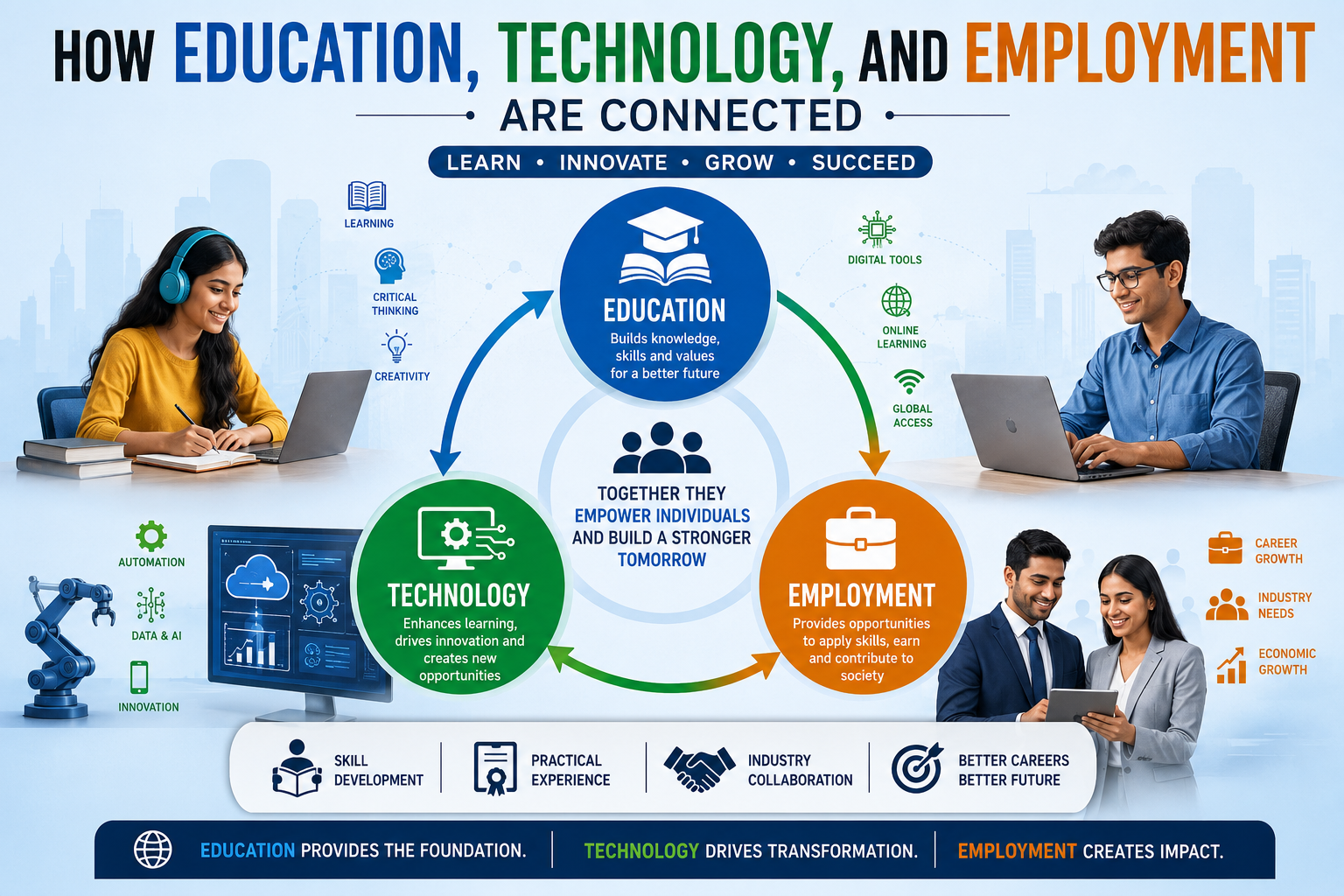
Education provides the foundation of knowledge, technology enhances the way people learn and work, and employment enables individuals to apply their skills to create value for businesses and society. Together, these three pillars form a cycle that supports innovation, economic growth, and personal development.
Today's students have access to digital classrooms, online certifications, virtual internships, and AI-powered learning tools that were unimaginable just a decade ago. At the same time, businesses are embracing automation, cloud computing, artificial intelligence, data analytics, and digital collaboration platforms to improve efficiency and remain competitive. As a result, employers are looking beyond traditional qualifications and placing greater emphasis on practical expertise, adaptability, problem-solving, and continuous learning.
This transformation has also changed the expectations of educational institutions. Schools, colleges, universities, and training organizations are increasingly integrating industry-oriented curricula, project-based learning, internships, and digital tools into their programs to better prepare learners for the modern workforce.
Understanding how education, technology, and employment influence one another is essential for students planning their careers, professionals looking to upskill, businesses seeking qualified talent, and educators designing future-ready learning experiences.
In this blog, we'll explore the relationship between these three critical areas, how they are evolving together, and what individuals and organizations can do to thrive in the digital era.
Understanding the Relationship Between Education, Technology, and Employment
Education, technology, and employment form a connected ecosystem where progress in one area influences the others.
Education equips individuals with knowledge, critical thinking, and foundational skills.
Technology transforms how people learn, communicate, innovate, and perform their jobs.
Employment provides opportunities to apply skills, gain experience, and contribute to economic development.
When education adapts to technological advancements, graduates become more prepared for the evolving job market. Likewise, businesses benefit from a workforce that can quickly adapt to new tools, systems, and industry practices.
This interconnected relationship drives innovation, productivity, and long-term economic growth.
Why This Connection Matters in the Digital Era
The digital revolution has fundamentally changed how people study, work, and build careers.
Today's workforce is expected to:
Learn continuously.
Adapt to new technologies.
Solve complex problems.
Collaborate across digital platforms.
Communicate effectively.
Analyze data.
Think creatively.
Traditional education alone is often no longer sufficient. Employers increasingly value practical experience, technical proficiency, and the ability to apply knowledge in real-world situations.
As industries continue to evolve, educational institutions and learners must keep pace with changing workforce requirements.
How Education Has Evolved Over the Years
Education has undergone significant transformation over the past few decades.
Traditional Education
Traditionally, education focused primarily on classroom lectures, textbooks, examinations, and theoretical knowledge.
While this model helped build strong academic foundations, it often provided limited exposure to practical industry requirements.
Students frequently graduated with degrees but lacked the hands-on experience employers expected.
Modern Education
Today's education system places greater emphasis on:
Practical learning
Project-based education
Skill development
Digital literacy
Industry exposure
Collaborative learning
Critical thinking
Innovation
Many institutions now integrate internships, workshops, simulations, and industry certifications into their programs to improve career readiness.
Lifelong Learning
Learning no longer ends with graduation.
Rapid technological advancements require professionals to continuously update their skills throughout their careers.
Continuous learning may include:
Professional certifications
Online courses
Industry webinars
Workshops
Micro-credentials
Self-paced learning
Employer-sponsored training
Lifelong learning has become an essential strategy for maintaining employability in today's competitive job market.
The Role of Technology in Modern Education
Technology has transformed nearly every aspect of education, making learning more accessible, flexible, and personalized.
Students can now access high-quality educational resources from anywhere in the world using computers, tablets, or smartphones.
Some of the most significant technological advancements include:
Learning Management Systems (LMS)
Virtual classrooms
Artificial Intelligence
Cloud computing
Educational mobile applications
Interactive simulations
Digital libraries
Online assessments
Virtual reality learning experiences
These innovations enhance both teaching effectiveness and student engagement.
Benefits of Technology in Education
Technology offers numerous advantages for learners, educators, and institutions.
1. Greater Accessibility
Students can access educational content regardless of their geographical location.
This has expanded opportunities for learners in rural areas, working professionals, and individuals pursuing flexible education.
2. Flexible Learning
Online education allows learners to study at their own pace.
This flexibility is particularly beneficial for:
Working professionals
College students
Career changers
Entrepreneurs
Parents balancing multiple responsibilities
3. Interactive Learning Experiences
Digital tools make education more engaging through:
Videos
Interactive quizzes
Simulations
Gamification
Virtual laboratories
Discussion forums
Interactive learning often improves knowledge retention and student participation.
4. Personalized Learning
Artificial Intelligence enables personalized learning experiences by adapting educational content to individual learning styles and progress.
Students receive recommendations, targeted practice exercises, and feedback based on their performance.
5. Collaboration Beyond Classrooms
Cloud-based collaboration platforms allow students to:
Work on group projects
Share resources
Communicate in real time
Learn from global communities
These experiences help develop teamwork and digital communication skills valued by employers.
Skill-Based Education: The Need of the Hour
One of the biggest shifts in modern education is the increasing importance of skill-based learning.
Employers today seek candidates who can demonstrate practical capabilities rather than relying solely on academic qualifications.
Skill-based education emphasizes:
Practical application
Hands-on projects
Real-world problem solving
Industry tools
Professional communication
Team collaboration
This approach helps learners become job-ready from the beginning of their careers.
Essential Skills for the Modern Workforce
Students should focus on building a balanced combination of technical and professional skills.
Technical Skills
Examples include:
Programming
Artificial Intelligence
Machine Learning
Data Analytics
Cybersecurity
Cloud Computing
Digital Marketing
UI/UX Design
Web Development
Mobile App Development
Soft Skills
Equally important are transferable skills such as:
Communication
Leadership
Teamwork
Critical Thinking
Creativity
Emotional Intelligence
Adaptability
Time Management
Decision Making
Problem Solving
Professionals who combine technical expertise with strong interpersonal skills are often better prepared for leadership roles and long-term career growth.
Digital Learning Is Shaping the Future
Digital learning has become one of the most significant developments in education.
Students can now:
Attend live online classes.
Earn globally recognized certifications.
Learn from industry experts.
Participate in virtual internships.
Build digital portfolios.
Collaborate internationally.
Access learning resources 24/7.
This flexibility has made quality education more accessible than ever before.
The Rise of Hybrid Learning
Many educational institutions now use a hybrid model that combines traditional classroom teaching with online learning.
Hybrid learning offers several advantages:
Greater flexibility
Better resource availability
Improved student engagement
Reduced geographical barriers
Personalized learning experiences
It also prepares students for modern workplaces, where hybrid and remote work environments are increasingly common.
Why Career Readiness Starts During Education
Career preparation should begin well before graduation.
Students who actively participate in internships, industry projects, workshops, competitions, and certification programs often develop stronger professional skills and gain confidence before entering the workforce.
Educational institutions that collaborate with industry partners can better align their programs with current job market demands, helping graduates transition more smoothly into employment.
How Technology Is Transforming Employment
Technology has fundamentally changed the way businesses hire, train, and manage their workforce. Digital transformation has created new career opportunities while also reshaping traditional job roles. Today, employers seek candidates who can adapt to evolving technologies, collaborate effectively, and continuously learn new skills.
Automation, artificial intelligence (AI), cloud computing, big data, and digital communication tools have become integral to modern workplaces. These advancements have increased efficiency, reduced repetitive tasks, and enabled employees to focus on strategic, creative, and problem-solving responsibilities.
For job seekers, this means that technical knowledge combined with practical experience has become more valuable than ever before.
The Rise of Industry 4.0
Industry 4.0, often referred to as the Fourth Industrial Revolution, represents the integration of digital technologies into manufacturing, business operations, and everyday work environments.
Key technologies driving Industry 4.0 include:
Artificial Intelligence (AI)
Machine Learning (ML)
Internet of Things (IoT)
Robotics
Cloud Computing
Big Data Analytics
Blockchain
Cybersecurity
Automation
Augmented Reality (AR) and Virtual Reality (VR)
These technologies enable organizations to improve productivity, reduce operational costs, and make faster, data-driven decisions.
Emerging Career Opportunities in the Digital Economy
As technology advances, entirely new professions are emerging while existing roles continue to evolve.
Some of the fastest-growing career paths include:
Information Technology
Full Stack Developer
Software Engineer
Cloud Engineer
DevOps Engineer
Cybersecurity Analyst
Mobile App Developer
AI Engineer
Data and Artificial Intelligence
Data Analyst
Data Scientist
Machine Learning Engineer
Business Intelligence Analyst
AI Consultant
Prompt Engineer
Data Engineer
Digital Marketing
SEO Specialist
Content Strategist
Performance Marketer
Social Media Manager
Email Marketing Specialist
Marketing Automation Expert
Digital Advertising Specialist
Design and Creative Careers
UI Designer
UX Designer
Graphic Designer
Motion Graphics Artist
Video Editor
Product Designer
Business and Management
Product Manager
Business Analyst
Project Manager
Operations Manager
HR Technology Specialist
Customer Success Manager
The demand for professionals in these areas continues to grow as businesses expand their digital capabilities.
Artificial Intelligence and Automation in the Workplace
Artificial Intelligence is transforming how organizations operate across industries.
AI is commonly used for:
Customer support chatbots
Fraud detection
Predictive analytics
Personalized recommendations
Resume screening
Supply chain optimization
Healthcare diagnostics
Financial forecasting
Automation, meanwhile, handles repetitive tasks such as invoice processing, payroll management, appointment scheduling, and inventory tracking.
Rather than replacing all jobs, AI and automation are changing the nature of work. Employees who understand how to use these technologies effectively will be better positioned for future career opportunities.
Why Digital Skills Are Becoming Essential
Digital literacy is now a fundamental requirement across nearly every industry.
Whether someone works in healthcare, finance, education, manufacturing, retail, or government, technology plays a central role in daily operations.
Professionals who possess digital skills can:
Adapt to workplace technologies
Improve productivity
Solve complex problems
Collaborate remotely
Analyze business data
Support digital transformation initiatives
Digital skills also improve career flexibility, allowing professionals to explore opportunities across different industries.
The Most In-Demand Skills for Future Jobs
To succeed in the evolving job market, students and professionals should focus on developing a balanced combination of technical expertise and workplace competencies.
Technical Skills
High-demand technical skills include:
Artificial Intelligence
Machine Learning
Data Analytics
Cloud Computing
Cybersecurity
Full Stack Development
Mobile Application Development
UI/UX Design
Digital Marketing
Search Engine Optimization (SEO)
Business Analytics
Software Testing
Internet of Things (IoT)
These skills are widely applicable across industries and are expected to remain relevant as technology continues to evolve.
Professional Skills
Employers also prioritize transferable skills such as:
Communication
Leadership
Teamwork
Adaptability
Problem Solving
Critical Thinking
Creativity
Time Management
Emotional Intelligence
Decision Making
Professionals who combine technical expertise with strong interpersonal abilities are often better prepared for leadership roles.
The Growing Importance of Certifications
Professional certifications have become valuable additions to traditional academic qualifications.
Industry-recognized certifications demonstrate practical knowledge and a commitment to continuous learning.
Popular certification areas include:
Cloud Computing
Cybersecurity
Artificial Intelligence
Data Analytics
Digital Marketing
Project Management
HR Analytics
Foreign Languages
Certifications help candidates differentiate themselves in competitive job markets.
Remote and Hybrid Work Opportunities
Technology has expanded employment opportunities beyond geographical boundaries.
Many organizations now hire remote employees and hybrid teams, allowing professionals to work from different cities or even different countries.
Benefits of remote work include:
Greater flexibility
Improved work-life balance
Access to global employers
Reduced commuting time
Broader career opportunities
Students who develop digital collaboration skills are better prepared for these evolving work environments.
Challenges Facing Students and Employers
Despite significant progress, several challenges remain.
Skills Gap
One of the biggest concerns is the mismatch between academic education and industry expectations.
Many graduates possess theoretical knowledge but lack practical experience with modern tools and technologies.
This skills gap affects both job seekers and employers.
Rapid Technological Change
Technology evolves quickly, making continuous learning essential.
Professionals who fail to update their knowledge may struggle to remain competitive.
Organizations must also invest in employee training to keep pace with innovation.
Limited Industry Exposure
Some students graduate without participating in internships, live projects, or practical training.
As a result, they may find it difficult to transition into professional roles.
Industry-academia collaboration can help bridge this gap by providing real-world learning opportunities.
Digital Accessibility
Although internet connectivity has improved, unequal access to digital infrastructure and quality education remains a challenge in some regions.
Expanding digital literacy initiatives and improving infrastructure can help create more inclusive opportunities.
Bridging the Skills Gap
Addressing the skills gap requires collaboration among educational institutions, businesses, governments, and learners.
Educational Institutions Should
Update curricula regularly.
Introduce industry-relevant subjects.
Promote project-based learning.
Encourage internships.
Integrate digital technologies into classrooms.
Partner with industry experts.
Businesses Should
Offer internship programs.
Provide employee training.
Collaborate with educational institutions.
Support certification programs.
Invest in workforce development.
Students Should
Learn beyond textbooks.
Build practical portfolios.
Complete online certifications.
Participate in hackathons and competitions.
Develop both technical and soft skills.
Stay informed about industry trends.
Continuous learning is one of the most effective ways to remain employable in a rapidly changing job market.
Career Opportunities in the Digital Economy
India's digital economy continues to create employment across diverse sectors.
Promising industries include:
Information Technology
Software development, cloud computing, cybersecurity, and AI continue to generate high demand for skilled professionals.
Healthcare Technology
Telemedicine, digital health platforms, AI-assisted diagnostics, and health data management are expanding rapidly.
Financial Technology (FinTech)
Digital payments, online banking, blockchain solutions, and financial analytics have created new roles in finance and technology.
E-commerce
Online retail, logistics, digital marketing, customer support, and supply chain management continue to offer strong career prospects.
EdTech
Digital learning platforms require professionals in content development, instructional design, technology, marketing, and customer success.
Manufacturing
Industry 4.0 technologies have increased demand for automation engineers, robotics specialists, industrial IoT professionals, and data analysts.
Green Technology
Renewable energy, electric vehicles, sustainability consulting, and environmental technology are creating new employment opportunities aligned with global sustainability goals.
Why Adaptability Is the Key to Career Success
The future of work will continue to evolve alongside technology.
Rather than relying on a single qualification, professionals should focus on becoming adaptable learners who embrace change and continuously improve their skills.
Adaptability enables individuals to:
Learn emerging technologies.
Transition between industries.
Solve evolving business challenges.
Collaborate in diverse teams.
Build resilient, future-ready careers.
Employers increasingly value candidates who demonstrate curiosity, flexibility, and a willingness to learn.
Building a Future-Ready Workforce Through Collaboration
The future of work cannot be shaped by one sector alone. Educational institutions, businesses, governments, and learners all play an important role in creating a workforce that is prepared for technological change and evolving industry needs.
When these stakeholders work together, they create an ecosystem where learning remains relevant, innovation thrives, and employment opportunities continue to grow.
How Educational Institutions Can Prepare Students for Future Careers
Educational institutions are responsible for more than delivering academic knowledge—they must also prepare students for real-world challenges.
Modern institutions should focus on:
Updating curricula regularly to match industry requirements.
Introducing project-based and experiential learning.
Encouraging internships and industrial training.
Teaching digital literacy from an early stage.
Promoting entrepreneurship and innovation.
Partnering with businesses for guest lectures and live projects.
Supporting research and emerging technologies.
Offering career counseling and placement assistance.
By combining theory with practical experience, institutions can help students transition smoothly into professional careers.
The Role of Businesses in Workforce Development
Businesses are no longer just employers—they are also learning partners.
Organizations can contribute by:
Offering Internship Programs
Internships provide students with valuable industry exposure and practical experience before graduation.
Investing in Employee Upskilling
Continuous training helps employees adapt to new technologies, improve productivity, and remain competitive.
Common areas include:
Artificial Intelligence
Cloud Computing
Cybersecurity
Leadership Development
Digital Marketing
Project Management
Collaborating with Educational Institutions
Businesses can:
Conduct workshops.
Sponsor innovation challenges.
Participate in curriculum development.
Offer industry certifications.
Mentor students.
Such partnerships help reduce the gap between education and employment.
Government's Contribution to Education and Employment
Government initiatives play a vital role in strengthening the connection between education, technology, and employment.
Key focus areas include:
Digital infrastructure development.
Skill development initiatives.
Startup support.
Entrepreneurship promotion.
Digital literacy campaigns.
Innovation ecosystems.
Employment generation programs.
Public-private partnerships.
By creating supportive policies and expanding access to technology, governments help individuals and businesses participate more effectively in the digital economy.
Why Lifelong Learning Is the Future
One of the biggest changes in today's professional world is the realization that learning never truly ends.
New technologies, business models, and workplace practices continue to emerge at a rapid pace.
Professionals who embrace lifelong learning are more likely to:
Stay relevant.
Advance their careers.
Transition into new roles.
Adapt to technological changes.
Increase earning potential.
Learning can take many forms, including online courses, certifications, webinars, workshops, books, conferences, and hands-on projects.
Entrepreneurship: Another Outcome of Education and Technology
Education and technology are not only preparing individuals for employment—they are also enabling entrepreneurship.
Today, aspiring entrepreneurs can:
Launch online businesses.
Build software products.
Create digital content.
Offer freelance services.
Sell products through e-commerce platforms.
Reach customers globally using digital marketing.
Technology has reduced the barriers to starting a business, allowing innovative ideas to reach the market faster than ever before.
The Importance of Digital Inclusion
For the benefits of the digital economy to reach everyone, digital inclusion must remain a priority.
Digital inclusion means ensuring that people have:
Reliable internet access.
Affordable digital devices.
Digital literacy skills.
Accessible learning resources.
Equal opportunities regardless of location.
Expanding digital inclusion helps create a more equitable workforce and supports sustainable economic growth.
The Role of SAC Management India Pvt. Ltd.
Organizations that combine education, technology, and career development play a significant role in strengthening India's digital ecosystem. SAC Management India Pvt. Ltd. contributes to this vision by bringing together multiple services that support individuals, professionals, and businesses throughout their growth journey.
Its four specialized verticals work together to create an integrated ecosystem:
Skill Excellent
Skill Excellent focuses on industry-oriented training, professional certifications, career counseling, and practical learning that helps students and professionals become job-ready.
SoftTechEdge
SoftTechEdge delivers technology solutions such as website development, software development, mobile applications, digital marketing, cloud services, and IT consulting, helping businesses accelerate their digital transformation.
Jobsglint
Jobsglint connects employers with qualified candidates through recruitment services, career support, resume assistance, and employment opportunities.
Indiantra
Indiantra promotes digital commerce by supporting local businesses, entrepreneurs, self-help groups, and Indian-made products, enabling them to reach broader markets through technology.
By connecting learning, technology, employment, and entrepreneurship, SAC Management India Pvt. Ltd. supports individuals and organizations in preparing for the opportunities of the digital economy.
Future Outlook
The relationship between education, technology, and employment will continue to strengthen over the coming years.
Several trends are expected to shape the future:
Artificial Intelligence in Education
AI-powered learning platforms will deliver more personalized educational experiences and provide learners with customized recommendations.
Greater Demand for Digital Skills
Skills related to AI, cloud computing, cybersecurity, data analytics, digital marketing, and software development will remain highly sought after across industries.
Expansion of Hybrid Learning
Educational institutions will increasingly combine classroom instruction with digital learning to provide greater flexibility and accessibility.
Continuous Workforce Reskilling
As industries evolve, organizations will invest more heavily in employee training and lifelong learning programs.
Growth of Entrepreneurship
Digital tools, e-commerce platforms, and online services will continue to make entrepreneurship more accessible, encouraging innovation and job creation.
Frequently Asked Questions (FAQs)
1. How are education, technology, and employment connected?
Education builds foundational knowledge and skills, technology enhances learning and transforms workplaces, and employment enables individuals to apply those skills in real-world settings. Together, they create a cycle of continuous growth and innovation.
2. Why are digital skills important for students?
Digital skills improve employability, enable professionals to work with modern technologies, and prepare individuals for evolving career opportunities across industries.
3. What are the most valuable future skills?
Some of the most in-demand skills include:
Artificial Intelligence
Data Analytics
Cloud Computing
Cybersecurity
Digital Marketing
Software Development
Communication
Leadership
Problem Solving
Critical Thinking
4. How can students become job-ready?
Students should combine academic learning with internships, practical projects, professional certifications, portfolio development, and continuous skill enhancement.
5. How can businesses help bridge the skills gap?
Businesses can collaborate with educational institutions, provide internships, offer employee training, support certifications, and participate in curriculum development.
Conclusion
Education, technology, and employment are no longer independent elements of personal and economic development—they are interconnected drivers of progress. As industries embrace digital transformation, the expectations placed on both learners and professionals continue to evolve.
Education provides the knowledge and critical thinking needed to solve real-world challenges. Technology expands access to learning, improves productivity, and creates new opportunities across industries. Employment allows individuals to apply their skills, contribute to innovation, and support economic growth. Together, these three pillars form the foundation of a resilient and future-ready society.
Success in the modern world requires more than earning a degree. It requires continuous learning, practical experience, adaptability, and a willingness to embrace technological change. Educational institutions must deliver industry-relevant learning, businesses should invest in workforce development, and governments need to strengthen digital infrastructure and skill development initiatives.
Organizations like SAC Management India Pvt. Ltd. demonstrate how education, technology, employment, and entrepreneurship can work together to support individuals and businesses throughout their growth journey. By fostering practical learning, enabling digital transformation, creating career opportunities, and encouraging innovation, such organizations contribute to building a stronger workforce and a more competitive digital economy.
As technology continues to reshape the future of work, those who remain curious, adaptable, and committed to lifelong learning will be best positioned to thrive in the years ahead.