Introduction
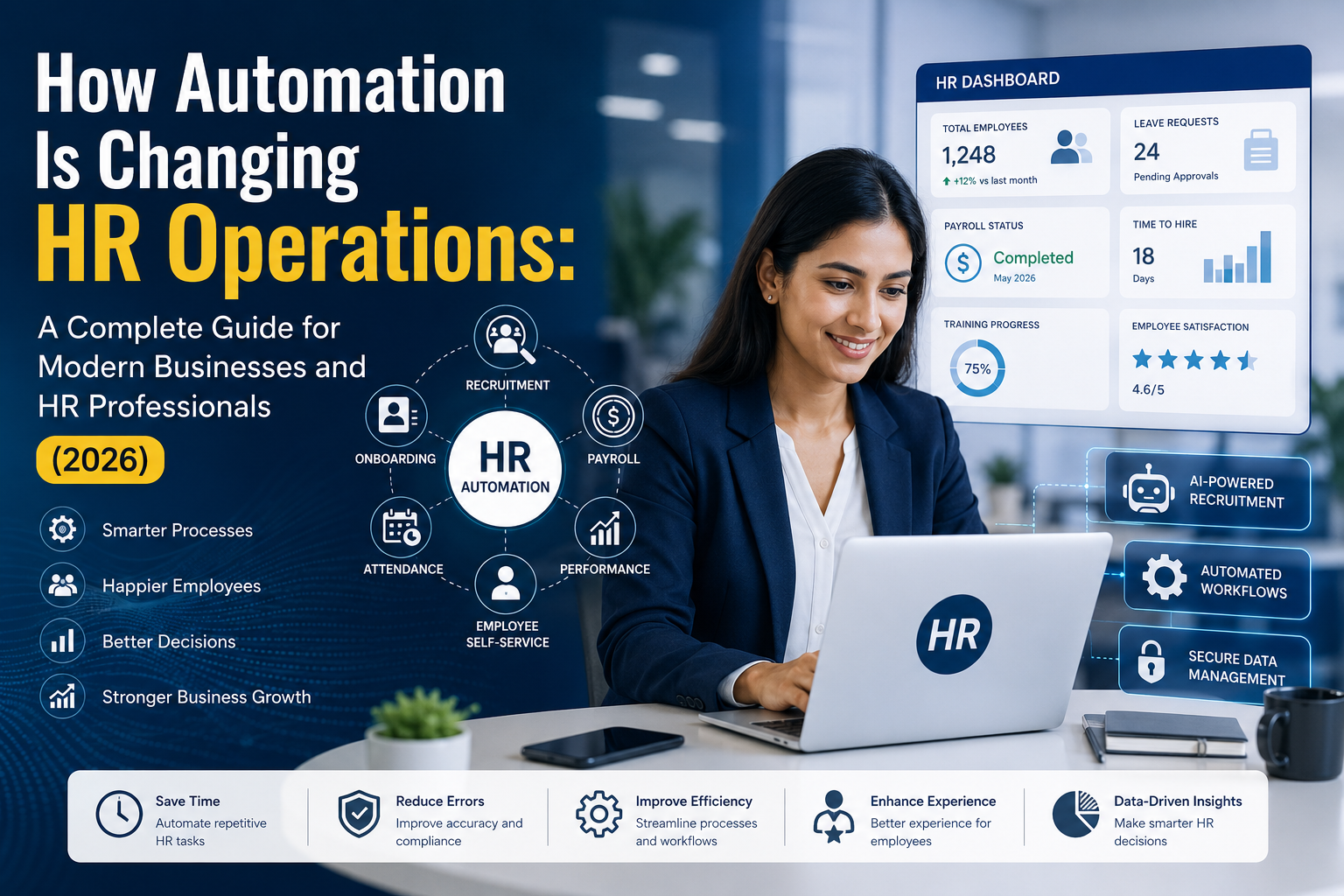
Human Resources (HR) has evolved significantly over the last decade. What was once considered an administrative department focused mainly on hiring, payroll, and employee records has now become a strategic function that directly contributes to business growth, employee engagement, and organizational success. One of the biggest drivers behind this transformation is HR automation.
In 2026, organizations of all sizes—from startups to multinational corporations—are adopting automation to simplify repetitive HR tasks, reduce manual errors, improve employee experiences, and enable HR professionals to focus on strategic initiatives. Whether it's screening resumes, processing payroll, managing attendance, or onboarding new employees, automation has become an essential part of modern HR operations.
Businesses are no longer asking, "Should we automate HR?" Instead, they are asking, "How can we automate HR more effectively?"
For aspiring HR professionals, understanding automation is no longer optional—it is a critical skill. Employers increasingly seek HR executives who can work with HR software, data analytics, AI-powered recruitment tools, and cloud-based HR management systems.
In this comprehensive guide, you'll learn how automation is transforming HR operations, the technologies behind it, and why it is shaping the future of human resource management.
What Is HR Automation?
HR automation refers to the use of software, artificial intelligence (AI), machine learning, robotic process automation (RPA), and digital workflows to perform repetitive HR tasks with minimal manual intervention.
Instead of spending hours on paperwork, spreadsheets, and repetitive administrative activities, HR professionals can automate these processes using specialized HR software.
Examples include:
Automatically posting job openings across multiple job portals
Screening resumes using AI
Scheduling interviews without manual coordination
Generating offer letters instantly
Processing payroll automatically
Managing employee attendance digitally
Sending automated reminders for document submissions
Tracking employee performance
Managing employee leave requests online
Automation doesn't replace HR professionals—it empowers them to become more strategic by eliminating repetitive tasks.
Why HR Automation Matters in 2026
The workplace has changed dramatically over the past few years. Hybrid work, remote teams, AI adoption, digital transformation, and increased employee expectations have forced organizations to rethink how HR functions operate.
Today's HR teams manage:
Remote employees
Hybrid workforces
Global hiring
Employee engagement
Learning and development
Compliance
Performance management
Workforce analytics
Managing all these responsibilities manually is inefficient and increases the risk of errors.
HR automation helps organizations:
Save time
Improve accuracy
Enhance employee satisfaction
Increase productivity
Strengthen compliance
Make data-driven decisions
Scale HR operations as the business grows
As companies continue embracing digital transformation, HR automation has become a competitive advantage rather than a luxury.
Benefits of HR Automation
1. Saves Significant Time
One of the biggest advantages of HR automation is time savings.
HR professionals spend countless hours on repetitive administrative work, including:
Entering employee information
Updating records
Processing leave applications
Managing payroll
Preparing reports
Automation completes these tasks within minutes.
This allows HR teams to dedicate more time to:
Employee engagement
Leadership development
Talent management
Organizational culture
Strategic workforce planning
Instead of acting as administrators, HR professionals become business partners.
2. Reduces Human Errors
Manual processes often lead to mistakes.
Examples include:
Incorrect payroll calculations
Wrong employee records
Missed deadlines
Duplicate entries
Compliance issues
Automated HR systems minimize these errors by using predefined workflows and validation rules.
As a result:
Payroll becomes more accurate.
Attendance records remain consistent.
Employee data stays reliable.
Compliance risks decrease.
Accuracy improves overall organizational efficiency.
3. Faster Recruitment Process
Hiring is one of the most time-consuming HR functions.
Traditional recruitment involves:
Posting job advertisements
Collecting resumes
Screening applications
Scheduling interviews
Communicating with candidates
Automation speeds up every stage.
AI-powered Applicant Tracking Systems (ATS) can:
Scan thousands of resumes in minutes
Match candidates with job descriptions
Rank applicants automatically
Schedule interviews
Send automated emails
This significantly reduces the time-to-hire.
4. Better Employee Experience
Employees today expect fast, digital, and convenient HR services.
Instead of emailing HR for every request, employees can use self-service portals to:
Download salary slips
Apply for leave
Update personal details
Check attendance
Submit reimbursement claims
Access company policies
Employees receive quicker responses while HR departments handle fewer routine inquiries.
This improves employee satisfaction and engagement.
5. Improved Compliance
Labour laws and employment regulations continue evolving.
Organizations must comply with:
Payroll regulations
Tax requirements
Employee documentation
Leave policies
Working hours
Statutory compliance
Automation helps by:
Tracking deadlines
Maintaining digital records
Generating compliance reports
Reducing documentation errors
Sending compliance reminders
This lowers legal risks and improves transparency.
6. Cost Savings
Although HR software requires an initial investment, it reduces long-term operational costs.
Organizations save money by reducing:
Paperwork
Administrative workload
Manual processing
Recruitment costs
Payroll errors
Compliance penalties
Automation also improves productivity, enabling HR teams to manage larger workforces without proportionally increasing staffing costs.
7. Better Decision-Making Through Data
Modern HR software generates real-time reports and dashboards that provide valuable insights into the workforce.
HR leaders can monitor:
Employee turnover
Hiring trends
Recruitment performance
Attendance patterns
Leave usage
Training completion rates
Employee performance metrics
These insights support informed decisions related to hiring, retention, workforce planning, and organizational development.
Key HR Processes That Are Being Automated
Automation is transforming nearly every HR function. Below are some of the most impactful areas.
1. Recruitment Automation
Recruitment has become faster and more efficient with automation.
Tasks that can be automated include:
Job posting across multiple platforms
Resume screening
Candidate ranking
Interview scheduling
Candidate communication
Offer letter generation
Benefits:
Reduced hiring time
Improved candidate experience
Better quality hires
Lower recruitment costs
2. Employee Onboarding
The onboarding process shapes a new employee's first impression of an organization.
Automated onboarding systems can:
Send welcome emails
Share joining instructions
Collect documents digitally
Assign training modules
Create employee accounts
Generate ID cards
Schedule orientation sessions
This creates a smooth and professional onboarding experience while reducing administrative work.
3. Attendance and Leave Management
Manual attendance tracking is outdated.
Modern HR systems use:
Biometric devices
Mobile attendance apps
GPS-based check-ins
Facial recognition
Cloud-based attendance systems
Leave requests are processed automatically.
Managers receive notifications and can approve requests online.
Employees can also monitor their leave balances in real time.
4. Payroll Automation
Payroll is one of the most critical HR responsibilities.
Automation simplifies payroll by:
Calculating salaries
Managing overtime
Computing deductions
Processing tax calculations
Generating salary slips
Handling reimbursements
Supporting direct bank transfers
Accurate payroll processing enhances employee trust and reduces administrative complexity.
5. Performance Management
Annual performance reviews are increasingly being replaced by continuous performance management systems.
Automated platforms allow organizations to:
Set goals and Key Performance Indicators (KPIs)
Track employee progress
Gather ongoing feedback
Conduct performance evaluations
Generate appraisal reports
Managers gain real-time visibility into employee performance, enabling timely coaching and recognition.
6. Employee Records Management
Maintaining employee records manually can be time-consuming and prone to errors.
Automated HR systems securely store:
Personal information
Educational qualifications
Employment history
Identity documents
Salary records
Performance reports
Training certifications
Cloud-based storage ensures quick access, secure backups, and easier compliance with data management policies.
Why HR Professionals Must Learn Automation
Automation is reshaping the HR profession. Companies now look for HR professionals who are comfortable using digital tools and interpreting workforce data, not just managing paperwork.
Key skills that are increasingly in demand include:
Working with HRMS and HRIS platforms
Understanding Applicant Tracking Systems (ATS)
Using payroll software
Managing digital onboarding workflows
Creating HR reports and dashboards
Basic HR analytics
AI-assisted recruitment tools
Advanced Microsoft Excel for HR
Digital documentation and compliance management
Professionals who combine traditional HR knowledge with technology skills are better positioned for career growth in today's competitive job market.
The Role of Artificial Intelligence (AI) in HR Automation
Artificial Intelligence (AI) is one of the biggest forces driving innovation in Human Resources. Unlike traditional automation, which follows predefined rules, AI can analyze large amounts of data, identify patterns, and make intelligent recommendations.
AI is helping HR teams make faster, more informed, and more accurate decisions across various functions.
AI in Recruitment
Recruitment has become one of the most AI-driven HR functions.
AI-powered recruitment tools can:
Analyze thousands of resumes within minutes.
Match candidates with job descriptions based on skills and experience.
Identify the most suitable applicants.
Eliminate duplicate applications.
Schedule interviews automatically.
Send personalized emails to candidates.
Predict candidate success based on historical hiring data.
This reduces hiring time while improving the quality of recruitment.
AI Chatbots for Employee Support
Many organizations now use AI chatbots to provide instant HR assistance.
Employees can ask questions such as:
How many leave days do I have?
How can I download my salary slip?
What is the company's leave policy?
How do I apply for reimbursement?
When is the payroll date?
Instead of waiting for HR executives, employees receive immediate responses 24/7.
This improves employee satisfaction while reducing the workload of HR teams.
AI in Employee Engagement
Employee engagement plays a vital role in retention and productivity.
AI tools can:
Conduct pulse surveys.
Analyze employee feedback.
Measure employee satisfaction.
Detect disengagement trends.
Recommend personalized learning opportunities.
Suggest recognition programs.
HR managers can address concerns before they become major problems.
Predictive HR Analytics
Predictive analytics is becoming increasingly valuable for HR departments.
Using historical workforce data, AI can forecast:
Employee turnover
Recruitment requirements
Future skill gaps
Training needs
High-performing employees
Promotion readiness
Instead of reacting to problems, HR leaders can plan proactively.
Popular HR Automation Tools Used in 2026
Organizations use a variety of HR software solutions depending on their size, industry, and requirements. These tools help streamline HR operations, improve employee experiences, and provide actionable insights.
1. Human Resource Management System (HRMS)
An HRMS is a centralized platform that manages employee information and HR workflows.
Typical features include:
Employee database
Attendance management
Leave management
Payroll processing
Performance tracking
Recruitment support
Employee self-service portal
HRMS software reduces paperwork and improves operational efficiency.
2. Human Resource Information System (HRIS)
An HRIS focuses on storing and managing employee information digitally.
It enables organizations to:
Maintain employee records
Track employment history
Manage benefits
Generate reports
Monitor compliance
HRIS serves as the foundation for digital HR operations.
3. Applicant Tracking System (ATS)
An ATS simplifies the hiring process from job posting to onboarding.
Key capabilities include:
Resume collection
Candidate screening
Interview scheduling
Recruitment pipeline management
Candidate communication
Hiring analytics
An ATS significantly reduces administrative work and accelerates recruitment.
4. Payroll Management Software
Payroll software automates complex salary calculations while ensuring compliance with statutory requirements.
It typically handles:
Salary processing
Tax calculations
Overtime payments
Bonus management
Provident Fund (PF)
Employee State Insurance (ESI)
Professional Tax
Payslip generation
Automation improves accuracy and minimizes payroll-related errors.
5. Learning Management Systems (LMS)
Employee learning has become a continuous process.
An LMS enables organizations to:
Deliver online training
Track course completion
Assess employee skills
Provide certifications
Recommend personalized learning paths
Continuous learning supports employee development and organizational growth.
Challenges of HR Automation
While automation offers numerous advantages, successful implementation requires careful planning. Organizations may encounter several challenges during the transition.
1. Resistance to Change
Employees and managers may hesitate to adopt new technologies due to unfamiliarity or fear of change.
Organizations should address this by:
Communicating the benefits of automation.
Providing hands-on training.
Offering continuous support.
Involving employees in the implementation process.
Building trust is essential for successful adoption.
2. High Initial Investment
Implementing HR software involves costs such as:
Software licensing
System customization
Employee training
Data migration
Technical support
Although the upfront investment may be significant, automation often delivers long-term savings through increased efficiency and reduced manual effort.
3. Data Security and Privacy
HR systems store sensitive employee information, including:
Personal identification details
Salary records
Bank account information
Performance evaluations
Medical and statutory documents
Organizations must ensure:
Strong encryption
Multi-factor authentication
Regular security audits
Role-based access controls
Compliance with data protection regulations
Protecting employee data is a critical responsibility.
4. Integration with Existing Systems
Many businesses already use accounting, finance, attendance, or ERP systems.
Integrating new HR software with existing platforms can be technically challenging.
Proper planning and collaboration with IT teams help ensure a smooth implementation.
5. Overdependence on Technology
Automation should enhance—not replace—human judgment.
Certain HR responsibilities still require empathy, emotional intelligence, and interpersonal communication, such as:
Conflict resolution
Employee counseling
Leadership coaching
Sensitive workplace investigations
Organizational culture building
Technology supports HR professionals but cannot replace the human element.
Best Practices for Implementing HR Automation
Organizations should follow these best practices to maximize the benefits of automation.
Define Clear Objectives
Before implementing automation, identify specific goals, such as:
Reducing hiring time
Improving payroll accuracy
Enhancing employee experience
Increasing compliance
Streamlining onboarding
Clear objectives guide technology selection and implementation.
Choose the Right Software
Not every HR solution fits every organization.
Evaluate software based on:
Business size
Budget
Features
Ease of use
Customer support
Scalability
Security standards
Integration capabilities
Selecting the right platform is crucial for long-term success.
Train HR Teams and Employees
Technology adoption depends on user confidence.
Organizations should provide:
Initial training sessions
User manuals
Video tutorials
Helpdesk support
Regular refresher programs
Well-trained users maximize software utilization.
Monitor Performance Regularly
After implementation, measure key performance indicators (KPIs), including:
Time-to-hire
Employee satisfaction
Payroll accuracy
Leave processing time
Recruitment costs
Employee retention
HR productivity
Continuous monitoring helps identify areas for improvement.
Real-World Applications of HR Automation
Automation benefits organizations across industries.
Information Technology (IT)
IT companies automate:
Bulk hiring
Remote onboarding
Performance management
Learning programs
Employee engagement
Manufacturing
Manufacturing organizations automate:
Shift scheduling
Attendance tracking
Payroll processing
Compliance reporting
Workforce planning
Healthcare
Hospitals automate:
Staff scheduling
Credential management
Recruitment
Training compliance
Employee documentation
Retail
Retail businesses automate:
Seasonal hiring
Attendance management
Workforce scheduling
Incentive calculations
Employee communication
Educational Institutions
Schools, colleges, and universities automate:
Faculty recruitment
Payroll
Leave management
Training records
Performance evaluations
Future Trends in HR Automation
The future of HR is becoming increasingly digital, intelligent, and employee-centric. Several emerging trends are expected to shape HR operations in the coming years.
AI-Powered Decision Support
AI will provide deeper insights into workforce planning, hiring strategies, and employee development by analyzing large datasets and offering evidence-based recommendations.
Hyperautomation
Organizations will combine AI, Robotic Process Automation (RPA), machine learning, and workflow automation to streamline end-to-end HR processes with minimal manual intervention.
Skills-Based Hiring
Instead of focusing solely on degrees, employers are increasingly assessing candidates based on practical skills, certifications, portfolios, and real-world experience.
Personalized Employee Experiences
Automation platforms will deliver customized learning paths, career development plans, wellness initiatives, and recognition programs tailored to individual employee needs.
Advanced Workforce Analytics
Future HR dashboards will provide real-time insights into productivity, engagement, retention, diversity, and workforce planning, enabling faster and more strategic decision-making.
Human-Centered Automation
Successful organizations will strike a balance between technology and human interaction. While automation will handle repetitive tasks, HR professionals will continue to lead in areas that require empathy, ethics, communication, and relationship-building.
Frequently Asked Questions (FAQs)
1. What is HR automation?
HR automation is the use of software, Artificial Intelligence (AI), and digital workflows to automate repetitive human resource tasks such as recruitment, payroll, attendance tracking, employee onboarding, leave management, and performance evaluations. It reduces manual effort, improves accuracy, and allows HR professionals to focus on strategic initiatives.
2. Why is HR automation important?
HR automation helps organizations:
Save time by eliminating repetitive administrative tasks.
Reduce human errors in payroll and employee records.
Improve compliance with labour laws and company policies.
Enhance employee experiences through self-service portals.
Support data-driven decision-making using HR analytics.
Increase overall operational efficiency.
As workplaces become more digital, HR automation has become essential for businesses aiming to stay competitive.
3. Can automation replace HR professionals?
No. Automation is designed to support HR professionals, not replace them.
While technology can handle repetitive and data-driven tasks, human skills remain essential for:
Leadership
Employee relations
Conflict resolution
Workplace culture
Coaching and mentoring
Strategic planning
Organizational development
The future of HR lies in collaboration between technology and human expertise.
4. Which HR tasks can be automated?
Many routine HR processes can be automated, including:
Resume screening
Job posting
Interview scheduling
Employee onboarding
Payroll processing
Attendance tracking
Leave management
Performance reviews
Document management
Employee communication
Compliance reminders
Training management
Automation allows HR teams to work faster while maintaining consistency.
5. What are the benefits of HR automation for employees?
Employees also benefit from automation through:
Faster HR services
Easy access to salary slips
Online leave applications
Self-service portals
Quicker reimbursement processing
Transparent attendance records
Better communication
Improved onboarding experiences
These improvements contribute to higher employee satisfaction and engagement.
6. Is HR automation suitable for small businesses?
Yes. Small and medium-sized businesses (SMEs) can benefit significantly from HR automation.
Affordable cloud-based HR software enables SMEs to:
Manage employee records
Automate payroll
Simplify recruitment
Track attendance
Maintain compliance
Reduce administrative workload
Automation allows smaller organizations to operate more efficiently without significantly increasing HR costs.
7. What skills should HR professionals learn in 2026?
To succeed in today's digital workplace, HR professionals should develop skills in:
HRMS and HRIS platforms
Applicant Tracking Systems (ATS)
Payroll management software
HR analytics
Microsoft Excel
Artificial Intelligence (AI) applications
Data interpretation
Employee engagement strategies
Labour law compliance
Communication and leadership
Combining technical knowledge with strong interpersonal skills makes HR professionals more valuable in the modern workplace.
8. What is the future of HR automation?
The future of HR automation includes:
AI-powered recruitment
Predictive workforce analytics
Skills-based hiring
Personalized employee experiences
Intelligent chatbots
Robotic Process Automation (RPA)
Cloud-based HR ecosystems
Continuous performance management
Organizations that adopt these technologies responsibly will be better equipped to attract, retain, and develop top talent.
Key Takeaways
Before concluding, let's summarize the major insights from this guide:
HR automation streamlines repetitive tasks such as recruitment, payroll, attendance, onboarding, and performance management.
Automation reduces manual errors, saves time, and improves productivity.
AI is transforming recruitment, employee engagement, analytics, and workforce planning.
HR software helps organizations improve compliance and make informed decisions using real-time data.
Human skills such as empathy, communication, leadership, and strategic thinking remain indispensable.
Successful automation requires careful planning, employee training, strong data security, and ongoing evaluation.
HR professionals who embrace technology will have greater career opportunities and play a more strategic role in organizational success.
Conclusion
Human Resources is no longer limited to administrative responsibilities. In today's fast-changing business environment, HR has become a strategic function that directly influences employee satisfaction, organizational culture, productivity, and long-term business growth.
Automation is at the heart of this transformation. By eliminating repetitive tasks, reducing administrative burdens, and providing actionable insights through AI and analytics, automation empowers HR professionals to focus on initiatives that truly add value—such as talent development, employee engagement, leadership planning, and organizational innovation.
However, technology alone cannot build strong workplaces. Successful organizations understand that automation works best when combined with human judgment, empathy, ethical decision-making, and meaningful employee relationships. The goal is not to replace HR professionals but to equip them with tools that make their work more impactful and efficient.
For aspiring HR professionals, learning how to use HR automation tools is no longer optional—it is a career necessity. Employers increasingly seek candidates who can navigate digital HR systems, interpret workforce data, and leverage technology to improve HR processes. Investing in practical HR training that covers HR software, payroll systems, recruitment platforms, compliance, and analytics can provide a significant competitive advantage.
As businesses continue embracing digital transformation, the future belongs to HR professionals who are adaptable, tech-savvy, and committed to continuous learning. Organizations that successfully integrate automation with a people-first approach will be better positioned to attract top talent, improve employee experiences, and achieve sustainable growth in the years ahead.