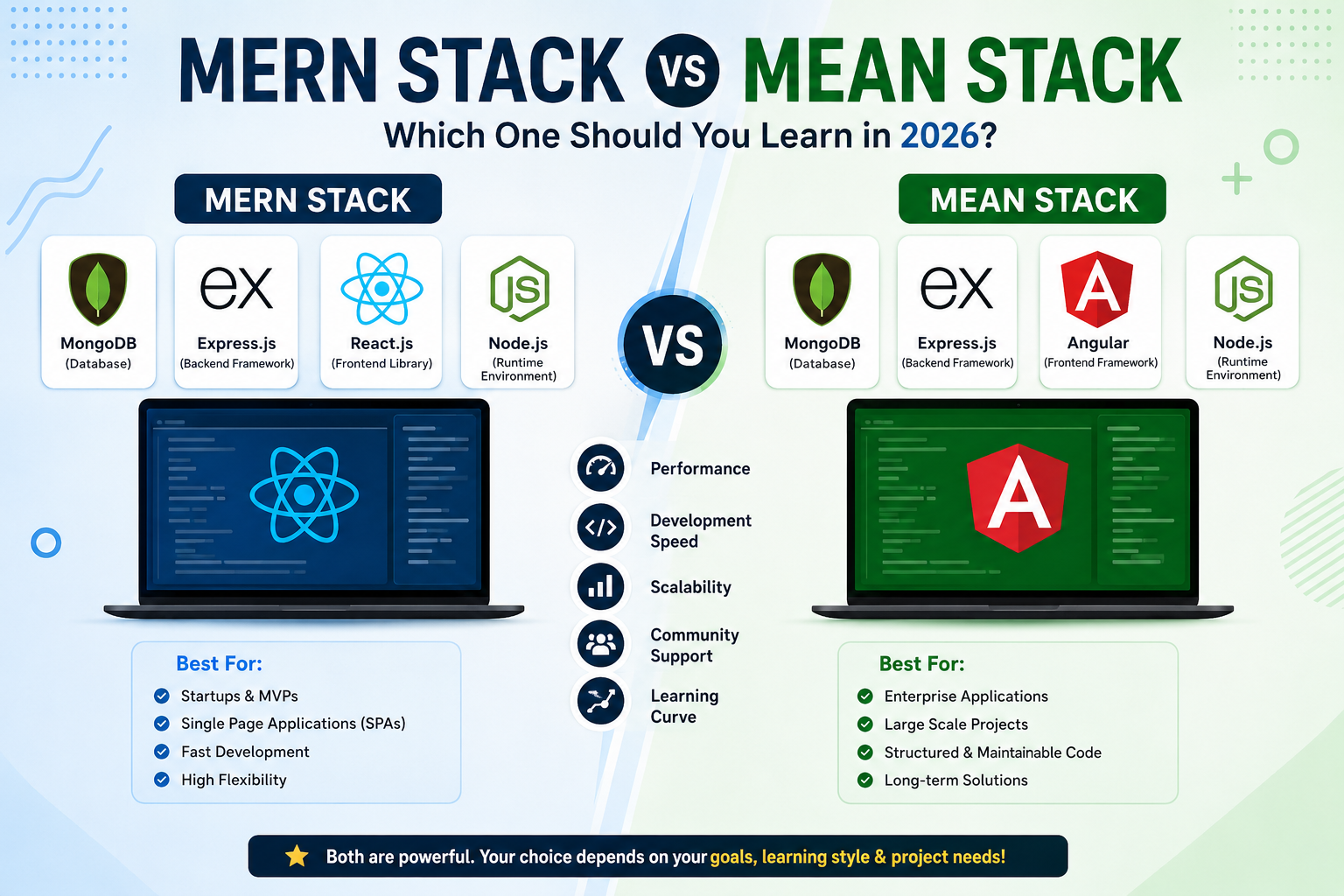
The demand for Full Stack Developers has reached an all-time high as businesses continue to embrace digital transformation. Whether it's building e-commerce websites, SaaS platforms, social media applications, or enterprise software, companies are actively hiring professionals who can handle both front-end and back-end development.
If you've started exploring full stack development, you've probably come across two of the most popular technology stacks:
MERN Stack
MEAN Stack
At first glance, they seem almost identical because they share three common technologies:
MongoDB
Express.js
Node.js
The only major difference lies in the front-end framework:
MERN uses React.js
MEAN uses Angular
But does that one difference really matter?
Absolutely.
The choice between MERN and MEAN can significantly impact your learning experience, career opportunities, salary potential, project types, and even the companies you work for.
In this comprehensive guide, you'll learn everything about both technology stacks, including their architecture, advantages, disadvantages, career scope, and which one is the better choice in 2026.
What is a Technology Stack?
A technology stack is a collection of programming languages, frameworks, libraries, databases, and tools used together to build a complete web application.
A full stack generally includes:
Front-end (User Interface)
Back-end (Server-side Logic)
Database
APIs
Authentication
Hosting
Instead of learning different technologies randomly, developers learn a predefined stack that works seamlessly together.
This makes development faster, easier, and more efficient.
What is the MERN Stack?
MERN Stack is a JavaScript-based full stack development framework used for building modern, interactive, and scalable web applications.
The word MERN stands for:
M – MongoDB
MongoDB is a NoSQL database that stores data in flexible JSON-like documents instead of traditional tables.
Key Features:
High scalability
Flexible schema
Fast performance
Cloud support
Easy integration with JavaScript
Examples:
User profiles
Product catalogs
Blog posts
Chat messages
Orders
E – Express.js
Express.js is a lightweight backend framework that runs on Node.js.
It helps developers create:
APIs
Authentication systems
Routing
Middleware
Server-side logic
Instead of writing lengthy backend code, Express simplifies development considerably.
R – React.js
React is the biggest reason why MERN has become so popular.
Developed by Meta (Facebook), React is a JavaScript library used for building highly interactive user interfaces.
Popular React Features:
Component-based architecture
Virtual DOM
High performance
Reusable components
Huge community support
Easy integration
React powers some of the world's most popular websites.
Examples include:
Facebook
Instagram
Netflix
Airbnb
WhatsApp Web
N – Node.js
Node.js allows JavaScript to run on the server.
This means developers can write both frontend and backend code using the same programming language.
Benefits include:
Fast execution
Event-driven architecture
Excellent scalability
Huge package ecosystem (npm)
Cross-platform support
MERN Stack Architecture
A typical MERN application follows this workflow:
Frontend (React.js)
⬇
API Requests
⬇
Express.js + Node.js
⬇
Database Queries
⬇
MongoDB
⬇
Data Returned to React
This architecture enables developers to create fast, scalable, and responsive web applications.
Advantages of MERN Stack
1. One Programming Language
Everything is built using JavaScript.
You don't have to switch between multiple programming languages.
2. Faster Development
React offers reusable components, reducing development time significantly.
3. Huge Community
React has one of the largest developer communities, making it easier to find tutorials, libraries, and solutions.
4. Better Performance
The Virtual DOM updates only the necessary parts of a webpage, resulting in faster rendering and a smoother user experience.
5. High Demand
Thousands of startups and tech companies actively seek MERN developers because of React's popularity.
Disadvantages of MERN Stack
Although MERN is powerful, it has a few drawbacks:
Frequent React updates require continuous learning.
Large applications need a well-defined architecture to stay maintainable.
Developers often rely on multiple third-party libraries.
State management can become complex in large-scale projects.
What is the MEAN Stack?
The MEAN Stack is another JavaScript-based technology stack used for developing dynamic web applications.
MEAN stands for:
MongoDB
Express.js
Angular
Node.js
Unlike MERN, the front-end is built with Angular instead of React.
Angular is a complete front-end framework developed and maintained by Google.
Understanding Angular
Angular is a comprehensive framework designed for building robust, scalable, and enterprise-grade web applications.
Unlike React, which focuses primarily on the user interface, Angular includes many built-in features such as:
Routing
Dependency Injection
State Management
Form Validation
HTTP Client
Testing Utilities
This makes Angular a strong choice for large and complex applications.
Key Features of Angular
Component-Based Development
Applications are divided into reusable components, improving code organization and maintainability.
TypeScript Support
Angular uses TypeScript by default, offering:
Better code quality
Strong typing
Improved debugging
Enhanced IDE support
Easier maintenance
Two-Way Data Binding
Angular automatically synchronizes data between the UI and application logic, reducing manual coding.
Dependency Injection
This feature promotes modular development by allowing components and services to be loosely coupled.
Built-In Security
Angular includes built-in protections against common vulnerabilities such as Cross-Site Scripting (XSS), making it suitable for enterprise applications.
MEAN Stack Architecture
A MEAN application follows a similar architecture to MERN:
Angular Frontend
⬇
REST APIs
⬇
Express.js
⬇
Node.js
⬇
MongoDB Database
The primary distinction is Angular handling the presentation layer instead of React.
Advantages of MEAN Stack
Complete Framework
Angular provides most of the tools developers need out of the box, reducing reliance on external libraries.
Enterprise-Friendly
Large organizations prefer Angular for its structured architecture and long-term maintainability.
Strong Type Checking
TypeScript helps detect errors during development, leading to more reliable applications.
Scalable Codebase
Angular's opinionated structure makes it easier for teams to collaborate on large projects.
Google Backing
Being maintained by Google ensures regular updates, comprehensive documentation, and long-term support.
Disadvantages of MEAN Stack
While MEAN is powerful, it also presents some challenges:
Steeper learning curve due to Angular and TypeScript.
More boilerplate code compared to React.
Smaller ecosystem than React.
Initial development may take longer because of Angular's complexity.
MERN Stack vs MEAN Stack: Understanding the Core Difference
Although both stacks share MongoDB, Express.js, and Node.js, the choice between React and Angular significantly affects development style, project structure, and learning experience.
| Feature | MERN Stack | MEAN Stack |
|---|---|---|
| Front-end Technology | React.js | Angular |
| Maintained By | Meta | |
| Type | JavaScript Library | Full-fledged Framework |
| Programming Language | JavaScript | TypeScript |
| Learning Curve | Easier for beginners | Steeper, more structured |
| Flexibility | Highly flexible | Opinionated and structured |
| Best For | Startups, SPAs, dynamic web apps | Enterprise-level, large-scale applications |
MERN Stack vs MEAN Stack: A Detailed Comparison
Choosing between MERN and MEAN isn't about finding the "better" stack—it's about selecting the one that aligns with your career goals, interests, and the type of projects you want to build. Let's compare both stacks across the factors that matter most.
1. Learning Curve
MERN Stack
MERN is often recommended for beginners because React is relatively easy to learn. Developers can start building user interfaces quickly without needing to understand many complex concepts upfront.
React focuses only on the UI layer, allowing learners to gradually explore routing, state management, and advanced concepts as they gain confidence.
Best for:
Beginners
College students
Self-learners
Career changers
Freelancers
MEAN Stack
Angular has a steeper learning curve because it's a complete framework. To become productive with Angular, you'll need to learn:
TypeScript
Components
Services
Modules
Dependency Injection
RxJS
Routing
Pipes
Directives
Although it requires more effort initially, Angular provides a well-organized structure that's ideal for large-scale projects.
Winner: MERN (for beginners)
2. Performance
Performance depends on the application's architecture and optimization, but there are some key differences.
MERN Performance
React uses a Virtual DOM, which updates only the parts of the webpage that change. This results in:
Faster rendering
Smooth user interactions
Better performance for dynamic applications
Excellent user experience
MEAN Performance
Angular uses a Real DOM along with advanced optimization techniques. While Angular performs exceptionally well, it may feel heavier than React in highly interactive applications due to its comprehensive feature set.
Winner: MERN for highly interactive applications
3. Flexibility
MERN
React gives developers the freedom to choose libraries for:
State management
Routing
Authentication
Form validation
UI components
This flexibility makes MERN highly customizable.
MEAN
Angular follows strict development conventions. Since most tools are built into the framework, developers have fewer decisions to make, leading to consistency across projects.
Winner: Depends on your preference:
Want flexibility? → MERN
Prefer structure? → MEAN
4. Scalability
Both stacks can scale effectively, but they approach scalability differently.
MERN
Scalability depends on how well developers organize the project. Large React applications require proper folder structures, reusable components, and efficient state management.
MEAN
Angular's opinionated architecture naturally supports large teams and complex applications, making it easier to maintain as projects grow.
Winner: MEAN (for enterprise-scale applications)
5. Community Support
MERN
React has one of the largest developer communities in the world.
Benefits include:
Countless tutorials
Open-source libraries
Active forums
Frequent updates
Large hiring market
MEAN
Angular also has a strong community and official support from Google, but its ecosystem is comparatively smaller than React's.
Winner: MERN
6. Development Speed
React's lightweight nature and reusable components often allow developers to build prototypes and products more quickly.
Angular's built-in tools reduce the need for third-party libraries but require more setup and configuration.
Winner: MERN
7. Code Maintainability
Angular enforces coding standards, making it easier for large development teams to maintain consistent codebases.
React offers more flexibility, but without proper conventions, large projects can become difficult to manage.
Winner: MEAN
MERN Stack vs MEAN Stack: Feature Comparison
| Feature | MERN Stack | MEAN Stack |
|---|---|---|
| Front-end | React.js | Angular |
| Backend | Node.js + Express | Node.js + Express |
| Database | MongoDB | MongoDB |
| Language | JavaScript | TypeScript |
| Learning Difficulty | Easy | Moderate to Difficult |
| Performance | Excellent | Very Good |
| Flexibility | High | Moderate |
| Community Support | Very Large | Large |
| Enterprise Usage | Moderate | High |
| Startup Popularity | Very High | Moderate |
| Development Speed | Faster | Structured |
| Best For | Startups, Freelancers, SPAs | Enterprise Applications |
Real-World Applications of MERN Stack
MERN is widely used to create:
Social media platforms
E-commerce websites
Food delivery apps
Video streaming platforms
Online learning portals
Project management tools
CRM dashboards
SaaS applications
Blogging platforms
Chat applications
Popular Companies Using React
Meta (Facebook)
Instagram
Netflix
Airbnb
Dropbox
WhatsApp Web
Uber Eats
Discord
These companies value React for its speed, scalability, and exceptional user experience.
Real-World Applications of MEAN Stack
MEAN is commonly used for:
Banking software
ERP systems
Healthcare management systems
Government portals
Enterprise dashboards
Human Resource Management Systems (HRMS)
Supply chain management software
Financial platforms
Customer Relationship Management (CRM) systems
Internal business applications
Popular Companies Using Angular
Google
Microsoft
PayPal
Upwork
Deutsche Bank
Samsung
Forbes
IBM
Angular is often the preferred choice for applications requiring long-term maintenance and structured development.
Career Opportunities
Both stacks offer excellent career prospects as businesses increasingly rely on full stack developers.
MERN Stack Jobs
Frontend Developer
React Developer
Full Stack Developer
JavaScript Developer
Web Application Developer
UI Developer
Software Engineer
Freelance Web Developer
MEAN Stack Jobs
Angular Developer
Full Stack Developer
Software Engineer
Enterprise Application Developer
Technical Consultant
Solutions Architect (with experience)
Web Application Developer
Salary Comparison in India (2026)
While salaries vary based on location, skills, company, and experience, here's a general estimate:
| Experience | MERN Developer | MEAN Developer |
|---|---|---|
| Fresher (0–1 Year) | ₹4–7 LPA | ₹4–6.5 LPA |
| 2–4 Years | ₹7–12 LPA | ₹7–11 LPA |
| 5+ Years | ₹12–22+ LPA | ₹12–20+ LPA |
Note: Developers with strong problem-solving skills, project experience, and knowledge of cloud platforms, APIs, Git, and DevOps often command higher salaries regardless of the stack.
MERN Stack: Advantages and Disadvantages
Advantages
Uses JavaScript throughout the development process
Faster UI rendering with React
Large ecosystem and community support
Easier to learn for beginners
Excellent for startups and MVPs
High demand in the job market
Great for freelance projects
Rapid development with reusable components
Disadvantages
Requires additional libraries for many features
Frequent updates may require continuous learning
Project architecture depends heavily on the developer
State management can become complex in large applications
MEAN Stack: Advantages and Disadvantages
Advantages
Complete framework with built-in features
Strong architecture for large applications
TypeScript improves code quality
Easier maintenance for enterprise teams
Excellent documentation
Long-term support from Google
Disadvantages
Steeper learning curve
More boilerplate code
Development can be slower initially
Smaller ecosystem compared to React
Which Stack is Better for Beginners?
If you're starting your web development journey, MERN Stack is generally the better option because:
React is easier to learn.
JavaScript is used across the entire stack.
There are abundant learning resources and community support.
It's widely adopted by startups and product-based companies.
It opens doors to freelancing, internships, and remote opportunities.
However, if your goal is to work on large enterprise applications or in organizations that heavily use Angular, learning the MEAN Stack can be a valuable investment.
Future Scope of MERN Stack and MEAN Stack in 2026 and Beyond
The web development industry continues to evolve rapidly with advancements in Artificial Intelligence (AI), cloud computing, Progressive Web Apps (PWAs), serverless architecture, and modern JavaScript frameworks. Despite these changes, both the MERN and MEAN stacks remain highly relevant and in demand.
However, industry trends suggest that React-based development is growing at a faster pace, particularly among startups, SaaS companies, and product-based organizations. At the same time, Angular continues to dominate enterprise-level applications, where scalability, structured architecture, and long-term maintenance are essential.
Rather than asking, "Which stack will survive?" the better question is, "Which stack aligns with my career goals?"
When Should You Choose MERN Stack?
The MERN stack is an excellent choice if you:
Are completely new to web development.
Want to become a Full Stack Developer quickly.
Prefer learning one programming language (JavaScript) across the entire stack.
Plan to work in startups or product-based companies.
Want to build dynamic and interactive web applications.
Aim to freelance or work remotely.
Enjoy creating visually engaging user interfaces.
Want access to a vast ecosystem of libraries and community support.
MERN is Ideal For Building:
Social media platforms
E-commerce websites
Learning Management Systems (LMS)
Portfolio websites
Online booking platforms
Food delivery applications
Chat applications
Project management tools
SaaS products
Blogging platforms
When Should You Choose MEAN Stack?
Choose the MEAN stack if you:
Enjoy working with structured frameworks.
Want to build enterprise-grade applications.
Are comfortable learning TypeScript.
Plan to work in large IT companies or multinational corporations.
Prefer frameworks with built-in solutions rather than relying on external libraries.
Like organized project architecture and coding standards.
MEAN is Ideal For Building:
Banking software
ERP systems
HRMS platforms
Government portals
Healthcare management systems
CRM applications
Financial software
Inventory management systems
Business intelligence dashboards
Large enterprise web applications
MERN vs MEAN: Which One Has Better Career Opportunities?
Both technology stacks offer excellent career prospects, but hiring trends vary by company type.
MERN Developers
Companies hiring MERN developers typically include:
Startups
SaaS companies
EdTech companies
E-commerce businesses
Product-based companies
Digital agencies
Freelance clients
Remote-first organizations
MEAN Developers
MEAN developers are commonly hired by:
Enterprise software companies
IT service providers
Financial institutions
Healthcare organizations
Government technology projects
Large multinational corporations
Industry Insight: If your goal is to maximize job opportunities as a fresher, learning the MERN stack can provide a broader range of openings. However, Angular expertise remains highly valued in enterprise environments.
Step-by-Step Roadmap to Learn MERN Stack
If you're starting from scratch, follow this learning path:
Step 1: Learn HTML5
Understand the structure of web pages using semantic HTML.
Step 2: Master CSS3
Learn layouts, Flexbox, Grid, animations, and responsive design.
Step 3: Learn JavaScript (ES6+)
Focus on variables, functions, arrays, objects, promises, async/await, DOM manipulation, and APIs.
Step 4: Version Control with Git & GitHub
Learn how to manage code, collaborate, and build a professional portfolio.
Step 5: Learn React.js
Study components, props, state, hooks, routing, API integration, and state management.
Step 6: Learn Node.js
Understand server-side JavaScript, modules, file systems, and asynchronous programming.
Step 7: Learn Express.js
Build RESTful APIs, routing, middleware, authentication, and error handling.
Step 8: Learn MongoDB
Work with collections, CRUD operations, indexing, aggregation, and cloud databases.
Step 9: Build Real Projects
Practice by creating:
E-commerce website
Blog platform
Student Management System
Job Portal
Chat Application
Expense Tracker
Food Delivery App
Step 10: Deploy Your Projects
Learn deployment using platforms like Vercel, Netlify, Render, or cloud providers to showcase live applications.
Essential Skills Every Full Stack Developer Should Learn
Beyond the MERN or MEAN stack, employers look for well-rounded developers with additional skills:
Data Structures & Algorithms (DSA)
RESTful APIs
Authentication (JWT, OAuth)
Responsive Web Design
Git & GitHub
Cloud Fundamentals
Basic DevOps Concepts
SQL and NoSQL Databases
Web Security Best Practices
Testing and Debugging
Problem-Solving Skills
Communication and Team Collaboration
Developing these complementary skills will make you a stronger candidate in the job market.
Frequently Asked Questions (FAQs)
1. Which is better for beginners: MERN or MEAN?
MERN is generally easier for beginners because React has a gentler learning curve, and the entire stack primarily uses JavaScript.
2. Is React better than Angular?
Neither is universally better. React excels in flexibility and dynamic user interfaces, while Angular is ideal for structured, enterprise-scale applications.
3. Can I learn MERN without knowing programming?
Yes. A basic understanding of HTML, CSS, and JavaScript is sufficient to begin learning the MERN stack.
4. Which stack offers a higher salary?
Both MERN and MEAN developers earn competitive salaries. Compensation depends more on your skills, experience, project portfolio, and problem-solving ability than on the stack itself.
5. How long does it take to learn the MERN stack?
With consistent practice, many learners gain job-ready skills in 6–9 months, though the timeline varies depending on prior experience and study hours.
6. Is the MERN stack still in demand in 2026?
Yes. MERN continues to be one of the most sought-after full stack development stacks, especially among startups, SaaS companies, and product-based organizations.
7. Can I switch from MERN to MEAN later?
Absolutely. Since both stacks share MongoDB, Express.js, and Node.js, you'll mainly need to learn Angular and TypeScript to transition.
Final Verdict: MERN or MEAN?
Both MERN and MEAN are powerful full stack development technologies that can lead to rewarding careers. The right choice depends on your aspirations.
Choose MERN Stack if you:
Want a beginner-friendly learning path.
Enjoy building modern, interactive user interfaces.
Aspire to work in startups, product companies, or freelance.
Prefer JavaScript across the entire stack.
Choose MEAN Stack if you:
Like structured frameworks and coding standards.
Aim to work on large-scale enterprise applications.
Are comfortable with TypeScript.
Plan to build long-term business solutions.
For most beginners and aspiring developers in 2026, MERN Stack is often the recommended starting point due to its ease of learning, strong community support, and high demand in the job market. Once you've mastered MERN, transitioning to Angular and the MEAN stack becomes significantly easier.
Why Learn Full Stack Development with Skill Excellent?
At Skill Excellent, we focus on practical, industry-oriented learning to prepare students for real-world software development careers.
Our Full Stack Development Training Includes:
Industry-focused curriculum
Expert mentors with real-world experience
Hands-on live projects
Portfolio development
Interview preparation
Resume-building support
Placement assistance
Practical coding assignments
Career guidance
Certification upon successful completion
Whether you're a student, graduate, working professional, or career switcher, our Full Stack Development program equips you with the technical and practical skills needed to succeed in today's competitive IT industry.
Conclusion
The demand for skilled Full Stack Developers continues to grow as businesses expand their digital presence. Both MERN and MEAN offer excellent career opportunities, but your success ultimately depends on continuous learning, hands-on practice, and building real-world projects.
If you're looking for a flexible, modern, and beginner-friendly path, MERN Stack is a great place to start. If your goal is enterprise application development with structured architecture, MEAN Stack is an equally valuable choice.
No matter which path you choose, investing in practical skills, a strong portfolio, and consistent learning will help you build a successful and future-ready career in web development.