Introduction
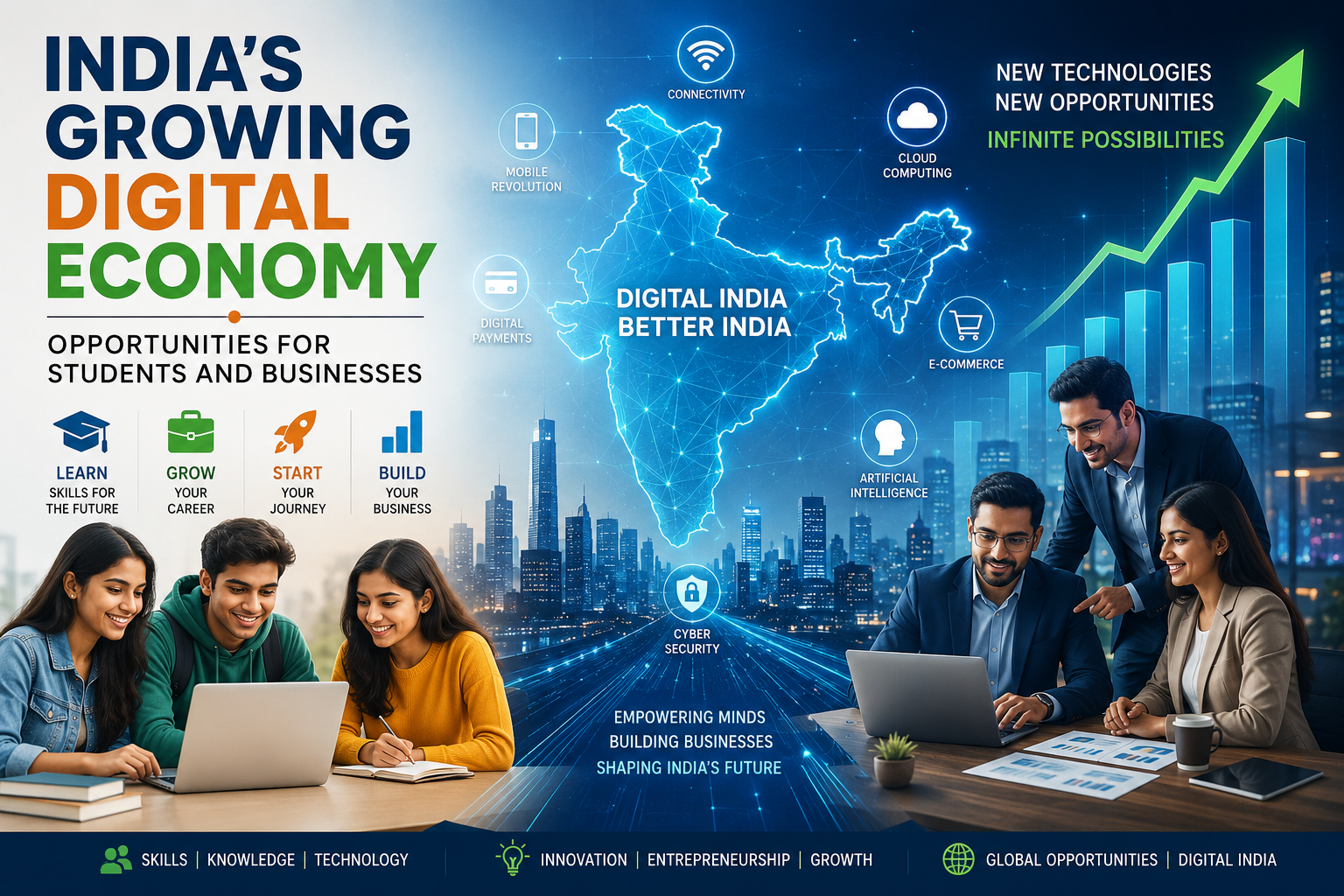
India is witnessing one of the fastest digital transformations in the world. Over the last decade, the country has evolved from being a largely cash-driven and traditional economy to becoming a global digital powerhouse. Today, smartphones, affordable internet, digital payment systems, artificial intelligence (AI), cloud computing, e-commerce, online education, and automation are transforming the way people live, learn, work, and conduct business.
The digital economy has become a major contributor to India's economic growth. From startups and multinational corporations to small businesses and individual entrepreneurs, digital technologies are opening doors to innovation and creating countless opportunities. Students now have access to world-class education through online platforms, professionals can build careers remotely, and businesses of every size can reach customers across the country—and even around the globe.
Government initiatives such as Digital India, Startup India, Skill India, and the rapid expansion of internet connectivity have accelerated this transformation. As a result, India is emerging as one of the world's leading digital economies, attracting investments, encouraging entrepreneurship, and creating millions of employment opportunities.
For students, this digital revolution means access to new career paths, industry-relevant skills, and global learning opportunities. For businesses, it offers improved efficiency, wider market reach, data-driven decision-making, and innovative ways to engage customers.
In this blog, we will explore how India's growing digital economy is reshaping education, employment, entrepreneurship, and business development, while highlighting the opportunities that individuals and organizations can leverage to thrive in the digital age.
What is the Digital Economy?
The digital economy refers to economic activities that are powered by digital technologies, internet connectivity, and data-driven innovations. It includes businesses that rely on digital platforms, software, online services, cloud computing, e-commerce, artificial intelligence, fintech, digital marketing, and various technology-enabled solutions.
Unlike traditional economies, where business operations were mostly manual and location-dependent, the digital economy enables organizations to operate faster, smarter, and more efficiently. It allows businesses to connect with customers worldwide, automate repetitive tasks, analyze customer behavior, and make informed decisions using data.
Key Components of the Digital Economy
The digital economy consists of several interconnected sectors:
Digital payments and fintech
E-commerce platforms
Information technology services
Artificial Intelligence (AI)
Cloud Computing
Cybersecurity
Digital Marketing
Data Analytics
Internet of Things (IoT)
Software Development
Online Education
Mobile Applications
Remote Work Technologies
These technologies work together to create an ecosystem where businesses can innovate continuously and consumers enjoy greater convenience.
India's Digital Economy at a Glance
India has rapidly become one of the world's largest digital markets. With a population of over 1.4 billion people and one of the largest internet user bases globally, the country offers enormous opportunities for digital businesses and technology-driven innovation.
Several factors have contributed to this rapid growth:
Affordable smartphones
Low-cost internet services
Expansion of 4G and 5G networks
Growth of digital payment systems
Government-backed digital initiatives
Rapid startup ecosystem
Increasing digital literacy
Rising demand for online services
Today, millions of Indians rely on digital platforms for education, healthcare, banking, shopping, entertainment, transportation, communication, and employment.
Whether someone wants to learn a new language, purchase groceries, attend a virtual interview, launch an online business, or make instant payments, digital technologies have made these activities more accessible than ever before.
Why India's Digital Economy is Growing So Fast
Several powerful factors are driving India's digital transformation.
1. Affordable Internet Access
India has one of the world's lowest mobile internet costs, making internet access affordable for millions of people.
As internet penetration increases in urban as well as rural areas, more individuals are using online services for education, business, communication, and financial transactions.
Affordable connectivity has become the foundation of India's digital growth.
2. Rapid Smartphone Adoption
Smartphones have become the primary gateway to the digital world.
Students attend online classes.
Businesses manage operations.
Customers shop online.
Professionals work remotely.
Entrepreneurs market products through social media.
This widespread smartphone adoption has dramatically expanded digital participation across every age group.
3. Government Initiatives
Government programs have significantly accelerated digital adoption across the country.
Some major initiatives include:
Digital India
Startup India
Skill India
Make in India
BharatNet
PM Gati Shakti
ONDC (Open Network for Digital Commerce)
These initiatives encourage digital infrastructure development, entrepreneurship, financial inclusion, innovation, and employment generation.
4. Digital Payments Revolution
India has become a global leader in digital payments.
Unified Payments Interface (UPI) has transformed how people send money, pay bills, shop online, and conduct business.
Today, even small street vendors accept digital payments using QR codes.
This shift has increased transparency, convenience, and financial inclusion across the country.
5. Expanding Startup Ecosystem
India is now home to one of the largest startup ecosystems in the world.
Thousands of startups are solving real-world problems through technology in sectors such as:
Healthcare
Agriculture
Education
Logistics
Financial Services
Artificial Intelligence
SaaS
Clean Energy
These startups generate employment while encouraging innovation and entrepreneurship.
6. Growth of Artificial Intelligence
Artificial Intelligence is changing industries faster than ever.
Businesses now use AI for:
Customer support
Marketing automation
Fraud detection
Predictive analytics
Personalized recommendations
Recruitment
Healthcare diagnosis
Content creation
Students who develop AI skills today will likely enjoy strong career prospects in the coming years.
Opportunities for Students in India's Digital Economy
One of the biggest beneficiaries of India's digital revolution is the student community.
Today's learners are no longer limited by geographical boundaries or traditional classroom education.
Digital technologies have created countless learning and career opportunities.
1. Access to High-Quality Online Learning
Students can now learn from industry experts regardless of their location.
Online learning platforms offer courses in:
Programming
Artificial Intelligence
Digital Marketing
Cybersecurity
Graphic Design
Foreign Languages
Data Analytics
Finance
Cloud Computing
Full Stack Development
These courses help students become industry-ready even before graduation.
2. Better Career Opportunities
Companies are increasingly hiring candidates based on practical skills rather than academic degrees alone.
Students who build expertise in modern digital skills have better chances of securing:
High-paying jobs
Remote jobs
International freelancing opportunities
Internship programs
Startup roles
IT careers
Digital marketing positions
Data analytics roles
The demand for skilled professionals continues to rise across industries.
3. Freelancing Opportunities
The internet has made it easier than ever to work independently.
Students can earn while studying through freelancing in areas such as:
Content Writing
Graphic Designing
Video Editing
Web Development
App Development
Digital Marketing
SEO
Social Media Management
Translation Services
Virtual Assistance
Freelancing helps students gain practical experience, build portfolios, and develop entrepreneurial skills.
4. Learning Global Skills
Students can now compete in international markets by learning globally relevant skills such as:
Artificial Intelligence
Machine Learning
Cloud Computing
UI/UX Design
Business Analytics
Blockchain
Cybersecurity
Foreign Languages
Digital Communication
Project Management
These skills significantly improve employability in multinational companies and remote work environments.
5. Improved Employability Through Certifications
Professional certifications have become increasingly valuable in today's job market.
Industry-recognized certifications demonstrate practical expertise and commitment to continuous learning.
Certifications in cloud computing, cybersecurity, digital marketing, data analytics, software development, and foreign languages often give candidates a competitive edge during recruitment.
Students who combine academic education with professional certifications are generally better prepared to meet evolving industry requirements.
6. Entrepreneurship at a Young Age
The digital economy has lowered the barriers to starting a business.
Students no longer need significant capital to launch an entrepreneurial venture. With the right skills and digital tools, they can create websites, develop mobile applications, offer freelance services, build personal brands, or establish online stores from virtually anywhere.
Social media platforms, e-commerce marketplaces, digital payment systems, and cloud-based business tools make it easier than ever to validate ideas, reach customers, and scale operations. This environment encourages innovation and empowers young entrepreneurs to turn creative ideas into successful businesses.
Opportunities for Businesses in India's Digital Economy
India's digital economy is not only transforming education and employment but also redefining how businesses operate, compete, and grow. From startups and MSMEs to large enterprises, organizations across industries are leveraging digital technologies to improve efficiency, reduce costs, enhance customer experiences, and expand into new markets.
Businesses that embrace digital transformation are better positioned to adapt to changing consumer behavior, respond to market trends, and remain competitive in an increasingly technology-driven economy.
How Digital Transformation is Changing Businesses
Digital transformation involves integrating digital technologies into every aspect of a business. It goes beyond adopting new software—it is about reimagining business processes, improving customer engagement, and making informed decisions through data.
Today, businesses use technology to:
Automate repetitive tasks
Improve customer support
Enhance operational efficiency
Manage finances digitally
Analyze customer behavior
Improve marketing performance
Increase productivity
Enable remote collaboration
Strengthen cybersecurity
Deliver personalized customer experiences
Organizations that invest in digital transformation often experience higher productivity, improved customer satisfaction, and long-term growth.
Major Opportunities for Businesses
1. Reaching Customers Beyond Geographic Boundaries
One of the greatest advantages of digitalization is the ability to reach customers anywhere in the world.
Earlier, businesses relied heavily on physical stores and local markets. Today, companies can sell products and services through:
Business websites
E-commerce platforms
Mobile applications
Social media
Online marketplaces
Digital advertising
Even small businesses can now compete with larger organizations by establishing a strong online presence.
2. Digital Marketing Creates Affordable Growth
Traditional advertising often requires significant investment and may not accurately measure results. Digital marketing offers a more cost-effective and measurable approach.
Businesses can promote their products using:
Search Engine Optimization (SEO)
Google Ads
Social Media Marketing
Content Marketing
Email Marketing
Video Marketing
Influencer Marketing
WhatsApp Marketing
With access to real-time analytics, businesses can understand customer behavior, optimize campaigns, and maximize return on investment.
3. Better Customer Experience
Today's customers expect fast, convenient, and personalized services.
Digital tools enable businesses to:
Respond quickly to customer queries
Offer 24/7 support through chatbots
Provide personalized recommendations
Track customer preferences
Simplify payment processes
Improve delivery experiences
A positive customer experience not only increases satisfaction but also encourages repeat business and long-term loyalty.
4. Data-Driven Decision Making
Modern businesses generate large volumes of data every day. By analyzing this information, organizations can make smarter decisions based on evidence rather than assumptions.
Businesses use analytics to:
Understand customer preferences
Predict market trends
Measure sales performance
Optimize pricing strategies
Improve marketing campaigns
Reduce operational costs
Data-driven decision-making helps businesses stay competitive in rapidly changing markets.
5. Business Automation
Automation has become an essential component of modern business operations.
Organizations automate tasks such as:
Payroll processing
Invoice generation
Customer relationship management
Inventory management
Employee attendance
Marketing campaigns
Appointment scheduling
Financial reporting
Automation reduces manual errors, saves time, and allows employees to focus on strategic and creative work.
Emerging Technologies Driving India's Digital Economy
Several advanced technologies are shaping the future of Indian businesses.
Artificial Intelligence (AI)
Artificial Intelligence has moved from being an emerging concept to becoming a practical business tool.
AI is helping organizations:
Automate customer support
Detect fraud
Personalize customer experiences
Analyze business data
Generate business insights
Improve recruitment processes
Optimize supply chains
As AI adoption grows, professionals with AI-related skills are expected to remain in high demand.
Cloud Computing
Cloud computing allows businesses to store data and access software over the internet instead of relying on physical servers.
Benefits include:
Reduced infrastructure costs
Secure data storage
Remote accessibility
Business scalability
Faster collaboration
Automatic software updates
Cloud technology has become particularly valuable for startups and small businesses looking to grow efficiently.
Cybersecurity
As businesses become more digital, protecting sensitive information becomes increasingly important.
Cybersecurity solutions help organizations:
Prevent data breaches
Protect customer information
Secure financial transactions
Reduce cyber risks
Ensure regulatory compliance
Maintain customer trust
With cyber threats becoming more sophisticated, investing in cybersecurity is no longer optional—it is essential.
Internet of Things (IoT)
IoT refers to interconnected devices that collect and exchange data over the internet.
Industries using IoT include:
Manufacturing
Agriculture
Healthcare
Logistics
Smart Cities
Retail
IoT improves operational efficiency by enabling real-time monitoring, predictive maintenance, and smarter resource management.
Blockchain Technology
Blockchain is gaining attention for its ability to provide secure, transparent, and tamper-resistant digital records.
Applications include:
Supply chain management
Digital identity verification
Banking
Healthcare
Smart contracts
Financial transactions
As businesses seek greater transparency and security, blockchain adoption is expected to grow steadily.
Government Initiatives Fueling Digital Growth
India's digital transformation has been strongly supported by government initiatives aimed at improving infrastructure, promoting innovation, encouraging entrepreneurship, and increasing digital literacy.
Digital India
The Digital India initiative aims to transform India into a digitally empowered society by improving internet access, promoting digital governance, and expanding digital public services.
This initiative has accelerated digital adoption across education, healthcare, banking, and public administration.
Startup India
Startup India encourages entrepreneurship by supporting innovative businesses through funding opportunities, mentorship, tax benefits, and simplified regulations.
The initiative has played a significant role in making India one of the world's largest startup ecosystems.
Skill India
Skill India focuses on equipping young people with industry-relevant skills that improve employability and support economic growth.
Training programs cover sectors such as information technology, manufacturing, healthcare, hospitality, digital marketing, and more.
Make in India
Make in India promotes domestic manufacturing and encourages both Indian and international companies to establish production facilities within the country.
Digital technologies play a crucial role in improving manufacturing efficiency and global competitiveness.
ONDC (Open Network for Digital Commerce)
The Open Network for Digital Commerce (ONDC) aims to create an open and inclusive digital commerce ecosystem.
By reducing dependence on a few dominant platforms, ONDC provides businesses—especially small retailers—with greater opportunities to participate in online commerce and reach more customers.
Digital Economy Across Different Industries
Education
Educational institutions are increasingly adopting digital tools to deliver interactive and flexible learning experiences.
Students benefit from:
Virtual classrooms
Learning Management Systems (LMS)
AI-powered assessments
Online certifications
Digital libraries
Skill-based training
Healthcare
Healthcare providers use digital technologies for:
Telemedicine
Electronic health records
Online consultations
AI-assisted diagnostics
Health monitoring applications
These innovations improve accessibility and the quality of healthcare services.
Banking and Finance
The financial sector has embraced digital innovation through:
UPI payments
Mobile banking
Internet banking
Digital wallets
AI-based fraud detection
Digital lending
These services have made financial transactions faster, safer, and more convenient.
Retail and E-commerce
Retail businesses increasingly rely on digital platforms to expand their customer base and enhance shopping experiences.
Popular technologies include:
Online marketplaces
AI-powered recommendations
Digital payment systems
Inventory automation
Customer analytics
Manufacturing
Smart manufacturing technologies are improving productivity through:
Industrial automation
Robotics
IoT sensors
Predictive maintenance
AI-powered quality control
These innovations help manufacturers reduce costs and improve operational efficiency.
Why Small Businesses and MSMEs Should Embrace Digitalization
Micro, Small, and Medium Enterprises (MSMEs) form the backbone of India's economy. Digitalization enables them to compete with larger organizations by improving efficiency and expanding market access.
Key benefits include:
Lower operational costs
Improved customer engagement
Increased online visibility
Better inventory management
Faster digital payments
Access to national and international markets
Enhanced business credibility
Data-driven decision-making
Even a simple combination of a professional website, active social media presence, digital payment options, and basic customer relationship management tools can significantly improve business performance.
Challenges in India's Digital Economy
While India's digital economy is expanding rapidly, several challenges need to be addressed to ensure sustainable and inclusive growth. Overcoming these obstacles will require collaboration between the government, educational institutions, businesses, and individuals.
1. Digital Skill Gap
Technology is evolving faster than ever, but many graduates still lack the practical skills required by employers. Industries are looking for professionals who can work with AI, cloud computing, cybersecurity, data analytics, digital marketing, and software development.
Bridging this gap requires industry-oriented training, practical learning, internships, certifications, and continuous upskilling.
2. Cybersecurity Risks
As businesses and individuals rely more on digital platforms, cyber threats such as phishing attacks, ransomware, identity theft, and data breaches have become increasingly common.
Organizations must invest in robust cybersecurity measures, while individuals should adopt safe online practices, including strong passwords, multi-factor authentication, and regular software updates.
3. Digital Divide
Although internet penetration has improved significantly, many rural and remote regions still face challenges related to connectivity, affordability, and digital literacy.
Expanding digital infrastructure and promoting digital education are essential to ensuring that every citizen can benefit from India's digital transformation.
4. Rapid Technological Change
Technologies such as Artificial Intelligence, automation, blockchain, and robotics are evolving quickly. Professionals who stop learning may find their skills becoming outdated.
Continuous learning has become an essential part of career growth in the digital economy.
5. Data Privacy and Compliance
Businesses collect large volumes of customer data. Managing this information responsibly is critical for maintaining trust and complying with evolving data protection regulations.
Organizations should establish clear data privacy policies and invest in secure digital systems.
Future Outlook: What Lies Ahead?
India's digital economy is expected to become one of the largest contributors to the country's GDP over the coming years. With increasing internet access, rapid adoption of emerging technologies, and continued government support, the future presents enormous opportunities.
Several trends are expected to shape the next phase of growth.
Artificial Intelligence Will Become Mainstream
AI will increasingly assist professionals across industries by automating repetitive tasks, enhancing productivity, and supporting better decision-making.
Rather than replacing all jobs, AI is expected to create new roles that require creativity, analytical thinking, problem-solving, and digital expertise.
Demand for Skilled Professionals Will Continue to Rise
Organizations will continue to seek talent in areas such as:
Artificial Intelligence
Machine Learning
Cybersecurity
Cloud Computing
Data Analytics
Full Stack Development
UI/UX Design
Digital Marketing
Business Analytics
Product Management
Students who invest in these skills today will be better prepared for tomorrow's job market.
Hybrid and Remote Work Will Continue
The workplace has evolved significantly in recent years. Many organizations now offer hybrid or remote work options, allowing professionals to collaborate across cities and countries.
This shift creates opportunities for skilled individuals to work with national and international companies without relocating.
Growth of Entrepreneurship
India's startup ecosystem will continue expanding as digital tools make entrepreneurship more accessible.
Low-cost digital platforms enable entrepreneurs to launch businesses in sectors such as education, healthcare, technology, e-commerce, consulting, logistics, and creative services.
Young innovators with practical skills and strong ideas will play a vital role in shaping the country's future economy.
How Students Can Prepare for the Digital Economy
Students should adopt a proactive approach to learning and career development.
Here are some practical strategies:
Learn Industry-Relevant Skills
Focus on high-demand areas such as:
Programming
Artificial Intelligence
Data Analytics
Cybersecurity
Cloud Computing
Digital Marketing
UI/UX Design
Business Communication
Foreign Languages
Build Practical Experience
Employers increasingly value hands-on experience.
Students should participate in:
Internships
Freelancing
Live projects
Hackathons
Open-source contributions
Portfolio development
Practical exposure builds confidence and improves employability.
Develop Soft Skills
Technical knowledge alone is not enough.
Professionals also need:
Communication skills
Teamwork
Leadership
Problem-solving
Critical thinking
Time management
Adaptability
These skills help individuals succeed in collaborative and fast-changing work environments.
Stay Updated
Technology evolves continuously.
Students should regularly:
Read industry blogs
Attend webinars
Earn certifications
Follow technology trends
Join professional communities
Practice new tools
Continuous learning is one of the most valuable investments for long-term career success.
How Businesses Can Thrive in the Digital Economy
Organizations that embrace innovation are more likely to achieve sustainable growth.
Businesses should:
Invest in digital transformation
Strengthen cybersecurity
Adopt cloud-based solutions
Use data for decision-making
Improve customer experience
Train employees regularly
Build a strong online presence
Leverage AI and automation responsibly
Digital adoption is no longer optional—it is a key driver of competitiveness.
The Role of SAC Management India Pvt. Ltd. in India's Digital Growth
India's digital transformation requires organizations that can bridge the gap between education, employment, technology, and business development. SAC Management India Pvt. Ltd. contributes to this ecosystem by supporting individuals and businesses through its integrated approach across multiple domains.
Through its four specialized verticals, the company addresses different aspects of the digital economy:
Skill Excellent focuses on industry-oriented training and professional skill development, helping students and professionals build practical, job-ready capabilities.
SoftTechEdge delivers technology and digital solutions that support businesses in their digital transformation journey.
Jobsglint connects skilled candidates with employment opportunities, helping bridge the gap between talent and industry requirements.
Indiantra promotes digital commerce by supporting local businesses, entrepreneurs, and Indian-made products through online platforms.
By bringing together skill development, technology, employment, and digital business solutions, SAC Management India Pvt. Ltd. aims to contribute to a future-ready workforce and a stronger digital ecosystem in India.
Frequently Asked Questions (FAQs)
1. What is the digital economy?
The digital economy refers to economic activities that use digital technologies such as the internet, software, artificial intelligence, cloud computing, digital payments, and online platforms to create value and deliver products or services.
2. Why is India's digital economy growing so quickly?
Growth is driven by affordable internet, widespread smartphone usage, government initiatives, digital payment systems, increasing startup activity, and rapid adoption of emerging technologies.
3. What are the best career opportunities in the digital economy?
Some of the most promising careers include software development, artificial intelligence, cybersecurity, data analytics, cloud computing, digital marketing, UI/UX design, business analytics, and product management.
4. How can students prepare for digital careers?
Students should combine academic education with practical training, certifications, internships, project work, and continuous learning to stay aligned with industry demands.
5. Why is digital transformation important for businesses?
Digital transformation helps businesses improve efficiency, reduce operational costs, enhance customer experiences, automate processes, and expand into new markets.
Conclusion
India's digital economy is reshaping the nation's future by creating unprecedented opportunities for students, professionals, entrepreneurs, and businesses. As technology becomes deeply integrated into every sector, digital skills are no longer optional—they are essential for career growth, innovation, and business success.
For students, the digital revolution offers access to global learning platforms, industry-relevant skills, remote work opportunities, and entrepreneurship. For businesses, it provides new ways to reach customers, improve efficiency, leverage data, and compete in an increasingly connected marketplace.
However, realizing the full potential of this transformation requires a commitment to continuous learning, digital inclusion, cybersecurity, and responsible innovation. Educational institutions, businesses, and policymakers must work together to bridge the skill gap and ensure that the benefits of digital growth reach every part of society.
Organizations like SAC Management India Pvt. Ltd. play an important role in this journey by connecting skill development, technology, employment, and digital business solutions. By empowering individuals with practical knowledge and supporting businesses in their digital transformation, such organizations contribute to building a more capable workforce and a stronger digital economy.
As India continues its journey toward becoming a global digital leader, those who embrace learning, innovation, and adaptability will be best positioned to seize the opportunities of tomorrow.