Introduction
In today's digital-first world, a mobile application is more than just a convenience—it's a powerful business tool. Whether you're a startup aiming to disrupt the market or an established enterprise looking to enhance customer engagement, a well-designed mobile app can help you achieve your goals. However, turning an idea into a successful app available on the App Store or Google Play involves much more than coding.
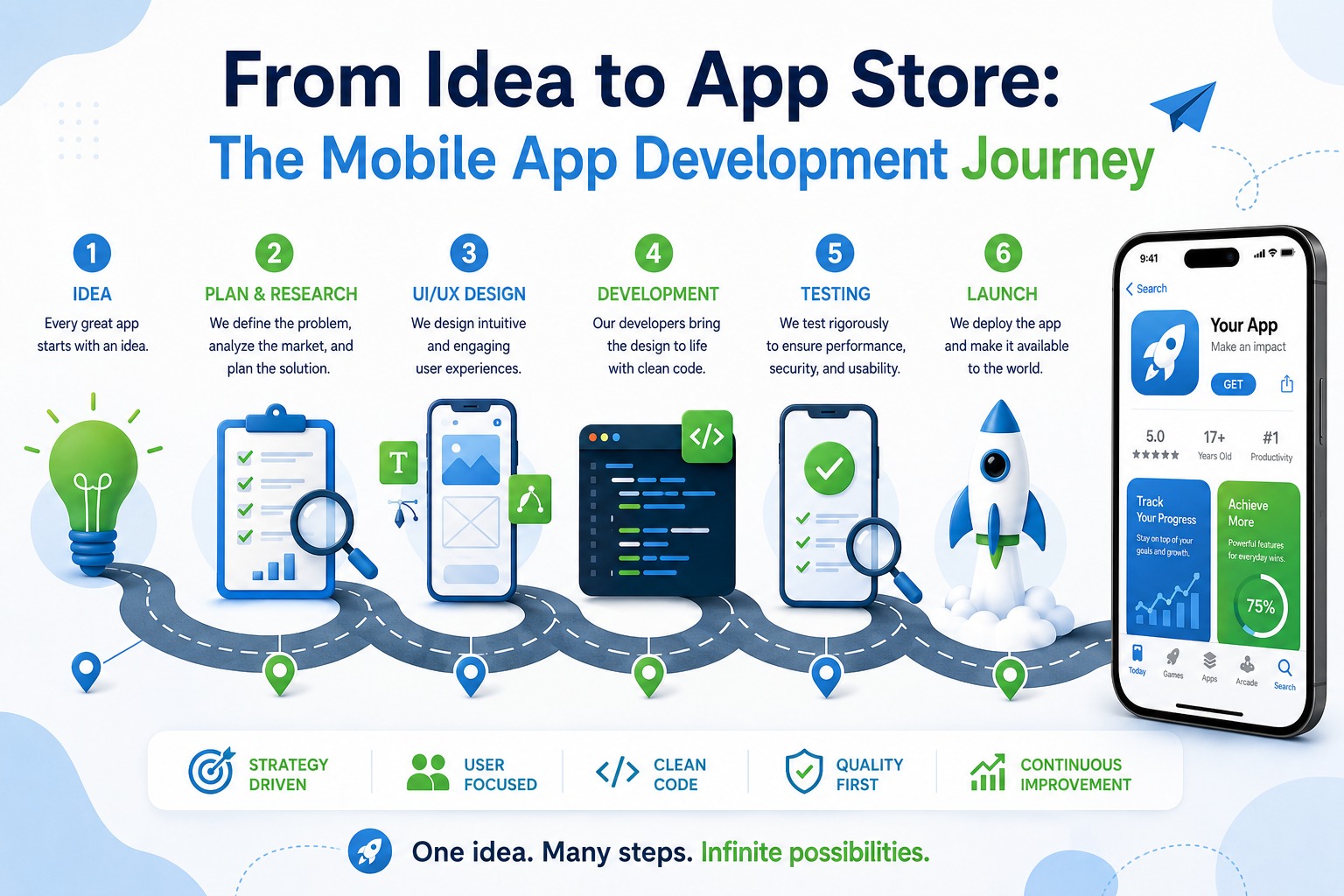
At Softechedge, we believe that every successful mobile application begins with a clear vision and follows a structured development process. This guide walks you through the complete mobile app development journey—from brainstorming an idea to launching your app and beyond.
Step 1: Transforming an Idea into a Business Solution
Every successful mobile app starts with a problem that needs solving.
Before writing a single line of code, it's important to answer a few critical questions:
1.What problem does the app solve?
2.Who is the target audience?
3.What value will users receive?
4.How will the app generate revenue or business growth?
Rather than focusing solely on features, businesses should concentrate on delivering solutions that improve customer experiences or simplify operations.
Example: Instead of creating another shopping app, consider how your app can offer personalized recommendations, faster checkout, or AI-powered customer support.
Step 2: Market Research and Competitor Analysis
Once the idea is validated, thorough research helps determine whether there's real demand.
This stage includes:
1.Identifying target users
2.Studying competitors
3.Understanding industry trends
4.Finding market gaps
5.Defining the app's Unique Value Proposition (UVP)
Competitor analysis provides valuable insights into successful features while helping you avoid common mistakes. At Softechedge, we combine market research with business strategy to ensure every application is built for long-term success.
Step 3: Defining Features and Creating an MVP
Many businesses make the mistake of trying to launch with every possible feature.
Instead, successful apps begin with a Minimum Viable Product (MVP)—a version that includes only the essential features needed to solve the core problem.
An MVP allows businesses to:
1.Launch faster
2.Reduce development costs
3.Gather real user feedback
4.Improve the product through updates
Popular companies like Airbnb, Uber, and Instagram all started with simple MVPs before evolving into global platforms.
Step 4: UI/UX Design – Creating a Great User Experience
Even the most powerful app can fail if users find it confusing.
This is where User Interface (UI) and User Experience (UX) design become essential.
A good design focuses on:
User-Friendly Navigation
Simple menus, intuitive layouts, and clear actions improve usability.
Attractive Visual Design
Colors, typography, icons, and branding create a memorable experience.
Smooth User Journey
Every screen should naturally guide users toward their goals without unnecessary complexity.
At Softechedge, our designers prioritize both aesthetics and functionality to ensure users enjoy every interaction.
Step 5: Choosing the Right Development Approach
Businesses must decide how their app will be developed.
Native App Development
Native apps are built specifically for Android or iOS.
Advantages:
Better performance
Enhanced security
Superior user experience
Cross-Platform Development
Using frameworks like Flutter or React Native allows developers to create one codebase for multiple platforms.
Advantages:
Lower development cost
Faster launch
Easier maintenance
The right choice depends on your business goals, target audience, timeline, and budget.
Step 6: Mobile App Development
This is where the actual development begins.
The process typically includes:
Front-End Development
Everything users see and interact with, including screens, buttons, animations, and navigation.
Back-End Development
Servers, databases, APIs, authentication, and business logic that power the application.
Third-Party Integrations
Modern apps often integrate:
1.Payment gateways
2.Maps and GPS
3.Social media login
4.Push notifications
5.Cloud storage
6.AI chatbots
7.Analytics tools
Softechedge follows agile development practices, allowing continuous improvements throughout the project.
Step 7: Testing and Quality Assurance
Before launching, every application undergoes rigorous testing.
This includes:
Functional Testing
Ensures every feature works correctly.
Performance Testing
Checks app speed and responsiveness under different conditions.
Security Testing
Protects sensitive customer data from cyber threats.
Compatibility Testing
Verifies the app performs smoothly across multiple devices and operating systems.
Quality assurance minimizes bugs, improves stability, and enhances user satisfaction.
Step 8: App Store Preparation and Launch
Publishing an app involves more than uploading files.
The launch process includes:
1.Preparing screenshots
2.Writing SEO-friendly app descriptions
3.Selecting keywords
4.Creating promotional graphics
5.Meeting App Store and Google Play guidelines
6.Configuring privacy policies
7.Final review and submission
A successful launch strategy can significantly improve visibility and downloads.
Softechedge assists businesses throughout the publishing process to ensure smooth approval and deployment.
Step 9: Marketing Your Mobile App
Building a great app isn't enough—people need to discover it.
An effective marketing strategy includes:
1.App Store Optimization (ASO)
2.Social media campaigns
3.Digital advertising
4.Influencer marketing
5.Email marketing
6.Content marketing
7.Referral programs
User reviews and ratings also play a major role in increasing app visibility and credibility.
Step 10: Continuous Maintenance and Updates
The journey doesn't end after launch.
Successful apps evolve continuously based on user feedback and changing market trends. Regular maintenance includes:
1.Bug fixes
2.Security updates
3.Performance optimization
4.New feature releases
5.Compatibility with new operating systems
Continuous improvement helps retain users and keeps the application competitive.
At Softechedge, we provide ongoing support to ensure your app remains secure, fast, and future-ready.
Common Mistakes to Avoid
Many businesses delay success by making avoidable mistakes, including:
1.Skipping market research
2.Ignoring user feedback
3.Overloading the app with unnecessary features
4.Choosing the wrong technology stack
5.Neglecting app security
6.Launching without proper testing
7.Failing to market the app effectively
Avoiding these pitfalls can save both time and development costs.
Why Partner with Softechedge?
Developing a mobile app requires technical expertise, strategic planning, and a user-first approach. At Softechedge, we offer end-to-end mobile app development services tailored to your business objectives.
Our services include:
1.Custom Android and iOS app development
2.Cross-platform app development
3.UI/UX design
API and third-party integrations
4.Cloud-enabled applications
5.App testing and quality assurance
6.App Store and Google Play deployment
7.Ongoing maintenance and support
Whether you're building your first mobile app or upgrading an existing solution, our experienced team ensures every stage of the journey is executed with precision.
Conclusion
The journey from an app idea to a successful launch is a carefully planned process that combines creativity, technology, and business strategy. From validating your concept and designing an engaging user experience to development, testing, deployment, and continuous improvement, each phase contributes to the app's long-term success.
With the right technology partner, this journey becomes faster, smoother, and more rewarding. Softechedge is committed to helping businesses transform innovative ideas into high-performing mobile applications that drive customer engagement, operational efficiency, and sustainable growth.
Ready to bring your app idea to life? Connect with Softechedge and start your mobile app development journey today.