Introduction
In today's competitive job market, simply listing your job responsibilities is no longer enough to impress recruiters. Hiring managers and Applicant Tracking Systems (ATS) are increasingly looking for candidates who can demonstrate measurable impact and proven results. This is where quantifying your achievements becomes essential.
A resume that highlights specific accomplishments backed by numbers can significantly increase your chances of landing interviews. Instead of telling employers what you were responsible for, quantified achievements show what you actually accomplished and the value you brought to your organization.
This article explores why quantified achievements matter and how you can effectively showcase them on your resume for better job search outcomes.
Why Quantified Achievements Matter
Recruiters spend only a few seconds reviewing each resume. During this brief review, they look for evidence that a candidate can deliver results.
Numbers help your achievements stand out because they provide concrete proof of your capabilities. Quantified accomplishments:
1.Demonstrate your impact clearly
2.Make your resume more credible
3.Help recruiters understand your value quickly
4.Differentiate you from other applicants
5.Improve ATS keyword relevance
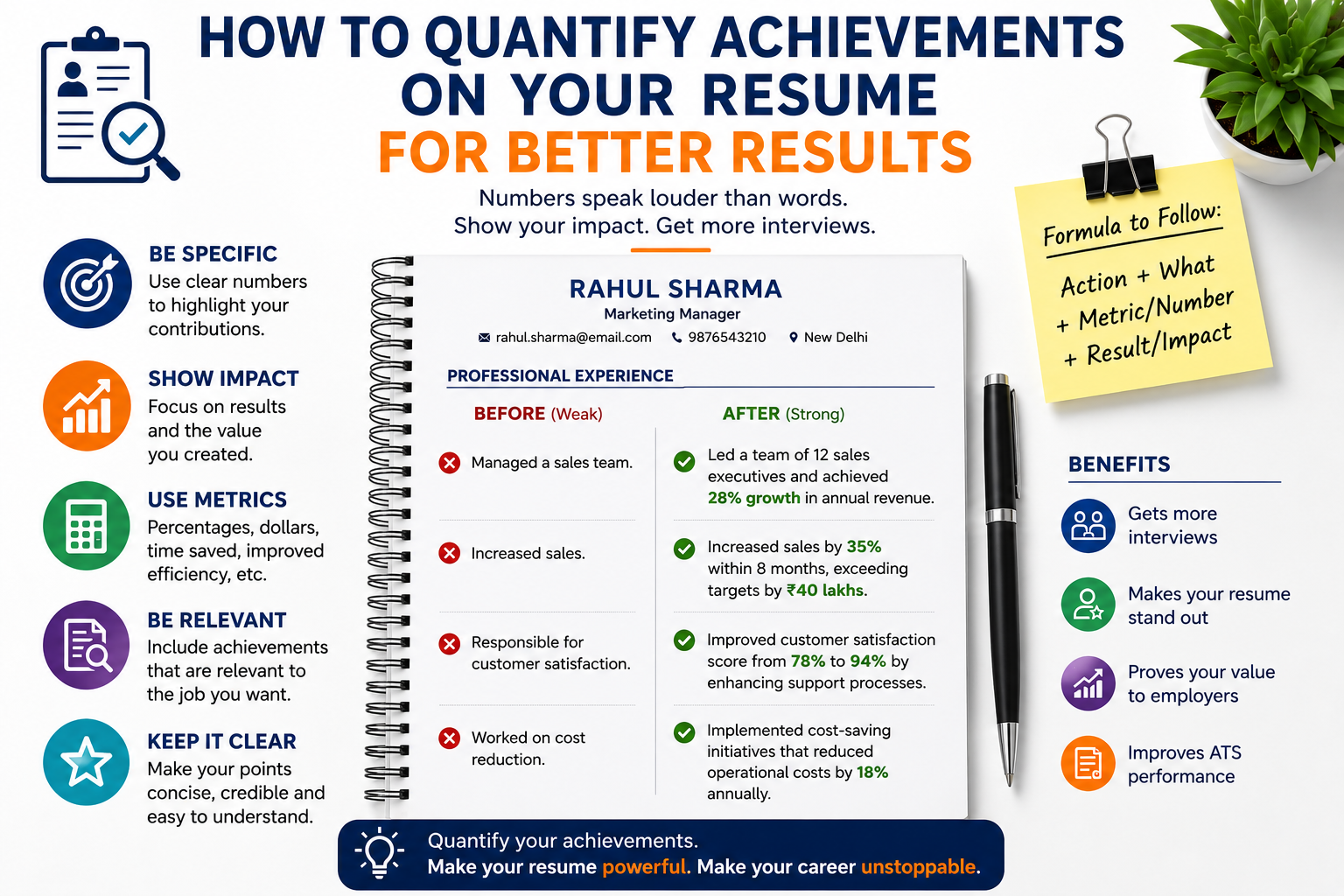
For example:
Weak Statement:
Managed a sales team and improved performance.
Strong Statement:
Led a team of 12 sales representatives and increased quarterly revenue by 28% within one year. The second statement provides measurable evidence of success, making it much more compelling.
The Difference Between Responsibilities and Achievements
Many job seekers make the mistake of listing duties instead of accomplishments. Responsibility-Based Statement
1.Responsible for handling customer inquiries.
2.Managed social media accounts.
3.Assisted with recruitment activities.
Achievement-Based Statement
1.Resolved over 150 customer inquiries monthly while maintaining a 95% satisfaction rating.
2.Increased social media engagement by 40% through targeted content campaigns.
3.Supported recruitment efforts that reduced hiring time by 25%.
Achievements show outcomes, while responsibilities merely describe tasks.
What Can Be Quantified on a Resume?
Many professionals assume that only sales or finance roles can include measurable achievements. In reality, almost every role offers opportunities for quantification.
Revenue and Sales Growth
If you work in sales, business development, or marketing, include metrics such as:
1.Revenue generated
2.Sales growth percentage
3.Lead conversion rates
4.Customer acquisition numbers
Example: Generated ₹1.5 crore in annual sales revenue, exceeding targets by 20%.
Cost Savings
Organizations value employees who help reduce expenses.
Example: Implemented process improvements that reduced operational costs by ₹10 lakh annually.
Productivity Improvements
Highlight how your work improved efficiency.
Example: Automated reporting processes, reducing report preparation time by 50%.
Customer Satisfaction
Customer-facing professionals can showcase service excellence.
Example: Maintained a 98% customer satisfaction score while handling over 200 support cases per month.
Team Leadership
Managers and team leaders should emphasize team performance metrics.
Example: Managed a team of 15 employees and achieved a 30% increase in project completion rates.
Project Management
Projects often provide measurable results.
Example: Delivered a technology implementation project worth ₹50 lakh three weeks ahead of schedule.
How to Identify Your Achievements
Many professionals struggle to recall measurable accomplishments. Start by reviewing your previous roles and asking yourself:
Did You Increase Something?
Examples include:
1.Sales
2.Revenue
3.Website traffic
4.Customer retention
5.Productivity
Did You Reduce Something?
Examples include:
1.Costs
2.Errors
3.Processing time
4.Employee turnover
5.Customer complaints
Did You Improve Something?
Examples include:
1.Efficiency
2.Service quality
3.Team performance
4.Customer satisfaction
5.Operational processes
Did You Lead or Manage Anything?
Examples include:
1.Team size
2.Budget value
3.Number of projects
4.Training sessions
5.Stakeholders managed
Review performance evaluations, project reports, sales records, and internal dashboards to find supporting data.
The Best Formula for Writing Quantified Achievements
A simple formula can help you create impactful resume bullet points:
Action Verb + Task + Metric + Result
Example: Developed and executed a digital marketing strategy that increased website traffic by 45% within six months.
Additional examples:
1.Reduced customer response times by 35% through process optimization.
2.Trained 50+ employees on new software systems, improving adoption rates by 90%.
3.Increased client retention by 22% through enhanced account management strategies.
This structure keeps your accomplishments clear, concise, and results-focused.
Common Resume Metrics Recruiters Love to See
Recruiters pay close attention to metrics such as:
1.Percentage increases
2.Percentage reductions
3.Revenue generated
4.Cost savings
5.Team size managed
6.Budget handled
7.Project value
8.Customer satisfaction scores
9.Number of clients served
10.Training participants
11.Productivity improvements
12.Process efficiencies
Even approximate figures can be valuable if exact data is unavailable.
Avoid These Common Mistakes
Using Vague Language
Avoid statements such as:
1.Helped improve sales.
2.Assisted customers.
3.Supported team projects.
These lack measurable impact.
Overloading with Numbers
Not every bullet point needs a statistic. Focus on your most significant accomplishments. Exaggerating Results Always ensure your claims are truthful and can be discussed confidently during interviews.
Ignoring Context
Numbers alone are not enough. Explain what the achievement represents.
Weak Example: Increased sales by 15%.
Better Example: Increased regional sales by 15%, generating an additional ₹25 lakh in annual revenue.
Final Thoughts
In a hiring environment increasingly driven by data and results, quantified achievements can transform an ordinary resume into a powerful career marketing tool. Recruiters want evidence of performance, not just a list of responsibilities.
By incorporating measurable accomplishments into your resume, you demonstrate your ability to contribute, solve problems, and create value for employers. Whether you are a fresher, experienced professional, manager, or executive, showcasing achievements through numbers can significantly improve your chances of securing interviews and advancing your career.
If you're unsure how to identify and present your accomplishments effectively, professional resume writing services can help transform your experience into a compelling, results-driven resume that stands out in today's competitive job market.