Introduction
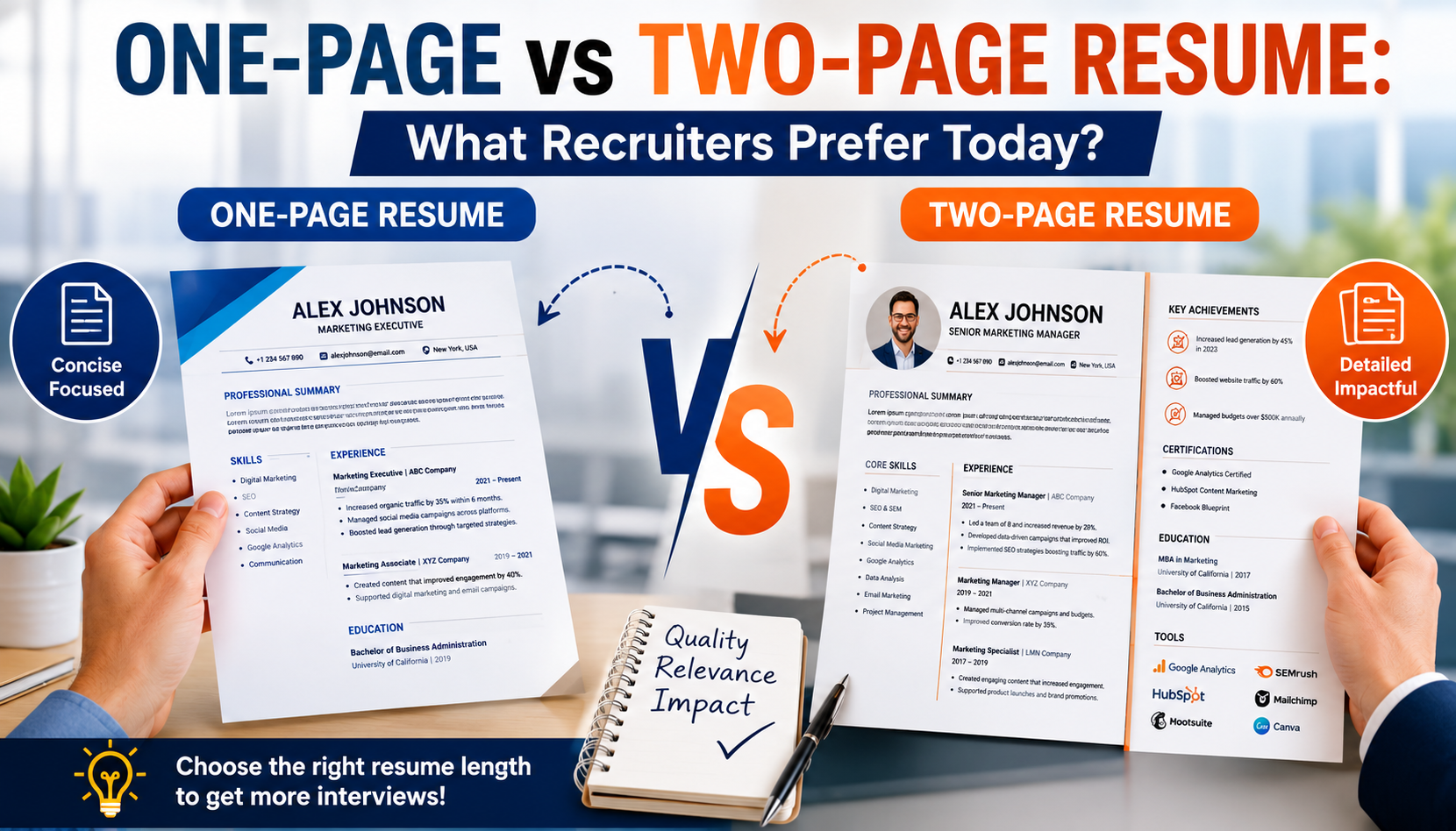
In today's competitive job market, your resume serves as your personal marketing document. It is often the first impression a recruiter has of you, making it crucial to present your qualifications effectively. One question that continues to confuse job seekers is whether a resume should be one page or two pages long.
For years, the conventional wisdom was that resumes should never exceed one page. However, hiring practices have evolved, and recruiters today are more focused on the quality and relevance of information rather than strict page limits.
So, what do recruiters actually prefer in 2026? Let's explore the advantages of both formats and determine which one might be right for your career stage and goals.
Why Resume Length Matters
Recruiters spend only a few seconds scanning a resume before deciding whether to continue reading. According to various hiring studies, recruiters typically spend between 6 and 10 seconds on an initial resume review.
This means your resume must be concise, well-organized, and relevant. Whether it's one page or two, the key objective is to communicate your value quickly and effectively.
The ideal resume length depends on factors such as:
1.Years of experience
2.Industry requirements
3.Career level
4.Technical skills
5.Professional achievements
6.Job role complexity
Rather than focusing solely on page count, job seekers should prioritize clarity and relevance.
The Case for a One-Page Resume
A one-page resume remains highly effective for many professionals, especially those in the early stages of their careers.
Who Should Use a One-Page Resume?
A one-page format is generally suitable for:
1.Fresh graduates
2.Entry-level professionals
3.Candidates with less than 5 years of experience
4.Individuals applying for internships
5.Career changers with limited relevant experience
Advantages of a One-Page Resume
1. Easy to Read
Recruiters appreciate concise resumes that highlight essential qualifications without unnecessary details.
2. Highlights Key Achievements
Limited space forces candidates to focus on their most relevant accomplishments and skills.
3. ATS-Friendly
A clean and concise structure often performs well in Applicant Tracking Systems (ATS), making it easier for recruiters to find relevant keywords.
4. Demonstrates Communication Skills
The ability to summarize your career effectively reflects strong communication and organizational skills.
Potential Drawbacks
While a one-page resume offers many benefits, it may not provide enough space for experienced professionals to showcase their full expertise, certifications, projects, and accomplishments.
The Case for a Two-Page Resume
As careers progress, professionals accumulate experience, achievements, certifications, leadership roles, and technical expertise. Compressing all of this into a single page can result in important information being omitted.
Who Should Use a Two-Page Resume?
A two-page resume is often appropriate for:
1.Professionals with 5+ years of experience
2.Mid-level managers
3.Senior executives
4.IT and technology professionals
5.EngineersHealthcare professionals
6.Consultants
7.Researchers and academics
Advantages of a Two-Page Resume
1. More Space for Achievements Experienced candidates can provide detailed examples of measurable accomplishments that demonstrate their impact.
2. Better Showcase of Skills Technical professionals often possess numerous certifications, tools, technologies, and specialized skills that require additional space.
3. Comprehensive Career Story A two-page format allows recruiters to understand career progression, leadership experience, and industry expertise.
4. Stronger Personal Brand When used effectively, a longer resume can position candidates as subject matter experts and strategic contributors.
Potential Drawbacks
The biggest risk of a two-page resume is including unnecessary information. Recruiters may lose interest if the second page contains irrelevant details or repetitive content.
What Recruiters Actually Prefer in 2026
The hiring landscape has changed significantly due to AI-powered recruitment and ATS systems. Recruiters are no longer obsessed with the one-page rule.
Today, recruiters generally follow a simple principle:
If the content is relevant, valuable, and easy to read, a two-page resume is perfectly acceptable.
Many hiring managers actually expect experienced professionals to submit two-page resumes because it allows them to better evaluate qualifications and achievements.
However, recruiters still dislike resumes that are:
1.Filled with irrelevant information
2.Poorly formatted
3.Difficult to scan
4.Excessively long
5.Repetitive
The focus has shifted from page count to content quality.
One-Page vs Two-Page Resume: Quick Comparison
Choose a One-Page Resume If:
1.You have less than 5 years of experience.
2.You're applying for entry-level positions.
3.Your work history is straightforward.
4.You can effectively present your qualifications on one page.
Choose a Two-Page Resume If:
1.You have extensive professional experience.
2.You're targeting managerial or leadership roles.
3.You possess multiple certifications and technical skills.
4.You have significant achievements worth highlighting.
Tips for Creating an Effective Resume
Regardless of length, every resume should follow these best practices:
Focus on Achievements
Instead of listing responsibilities, highlight measurable accomplishments.
For example:
Weak: Managed social media accounts.
Strong: Increased social media engagement by 45% within six months through targeted content strategies.
Tailor for Each Job
Customize your resume for every application by aligning your skills and experience with the job description.
Optimize for ATS
Include relevant keywords naturally throughout your resume to improve ATS visibility.
Use Clean Formatting
Maintain consistent fonts, headings, spacing, and bullet points for easy readability.
Prioritize Relevant Information
The most important details should appear in the top half of the first page.
Final Verdict
The debate between one-page and two-page resumes is no longer about following rigid rules. Instead, it's about presenting your qualifications in the most effective way possible.
For freshers and early-career professionals, a one-page resume often works best because it keeps information focused and concise. For experienced professionals, a well-structured two-page resume provides the necessary space to showcase achievements, leadership experience, and specialized skills.
Ultimately, recruiters don't count pages—they evaluate value. Whether your resume is one page or two, ensure that every section serves a purpose and demonstrates why you're the right candidate for the role.
Remember: A great resume isn't defined by its length. It's defined by its ability to secure interviews.