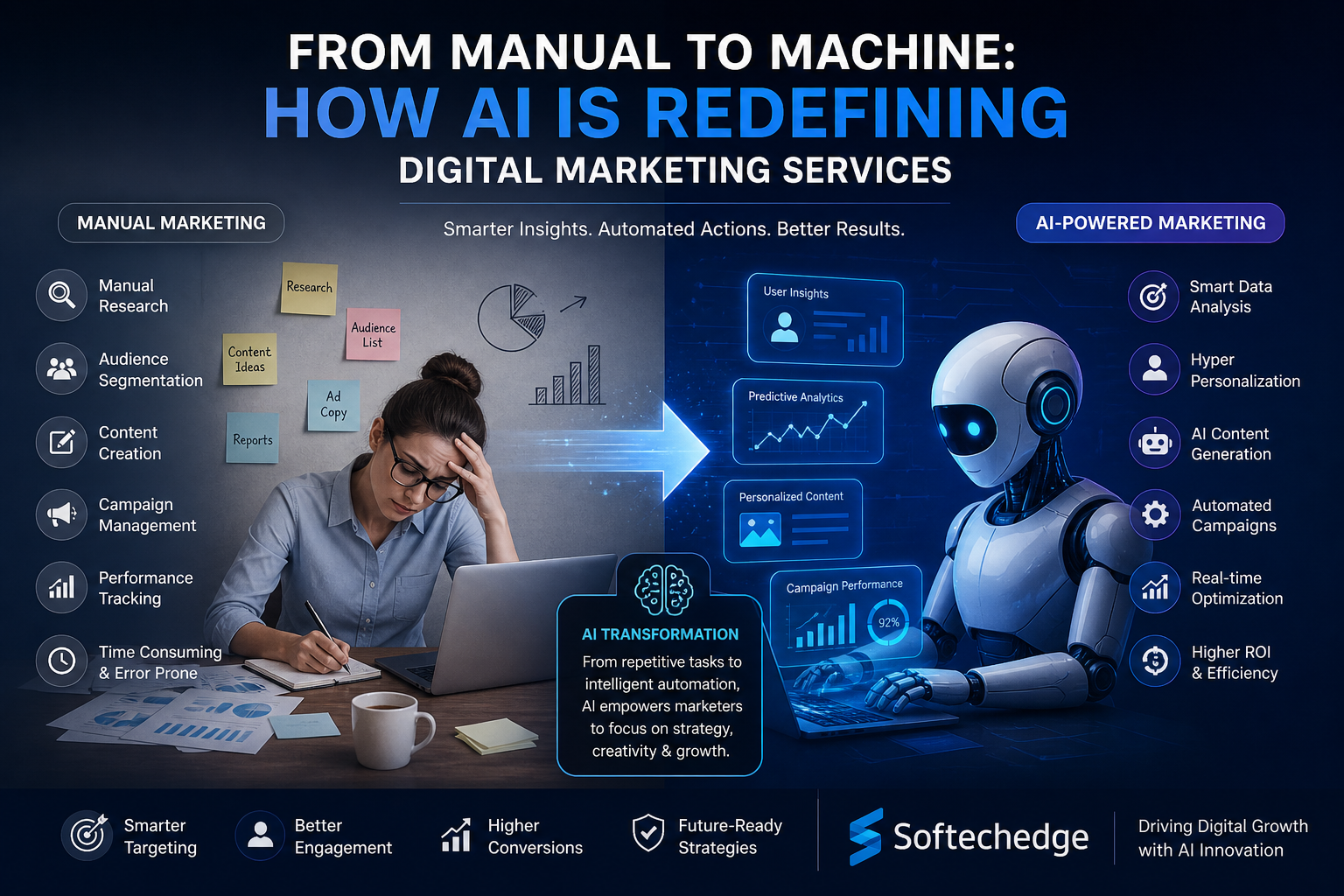
Introduction
In 2026, digital marketing
is no longer driven solely by human effort—it’s powered by intelligent
machines. What once required hours of manual research, campaign setup, and
performance tracking is now handled in seconds by Artificial Intelligence (AI).
For businesses and agencies like Softechedge, this shift from manual to
machine-driven marketing is not just a trend—it’s a transformation that is
reshaping how brands connect, engage, and convert customers.
The Shift from Traditional to AI-Driven Marketing
Digital marketing used to
rely heavily on manual processes—keyword research, audience segmentation, ad
optimization, and performance analysis. While effective, these methods were
time-consuming and often limited by human capacity.
Today, AI tools can:
1.Analyze massive
datasets in real time
2.Predict customer
behavior
3.Automate repetitive
tasks
4.Deliver highly
personalized experiences
This evolution allows
marketers to focus more on strategy and creativity, while machines handle
execution and optimization.
Smarter Data Analysis for Better Decisions
One of AI’s biggest
strengths lies in its ability to process and interpret data at scale. Modern
businesses generate enormous amounts of data from websites, social media,
emails, and ads. Manually analyzing this data is nearly impossible.
AI changes the game by:
1.Identifying patterns
and trends instantly
2.Providing actionable
insights
3.Predicting future
outcomes based on past behavior
For example
, AI can
determine which marketing channels are delivering the highest ROI, helping
businesses allocate budgets more effectively. This data-driven approach ensures
smarter, faster decision-making.
Hyper-Personalization at Scale
In 2026, customers expect
personalized experiences—not generic messages. AI enables brands to deliver
hyper-personalized content tailored to individual preferences, behaviors, and
buying journeys.
With AI, digital marketing
services can:
1.Recommend products
based on browsing history
2.Send personalized email
campaigns
3.Customize website
content in real time
4.Target ads with
precision
This level of
personalization not only improves user experience but also significantly boosts
engagement and conversions.
Automation of Repetitive Marketing Tasks
One of the most impactful
contributions of AI is automation. Tasks that once required constant human
intervention can now run automatically with minimal supervision.
AI-powered automation
includes:
1.Ad campaign management
and optimization
2.Email marketing
workflows
3.Social media scheduling
and posting
4.Chatbots for customer
support
By automating these
processes, businesses save time, reduce errors, and ensure consistent
performance. For agencies like Softechedge, this means delivering faster and
more efficient services to clients.
AI-Powered Content Creation
Content remains the backbone
of digital marketing, but creating high-quality content consistently can be
challenging. AI tools now assist in generating blogs, ad copies, social media
captions, and even video scripts.
Benefits of AI-driven
content creation:
1.Faster content
production
2.SEO-optimized writing
3.Consistent brand
messaging
4.Data-backed content
strategies
However, human creativity
still plays a crucial role. The best results come from a combination of AI
efficiency and human storytelling.
Enhanced Customer Engagement with AI Chatbots
Customer engagement has
evolved significantly with the introduction of AI chatbots and virtual
assistants. These tools provide instant responses, 24/7 support, and
personalized interactions.
AI chatbots can:
1.Answer customer queries
in real time
2Guide users through the
sales funnel
3.Collect valuable
customer data
4.Improve overall user
experience
This not only enhances
customer satisfaction but also increases the chances of conversion.
Predictive Marketing: Anticipating Customer Needs
AI doesn’t just analyze the
present—it predicts the future. Predictive marketing uses machine learning
algorithms to forecast customer behavior and trends.
With predictive analytics,
businesses can:
1.Identify potential
leads
2.Predict purchase intent
3.Reduce customer churn
4.Optimize marketing
campaigns before launch
This proactive approach
gives businesses a competitive edge in an increasingly crowded digital
landscape.
Improved ROI with AI Optimization
Return on Investment (ROI)
is a key metric in digital marketing. AI helps maximize ROI by continuously
optimizing campaigns based on performance data.
AI tools can:
1.Adjust ad bids in real
time
2.Optimize targeting
parameters
3.Test multiple campaign
variations (A/B testing)
4.Eliminate
underperforming strategies
As a result, businesses
achieve better results with lower costs—making marketing more efficient and
scalable.
Challenges and the Human Element
While AI offers numerous
advantages, it’s not without challenges. Over-reliance on automation can lead
to a lack of creativity and emotional connection. Additionally, data privacy
and ethical concerns must be addressed.
That’s why the future of
digital marketing lies in a balanced approach:
1.AI for efficiency and
data-driven insights
2.Humans for creativity,
strategy, and emotional intelligence
Agencies like Softechedge
can leverage this balance to deliver impactful and authentic marketing
campaigns.
The Future of Digital Marketing Services
The transition from manual
to machine is only the beginning. As AI continues to evolve, digital marketing
will become even more intelligent, automated, and customer-centric.
Future trends include:
1.Voice and visual search
optimization
2.AI-generated video
content
3.Advanced customer
journey mapping
4.Real-time marketing
personalization
Businesses that embrace
these innovations will stay ahead of the curve, while those that resist may
struggle to compete.
Conclusion
AI is not replacing digital
marketers—it’s empowering them. By automating repetitive tasks, enhancing data
analysis, and enabling personalization at scale, AI is redefining the way
digital marketing services operate.
For Softechedge, this
transformation presents an opportunity to deliver smarter, faster, and more
effective marketing solutions. The key lies in embracing AI while maintaining
the human touch that builds genuine connections with audiences.
The future of digital marketing is here—and
it’s driven by intelligent machines working alongside creative minds.