Introduction
In today’s hyper-competitive
job market, your resume is more than just a document—it’s your first
psychological impression. Before a recruiter reads your qualifications in
detail, their brain is already making rapid judgments about your suitability.
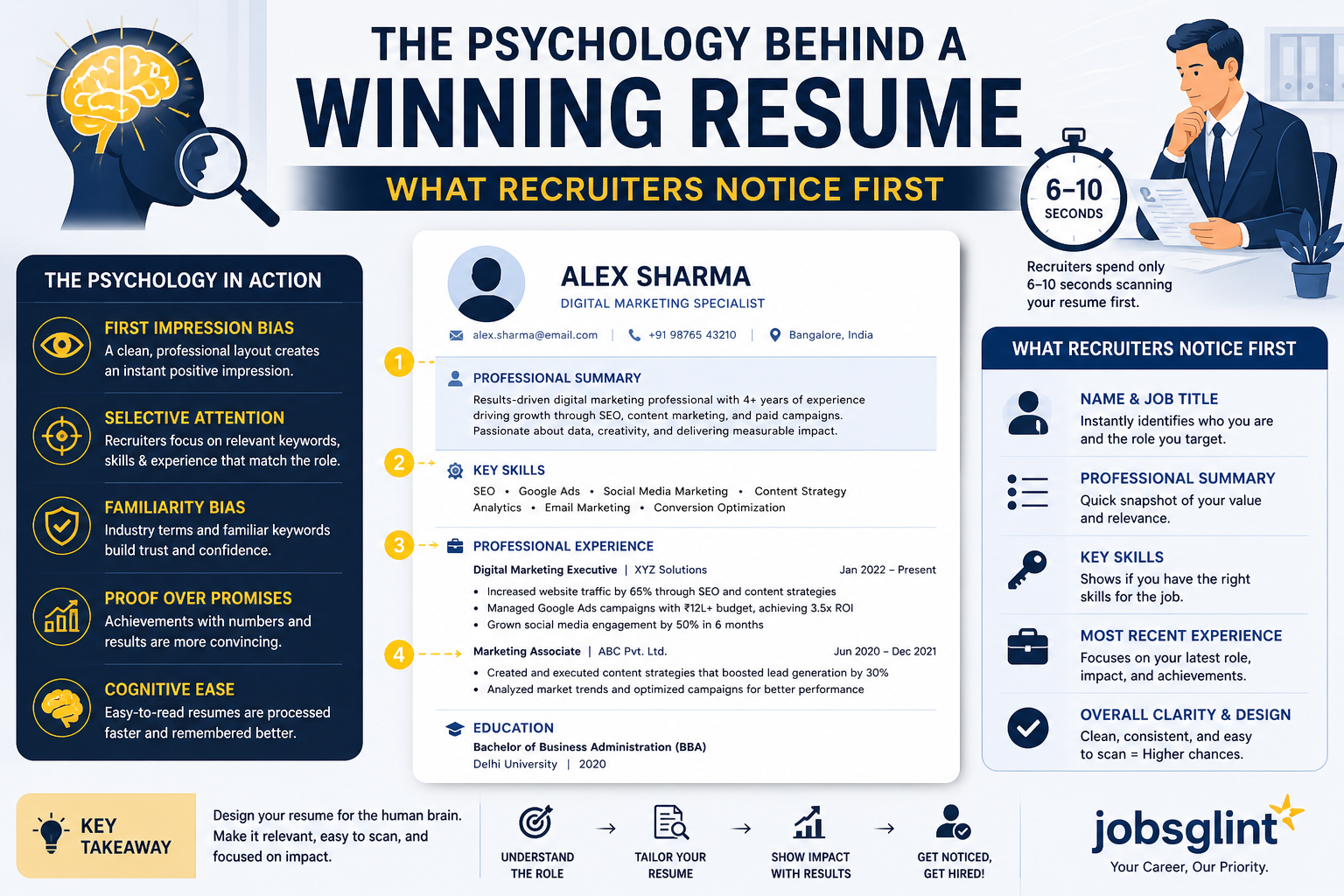
Studies suggest recruiters spend 6–10 seconds scanning a resume
initially. That means your success depends not only on what you write,
but how it is perceived instantly.
Understanding the psychology
behind resume screening can give you a powerful advantage. Let’s explore what
recruiters truly notice first—and how you can use that insight to craft a
winning resume.
The 6-Second Brain Scan: First Impressions Matter
Recruiters don’t read
resumes word by word in the beginning—they scan. During this quick scan, their
brain looks for patterns, clarity, and relevance.
What they notice instantly:
1.Your name and job
title
2.Headings and structure
3.Recent experience
4.Keywords related to the
job
5.Overall visual
cleanliness
This is driven by a
psychological principle called cognitive ease—the easier your resume is
to read, the more positively it is perceived. If your resume looks cluttered or
confusing, the recruiter’s brain associates it with difficulty, and chances
are, they move on.
Visual Hierarchy: Guiding the Recruiter’s Attention
Humans naturally follow a
visual path while reading—usually in an F-pattern (left to right, top to
bottom). A well-structured resume uses this behavior to guide attention
strategically.
How to optimize visual hierarchy
1.Use clear headings
(e.g., Experience, Skills, Education)
2.Keep consistent
formatting
3.Highlight key
achievements using bold text
4.Use bullet points
instead of long paragraphs
A clean layout signals
professionalism and makes it easier for recruiters to find what they’re looking
for—quickly.
Relevance Over Everything
Recruiters are not just
scanning—they’re filtering. Their primary question is:
“Is this candidate relevant to the role?” Your resume must answer this
within seconds.
Psychological trigger: Selective Attention
The brain focuses only on
what matches its goal—in this case, the job description.
What you should do:
1.Tailor your resume for
each job
2.Use keywords from
the job description
3.Highlight relevant
skills and achievements first
Generic resumes fail because
they force recruiters to search for relevance—and they won’t.
The Power of Keywords and Familiarity
Recruiters often rely on Applicant
Tracking Systems (ATS) and mental keyword matching. When they see familiar
terms related to the role, it builds instant trust.
Why this works:
The brain prefers familiar
information—it feels safer and more credible.
Example:
Instead of saying:
“Handled company
projects”
Say:
“Managed
cross-functional projects using Agile methodology”
Specific, industry-relevant
keywords increase both ATS ranking and human approval.
Achievements Over Responsibilities
One of the biggest
psychological shifts in resume evaluation is this:
Recruiters care more about impact than duties.
Why?
Because achievements provide
proof, and the brain trusts evidence over claims.
Weak statement:
Responsible for social
media management
Strong statement:
Increased social media
engagement by 45% in 3 months
Numbers, results, and
outcomes activate analytical thinking, making your profile more
convincing.
Simplicity vs Overload: Less is More
Many job seekers believe
adding more information increases their chances. In reality, it does the
opposite.
Psychological concept: Cognitive Overload
Too much information
overwhelms the brain, leading to rejection or skipping.
Best practices:
1.Keep your resume 1–2
pages
2.Avoid unnecessary
graphics or colors
3.Focus only on relevant
information
Clarity always beats
complexity.
The Tone of Your Resume Matters
Your resume reflects your
professional personality. The language you use influences how recruiters
perceive you.
Use:
1.Action verbs (e.g.,
Led, Created, Improved)
2.Confident but not
exaggerated language
3.Clear and concise
sentences
Avoid:
1.Passive phrases
2.Buzzwords without
meaning (e.g., “hardworking,” “team player” without proof)
The right tone builds credibility
and confidence.
Consistency Builds Trust
Small inconsistencies can
create doubt in a recruiter’s mind.
Watch out for:
1.Different font styles
2.Misaligned bullet
points
3.Inconsistent date
formats
4.Spelling or grammar
errors
The brain is wired to notice
irregularities. Even minor mistakes can signal carelessness.
The “Top Section” Advantage
The top third of your resume
is the most valuable space—it gets the most attention.
What to include:
1.A strong professional
summary
2.Key skills
3.Your most relevant
experience
Think of it as your “hook.”
If this section is compelling, recruiters are more likely to continue reading.
Final Thoughts: Design for the Human Brain
A winning resume is not just
about qualifications—it’s about presentation, perception, and psychology.
When you understand how recruiters think, you can design your resume to match
their expectations.
Key Takeaways:
1.Make your resume easy
to scan
2.Focus on relevance
and results
3.Use clear structure
and keywords
4.Keep it simple and
consistent
In 2026, resumes are no
longer just informational—they are strategic tools. By aligning your resume
with how recruiters think, you don’t just apply for jobs—you stand out.