Introduction
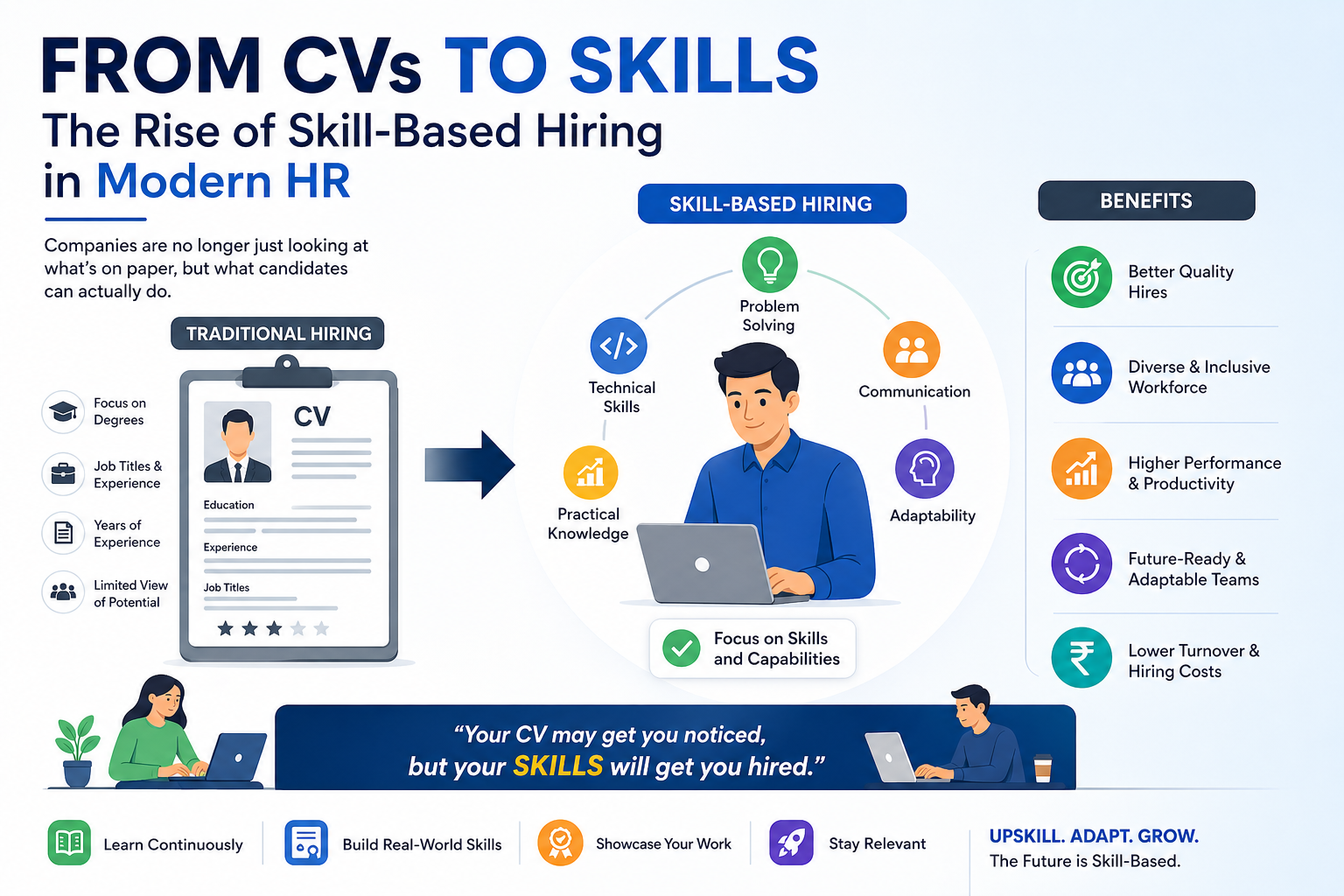
For decades, recruitment has
revolved around one central document: the CV. Degrees, job titles, and years of
experience were treated as the ultimate indicators of a candidate’s potential.
But in today’s rapidly evolving job market, this traditional approach is losing
relevance. Companies are no longer asking, “Where did you work?”—they’re
asking, “What can you actually do?”
Welcome to the era of skill-based
hiring, a transformative shift in modern Human Resource Management that
prioritizes real abilities over formal credentials.
The Problem with Traditional CV-Based Hiring
While CVs provide a snapshot
of a candidate’s background, they often fail to reflect true capability. Many
organizations have realized that hiring based solely on qualifications can lead
to mismatches between job requirements and employee performance.
Some key limitations of
CV-based hiring include:
1.Overemphasis on
degrees:
A
degree does not always guarantee practical skills.
2.Bias and inequality:
Candidates from
prestigious institutions often get preference, leaving skilled individuals
overlooked.
3.Outdated information:
A CV may not capture
newly acquired or evolving skills.
4.Keyword dependency:
Many resumes are
filtered through Applicant Tracking Systems (ATS), which prioritize
keywords over actual competence.
As industries become more
dynamic, these limitations have pushed HR professionals to rethink their hiring
strategies.
What is Skill-Based Hiring?
Skill-based hiring focuses
on assessing a candidate’s actual abilities rather than relying heavily on
their educational background or previous job titles. It involves evaluating
competencies such as problem-solving, communication, technical expertise, and
adaptability.
Instead of asking for a long
list of qualifications, companies are now asking candidates to:
1.Complete real-world
tasks
2.Showcase portfolios or
projects
3.Participate in skill
assessments or simulations
4.Demonstrate their
thinking process during interviews
This approach ensures that
the hiring decision is based on what the candidate can deliver, not just
what they claim on paper.
Why Skill-Based Hiring is Gaining Popularity
1. Changing Nature of Work
With the rise of technology,
many job roles are evolving faster than traditional education systems can keep
up. Skills like data analysis, digital marketing, coding, and critical thinking
are often self-taught or learned through short-term courses.
2. Rise of Alternative Learning
Online platforms, bootcamps,
and certifications have made it easier for individuals to acquire job-ready
skills without formal degrees. Employers are recognizing this shift and
adapting their hiring methods accordingly.
3. Demand for Agility
Modern workplaces require
employees who can quickly adapt, learn new tools, and solve problems.
Skill-based hiring helps identify candidates who are flexible and future-ready.
4. Better Job Fit
When candidates are selected
based on actual abilities, the chances of performance success increase
significantly. This leads to improved productivity and reduced employee
turnover.
How Companies are Implementing Skill-Based Hiring
Organizations are adopting
various innovative methods to assess skills effectively:
1.Skill Assessments &
Tests:
Online coding tests, aptitude exams, and role-specific assignments
2.Project-Based Hiring:
Candidates are asked
to complete a project relevant to the job role
3.Behavioral Interviews:
Focus on how
candidates approach challenges rather than just past roles
4.Portfolio Reviews:
Especially common in
fields like design, writing, and development
5.AI-Powered Tools:
Advanced platforms
analyze candidate skills, not just resume keywords
These methods help employers
gain a deeper understanding of a candidate’s real potential.
Benefits for Employers
Skill-based hiring offers
several advantages for organizations:
1.Improved hiring
accuracy
2.Reduced bias and more
diverse workforce
3.Higher employee
performance and productivity
4.Lower hiring and
training costs in the long run
By focusing on skills,
companies can build stronger and more capable teams.
Benefits for Job Seekers
This shift is equally
beneficial for candidates:
1.More opportunities
without elite degrees
2.Focus on talent and
practical knowledge
3.Encouragement to
continuously upskill
4.Fairer evaluation
process
Candidates who invest in
learning and building real-world skills now have a better chance of standing
out in the job market.
Challenges in Skill-Based Hiring
Despite its advantages, this
approach is not without challenges:
1.Time-consuming
assessments
2.Difficulty in
standardizing skill evaluation
3.Resistance from
traditional HR systems
4.Need for proper tools
and training
However, as technology
improves and awareness grows, these challenges are gradually being addressed.
The Future of Recruitment
The shift from CVs to skills
is not just a trend—it’s the future of recruitment. Companies are moving toward
a more practical, inclusive, and performance-driven hiring model.
In the coming years, we can
expect:
1.Increased use of AI in
skill evaluation
2Greater emphasis on
micro-credentials and certifications
3.Hybrid hiring models
combining CVs and skill assessments
4.Continuous learning
becoming a key hiring factor
Conclusion
The rise of skill-based
hiring marks a significant evolution in Human Resource Management. It
challenges outdated norms and creates a more level playing field for candidates
from diverse backgrounds.
For employers, it means
building stronger, more capable teams. For job seekers, it means focusing on
what truly matters—skills, adaptability, and continuous learning.
In a world where change is
constant, one thing is clear:
Your CV may get you noticed, but your skills will get you hired.