Introduction
In today’s fast-moving job
market, your resume isn’t being read—it’s being scanned. Multiple studies and
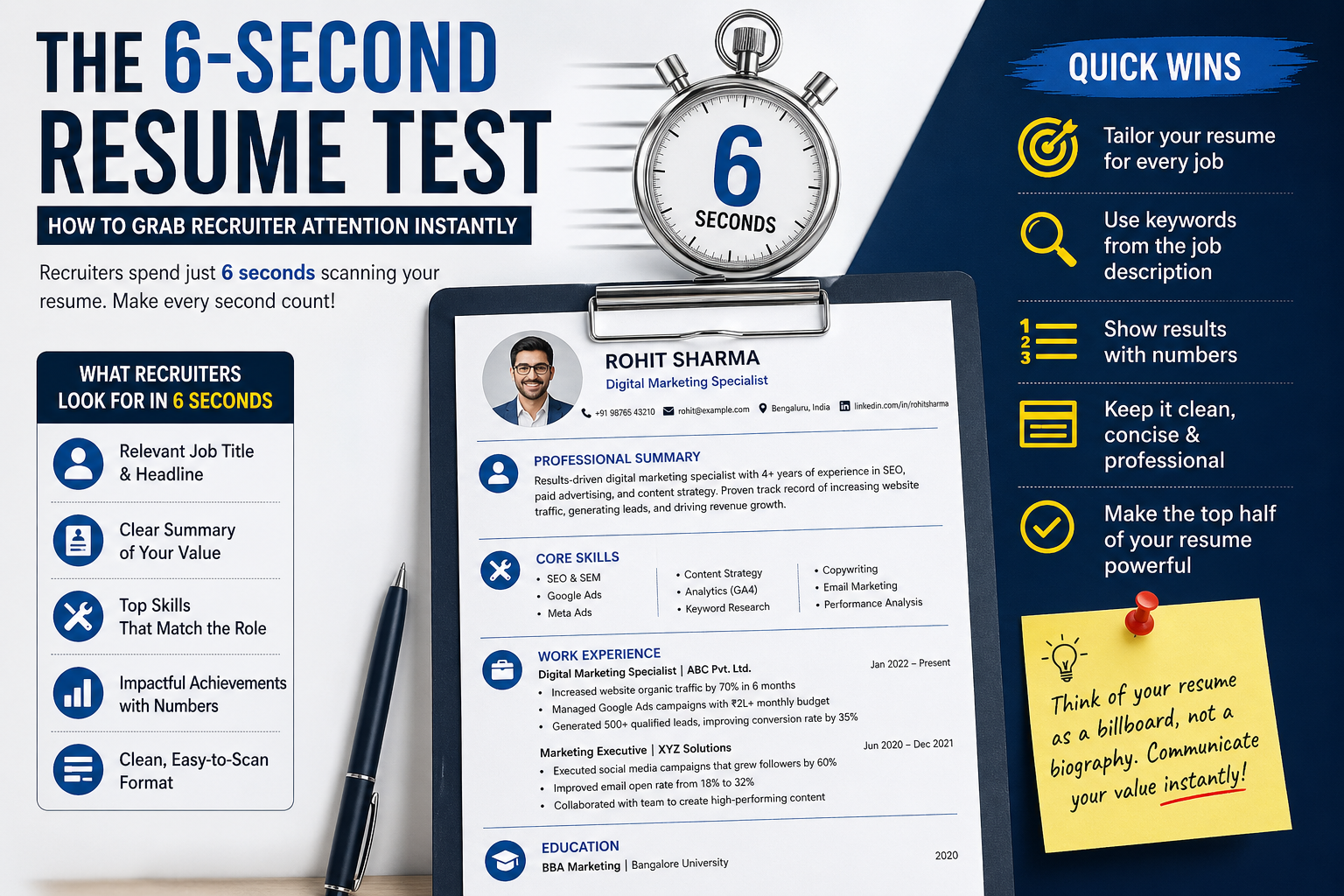
recruiter insights suggest that hiring managers spend just 6–8 seconds on
an initial resume review. That’s it. In those few seconds, they decide whether
your profile is worth a deeper look or a quick rejection.
This is what’s known as the “6-second
resume test.” If your resume doesn’t immediately communicate value,
clarity, and relevance, it gets skipped—no matter how qualified you are.
So how do you make those six
seconds count? Let’s break it down.
Why Recruiters Spend Only 6 Seconds
Recruiters often deal with
hundreds of applications for a single role. To manage this volume, they don’t
read resumes line by line—they scan for key signals, including:
1.Job title relevance
2.Core skills
3.Experience highlights
4.Measurable achievements
5.Clean, readable
formatting
If these elements aren’t
instantly visible, your resume doesn’t pass the test.
Step 1: Start with a Strong Headline
Your resume should begin
with a clear, professional headline—not just your name and contact
details.
Instead of:
“Resume of
Anjali Sharma”
Use:
“Digital
Marketing Specialist | SEO & Performance Ads Expert | 3+ Years Experience”
This immediately tells the
recruiter:
1.Who you are
2.What you do
3.Your level of
experience
A strong headline acts like
a hook—it grabs attention within seconds.
Step 2: Write a Sharp Professional Summary
Right below your headline,
include a 2–3 line summary that highlights your value.
Example:
Results-driven web developer
with 4+ years of experience building high-performance websites. Skilled in
React, JavaScript, and UI/UX optimization, with a track record of improving
site speed by 40% and increasing user engagement.
This section should:
1.Be concise (not a
paragraph)
2.Focus on impact, not
just roles
3.Include keywords
relevant to the job
Step 3: Make Your Skills Section Instantly Visible
Recruiters often jump
straight to skills. If they don’t see what they’re looking for quickly, they
move on.
Best practices:
1.Place skills near the
top
2.Use bullet points or
columns
3.Focus on job-relevant
skills only
Example:
Core Skills:
1.SEO & Keyword
Research
2.Google Ads & Meta
Ads
3.Data Analytics
4.Content Strategy
Avoid cluttering this
section with outdated or irrelevant skills.
Step 4: Use Bullet Points, Not Paragraphs
Dense paragraphs are a major
turn-off. Recruiters don’t have time to read them.
Instead, use short,
impactful bullet points under each role.
❌ Weak:
Responsible for managing
social media accounts and improving engagement.
✅ Strong:
1.Increased Instagram
engagement by 60% in 3 months
2.Managed paid ad
campaigns with ₹2L monthly budget
3.Grew follower base from
10K to 25K organically
Bullet points make your
achievements:
1.Easy to scan
2.Easy to understand
3.More impactful
Step 5: Highlight Achievements with Numbers
Generic statements don’t
stand out. Numbers do.
Recruiters look for evidence
of impact.
Instead of:
Improved website performance
Use:
Improved website loading
speed by 45%, reducing bounce rate by 30%
Numbers make your resume:
1.Credible
2.Measurable
3.Memorable
Step 6: Keep Formatting Clean and Professional
Your resume design plays a
huge role in passing the 6-second test.
Follow these rules:
1.Use clear headings
(Experience, Skills, Education)
2.Stick to 1–2
professional fonts
3.Maintain proper spacing
4.Keep it to 1 page
(freshers) or max 2 pages (experienced)
Avoid:
1.Too many colors
2.Fancy graphics (unless
in design roles)
3.Cluttered layouts
A clean resume = faster
readability.
Step 7: Tailor Your Resume for Each Job
One of the biggest mistakes
candidates make is using the same resume for every job.
Recruiters can instantly
tell.
To pass the 6-second test:
1.Match your skills with
the job description
2.Use similar keywords
3.Highlight relevant
experience first
For example, if the job
focuses on “data analysis,” make sure that appears prominently in your resume.
Step 8: Use Keywords for ATS and Recruiters
Before a human sees your
resume, it often goes through an Applicant Tracking System (ATS).
To pass both ATS and the
6-second scan:
1.Include job-specific
keywords
2.Use standard headings
(not creative ones)
3.Avoid overly complex
formatting
Think of keywords as your
visibility tool.
Step 9: Prioritize What Matters Most
The top half of your resume
is the most important—it’s what gets seen first.
Make sure it includes:
1.Headline
2.Summary
3.Key skills
4.Most relevant
experience
If a recruiter doesn’t find
value here, they won’t scroll further.
Common Mistakes That Fail the 6-Second Test
Avoid these at all costs:
❌ Long paragraphs
❌ Irrelevant information
❌ Spelling or grammar
errors
❌ No clear structure
❌ Generic
responsibilities without results
❌ Overcrowded design
These instantly reduce your
chances.
Final Thoughts
Your resume isn’t just a
document—it’s your first impression in a highly competitive market. And
in most cases, you only get six seconds to make it count.
To stand out:
1.Be clear
2.Be concise
3.Be results-driven
Think of your resume like a
billboard, not a biography. It should communicate your value instantly, not
make recruiters search for it.
Master the 6-second resume
test, and you won’t just get noticed—you’ll get shortlisted.