Introduction
The hiring landscape is
evolving rapidly. For decades, companies prioritized academic degrees when
evaluating job candidates. However, in recent years, organizations have begun
shifting their focus toward skills-based hiring, a recruitment approach
that emphasizes a candidate’s abilities, competencies, and practical experience
rather than just formal education.
In 2026, this trend has
become even more prominent as businesses seek employees who can adapt quickly,
solve real-world problems, and contribute immediately. With technological
advancements, changing workforce demands, and a growing emphasis on practical
knowledge, companies are increasingly valuing skills over traditional
qualifications.
What is Skills-Based Hiring?
Skills-based hiring is a
recruitment strategy where employers assess candidates based on their practical
skills, competencies, and experience instead of relying mainly on academic
degrees or certifications.
Instead of asking, “Which
university did you graduate from?”, companies now focus on questions such as:
1.What skills do you
possess?
2.What projects have you
worked on?
3.Can you demonstrate your
ability to solve real problems?
Employers often use skill
assessments, portfolio reviews, technical tests, and real-world assignments
to evaluate candidates. This approach helps organizations identify individuals
who can perform the job effectively, regardless of their educational
background.
Why Companies Are Moving Toward Skills-Based Hiring
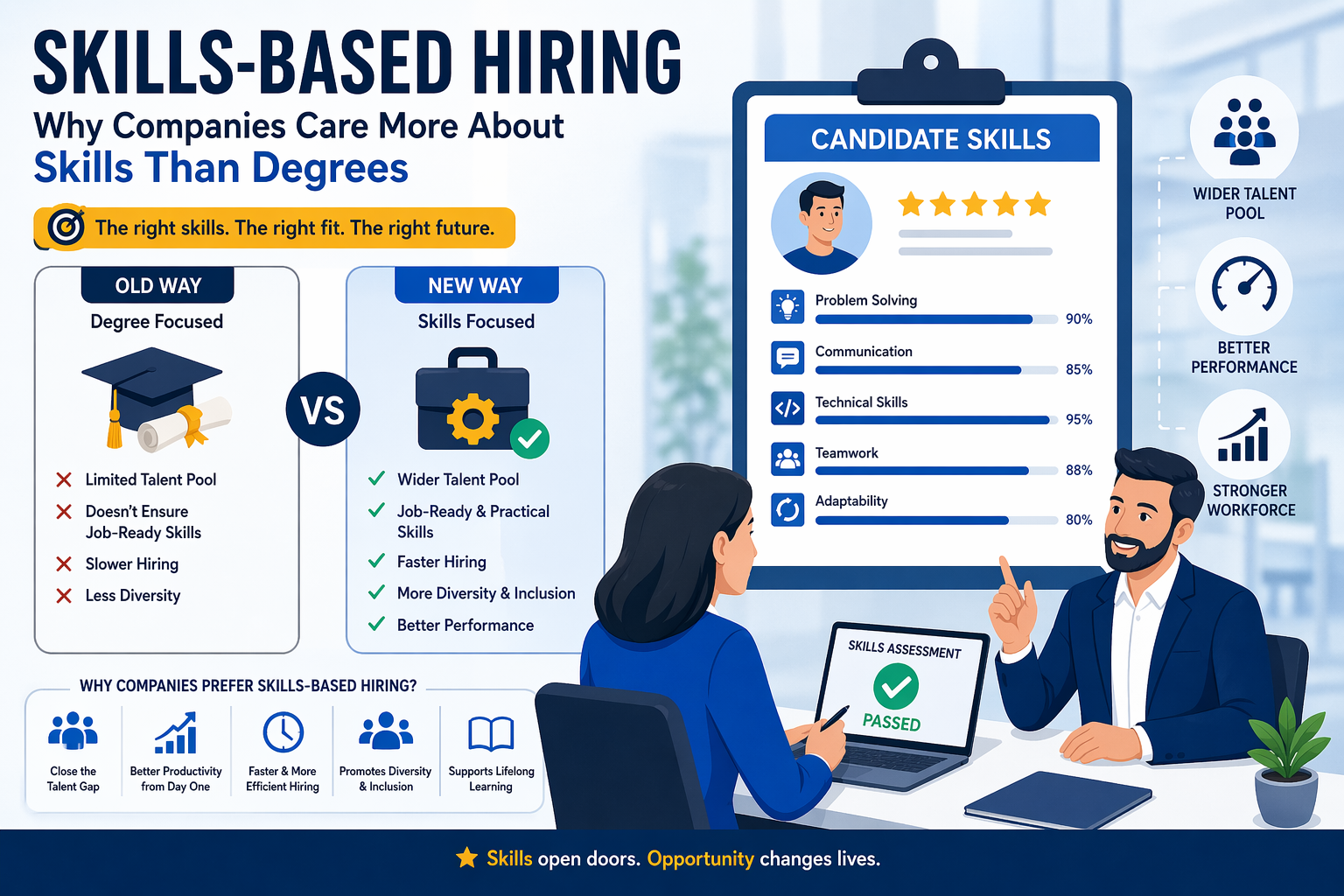
1. Closing the Talent Gap
Many industries are
experiencing a skills shortage, especially in areas like technology,
digital marketing, and data analysis. Relying only on degree holders limits the
talent pool.
By focusing on skills
instead of degrees, companies can access a broader and more diverse group of
candidates who may have gained expertise through certifications, online
courses, internships, or self-learning.
2. Real-World Skills Matter More
A degree does not always
guarantee job-ready skills. Many graduates enter the workforce without the
practical abilities required for modern workplaces.
Skills-based hiring allows
employers to identify candidates who already possess:
A. Technical expertise
B. Problem-solving abilities
C. Communication skills
D. Industry-specific
knowledge
This ensures that employees
can start contributing faster and require less training.
3. Faster and More Efficient Hiring
Traditional hiring methods
often involve reviewing hundreds of resumes based on educational
qualifications. However, this does not always help companies find the best
candidate.
Skills-based hiring focuses
on what candidates can actually do, making the recruitment process more
efficient. Employers can quickly shortlist applicants who demonstrate the
required competencies through tests, portfolios, or practical assignments.
4. Encouraging Diversity and Inclusion
Degree-based hiring
sometimes creates barriers for talented individuals who did not have access to
higher education. Skills-based hiring opens doors for people from different
backgrounds.
This approach promotes diversity
in the workplace, allowing companies to benefit from varied perspectives,
experiences, and ideas. As a result, organizations often become more innovative
and adaptable.
5. Supporting the Rise of Online Learning
The growth of online
learning platforms has made it easier than ever for people to develop
job-relevant skills. Many professionals now gain expertise through:
A.Online certifications
B.Bootcamps
C.Self-learning programs
D.Freelance projects
As a result, companies
recognize that skills can be developed outside traditional universities,
and they are adjusting their hiring strategies accordingly.
Industries Leading the Skills-Based Hiring Trend
Several industries are
already adopting this approach extensively.
Technology and IT - The tech industry
prioritizes coding ability, project experience, and technical expertise
over formal degrees. Many successful developers are self-taught or trained
through coding bootcamps.
Digital Marketing - Companies focus on practical
marketing skills such as SEO, social media management, content creation,
and data analytics.
Creative Fields - Design, video production,
and content creation industries often evaluate candidates through portfolios
and practical work samples rather than academic qualifications.
Customer Service and Sales -
Employers prioritize communication
skills, problem-solving abilities, and customer handling experience.
How Job Seekers Can Prepare for Skills-Based Hiring
As the hiring landscape
evolves, candidates must adapt their job search strategies. Instead of focusing
only on academic achievements, job seekers should highlight their practical
skills.
Here are some key steps:
Build a
strong portfolio -
Showcase projects, assignments, or freelance work that demonstrates your
abilities.
Learn
industry-relevant skills -
Take online courses, certifications, or training programs to stay updated.
Gain
practical experience -
Internships, freelancing, and real-world projects can help you develop valuable
skills.
Prepare for
skill assessments - Many companies now conduct technical tests or problem-solving exercises during
recruitment.
The Future of Hiring
Skills-based hiring is not
just a temporary trend—it represents the future of recruitment. As industries
continue to evolve and technology transforms workplaces, companies need
employees who can adapt, innovate, and perform effectively from day one.
By focusing on skills rather
than degrees, organizations can build stronger teams, improve productivity, and
create more inclusive workplaces. For job seekers, this shift offers new
opportunities to succeed based on their abilities and potential rather than
just academic credentials.
Conclusion
The move toward skills-based
hiring reflects a significant transformation in the way companies recruit
talent. Employers are realizing that practical abilities, experience, and
adaptability are more valuable than traditional qualifications alone.
As this trend continues to
grow in 2026 and beyond, both companies and job seekers must embrace a more
flexible and skill-focused approach to hiring and career development. In a
world driven by innovation and rapid change, skills truly have become the
new currency of employment.