Introduction
The global job market is
undergoing a significant transformation. For decades, academic degrees were
considered the primary benchmark for evaluating job candidates. Employers
relied heavily on educational qualifications to determine whether an applicant was
suitable for a role. However, as industries evolve and workplaces become more
dynamic, companies are beginning to shift their focus from degrees to practical
skills.
Today, organizations are
increasingly asking a simple but powerful question: What can a candidate
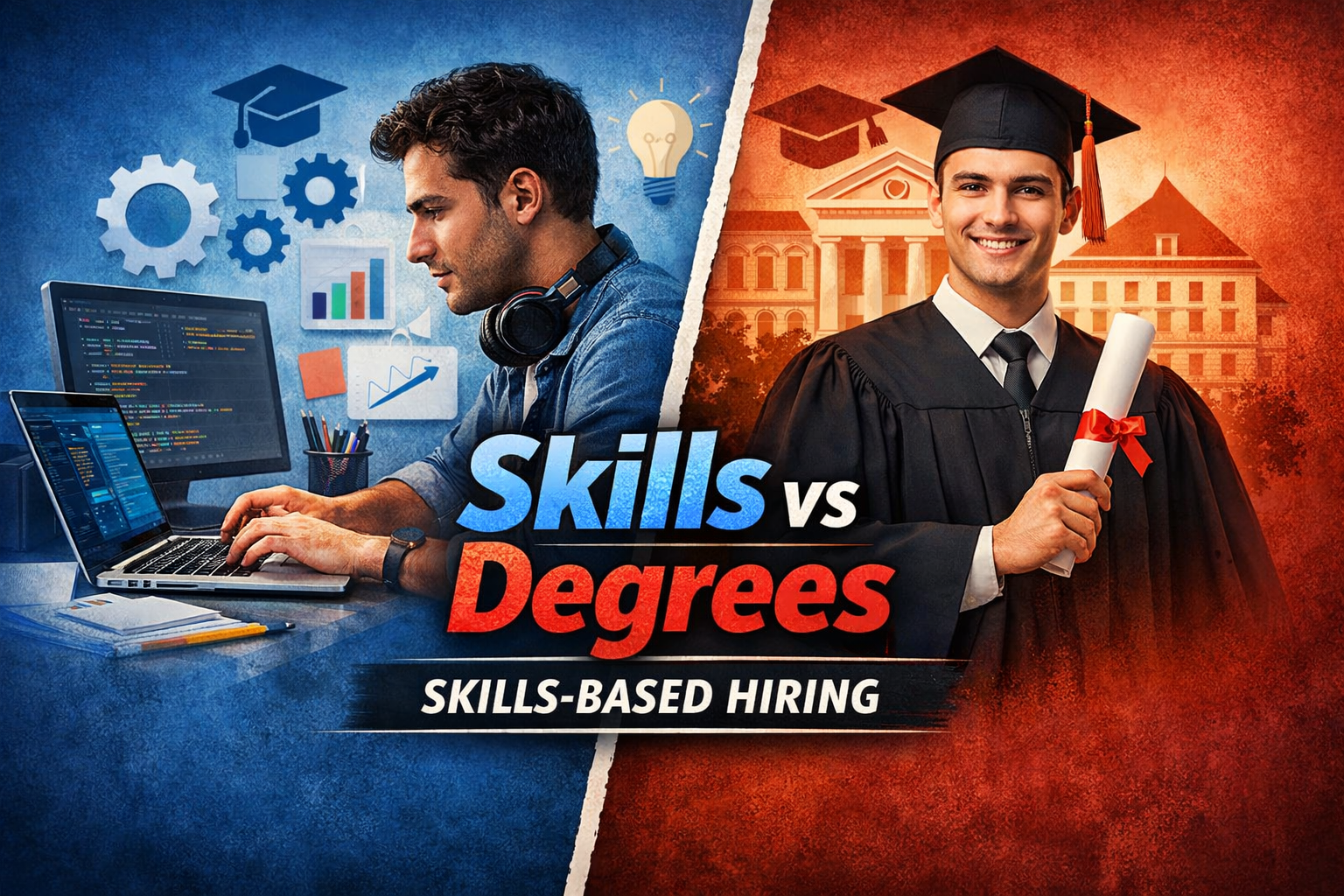
actually do? This shift toward skills-based hiring is reshaping recruitment
strategies and redefining how talent is identified and developed.
Understanding Skills-Based Hiring
Skills-based hiring is a
recruitment approach that prioritizes a candidate’s practical abilities,
competencies, and real-world experience rather than focusing solely on
academic credentials. Instead of filtering candidates strictly based on
degrees, companies assess their capacity to perform tasks, solve problems, and
contribute effectively to the organization.
Many leading global
companies, including Google, IBM, and Apple, have already adopted this approach
by removing degree requirements for several roles. These organizations
recognize that skills, creativity, and practical knowledge often provide a
better indicator of job performance than traditional academic qualifications.
Why Companies Are Shifting Toward Skills-Based
Hiring
1. Practical Skills Reflect Real Capability
A degree demonstrates that a
candidate has completed a specific educational program, but it does not always
guarantee practical competence. Many roles require hands-on experience,
critical thinking, and the ability to apply knowledge in real-world scenarios.
Employers increasingly
prefer candidates who can demonstrate their skills through projects,
portfolios, or relevant work experience. This approach allows organizations to
evaluate candidates based on their ability to perform rather than just their
academic achievements.
2. Rapid Technological Advancement
The pace of technological
change has accelerated dramatically in recent years. Industries such as
software development, digital marketing, data analytics, and artificial
intelligence are constantly evolving. As a result, the knowledge acquired
during a traditional degree program may quickly become outdated.
Skills-based hiring enables
companies to recruit individuals who stay updated with the latest technologies,
tools, and industry practices. Candidates who continuously learn and adapt are
often more valuable in a rapidly changing work environment.
3. Expanding the Talent Pool
Relying solely on degrees
can limit access to potential talent. Many skilled professionals develop
expertise through alternative pathways such as online courses, professional
certifications, internships, freelancing, or self-directed learning.
By focusing on skills rather
than formal qualifications, organizations can access a broader and more diverse
talent pool. This inclusive approach helps companies discover capable
individuals who may have been overlooked in traditional hiring processes.
4. Improving Workplace Performance
Modern workplaces require
employees who possess not only technical knowledge but also essential soft
skills. Communication, collaboration, adaptability, and problem-solving
abilities are critical for success in today’s work environment.
Skills-based hiring helps
companies identify candidates who demonstrate these competencies. As a result,
organizations can build stronger teams and improve overall workplace
productivity.
Benefits of Skills-Based Hiring
Benefits for Employers
For organizations,
skills-based hiring offers several advantages. It enables companies to recruit
candidates who are capable of delivering results quickly and efficiently. By
focusing on practical abilities, employers can reduce the risk of hiring individuals
who may have strong academic credentials but lack the necessary workplace
skills. Additionally, this approach
promotes workforce diversity by giving opportunities to individuals from
different educational backgrounds. It allows companies to prioritize talent and
capability rather than relying solely on traditional qualifications.
Benefits for Job Seekers
For candidates, the shift
toward skills-based hiring opens new career opportunities. Individuals who may
not have access to prestigious universities or advanced degrees can still build
successful careers by developing relevant skills.
It also encourages
continuous learning and professional development. Candidates who actively
improve their skills and gain practical experience can remain competitive in an
evolving job market.
How Job Seekers Can Adapt to the Change
As the hiring landscape
evolves, job seekers must focus on building practical expertise. Developing
industry-relevant skills, completing real-world projects, and gaining hands-on
experience can significantly enhance employability.
Creating a strong portfolio
is particularly valuable for candidates in fields such as technology,
marketing, design, and data analysis. Portfolios demonstrate a candidate’s
ability to apply knowledge and produce measurable results.
Additionally, obtaining
professional certifications, participating in internships, and staying updated
with industry trends can help candidates remain competitive in a skills-focused
job market.
The Future of Hiring
The transition from
degree-based hiring to skills-based hiring reflects broader changes in the
modern workplace. While academic qualifications will continue to hold value,
they are no longer the only indicator of talent and potential.
Organizations are
increasingly seeking professionals who can solve problems, adapt to change,
and deliver meaningful results. As industries continue to evolve, the
importance of continuous learning and skill development will only grow.
Conclusion
The shift toward
skills-based hiring represents a significant evolution in recruitment
practices. Employers are recognizing that practical abilities, adaptability,
and real-world experience often matter more than formal degrees alone.
For job seekers, this change
presents both an opportunity and a challenge. Those who focus on developing
relevant skills, gaining practical experience, and continuously learning will
be well-positioned to succeed in the modern job market.
Ultimately, while degrees
may open doors, it is skills that enable individuals to build lasting and
impactful careers.