Introduction
In today’s digital world,
having a website is not enough. If your website does not appear in search
results, potential customers may never find your business. Search engines like Google
prioritize websites that are well-structured, fast, and provide valuable
content. Building an SEO-friendly website ensures better visibility, higher
traffic, and more business opportunities.
Here are the key strategies
to create a website that ranks well on search engines.
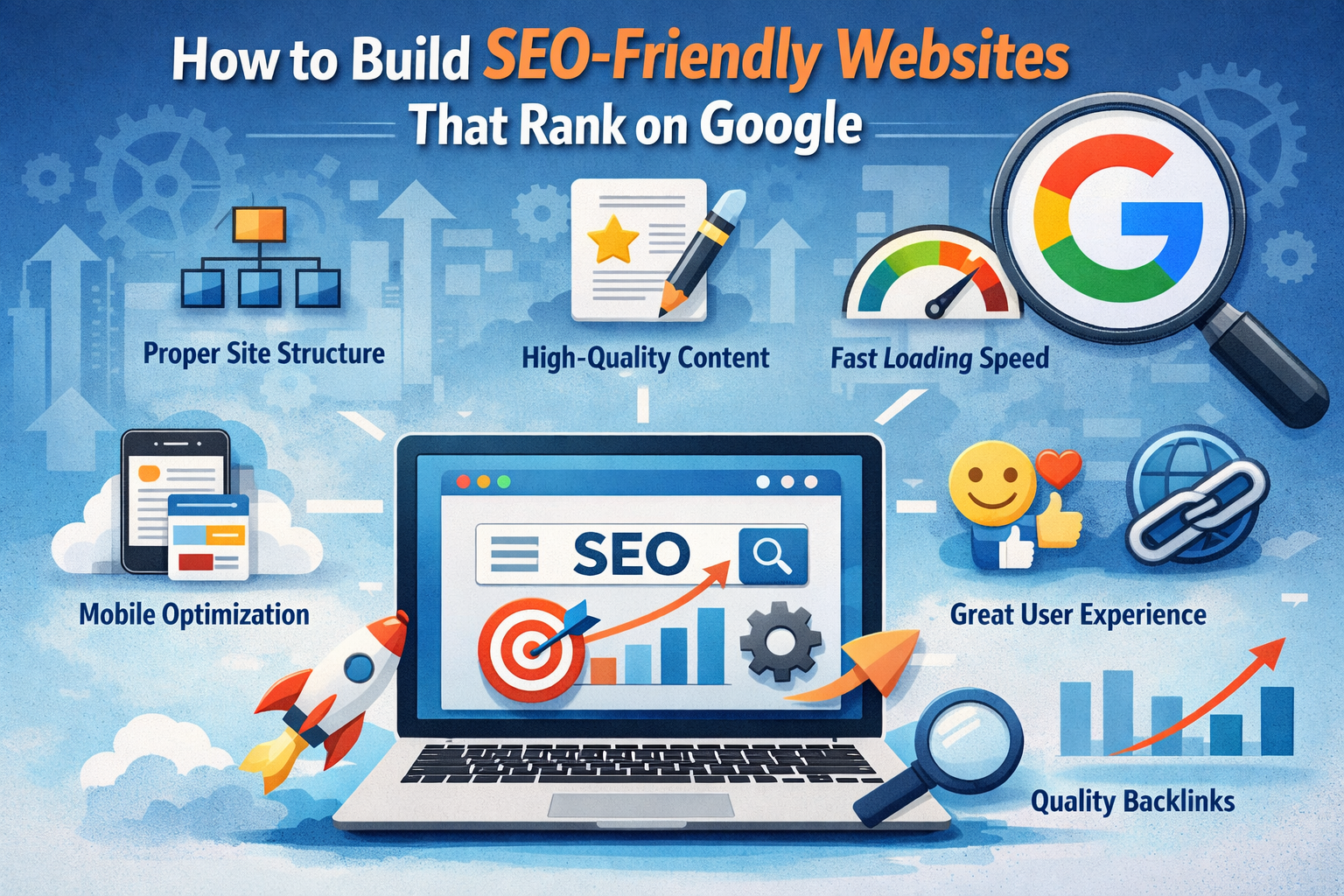
Start with Proper Website Structure
A well-organized website
helps both users and search engines understand your content. Clear navigation
and logical page hierarchy make it easier for search engines to crawl and index
your website.
Tips for a good website
structure:
1.Use clear navigation menus
2.Organize pages into
categories and subcategories
3.Keep important pages
accessible within a few clicks
4.Create an XML sitemap for
search engines
A simple and structured
layout improves user experience and boosts SEO performance.
Focus on High-Quality Content
Content remains one of the
most important ranking factors. Search engines prioritize websites that provide
useful, relevant, and original information.
To create SEO-friendly
content:
1.Use relevant keywords
naturally in headings and text
2.Write informative articles
that answer user queries
3.Update content regularly
to keep it fresh
4.Use headings (H1, H2, H3)
to organize information
High-quality content not
only improves rankings but also builds trust with your audience.
Optimize Website Speed
Website speed is crucial for
both user experience and search rankings. Slow websites increase bounce rates
and reduce engagement.
Tools such as Google
PageSpeed Insights can help analyze and improve your website performance.
Ways to improve website
speed:
1.Compress images before
uploading
2.Use reliable hosting
services
3.Minimize unnecessary
scripts and plugins
4.Enable browser caching
Faster websites provide a
better experience and are favored by search engines.
Make Your Website Mobile-Friendly
With the majority of users
browsing on smartphones, mobile optimization is essential. Search engines now
prioritize mobile-friendly websites in their ranking algorithms.
A mobile-friendly website
should:
1.Use responsive design
2.Load quickly on mobile
devices
3.Have easy-to-read text and
clickable buttons
4.Avoid intrusive pop-ups
Responsive design ensures
that your website works smoothly across all devices.
Use Proper On-Page SEO Techniques
On-page SEO helps search
engines understand what your page is about.
Important on-page SEO
elements include:
1.Optimized title tags and
meta descriptions
2.Keyword-rich headings
3.Descriptive image alt text
4.Internal linking between
pages
Platforms like WordPress
make it easier to manage on-page SEO through plugins and customization options.
Improve User Experience (UX)
Search engines prioritize
websites that offer a positive user experience. If visitors stay longer on your
site and interact with your content, it signals value to search engines.
Ways to improve UX include:
1.Simple and clean design
2.Easy navigation
3.Readable fonts and clear
layouts
4.Engaging visuals and
multimedia
A good user experience
increases time spent on the site and reduces bounce rates.
Build
Quality Backlinks
Backlinks are links from
other websites pointing to your site. They act as votes of trust for search
engines.
Effective ways to build
backlinks include:
1.Publishing high-quality
blog content
2.Guest posting on relevant
websites
3.Collaborating with
industry experts
4.Sharing content on social
media platforms
Quality backlinks improve
domain authority and search rankings.
Conclusion
Building an SEO-friendly
website requires a combination of technical optimization, high-quality content,
and strong user experience. By focusing on website structure, mobile
responsiveness, speed, and effective SEO strategies, businesses can
significantly improve their chances of ranking higher on search engines.
In a competitive digital
landscape, investing in SEO is essential for long-term online growth. A
well-optimized website not only attracts more visitors but also converts them
into loyal customers.