Introduction
Many businesses invest time
and money into driving traffic to their websites through SEO, ads, and social
media. However, a common problem remains: visitors come to the website but
leave without taking any action. This happens when a website is not designed
with conversions in mind.
A conversion-focused website
guides visitors toward a specific action—whether it’s making a purchase,
filling out a form, booking a demo, or contacting your business. The good news
is that improving website conversions doesn’t always require a complete redesign.
Small strategic changes can make a significant difference.
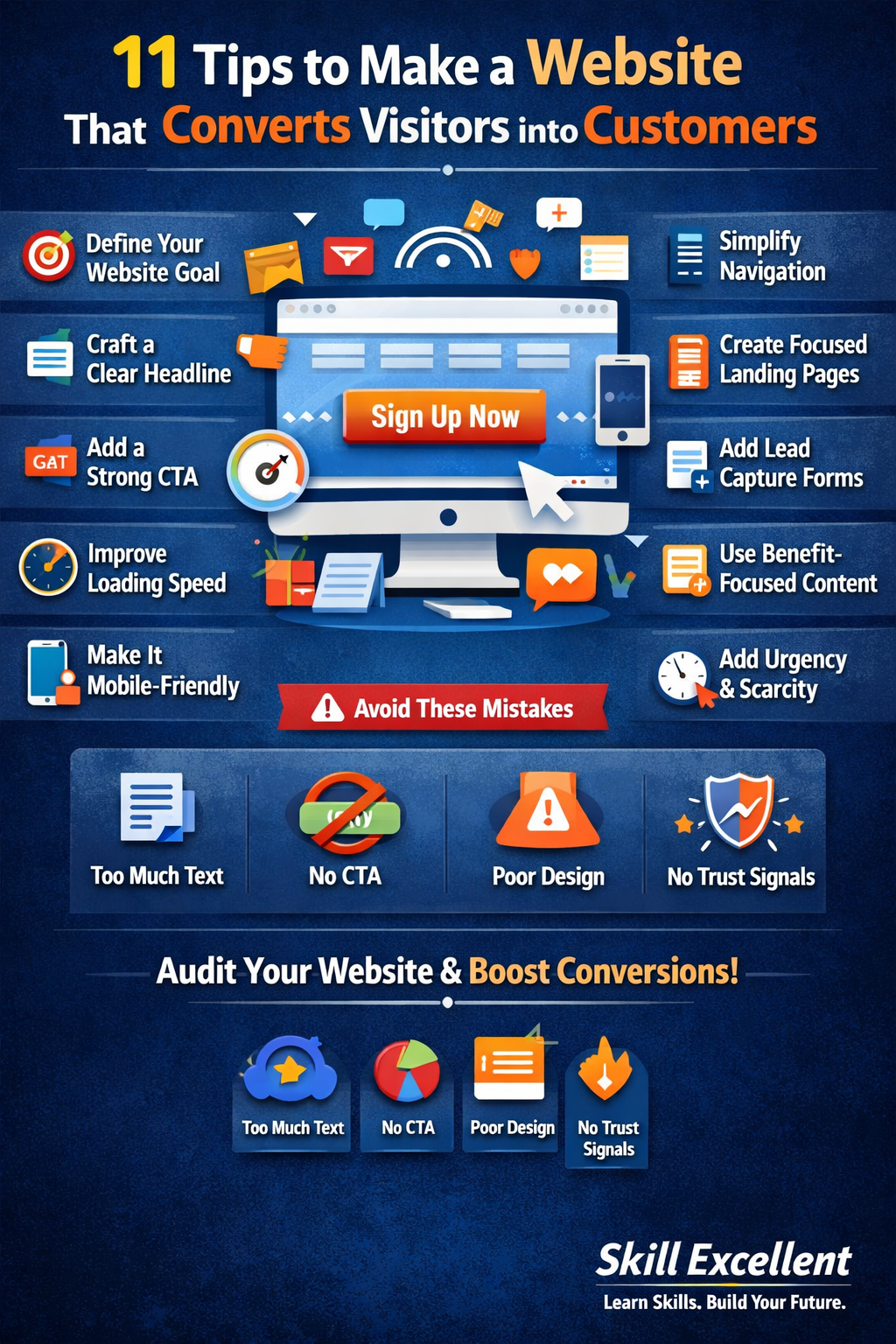
Here are 11 practical
tips to help you create a website that converts visitors into customers.
Define Your Website Goal Clearly
Every website should have one
primary goal. This goal could be generating leads, selling products,
booking appointments, or encouraging users to sign up.
When a website tries to
achieve too many objectives at once, visitors become confused and leave. A
focused homepage with a clear purpose helps guide users toward the desired
action.
Use a Clear and Compelling Headline
Visitors decide whether to
stay on your website within 3–5 seconds. Your headline should
immediately communicate what you do and how it benefits the user.
A simple formula for
effective headlines is:
“We help
[audience] achieve [result].”
For example:
“We help small businesses grow with powerful digital marketing solutions.”
A clear headline instantly
tells visitors they are in the right place.
Add Strong Call-to-Action (CTA)
A Call-to-Action tells users
what to do next. Without a clear CTA, visitors may leave without taking action.
Use visible and engaging CTA
buttons such as:
1.Get Started
2.Book a Demo
3.Download Now
4.Contact Us
Place the CTA above the
fold so visitors can see it without scrolling.
Improve Website Loading Speed
Website speed has a direct
impact on conversions. Studies show that even a one-second delay can
reduce user engagement and sales.
To improve speed:
1.Optimize image sizes
2.Minimize unnecessary
scripts
3.Use reliable hosting
services
4.Enable caching
A faster website creates a
better user experience and keeps visitors engaged.
Make Your Website Mobile-Friendly
Today, a large percentage of
users browse websites on their smartphones. If your website is not
mobile-friendly, you risk losing a significant portion of potential customers.
A responsive design ensures
that your website adapts to different screen sizes. Make sure buttons are easy
to tap, text is readable, and navigation is simple on mobile devices.
Build Trust with Social Proof
Visitors are more likely to
trust your business when they see proof that others have benefited from your
services.
You can build trust by
adding:
1.Customer testimonials
2.Client logos
3.Case studies
4.Ratings and reviews
5.Success statistics
Social proof reassures
visitors that they are making the right decision.
Use Simple and Clean Navigation
A complicated menu can
overwhelm visitors and make it difficult to find information.
Keep navigation simple by
limiting the main menu to 5–7 items. Focus on essential pages such as
Home, Services, About, Blog, and Contact.
Clear navigation helps users
explore your website smoothly.
Create High-Converting Landing Pages
Landing pages should have one
clear goal. Unlike regular pages, they should remove distractions and focus
on a single action such as signing up or downloading a resource.
Effective landing pages
include:
1.Clear headline
2.Benefit-focused content
3.Repeated CTA buttons
4.Minimal distractions
This focused approach
improves conversion rates.
Add Lead Capture Forms
Lead capture forms help you
collect valuable information such as email addresses and inquiries.
To improve conversions:
1.Keep forms short
2.Ask only essential
questions
3.Offer something valuable
like a free ebook, demo, or consultation
This encourages visitors to
share their information.
Use Benefit-Focused Content
Many websites focus too much
on features instead of explaining the benefits.
Visitors want to know how
your product or service will help them. Highlight the results they will
achieve and the problems you can solve.
Using bullet points and
clear language makes the content easier to understand.
Add Urgency and Scarcity
Urgency encourages visitors
to take action immediately rather than delaying their decision.
You can create urgency
through:
A.Limited-time offers
B.Limited seats or stock
C.Countdown timers
D.Bonuses for early
action
These techniques motivate
users to act quickly.
Bonus: Mistakes That Reduce Website Conversions
Some common mistakes that
reduce conversions include:
A.Too much text that
overwhelms readers
B.No clear CTA
C.Poor design and
cluttered layout
D.Lack of trust signals
such as testimonials or reviews
Avoiding these mistakes can
significantly improve your website’s effectiveness.
Conclusion
Creating a high-converting
website is not just about design—it’s about strategy. By defining clear goals,
improving user experience, building trust, and guiding visitors with strong
CTAs, you can turn more visitors into customers. Start by implementing these 11
tips step by step and monitor the results. Even small improvements can lead
to better engagement and higher conversions.
Now is the
best time to audit your website and optimize it for conversions. Your next
customer could already be visiting your site.