Introduction
Over the past decade,
digital marketing has evolved rapidly as businesses moved from traditional
advertising methods to online platforms. Earlier, companies invested in TV,
print, and radio ads without knowing exactly how many people actually responded
to them. Today, businesses want measurable results from every marketing
rupee they spend.
This is where ROI-driven
advertising comes into play. ROI (Return on Investment) means businesses
can clearly track whether their advertising spend is generating leads, sales,
or other desired actions. Instead of paying just for visibility, companies now
prefer to pay for actual outcomes.
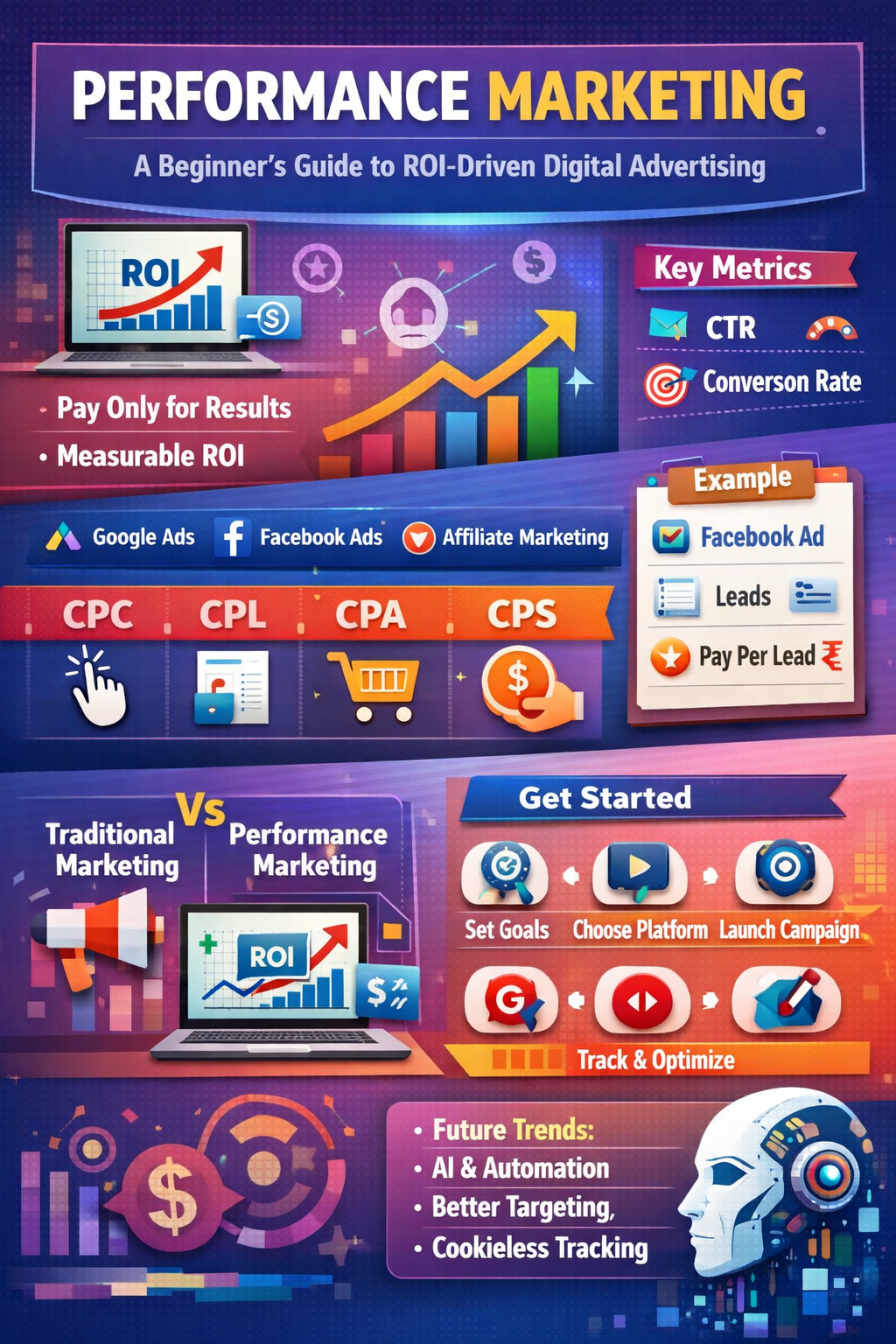
This approach is known as Performance
Marketing — a digital advertising strategy where businesses pay only when a
specific action occurs, such as a click, lead, or sale.
What is Performance Marketing?
Performance marketing is a
type of digital marketing where advertisers pay only when a specific measurable
result is achieved. These results may include website clicks, leads, app
installs, or product purchases.
In simple terms, it is a pay-for-results
model. Unlike traditional advertising where payment is made for ad
placement or exposure, performance marketing ensures that the advertiser pays
only for actual performance.
For example, if a company
runs an online ad campaign and decides to pay only when users click on the ad
or fill out a form, it is using performance marketing.
How Performance Marketing Works
Performance marketing works
through a structured digital campaign process.
First, the advertiser
defines a goal, such as generating leads, increasing sales, or driving website
traffic. Then, the campaign is launched on digital platforms where the target
audience spends time online.
The platform allows
advertisers to target specific audiences based on demographics,
interests, location, and online behavior. Tracking tools monitor user actions
such as clicks, sign-ups, or purchases. Payment is made only when the
predefined action occurs.
This system allows
businesses to continuously analyze results and improve campaign performance.
Key Channels in Performance Marketing
Performance marketing
operates through several digital channels.
One of the most common
channels is Search Engine Marketing, where businesses run ads on search
engines like Google to appear when users search for specific keywords.
Another major channel is Social
Media Advertising, where brands promote their products on platforms such as
Facebook, Instagram, and LinkedIn.
Other channels include affiliate
marketing, where partners promote products and earn commissions for
conversions; native advertising, where ads blend with platform content; display
advertising, which uses banners and visual ads across websites; and influencer
performance campaigns, where influencers promote products with trackable
links or codes.
Common Performance Marketing Models
Different payment models are
used in performance marketing depending on campaign goals.
1.CPC (Cost
Per Click): Advertiser
pays when someone clicks the ad.
2.CPL (Cost
Per Lead): Payment
occurs when a user submits their contact information.
3.CPA (Cost
Per Acquisition): Advertiser
pays when a specific action like a purchase happens.
4.CPM (Cost
Per Thousand Impressions): Payment is
based on ad views.
5.CPS (Cost
Per Sale): Payment
occurs only after a completed sale.
These models give businesses
flexibility to choose how they want to measure success.
Important Metrics to Track
Tracking performance is a
key part of this marketing approach. Important metrics include:
1.Click-Through
Rate (CTR) –
Percentage of people who click an ad after seeing it
2.Conversion
Rate – Percentage of users who
complete the desired action
3.Cost Per
Click (CPC) – Amount
paid for each click
4.Cost Per
Lead (CPL) – Cost of
acquiring a lead
5.Return on
Ad Spend (ROAS) – Revenue
generated from advertising spend
6.Customer
Acquisition Cost (CAC) – Cost of
acquiring a new customer
These metrics help
businesses understand whether their campaigns are profitable.
Benefits of Performance Marketing
Performance marketing offers
several advantages for businesses.
Companies pay only for
results, making advertising budgets more efficient. It provides clear
and measurable ROI, allowing marketers to evaluate campaign effectiveness.
Advertisers can target specific audiences, control their budgets, and scale
campaigns easily. Additionally, campaigns can be optimized in real time based
on performance data.
Performance Marketing vs Traditional Marketing
Traditional marketing often
focuses on brand exposure without precise measurement. In contrast, performance
marketing offers data-driven decision making.
It is more cost-efficient
because payment is linked to results. Targeting is more precise, campaigns
deliver faster insights, and ROI can be tracked accurately.
Example of Performance Marketing
Consider a business running
advertisements on Facebook. The company creates an ad that encourages users to
fill out a form for a free consultation.
The advertiser pays only
when users submit the form. By tracking conversions and user behavior, the
business can optimize the campaign and improve results over time.
Who Should Use Performance Marketing?
Performance marketing is
ideal for many types of organizations, including startups, small businesses,
e-commerce brands, service providers, EdTech platforms, and B2B companies.
Any business that wants measurable growth can benefit from this approach.
Getting Started with Performance Marketing
To begin with performance
marketing, businesses should first define their campaign goals. Next, they
should choose the right advertising platform, set a realistic budget, and
design engaging ad creatives.
After launching the
campaign, it is important to monitor performance data and continuously optimize
the ads.
Common Mistakes Beginners Should Avoid
Many beginners make mistakes
such as not defining clear goals, failing to set up proper tracking tools,
targeting audiences that are too broad, or not testing different ad creatives.
Another common mistake is
stopping campaigns too early before enough data is collected.
Future of Performance Marketing
The future of performance
marketing will be driven by AI-powered campaign optimization, automation
tools, improved audience targeting, and cookieless tracking solutions.
Businesses will increasingly focus on maximizing ROI through data-driven
strategies.
Conclusion
Performance marketing is a results-focused
approach to digital advertising. By paying only for measurable outcomes,
businesses can ensure better budget utilization and higher returns. Whether you
are a beginner or an experienced marketer, performance marketing provides a
powerful way to achieve scalable and measurable growth in today’s digital
landscape.