Introduction:
The Plugin Dilemma
In today’s digital world,
websites are no longer just static pages. Businesses expect their websites to
perform multiple tasks—capture leads, process payments, manage customers, and
improve search rankings. This is where plugins play a crucial role.
A plugin is essentially a
software component that adds specific functionality to a website without
requiring developers to build everything from scratch. Whether it’s adding a
contact form, improving SEO, or enabling eCommerce, plugins make websites more
powerful and flexible.
Because plugins are so
convenient, many website owners rely heavily on them. However, this growing
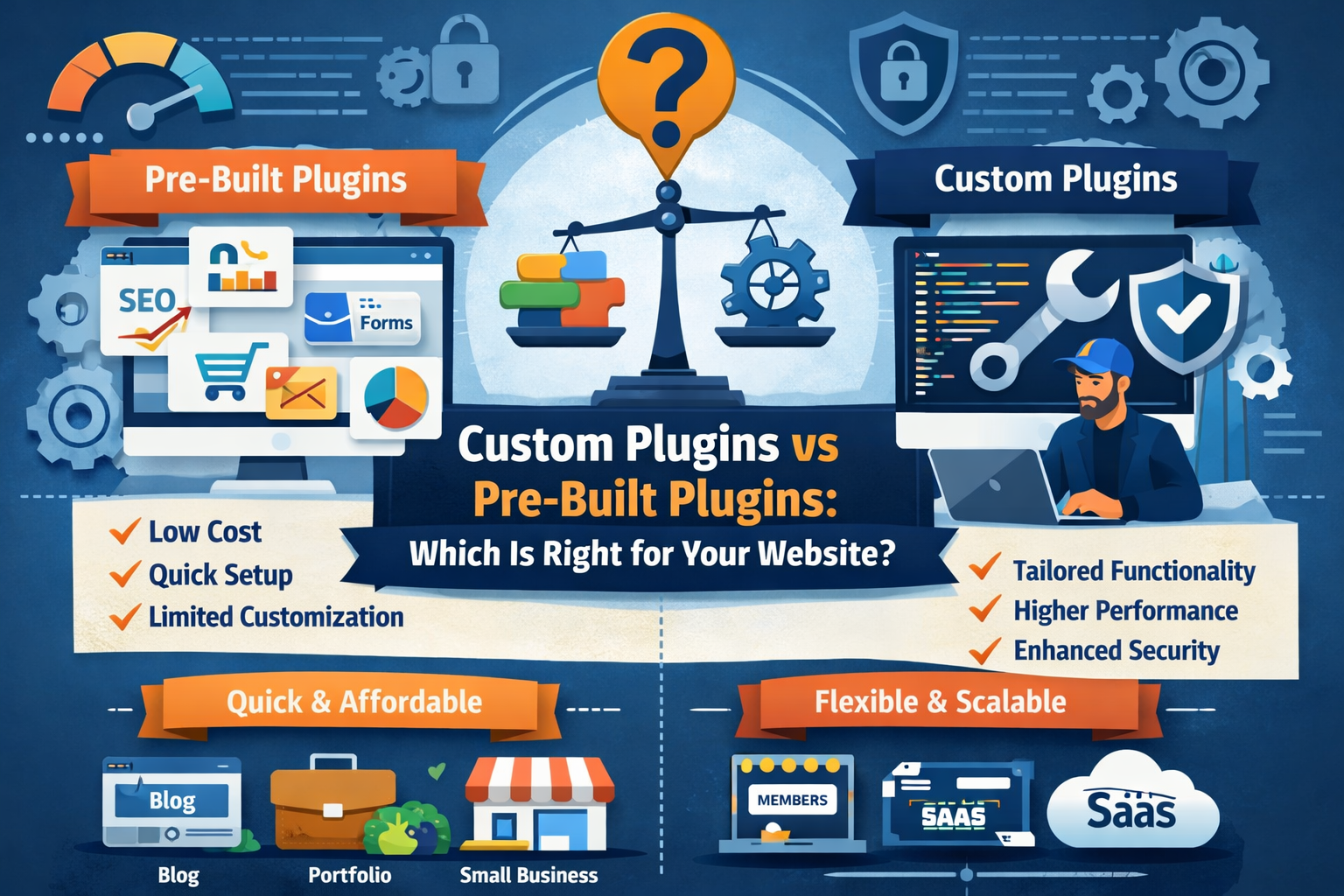
dependency also creates a common dilemma: Should you use pre-built plugins
or invest in custom plugins? Both options have their
advantages and limitations. Choosing the right one can significantly impact
your website’s performance, security, scalability, and long-term success.
This article will help you understand the key differences and decide which
solution is best for your business.
What Are Pre-Built Plugins?
Pre-built plugins are ready-made
tools developed by third-party developers and made available in online
marketplaces. They are designed to solve common website needs and can be
installed quickly with minimal technical knowledge.
These plugins are widely
used in popular platforms such as WordPress, where thousands of plugins
are available for different purposes like SEO, analytics, contact forms, and
eCommerce.
Advantages of Pre-Built Plugins
A. Quick
Installation
Most pre-built plugins can be installed in just a few clicks, allowing website
owners to add functionality instantly.
B. Low or No Initial Cost
Many plugins are free or available at a low price, making them ideal for
businesses with limited budgets.
C. Wide Variety of Options
There are thousands of plugins available, giving users multiple choices for
almost any feature.
Limitations of Pre-Built Plugins
A. Limited
Customization
Since they are designed for general use, customization options may be
restricted.
B. Feature
Bloat
Many plugins include unnecessary features that your website may never use,
which can slow down performance.
C. Dependency on Third-Party Updates
You rely on the developer for updates and maintenance. If the developer stops
supporting the plugin, your website may face compatibility or security issues.
What Are Custom Plugins?
Custom plugins are tailor-made
solutions developed specifically for a particular website or business
requirement. Instead of installing a ready-made tool, developers build the
functionality from scratch based on your exact needs.
These plugins are often
created by professional developers or development agencies to solve unique
challenges that pre-built plugins cannot address.
Advantages of Custom Plugins
A. Fully Customized Functionality
Custom plugins are designed to match your business requirements exactly,
without unnecessary features.
B. Better Performance
Since only the required code is included, custom plugins often perform faster
and more efficiently.
C. Enhanced Security
Custom plugins are less likely to be targeted by widespread attacks because
they are not publicly distributed.
D. Scalable for Future Growth
As your business grows, custom plugins can be updated and expanded to support
new features.
Limitations of Custom Plugins
A. Higher Initial Cost
Developing a custom plugin requires professional development work, which
increases upfront investment.
B. Development Time
Unlike pre-built plugins, custom solutions require time for planning,
development, and testing.
C. Technical Expertise Required
Maintenance and updates usually require skilled developers.
When Should You Choose Pre-Built Plugins?
Pre-built plugins are often
the best choice for small businesses or startups that need quick and
affordable solutions.
You should consider
pre-built plugins if:
1.Your website requires basic
functionality
2.You have a limited
budget
3.You want to launch your
website quickly
4.You have limited
technical knowledge
Common Use Cases
1.Blog websites
2.Basic business websites
3.Portfolio websites
These websites usually do
not require complex functionality, making pre-built plugins a practical option.
When Should You Choose Custom Plugins?
Custom plugins are ideal for
businesses that require advanced functionality or unique features that
cannot be achieved with standard plugins.
You should choose custom
plugins if:
1.Your business has unique
operational requirements
2.You need advanced
integrations with other systems
3.Your website expects high
traffic and growth
4.Security and performance
are top priorities
Common Use Cases
1.eCommerce platforms
2.Membership websites
3.SaaS products
4.Custom dashboards
For these platforms,
tailored functionality can significantly improve efficiency and user
experience.
Cost vs Value: A Long-Term Perspective
While pre-built plugins are
cheaper initially, businesses often end up installing multiple plugins to
achieve the desired functionality. This can increase complexity, reduce
performance, and create compatibility issues.
Custom plugins require a
higher initial investment, but they often save costs in the long run by
reducing dependency on multiple third-party tools and minimizing maintenance
problems.
Performance & SEO Impact
Website speed plays a major
role in user experience and search engine rankings. Installing too many
plugins can increase loading time and negatively impact Core Web Vitals,
which are key performance metrics used by search engines.
Custom plugins, on the other
hand, contain only the necessary code, making them more efficient and improving
overall website performance.
Security Considerations
Security is another critical
factor when choosing plugins.
Widely used plugins can
sometimes become targets for hackers, especially if they are outdated or poorly
maintained. Vulnerabilities in such plugins can expose websites to attacks.
Custom plugins provide an
advantage because they operate in a controlled environment and are less
likely to be targeted by mass exploits.
Hybrid Approach: The Best of Both Worlds
In many cases, businesses
benefit from a hybrid approach—using pre-built plugins for standard
features while developing custom plugins for critical functionalities.
This approach helps balance cost,
performance, and flexibility.
How to Decide What’s Right for Your Business
Before making a decision,
ask yourself the following questions:
1.Do I need unique
functionality?
2.What is my budget?
3.How important are
performance and security?
4.Will my business scale in
the near future?
Answering these questions
can guide you toward the most suitable solution.
Why the Right Choice Matters
Your plugin strategy
directly impacts:
1.Website performance
2.User experience
3.Conversion rates
4.Long-term scalability
Making the right decision
ensures your website remains fast, secure, and adaptable to future growth.
Conclusion: Make a Smart Investment
There is no universal
solution when it comes to plugins. Pre-built plugins are ideal for simple
websites and quick launches, while custom plugins provide flexibility,
security, and scalability for growing businesses.
The key is to evaluate your
business goals and choose the option that aligns best with your long-term
digital strategy.
Need help choosing the right
plugin solution for your website?
SkillExcellent can help you build a high-performance website
tailored to your business needs. Get expert guidance and create a scalable
digital platform designed for long-term success.