Introduction
In today’s competitive job
market, interviews play a crucial role in shaping your career. An interview is
more than just answering questions—it is your opportunity to showcase your
skills, personality, and professional potential. As hiring processes evolve in
2026, employers are looking for candidates who are not only qualified but also
adaptable, confident, and well-prepared.
With increasing competition
and the growing influence of technology in recruitment, candidates must
approach interviews strategically. Preparation, communication, and
self-awareness have become essential factors for success. This article will
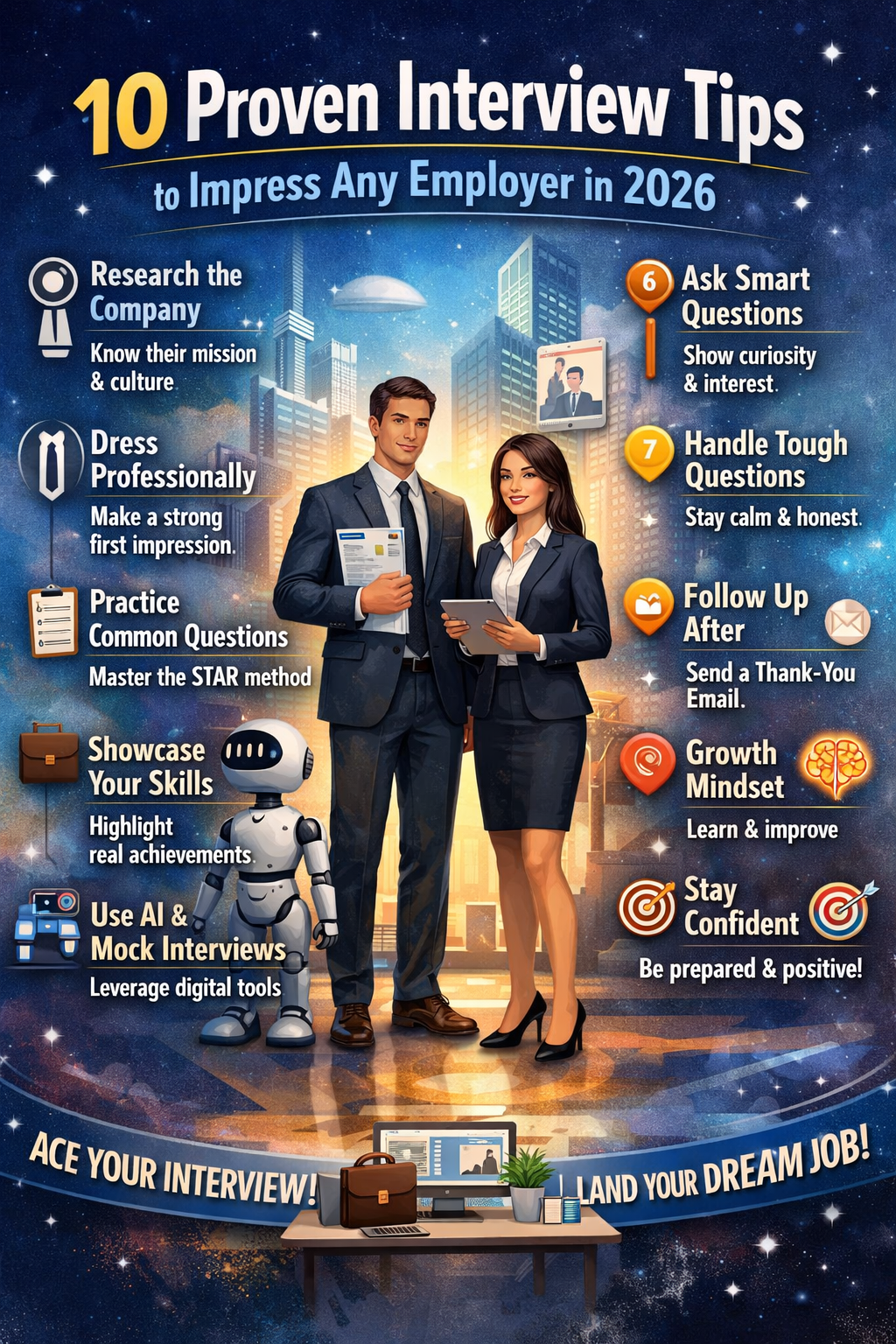
guide you through 10 proven interview tips that can help you make a
strong impression and increase your chances of landing your dream job.
Understand the Company & Role
One of the biggest mistakes
candidates make is attending interviews without researching the company.
Employers appreciate candidates who demonstrate genuine interest in their
organization.
Start by learning about the
company’s mission, values, culture, and recent achievements. Visit their
website, read their blog posts, and explore their social media presence. This
knowledge will help you understand how the organization operates and what they
expect from employees.
Additionally, study the job
description carefully. Identify the required skills and responsibilities,
and think about how your experience aligns with them. When you connect your
abilities to the company’s needs, you present yourself as the ideal candidate.
Build a Strong First Impression
First impressions are formed
within seconds, and they can significantly influence the outcome of your
interview. Your appearance, body
language, and attitude play a major role in how interviewers perceive you.
Dress professionally and appropriately for the role.
Even for virtual
interviews, maintain a neat appearance and choose a clean, quiet background.
Simple gestures such as a
confident smile, firm handshake (for in-person interviews), and polite greeting
can make a positive impact. Maintaining eye contact and sitting with good
posture also reflects professionalism and confidence.
Master Common Interview Questions
Most interviews include a
few standard questions that employers use to understand your background and
personality.
One of the most common
questions is “Tell me about yourself.” Instead of repeating your resume,
briefly highlight your education, experience, key skills, and career goals.
For behavioral questions,
use the STAR method (Situation, Task, Action, Result). This technique
helps you structure your answers clearly while demonstrating how you handled
real-life challenges.
For technical or
role-specific questions, practice explaining your skills and knowledge in a
clear and concise way.
Showcase Practical Skills & Experience
Employers are increasingly
interested in practical experience rather than just theoretical knowledge.
During the interview,
discuss projects, internships, freelance work, or real-world tasks that
demonstrate your abilities. Provide examples of how you solved problems,
improved processes, or achieved measurable results.
For example, instead of
saying “I improved website performance,” you could say “I optimized
the website and increased page speed by 40%, improving user experience.”
Specific achievements help employers understand the real value you bring.
Improve Communication Skills
Strong communication skills
are essential in any professional role. During interviews, it is important to express
your thoughts clearly and confidently.
Avoid speaking too fast or
using filler words such as “um,” “like,” or “you know.” Take a moment to think
before answering questions.
Active listening is also
important. Pay close attention to the interviewer’s questions and respond
thoughtfully. Good communication shows that you can collaborate effectively in
a professional environment.
Leverage AI & Digital Tools for Preparation
Technology has transformed
the way candidates prepare for interviews. In 2026, many job seekers use AI-powered
tools and mock interview platforms to improve their performance.
These tools simulate real
interview scenarios and provide feedback on your answers, tone, and body
language. Recording yourself while practicing can also help identify areas for
improvement.
Using digital tools allows
you to refine your responses and build confidence before the actual interview.
Ask Smart Questions to the Interviewer
Many candidates think
interviews are only about answering questions, but asking thoughtful
questions can leave a strong impression.
When the interviewer asks if
you have any questions, avoid responding with “No.” Instead, ask questions that
show curiosity and interest in the role.
For example:
1.What does success look
like in this position?
2.What are the biggest
challenges facing this team?
3.How does the company
support employee growth?
Such questions demonstrate
that you are serious about contributing to the organization.
Handle Difficult Questions with Confidence
Sometimes interviewers ask
challenging or unexpected questions to test your problem-solving ability and
honesty. If you are asked about
weaknesses or career gaps, answer honestly while focusing on what you have
learned from those experiences. For example, explain how you improved a
particular skill or overcame a challenge.
Remaining calm and composed
during difficult questions shows emotional intelligence and confidence.
Follow-Up After the Interview
Your effort should not end
when the interview is over. Sending a professional follow-up email can
reinforce your interest in the position.
Thank the interviewer for
their time and briefly mention something meaningful from the conversation. This
shows professionalism and appreciation.
Ideally, send your follow-up
message within 24 hours after the interview.
Bonus Tip: Maintain a Growth Mindset
Even if you do not get
selected for a particular role, every interview is a valuable learning
experience.
Reflect on your performance,
identify areas where you can improve, and continue practicing. Accept feedback
positively and focus on personal growth.
A growth mindset helps you
stay motivated and confident throughout your job search journey.
Conclusion
Interviews can be
challenging, but with the right preparation and mindset, they become an
opportunity to showcase your potential.
By researching the
company, building a strong first impression, mastering common questions,
highlighting practical skills, improving communication, using AI tools, asking
smart questions, handling challenges confidently, and following up
professionally, you can significantly increase your chances of success.
Remember, confidence comes
from preparation. Keep learning, keep improving, and approach every interview
as a step closer to your career goals.