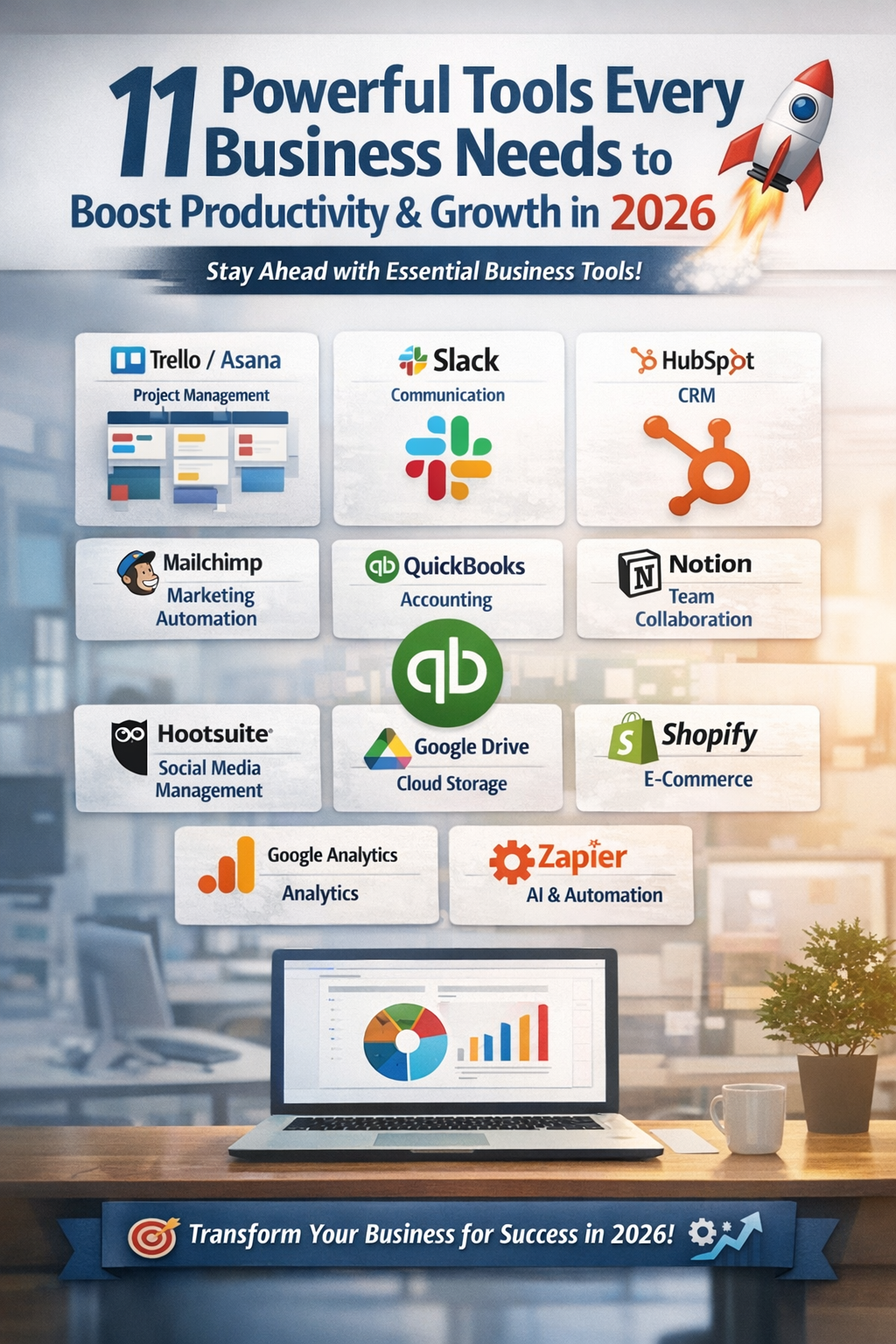
Introduction
The business world in 2026
is evolving faster than ever. With increasing competition, rapid technological
advancements, and growing customer expectations, companies must constantly
adapt to stay ahead. Traditional ways of managing work are no longer enough.
Businesses today rely heavily on digital tools that help automate tasks,
improve communication, and increase efficiency.
From project management to
marketing automation and data analytics, modern tools help organizations
streamline operations and make smarter decisions. By using the right
technology, businesses can save time, reduce errors, and focus more on
innovation and growth. This article explores 11 powerful tools that every
business should consider using in 2026 to improve productivity and
accelerate growth.
Why Business Tools Are Essential in 2026
In today’s competitive
environment, businesses must operate quickly and efficiently. Companies that
rely on manual processes often struggle with delays, miscommunication, and
reduced productivity. Digital tools help solve these problems by automating repetitive
tasks and improving collaboration across teams.
Technology also plays a
major role in scaling operations. When businesses grow, managing employees,
projects, and customer relationships becomes more complex. The right tools
simplify these processes and ensure everything runs smoothly.
Another major advantage is
cost reduction. Automation and smart software can reduce the need for excessive
manual work, saving both time and operational costs. As a result, companies can
focus their resources on strategic growth rather than routine administrative
tasks.
Tool #1: Project Management – Trello / Asana
Project management tools
help teams organize tasks and track progress efficiently. Platforms like Trello
and Asana allow teams to create boards, assign tasks, set deadlines, and
monitor project status in real time.
These tools provide a visual
workflow that makes it easy to understand who is responsible for each task.
This improves accountability and keeps projects on schedule. As a result, teams
become more organized and productive.
Tool #2: Communication – Slack
Effective communication is
essential for business success. Slack provides real-time messaging, file
sharing, and collaboration channels that allow teams to communicate instantly.
Instead of relying on long
email threads, employees can discuss projects, share updates, and collaborate
quickly within dedicated channels. Slack also integrates with many other tools,
making it easier to manage workflows in one place.
Tool #3: Customer Relationship Management – HubSpot
Customer relationships are
the foundation of every successful business. HubSpot helps companies manage
leads, track customer interactions, and organize sales pipelines.
With a CRM system,
businesses can store customer information, monitor communication history, and
automate follow-ups. This leads to better customer experiences and improved
sales performance.
Tool #4: Marketing Automation – Mailchimp
Marketing automation tools
help businesses reach customers more effectively. Mailchimp allows companies to
create email campaigns, automate messages, and segment audiences based on
behavior.
By sending personalized
emails to the right audience at the right time, businesses can increase
engagement and boost conversion rates. Automation also saves time for marketing
teams.
Tool #5: Accounting & Finance – QuickBooks
Managing finances is one of
the most important aspects of running a business. QuickBooks simplifies
accounting by tracking expenses, generating invoices, and creating financial
reports.
The software also helps
businesses manage taxes and maintain accurate financial records. This reduces
the chances of errors and makes financial management easier for companies of
all sizes.
Tool #6: Team Collaboration – Notion
Notion is an all-in-one
workspace that allows teams to manage notes, documents, tasks, and databases in
one place. It helps organizations centralize information and improve
collaboration.
Teams can create shared
documents, manage projects, and build knowledge bases that keep everyone
informed. This improves coordination and reduces confusion within teams.
Tool #7: Social Media Management – Hootsuite
Social media has become an
essential marketing channel for businesses. Hootsuite helps companies schedule
posts across multiple platforms, track engagement, and analyze performance.
By automating social media
posting, businesses can save time and maintain a consistent online presence
while monitoring the effectiveness of their campaigns.
Tool #8: Cloud Storage – Google Drive
Cloud storage is essential
for modern businesses that rely on remote collaboration. Google Drive allows
teams to store files securely, share documents, and collaborate in real time.
Employees can access files
from anywhere, making it easier for remote teams to work efficiently. It also
provides automatic backups, ensuring important data remains safe.
Tool #9: E-commerce Platform – Shopify
For businesses selling
products online, Shopify is a powerful platform that helps create and manage
online stores. It offers tools for product listings, payment processing, and
order management.
Shopify also provides
customizable templates and integrations that allow businesses to scale their
online sales easily.
Tool #10: Analytics – Google Analytics
Data plays a critical role
in business decision-making. Google Analytics helps businesses track website
traffic, user behavior, and marketing performance.
With detailed insights,
companies can understand how visitors interact with their websites and optimize
their strategies to improve conversion rates and return on investment.
Tool #11: AI & Automation – Zapier
Automation tools like Zapier
connect different applications and automate repetitive tasks. For example,
businesses can automatically transfer data between apps, send notifications, or
update records.
This reduces manual work and
allows employees to focus on more strategic tasks, increasing overall
operational efficiency.
How to Choose the Right Tools for Your Business
Choosing the right tools
depends on your company’s specific needs and goals. Businesses should start by
identifying the areas where they need improvement, such as communication,
marketing, or project management. Budget is another important
factor. While many tools offer free plans, companies should evaluate whether
premium features are necessary for their operations.
Finally, businesses should
consider integration and scalability. Tools that work well together and can
grow with the company provide long-term value.
Conclusion
In the modern digital
economy, the right tools can significantly impact business success. From
managing projects and communication to marketing, analytics, and automation,
these tools help businesses operate more efficiently and make smarter
decisions.
Adopting digital solutions
is no longer optional—it is essential for growth in 2026. By choosing the right
technology and integrating it into daily operations, businesses can improve
productivity, enhance customer experiences, and stay competitive in an ever-changing
marketplace.