Introduction
In today’s competitive job
market, submitting a resume is no longer just about impressing a recruiter.
Before your resume even reaches a human, it often goes through a digital
screening process. Many companies now use Applicant Tracking Systems (ATS)
to filter and organize thousands of job applications. This means your resume
must be optimized not only for people but also for software.
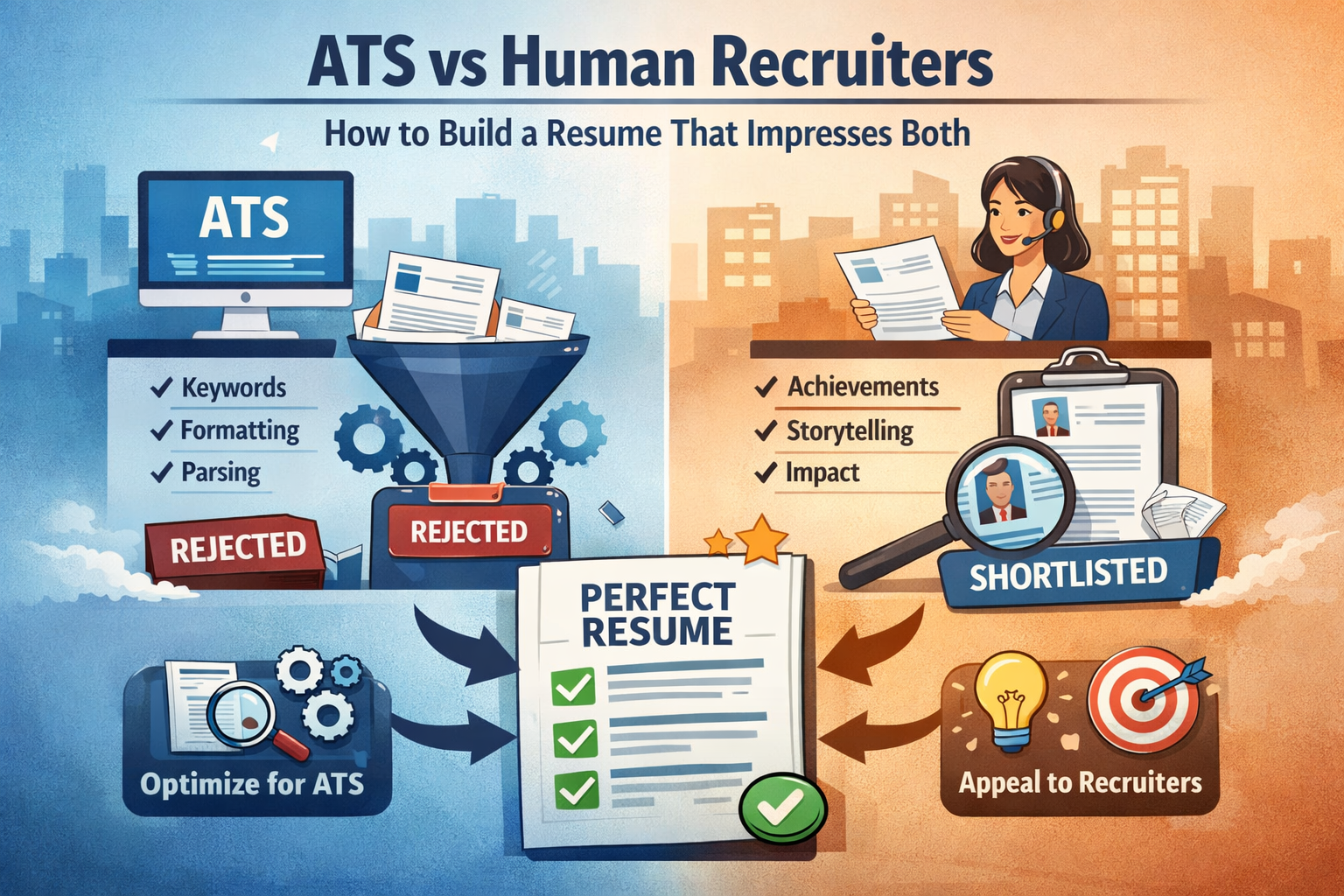
An ATS scans resumes for
keywords, formatting, and relevant information before deciding whether it
should move forward to a human recruiter. After passing this automated stage,
recruiters then review resumes quickly to identify the most promising candidates.
Because of this two-step
hiring process, job seekers must design resumes that satisfy both technology
and human judgment. Striking the right balance between ATS compatibility
and human readability has become crucial in the modern hiring landscape,
especially as recruitment becomes more technology-driven in 2026.
What is an ATS (Applicant Tracking System)?
An Applicant Tracking
System (ATS) is a software tool used by companies to manage and filter job
applications efficiently. With hundreds or even thousands of applicants
applying for a single role, recruiters rely on ATS platforms to organize
candidate data and shortlist relevant resumes.
The system works by scanning
resumes for specific keywords, skills, job titles, and qualifications
related to the job description. It also parses information such as work
experience, education, and skills to determine whether a candidate meets the
requirements.
ATS systems help companies
save time and improve hiring efficiency. Instead of manually reviewing every
application, recruiters receive a filtered list of candidates who closely match
the job criteria. However, this also means that poorly optimized resumes may
get rejected automatically—even if the candidate is qualified.
How Human Recruiters Evaluate Resumes
Once a resume passes the ATS
stage, it reaches human recruiters. At this point, the evaluation process
changes significantly. Recruiters often spend only 6–10 seconds scanning
each resume before deciding whether to continue reading or move to the next
candidate.
During this quick review,
recruiters focus on clarity, structure, and impact. They want to quickly
understand who you are, what you have accomplished, and why you are suitable
for the role.
Human recruiters also look
for evidence of achievements rather than just responsibilities. Instead
of listing what you were supposed to do in a job, they prefer to see measurable
results such as improved performance, increased revenue, or successful project
outcomes. A resume that tells a clear professional story tends to stand out
more than one filled with generic job descriptions.
Key Differences: ATS vs Human Recruiters
Understanding the difference
between ATS evaluation and human review can help candidates design more
effective resumes.
ATS systems prioritize keywords
and structured data. They analyze resumes based on whether they contain
relevant terms from the job description. Human recruiters, on the other hand,
focus on context, achievements, and overall presentation.
While ATS systems prefer simple
formatting that is easy to parse, human recruiters appreciate resumes that
are visually clean and easy to read. ATS focuses on consistency and
technical structure, whereas recruiters look for clarity, relevance, and the
story behind a candidate’s experience.
This difference means that
candidates must balance technical optimization with engaging content.
Common Mistakes Candidates Make
Many candidates unknowingly
create resumes that fail either the ATS stage or the recruiter review.
One common mistake is over-designing
resumes with graphics, icons, or complex layouts. While these designs may
look attractive, many ATS systems cannot properly read them.
Another mistake is ignoring
keywords from the job description. If important skills or terms are
missing, the ATS may not rank the resume highly enough to pass the initial
screening.
Candidates also frequently
write generic job descriptions instead of highlighting achievements.
Additionally, using complicated formatting such as tables, text boxes, or
unusual fonts can cause ATS systems to misinterpret information.
How to Make Your Resume ATS-Friendly
Creating an ATS-friendly
resume requires focusing on simplicity and relevance.
Start by using standard
section headings such as Education, Work Experience, Skills, and Certifications.
These headings help the ATS easily identify and categorize your information.
Next, include job-specific
keywords from the job description. If the role requires skills like project
management, data analysis, or digital marketing, make sure those terms appear
naturally in your resume.
Keep the formatting simple
and clean. Use standard fonts, bullet points, and clear sections. Avoid
graphics, images, or complicated layouts.
Finally, submit your resume
in the correct file format, typically PDF or Word, depending on the
employer’s requirements.
How to Make Your Resume Human-Friendly
Once your resume passes the
ATS, it must still impress a recruiter.
Begin with a strong
professional summary that clearly explains your expertise and career goals.
This section should quickly communicate your value to the employer.
Focus on achievements
instead of responsibilities. For example, instead of writing “Responsible
for managing social media accounts,” write “Increased social media engagement
by 40% through targeted content strategies.” Using numbers and
measurable results makes your accomplishments more convincing. Recruiters
appreciate concrete evidence of success.
Ensure that your resume
maintains proper spacing, clear headings, and readable formatting. A
clean and organized layout helps recruiters quickly identify key information.
The Perfect Balance: Resume That Works for Both
The most effective resumes
combine keyword optimization with compelling storytelling.
Use a simple, ATS-friendly
structure while highlighting meaningful achievements that appeal to recruiters.
Customize your resume for each job by aligning your skills and experiences with
the specific role.
When your resume is clear,
relevant, and results-focused, it becomes easier for both systems and
recruiters to recognize your value.
Pro Tips to Stand Out
To maximize your chances of
getting shortlisted, always tailor your resume for each job application.
Avoid sending the same resume to multiple roles.
Use strong action verbs
such as achieved, led, developed, improved, or implemented to
describe your work experience.
Keep your resume concise
and focused, ideally between one and two pages. Recruiters prefer short,
impactful resumes over lengthy documents.
Always proofread your
resume carefully to eliminate spelling or grammar errors. Finally, consider
adding a professional LinkedIn profile link to provide recruiters with
more information about your experience.
Conclusion
In the modern hiring
process, resumes must pass through two important stages: automated ATS
screening and human recruiter evaluation. Success requires understanding how
both systems work.
By combining keyword
optimization for ATS with clear achievements for recruiters, candidates can
create resumes that stand out in today’s competitive job market.
The best strategy is simple:
think like a system but write like a human. Updating your resume with
this balanced approach can significantly increase your chances of landing
interviews and advancing your career.