Introduction
Starting a business is
exciting, but scaling it successfully is one of the biggest challenges for
startups. Many startups struggle to grow because they lack the right
technology, expertise, and resources. In today’s digital-first world,
technology plays a critical role in determining how quickly and efficiently a
startup can expand.
This is where IT companies
step in as powerful growth partners. Instead of handling everything internally,
startups can collaborate with IT service providers to build products,
streamline operations, and implement scalable technology solutions. By leveraging
expert knowledge and modern tools, startups can focus on innovation while IT
companies manage the technical backbone of the business.
In this article, we will
explore what IT companies do, why startups need them, and how they help
startups scale faster and smarter.
What Do IT Companies Actually Do?
An IT company provides
technology-related services that help businesses build, manage, and improve
their digital infrastructure. These companies specialize in developing digital
solutions that support business operations, customer engagement, and long-term
growth.
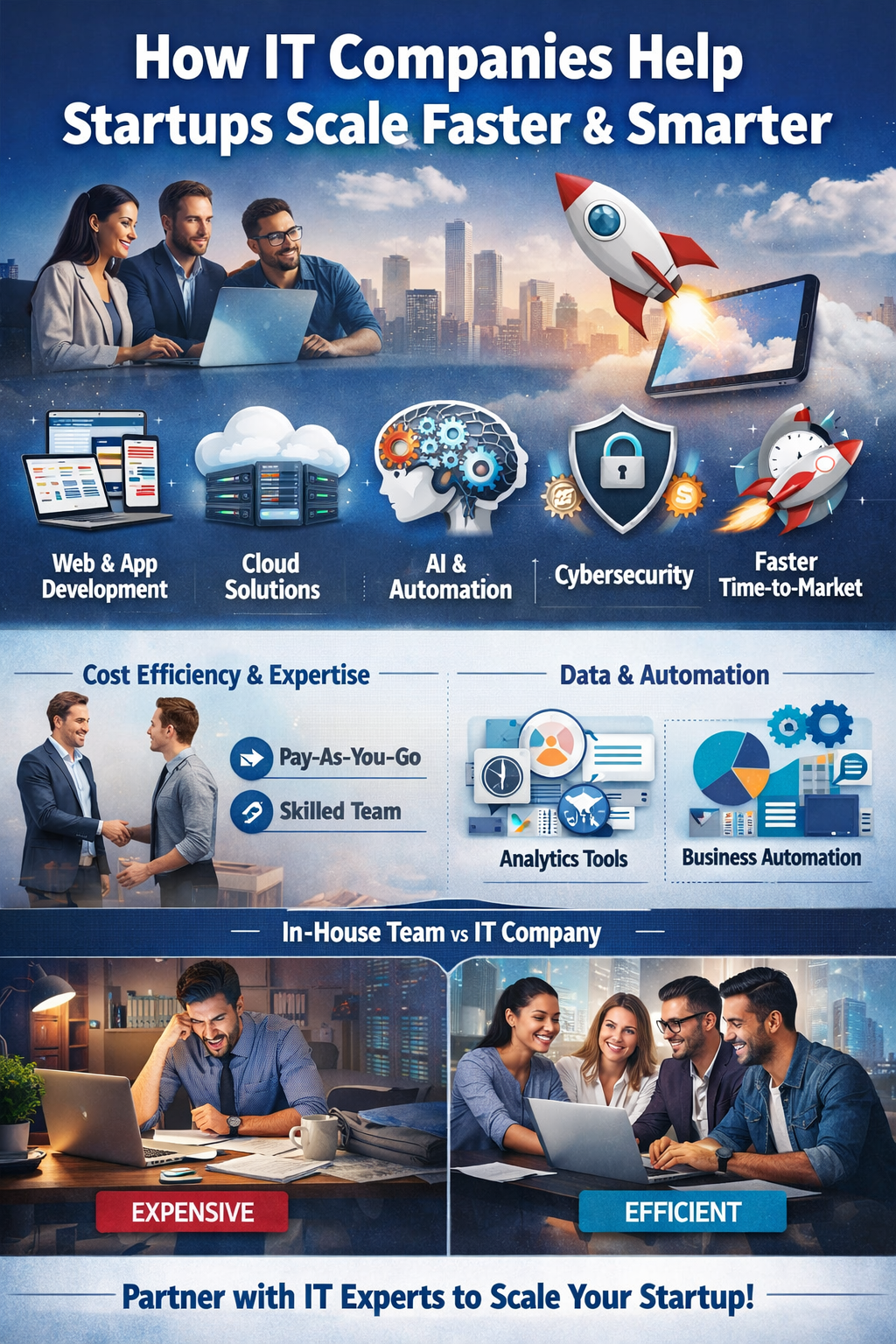
Some of the core services
offered by IT companies include:
1.Web and
App Development: Creating
responsive websites and mobile applications that deliver seamless user
experiences.
2.Cloud
Computing: Providing
scalable infrastructure and storage solutions that allow businesses to operate
efficiently.
3.Cybersecurity: Protecting business data, systems, and
customer information from cyber threats.
4.AI and
Automation:
Implementing artificial intelligence and automated systems to improve
productivity and decision-making.
5.IT
Consulting: Advising
businesses on the best technology strategies for growth.
For startups, hiring an
entire in-house tech team can be expensive and time-consuming. Outsourcing to
IT companies allows them to access specialized skills without the overhead
costs of full-time employees.
Why Startups Need IT Companies in Early Stages
1. Cost Efficiency
Startups often operate on
limited budgets. Hiring full-time developers, designers, and engineers can
significantly increase operational costs. IT companies provide flexible
engagement models, allowing startups to pay only for the services they need.
This pay-as-you-go approach helps startups manage their finances more
effectively.
2. Access to Expertise
IT companies bring together
teams of experienced professionals who have worked on multiple projects across
different industries. Startups gain access to skilled developers, UI/UX
designers, cybersecurity experts, and cloud engineers. This expertise ensures
high-quality development and better technical decision-making.
3. Faster Time-to-Market
Speed is critical in the
startup ecosystem. The faster a product reaches the market, the higher the
chances of gaining early users and investors. IT companies use proven
development frameworks and agile methodologies to build and launch products
quickly without compromising quality.
Key Ways IT Companies Help Startups Scale
1. Building Scalable Websites and Applications
A startup’s website or
application is often the foundation of its business model. IT companies design
scalable systems that can handle increasing traffic and users as the startup
grows. They ensure that platforms are mobile-friendly, optimized for performance,
and capable of adapting to future needs.
2. Cloud Solutions for Flexibility
Cloud technology enables
startups to scale their infrastructure without investing heavily in physical
servers. IT companies help startups deploy applications on cloud platforms,
allowing them to increase storage and computing power whenever required. This
flexibility ensures that startups can grow without facing technical
limitations.
3. Automation of Business Processes
Manual processes can slow
down business operations. IT companies implement automation tools that
streamline repetitive tasks such as customer support, data management, and
workflow tracking. Automation saves time, reduces errors, and allows teams to
focus on strategic activities.
4. Data-Driven Decision Making
Successful startups rely on
data to guide their decisions. IT companies integrate analytics and reporting
tools that track user behavior, product performance, and market trends. With
these insights, startups can identify opportunities, improve products, and make
smarter growth strategies.
5. Cybersecurity and Risk Management
Startups often handle
sensitive customer data, making cybersecurity a top priority. IT companies
implement security protocols, data encryption, and monitoring systems to
protect digital assets. Strong cybersecurity measures not only prevent data
breaches but also build trust with customers and investors.
IT Companies vs In-House Teams
One common question startups
face is whether to build an in-house tech team or partner with an IT company.
1.Cost: Outsourcing to IT companies is generally more
cost-effective in the early stages.
2.Flexibility: IT companies allow startups to scale services
up or down depending on business needs.
3.Speed: External teams often have established
processes that accelerate development.
However, as startups grow
and require dedicated internal expertise, they may gradually build their own
tech teams while still collaborating with IT partners for specialized projects.
Latest Trends IT Companies Bring to Startups (2026)
Technology continues to
evolve rapidly, and IT companies help startups stay ahead by introducing the
latest innovations.
Some key trends include:
1.AI
Integration: Businesses
are using artificial intelligence to automate operations and improve customer
experiences.
2.No-Code
and Low-Code Platforms: These
tools allow faster product development with minimal coding.
3.DevOps
Practices: Continuous
development and deployment improve efficiency and reliability.
4.Remote
Development Teams: Global
talent pools enable startups to access the best skills from anywhere.
How to Choose the Right IT Company
Selecting the right IT
partner is crucial for startup success. Startups should evaluate:
1.Portfolio
and experience in similar
industries
2.Technical
expertise in relevant technologies
3.Communication
and support during
project execution
4.Flexible
pricing models that suit
startup budgets
5.Client
reviews and testimonials to verify
credibility
A reliable IT company should
act as a long-term partner rather than just a service provider.
Conclusion
Scaling a startup requires
more than just a great idea—it requires strong technology and the right
strategic support. IT companies play a vital role in helping startups build
scalable products, automate operations, protect data, and make smarter decisions.
By partnering with
experienced IT companies, startups can accelerate their growth, reduce
operational challenges, and focus on innovation. In today’s competitive
business landscape, the smartest startups understand that they don’t have to do
everything alone. The right technology partner can make the journey from
startup to success much faster and smoother.