Introduction
Hiring is evolving faster
than ever before. The traditional methods of recruitment—posting job ads,
manually reviewing resumes, and conducting in-person interviews—are rapidly
being replaced by smarter, technology-driven strategies. As businesses become more
digital and global, the way organizations attract and hire talent is also
transforming.
In 2026, talent acquisition
is no longer just about filling open positions. It has become a strategic
function that focuses on building a strong workforce for the future. Companies
that fail to adapt to these changes risk losing skilled professionals to more
innovative competitors.
This article explores how
talent acquisition is changing, the major trends shaping hiring in 2026, and
how companies can adapt to stay competitive in the modern job market.
What is Talent Acquisition in 2026?
Talent acquisition refers to
a long-term strategy used by organizations to identify, attract, and hire
skilled professionals who can contribute to business growth. Unlike traditional
recruitment, which focuses mainly on filling immediate job vacancies, talent
acquisition emphasizes long-term workforce planning and building a strong
talent pipeline.
In 2026, talent acquisition
is more strategic and data-driven. Organizations are focusing not only on
qualifications but also on skills, adaptability, and cultural fit. Companies
are also investing in employer branding and candidate experience to attract
high-quality talent.
The difference between
recruitment and talent acquisition lies in their scope. Recruitment is
short-term and reactive, while talent acquisition is proactive and strategic.
It involves planning for future workforce needs, building relationships with
potential candidates, and creating a strong employer brand.
Why Talent Acquisition is Rapidly Changing
Several factors are driving
rapid changes in talent acquisition. One of the most significant influences is
the advancement of technology and artificial intelligence. AI tools can now
screen resumes, analyze candidate data, and match applicants with suitable
roles within seconds.
Another key factor is the
changing expectations of the workforce. Modern professionals seek flexibility,
career growth, and meaningful work. Companies must now offer better work
environments, competitive benefits, and opportunities for development.
The rise of remote and
hybrid work models has also transformed hiring practices. Organizations are no
longer limited to local candidates; they can recruit talent from anywhere in
the world.
Additionally, competition
for skilled professionals has intensified. Businesses must adopt innovative
hiring strategies to attract and retain top talent.
Top Talent Acquisition Trends in 2026
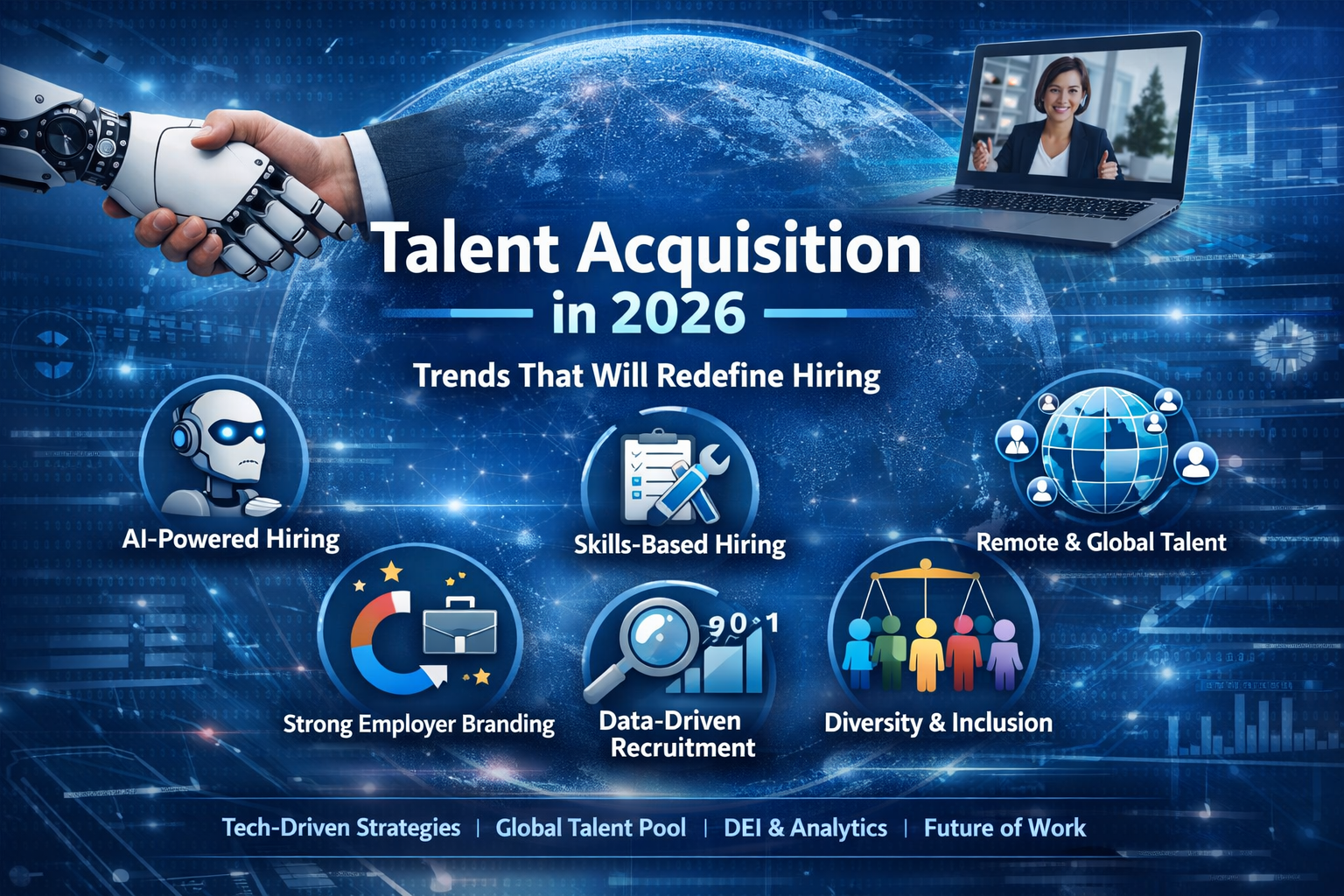
1 AI-Powered Hiring
Artificial intelligence is
playing a major role in modern recruitment. AI-powered tools help recruiters
automate resume screening, identify the best candidates, and reduce the time
required for hiring.
Many companies are also
using chatbots to interact with candidates, answer questions, and conduct
initial interviews. These technologies improve efficiency while allowing
recruiters to focus on strategic tasks.
2 Skills-Based Hiring Over Degrees
In 2026, organizations are
increasingly prioritizing practical skills over traditional academic degrees.
Employers now focus on what candidates can actually do rather than where they
studied.
Certifications, portfolios,
and project-based experience are becoming more valuable indicators of a
candidate’s capability. This approach also helps companies access a wider and
more diverse talent pool.
3 Remote and Global Talent Pool
Remote work has opened doors
to global hiring opportunities. Companies can now recruit skilled professionals
from different countries without requiring them to relocate.
This trend allows
organizations to access diverse talent, reduce hiring costs, and build more
inclusive teams. It also provides candidates with greater flexibility in
choosing where they work.
4 Employer Branding Becomes Crucial
Employer branding has become
a key factor in attracting top talent. Job seekers often research companies
before applying, looking at factors such as company culture, employee reviews,
and social media presence.
Organizations that maintain
a strong and positive brand image are more likely to attract skilled
candidates. A good employer brand also improves employee retention and
engagement.
5 Data-Driven Recruitment
Data analytics is
transforming how hiring decisions are made. Companies are using recruitment
analytics to track candidate performance, hiring success rates, and recruitment
efficiency.
Predictive analytics can
even help organizations forecast future hiring needs and identify the best
sources of talent. This data-driven approach leads to more informed and
effective hiring strategies.
6 Diversity, Equity, and Inclusion (DEI)
Building diverse and
inclusive workplaces is another major trend in talent acquisition. Companies
are actively working to reduce bias in hiring and create equal opportunities
for all candidates.
Diverse teams bring
different perspectives, improve innovation, and contribute to better business
outcomes.
Role of Technology in Modern Hiring
Technology plays a central
role in modern hiring processes. Applicant Tracking Systems (ATS) help
recruiters manage applications, track candidate progress, and streamline
recruitment workflows.
Video interviews and virtual
hiring tools have also become common, especially for remote roles. These
technologies allow companies to conduct interviews quickly and efficiently
regardless of location.
Automation is also being
used in onboarding processes to help new employees integrate smoothly into the
organization. Additionally, AI tools are helping HR teams analyze large volumes
of candidate data to identify the best talent.
Challenges in Talent Acquisition in 2026
Despite these advancements,
talent acquisition also faces several challenges. One major issue is the
shortage of skilled professionals in key industries such as technology,
healthcare, and engineering.
Another challenge is the
over-reliance on automation. While AI tools improve efficiency, excessive
automation may reduce the human element in hiring.
Data privacy is also a
growing concern, as organizations collect and store large amounts of candidate
information.
Maintaining a balance
between technology and human interaction is essential for effective hiring.
How Companies Can Adapt to These Trends
To succeed in the evolving
hiring landscape, organizations must adopt modern strategies. Investing in
AI-powered hiring tools can help companies improve recruitment efficiency and
identify top talent quickly.
Providing a positive
candidate experience is equally important. Clear communication, transparent
hiring processes, and timely feedback can significantly enhance the candidate
journey.
Building a strong employer
brand through social media, employee testimonials, and workplace culture
initiatives can also attract skilled professionals.
Companies should also focus
on upskilling HR teams so that recruiters can effectively use new technologies
and hiring tools.
Finally, adopting flexible
work policies such as remote and hybrid models can help organizations attract a
wider talent pool.
Future of Talent Acquisition
The future of talent
acquisition will continue to evolve as technology advances and workforce
expectations change. The most successful hiring strategies will combine the
efficiency of artificial intelligence with the insight and empathy of human
decision-making.
Soft skills such as
communication, adaptability, and teamwork will become increasingly important
alongside technical expertise.
Organizations that embrace
innovation and prioritize people-centric hiring strategies will be better
positioned to attract and retain top talent.
Conclusion
Talent acquisition in 2026
is being reshaped by technology, changing workforce expectations, and global
connectivity. Trends such as AI-powered hiring, skills-based recruitment,
remote work, and data-driven decision-making are redefining how companies find
and hire talent.
Businesses that adapt to
these changes early will gain a competitive advantage in attracting skilled
professionals. Ultimately, the
organizations that successfully balance technology with human insight will
build stronger teams and thrive in the future of work.