Introduction
In today’s highly
competitive job market, a well-crafted resume is one of the most important
tools for job seekers. Your resume is often the first impression a recruiter
has of you, and that first impression can determine whether you move forward in
the hiring process or get rejected immediately. Studies suggest that recruiters
spend only a few seconds scanning a resume before deciding if a candidate is
worth considering. This means even small mistakes can cost you valuable job
opportunities.
Many candidates have the
right skills and qualifications but still fail to get interview calls because
their resumes contain common errors. From poor formatting to irrelevant
information, these mistakes can make your application look unprofessional and reduce
your chances of standing out. Understanding and avoiding these errors can
significantly improve your chances of getting noticed by recruiters. In this
article, we will explore the top 10 resume mistakes that could be holding you
back and how to fix them.
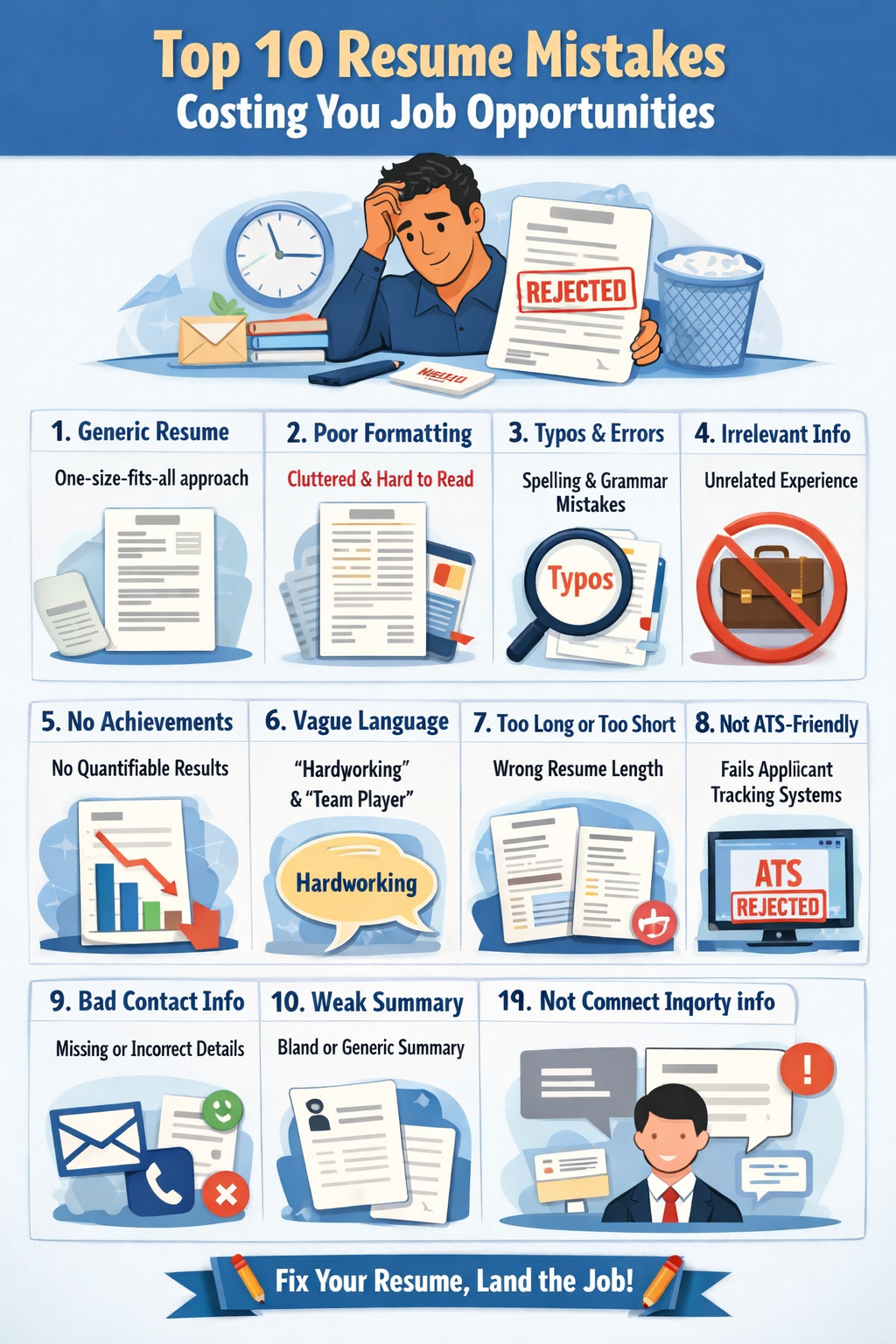
Mistake #1: Using a Generic Resume for Every Job
One of the biggest mistakes
job seekers make is sending the same resume to every employer. A generic resume
may fail to highlight the specific skills and experiences required for a
particular job.
Recruiters look for
candidates who match the job description closely. If your resume does not
reflect the requirements mentioned in the job posting, it may be overlooked. To
avoid this, tailor your resume for each job application. Carefully read the job
description and include relevant keywords and skills that match the role.
Customizing your resume shows employers that you have taken the time to
understand their needs.
Mistake #2: Poor Formatting and Design
A cluttered or poorly
formatted resume can make it difficult for recruiters to read your information
quickly. Inconsistent fonts, large blocks of text, and lack of proper spacing
can create a negative impression.
A professional resume should
be clean, organized, and easy to scan. Use clear headings, bullet points, and
consistent font styles throughout the document. Maintain proper spacing between
sections and keep the design simple. A well-structured resume improves
readability and allows recruiters to quickly identify your qualifications.
Mistake #3: Spelling and Grammar Errors
Spelling and grammar
mistakes can instantly damage your credibility. Even a small typo can make
employers question your attention to detail and professionalism.
Before submitting your
resume, carefully proofread it multiple times. You can also use grammar
checking tools or ask a friend or mentor to review it. Reading your resume
aloud can help you catch mistakes that you might miss otherwise. Ensuring your
resume is error-free reflects professionalism and attention to detail.
Mistake #4: Including Irrelevant Information
Many job seekers make the
mistake of including too much information that is not relevant to the job they
are applying for. Outdated experiences or unrelated skills can distract
recruiters from your key qualifications.
Instead, focus on
experiences, achievements, and skills that are directly related to the job
role. Remove unnecessary details and keep your resume concise. A targeted
resume helps recruiters quickly understand why you are the right candidate for
the position.
Mistake #5: Lack of Quantifiable Achievements
Listing job responsibilities
alone does not make your resume stand out. Recruiters want to see the impact of
your work, not just what tasks you performed.
Instead of writing general
statements, include measurable achievements. For example, instead of saying
“Responsible for managing sales,” you could say “Increased sales by 30% within
six months.” Numbers and statistics make your accomplishments more credible and
demonstrate your value to potential employers.
Mistake #6: Using Weak or Vague Language
Using generic words like
“hardworking,” “motivated,” or “team player” does not effectively showcase your
skills. These terms are overused and do not provide specific information about
your abilities.
Instead, use strong action
verbs such as “developed,” “implemented,” “led,” or “improved.” For example,
instead of saying “Worked on marketing campaigns,” you could say “Developed and
executed digital marketing campaigns that increased website traffic by 40%.”
Specific language makes your resume more powerful and engaging.
Mistake #7: Making the Resume Too Long or Too Short
Another common mistake is
having a resume that is either too lengthy or too brief. A resume filled with
unnecessary details can overwhelm recruiters, while a very short resume may
fail to highlight your qualifications. For fresh graduates, a
one-page resume is usually sufficient. For professionals with several years of
experience, a two-page resume is generally acceptable. The key is to include
relevant information while keeping the content concise and meaningful.
Mistake #8: Not Optimizing for ATS (Applicant
Tracking Systems)
Many companies use Applicant
Tracking Systems (ATS) to filter resumes before they reach recruiters. If your
resume is not optimized for ATS, it may be rejected automatically.
To improve ATS
compatibility, use keywords from the job description and avoid complex
formatting such as graphics, tables, or unusual fonts. Keep your resume simple
and structured so that ATS software can easily read and process the
information.
Mistake #9: Missing or Incorrect Contact
Information
Incorrect or missing contact
details can prevent recruiters from reaching you, even if they are interested
in your profile. This is a simple mistake that can cost you an opportunity.
Always include your updated
phone number, professional email address, and location. You can also add links
to your LinkedIn profile or professional portfolio. Before submitting your
resume, double-check that all contact details are accurate.
Mistake #10: Ignoring the Power of a Strong Summary
Many candidates skip the
professional summary section or write a vague introduction. However, a strong
resume summary can quickly capture a recruiter’s attention.
Your summary should briefly
highlight your key skills, experience, and career goals in two or three
sentences. Tailor it to match the job role you are applying for. A compelling
summary can encourage recruiters to read the rest of your resume.
Bonus Tips for a Winning Resume
To create a strong resume,
always customize it for each job application. Regularly update your resume with
new skills, certifications, and achievements. Seeking feedback from
professionals, mentors, or career advisors can also help you improve your resume.
Additionally, keep your
resume clear, concise, and focused on results. A well-written resume should
clearly demonstrate your value to potential employers.
Conclusion
Your resume plays a critical
role in your job search, and even small mistakes can significantly reduce your
chances of getting an interview. From using generic resumes to ignoring ATS
optimization, these common errors can prevent your application from standing
out.
By avoiding these top 10
resume mistakes and focusing on clarity, relevance, and measurable
achievements, you can create a stronger and more effective resume. Take the
time to review and optimize your resume today—because a well-crafted resume can
open the door to new career opportunities.