Introduction
In today’s data-driven
business environment, organizations rely heavily on accurate information to
make effective decisions. One of the most important tools used for this purpose
is the MIS report. MIS reports help businesses collect, organize, and
analyze data so that managers can understand performance and make better
strategic decisions.
An MIS report plays a vital
role in business decision-making because it transforms raw data into meaningful
insights. Instead of manually reviewing large amounts of information, managers
can quickly view summarized reports and identify patterns or problems.
MIS reports are widely used
across different departments such as Human Resources (HR), Sales, Finance,
and Operations. Whether it is tracking employee attendance, monitoring
sales performance, analyzing financial expenses, or measuring operational
efficiency, MIS reporting helps organizations stay informed and organized.
What is an MIS Report?
MIS stands for Management
Information System. An MIS report is a structured document that provides
data analysis and performance insights to help management make informed
decisions.
The main purpose of MIS
reporting is to convert complex data into simple, understandable information
that managers can use to monitor business activities.
The key objectives of MIS
reports include:
Data
Analysis:
MIS reports help businesses analyze large volumes of data and convert them into
useful insights.
Performance
Tracking:
Organizations use MIS reports to monitor performance over different periods
such as daily, weekly, or monthly.
Decision
Support:
Managers rely on MIS reports to evaluate business performance and make
strategic decisions based on reliable information.
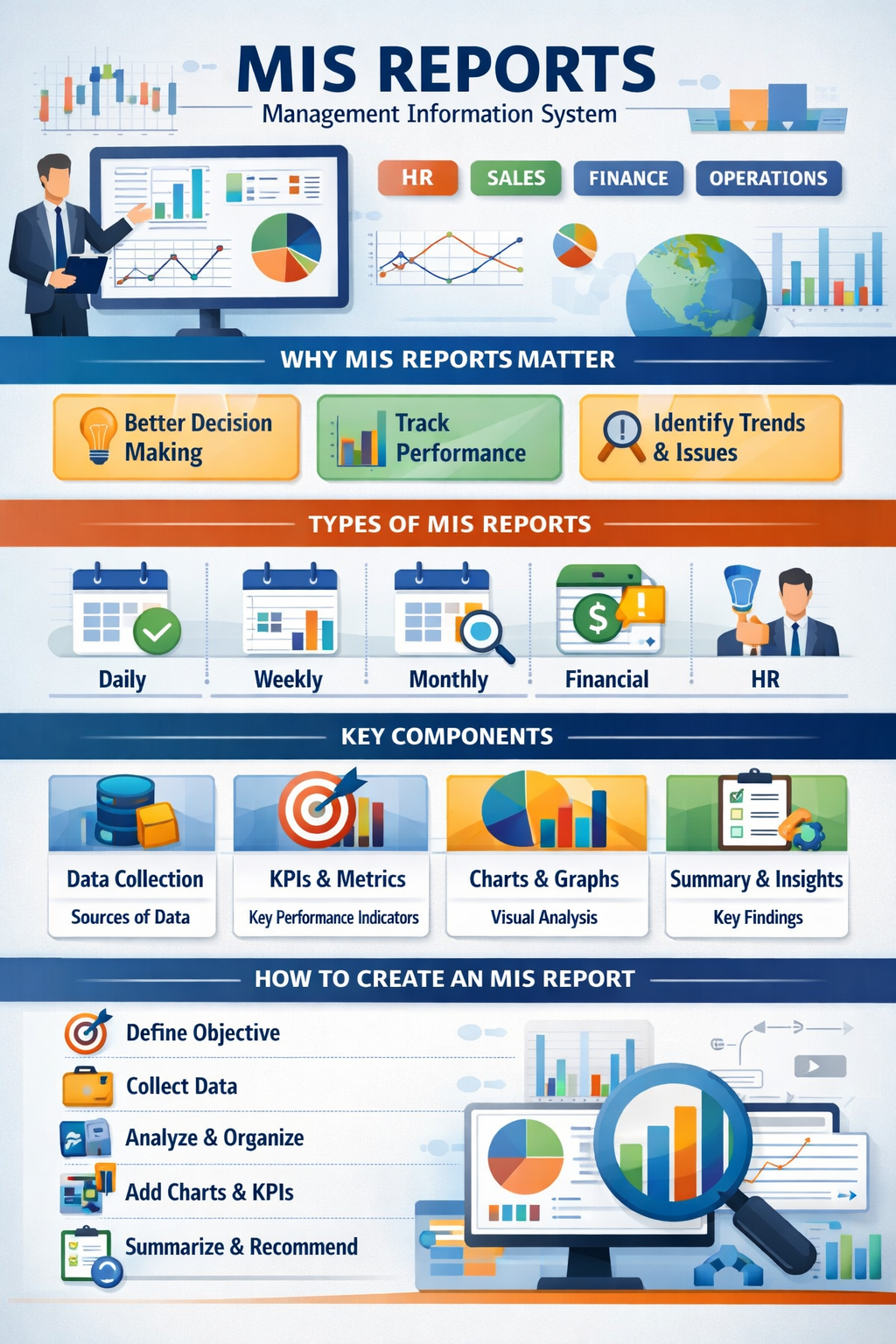
Importance of MIS Reports in Business
MIS reports play a crucial
role in improving business efficiency and management effectiveness.
Better
Decision-Making
MIS reports provide accurate and organized information that helps managers make
well-informed decisions.
Improves
Efficiency and Productivity
By tracking key performance metrics, businesses can identify areas that need
improvement and optimize their processes.
Performance
Monitoring
MIS reports allow companies to track performance on a daily, weekly, or monthly
basis. This helps management evaluate progress and take corrective action when
necessary.
Identifying
Trends and Problems
By analyzing historical data, MIS reports help businesses identify patterns,
trends, and potential issues before they become serious problems.
Key Components of an MIS Report
An effective MIS report
contains several essential components that ensure clarity and usefulness.
Data
Collection
The first step involves gathering data from different sources such as
databases, spreadsheets, CRM systems, or financial software.
Data
Organization
Once collected, the data is structured into tables, dashboards, or structured
formats to make it easy to understand.
KPIs and
Metrics
Key Performance Indicators (KPIs) are used to measure business performance.
These may include revenue growth, employee productivity, sales conversions, or
operational efficiency.
Visual
Elements
Charts, graphs, and dashboards make it easier to interpret data and quickly
identify patterns or trends.
Summary and
Insights
The final section of an MIS report usually includes a summary that highlights
key insights, findings, and recommendations.
Types of MIS Reports
MIS reports can be created
for different time periods and business functions.
1 Daily MIS Report
A daily MIS report tracks
day-to-day business activities. It helps managers monitor operations and
identify immediate issues.
2 Weekly MIS Report
Weekly MIS reports provide a
summary of performance over the week. They help managers evaluate progress and
productivity.
3 Monthly MIS Report
Monthly reports offer a
deeper analysis of business performance, including trends, comparisons, and
long-term insights.
4 Financial MIS Report
This report focuses on
financial data such as revenue, expenses, profitability, and budget analysis.
5 Sales MIS Report
Sales MIS reports track
leads, conversions, revenue generation, and sales team performance.
6 HR MIS Report
HR MIS reports focus on
employee-related data such as attendance, payroll, recruitment, and employee
performance.
How to Create an MIS Report (Step-by-Step Guide)
Creating an effective MIS
report involves several important steps.
Step 1:
Define the Objective
First, determine what you want to measure. The objective could be sales
performance, employee productivity, or financial analysis.
Step 2:
Identify Data Sources
Collect relevant data from sources such as CRM systems, ERP software,
spreadsheets, or internal databases.
Step 3:
Choose the Right Tool
Common tools used for MIS reporting include Microsoft Excel, Google Sheets, and
business intelligence dashboards.
Step 4:
Organize the Data
Clean and structure the data to remove errors or duplicates and ensure
accuracy.
Step 5: Add
Formulas and KPIs
Use calculations and key metrics to analyze the data and extract meaningful
insights.
Step 6:
Create Visual Elements
Use charts, graphs, and dashboards to make the report more visually
understandable.
Step 7:
Analyze and Summarize
Finally, analyze the results and provide insights, conclusions, and
recommendations for management.
MIS Report Format (Sample Structure)
A typical MIS report usually
follows a simple and organized format:
1.Title and reporting date
2.Data tables with relevant
information
3.KPI summary section
4.Charts and graphs for
visualization
5.Key insights or
observations
6.Recommendations for
improvement
This structure helps
decision-makers quickly review the report and understand important information.
Common Mistakes to Avoid
While creating MIS reports,
businesses should avoid certain common mistakes.
Using
Incorrect or Incomplete Data
Inaccurate data can lead to poor decisions and misleading insights.
Overloading
the Report with Information
Too much data can make the report confusing. It is important to include only
relevant information.
Lack of
Clear Objective
Without a defined purpose, the report may not provide useful insights.
Ignoring
Insights and Conclusions
Data alone is not enough. Reports should always include analysis and
recommendations.
Tips to Create Perfect MIS Reports
To make MIS reports more
effective, consider the following tips:
1.Keep the report simple and
easy to understand
2.Focus on actionable
insights rather than raw data
3.Use automation tools to
reduce manual work
4.Update reports regularly
for accurate tracking
Conclusion
MIS reports are essential
tools for modern businesses. They help organizations analyze data, track
performance, and make informed decisions. By providing structured and
meaningful information, MIS reporting improves efficiency, transparency, and
strategic planning.
When created correctly, MIS
reports can help businesses identify opportunities, solve problems quickly, and
achieve long-term growth. Therefore, professionals and organizations should
adopt effective MIS reporting practices to enhance their decision-making and
overall performance.