Introduction
Recruitment has always been
a critical function for organizations, but the process has traditionally been
time-consuming, manual, and sometimes biased. In 2026, Artificial Intelligence
(AI) is dramatically transforming the way companies find, evaluate, and hire
talent. From automated resume screening to predictive hiring analytics, AI is
helping organizations make faster, smarter, and more efficient hiring
decisions.
As companies compete for
skilled talent in an increasingly digital world, AI-driven recruitment tools
are becoming essential for HR teams. These technologies not only streamline
hiring processes but also improve candidate experience and reduce recruitment
costs.
This article explores how AI
is reshaping recruitment in 2026 and what it means for employers and job
seekers.
The Rise of AI in Recruitment
Artificial Intelligence
refers to technologies that enable machines to perform tasks that normally
require human intelligence. In recruitment, AI tools analyze large amounts of
data, automate repetitive tasks, and assist recruiters in identifying the best
candidates.
With organizations receiving
thousands of job applications for a single role, manual screening is no longer
practical. AI systems can quickly analyze resumes, assess candidate
qualifications, and shortlist applicants who best match the job requirements.
As a result, HR departments
are increasingly integrating AI into their recruitment strategies to improve
efficiency and accuracy.
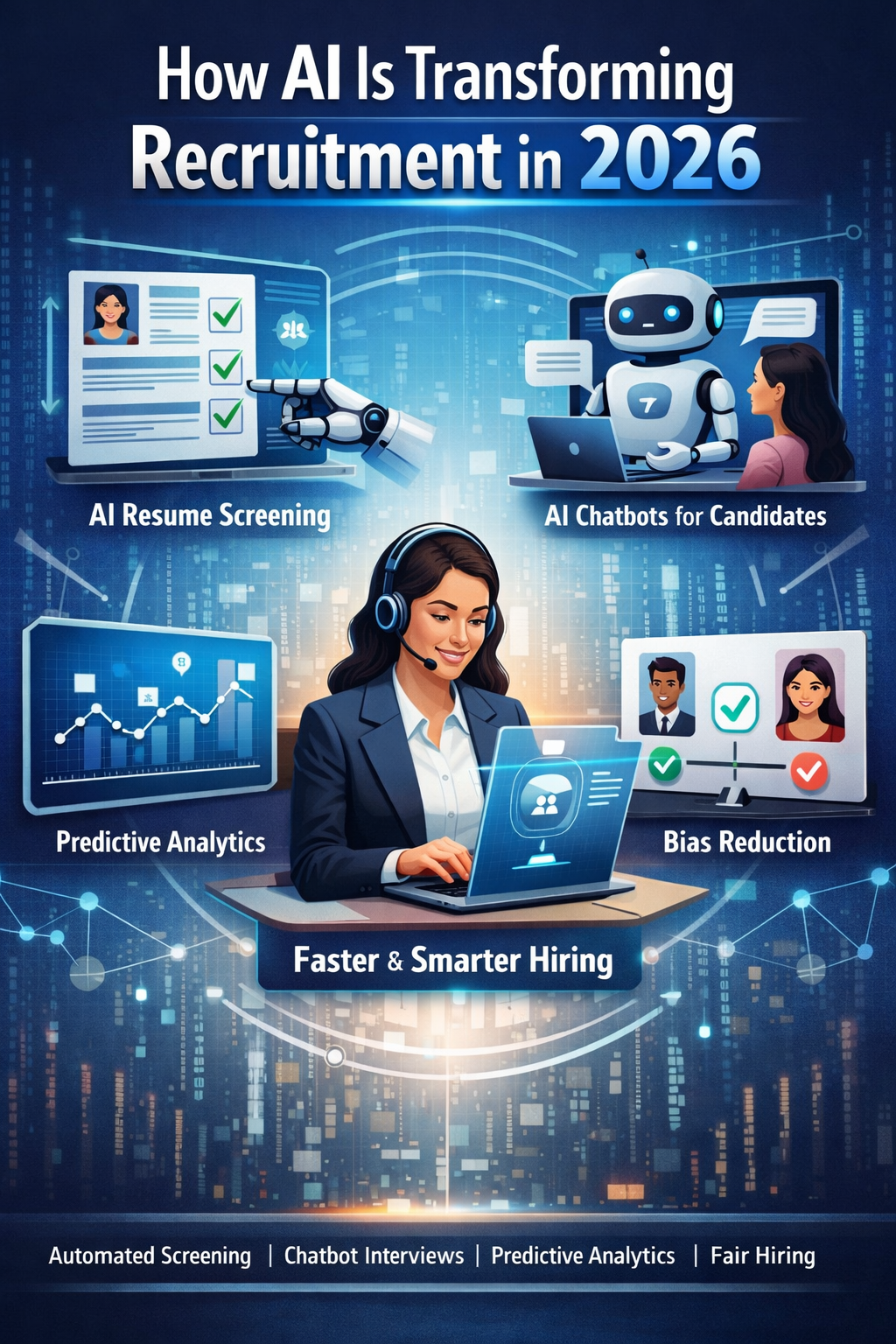
AI-Powered Resume Screening
One of the most significant
ways AI is transforming recruitment is through automated resume screening. Traditionally, recruiters
had to manually review hundreds or even thousands of resumes, which could take
days or weeks. AI-powered systems can now scan resumes within seconds,
identifying relevant skills, qualifications, experience, and keywords.
These systems rank
candidates based on how closely their profiles match the job description. This
allows recruiters to focus only on the most suitable candidates instead of
reviewing every application manually.
AI screening also helps
reduce human error and speeds up the entire hiring process.
AI Chatbots for Candidate Communication
Another major advancement in
recruitment is the use of AI chatbots.
AI chatbots interact with
candidates in real time, answering questions about job roles, company policies,
application status, and interview schedules. This improves communication
between recruiters and applicants while reducing the workload for HR teams.
Chatbots can also conduct
initial screening by asking candidates basic questions about their
qualifications, experience, and availability. Based on the responses, the
system can decide whether the candidate should move forward in the recruitment
process.
This technology ensures that
candidates receive quick responses and improves overall candidate experience.
Predictive Analytics in Hiring
AI is also enabling
predictive hiring, which helps companies make better talent decisions.
Predictive analytics uses
historical hiring data, employee performance records, and behavioral patterns
to identify candidates who are more likely to succeed in a specific role.
For example, AI can analyze
the characteristics of high-performing employees within an organization and
identify candidates who share similar skills, experience, or work patterns.
This helps companies hire
individuals who are not only qualified but also more likely to perform well and
stay longer with the organization.
Reducing Bias in Recruitment
One of the biggest
challenges in traditional hiring is unconscious bias. Recruiters may
unknowingly favour certain candidates based on background, education, gender,
or other factors.
AI tools can help reduce
such bias by focusing purely on data and qualifications rather than personal
characteristics.
By analyzing objective
criteria such as skills, experience, certifications, and achievements, AI
systems can recommend candidates based on merit rather than subjective
judgment.
However, organizations must
carefully design AI systems to ensure that algorithms themselves do not inherit
bias from historical data.
Faster and More Efficient Hiring
AI significantly speeds up
recruitment processes. Tasks that once took weeks—such as resume screening,
candidate communication, interview scheduling, and data analysis—can now be
completed within hours.
Automated interview
scheduling tools coordinate availability between recruiters and candidates,
reducing delays. AI systems can also conduct video interview analysis,
evaluating factors such as communication skills, facial expressions, and
confidence.
This efficiency allows
companies to hire faster, which is crucial in competitive industries where top
candidates may receive multiple job offers.
Better Candidate Experience
A positive candidate
experience is essential for employer branding, and AI is playing an important
role in improving it.
With AI-powered tools,
candidates receive faster responses, real-time updates about their
applications, and smoother interview processes. Chatbots ensure that applicants
always have access to information and support. Additionally, AI platforms
can recommend suitable job opportunities to candidates based on their skills
and career interests, helping them find roles that match their profiles.
Challenges of AI in Recruitment
Despite its benefits, AI
recruitment also comes with challenges.
Some candidates may feel
uncomfortable being evaluated by algorithms instead of human recruiters. There
are also concerns about data privacy, algorithm bias, and over-reliance on
automated systems.
Organizations must ensure
transparency in AI-based hiring processes and maintain a balance between
technology and human judgment.
AI should assist
recruiters—not replace them entirely.
The Future of AI in Recruitment
Looking ahead, AI will
continue to evolve and become even more integrated into recruitment strategies.
Future AI systems may
analyze candidate portfolios, social profiles, and skill assessments to provide
deeper insights into talent potential. Virtual reality interviews and advanced
behavioral analytics may also become part of the hiring process.
However, human recruiters
will remain essential for evaluating cultural fit, building relationships, and
making final hiring decisions.
Conclusion
In 2026, Artificial
Intelligence is transforming recruitment by making hiring faster, smarter, and
more data-driven. From automated resume screening and chatbots to predictive
analytics and bias reduction, AI is revolutionizing the way organizations identify
and hire talent.
While challenges remain, the
combination of AI technology and human expertise is creating a more efficient
and effective recruitment process.
For companies, adopting
AI-powered recruitment tools is no longer optional—it is becoming a necessity
in the modern hiring landscape. And for job seekers, understanding how AI works
in hiring can help them better prepare for the future of work.